
Reviewed · THIRD REICH & COLD WAR TOURS
East Berlin and the Berlin Wall 2-Hour Walking Tour
The most powerful part of this tour is not a museum display. It is the chance to stand beside an original section of the Berlin Wall, look down over the former Death Strip, and hear how ordinary people lived with a border built through their city. You also visit Bornholmer Strasse, where the Wall first opened on November 9, 1989.
I like the clear route from Cold War politics to personal stories, and I like that the tour includes the Stasi headquarters and the Palace of Tears rather than stopping at a few painted Wall fragments. The main drawback is time: two hours is brisk, and a short train ride means you need a Berlin AB transport pass and must pay close attention when the group changes stations.
In This Review
- Key points to know before you book
- Why this two-hour walk matters
- Starting at Hackescher Markt and Friedrichstrasse
- The Palace of Tears and divided families
- The Berlin Wall Memorial and the Death Strip
- The Chapel of Reconciliation and the surviving watchtower
- Bornholmer Strasse and the night the Wall opened
- The Stasi and life under surveillance
- Ackerstrasse and the route toward Alexanderplatz
- Walking, trains, weather, and group size
- How the guide shapes the experience
- Is $21.78 good value for Berlin?
- Who should book this East Berlin walk?
- Should you book it?
- FAQ
- How long is the East Berlin and Berlin Wall tour?
- Where does the tour begin?
- What time does the tour start?
- Where does the tour end?
- Is public transportation included?
- Is the tour offered in English?
- What sites are covered?
- Is the tour suitable in bad weather?
- Can I cancel for a full refund?
Key points to know before you book
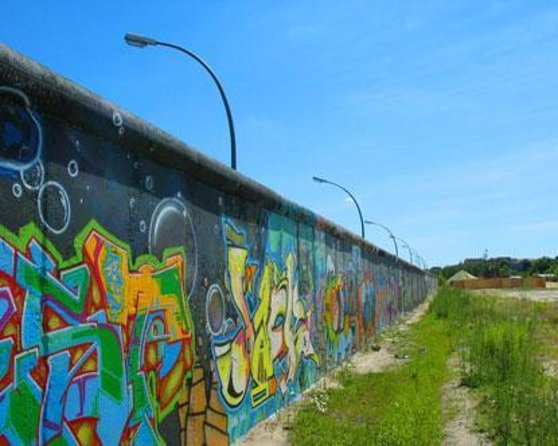
- See the Wall in its original setting: The Berlin Wall Memorial preserves a section of the barrier, the Death Strip, a watchtower, and the Chapel of Reconciliation.
- Follow the story to November 9, 1989: At Bornholmer Strasse, your guide explains how a confused official statement helped trigger the border opening.
- Connect politics with daily life: The tour covers escape attempts, surveillance, divided families, and the pressure of living under the East German state.
- Hear the history from an English-speaking guide: Guides have included Anastasia, Ariel, Dylan, Tom, Georgia, Jimmy, Nathan, Jasper, Heidi, Tobi, Susan, and Pip.
- Expect a small-group walk: The maximum group size is 20, with some departures forming groups of about 10.
- Budget for public transport: A Berlin AB Zone pass costs about 10.60 euros and is not included in the tour price.
Why this two-hour walk matters
Berlin can make the Cold War feel distant if you only visit famous squares and museums. The Wall once cut across streets, apartment blocks, railway lines, and family lives. This walk gives you the physical setting first, then fills it with the political and human story.
At roughly $21.78 per person, the tour is inexpensive for a guided two-hour experience in central Berlin. You are not paying for an admission ticket. The value comes from having someone explain why a plain stretch of pavement mattered, how the border worked, and why the Wall fell so suddenly after 28 years.
I would use this as an introduction rather than a complete study of East Germany. The subject is too large for two hours. Still, the route covers several strong sites and gives you enough background to make later visits to Berlin museums and memorials much easier to understand.
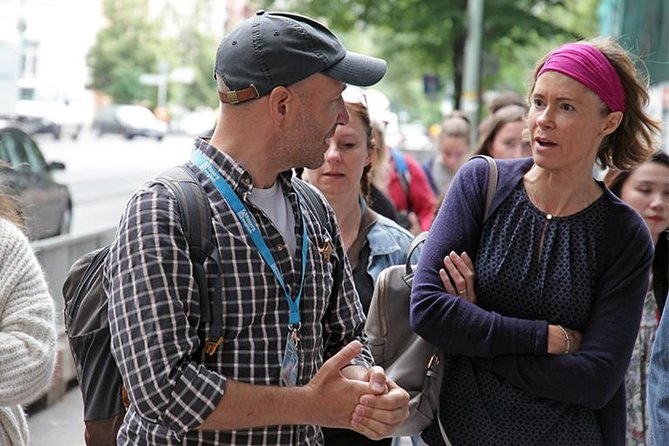
The guide makes a major difference. Names listed for past departures include Anastasia, Ariel, Dylan, Tom, Georgia, Jimmy, Nathan, Jasper, Heidi, Tobi, Susan, and Pip. The strongest feedback centers on guides who tell individual stories, answer questions, explain the larger political picture, and keep the tone conversational. One guide even offered ideas for parks and restaurants after the tour.
More Third Reich & Cold War Tours in Berlin
- Berlin: Third Reich and Cold War 2 Hour Walking Tour
★ 4.9 · 6,830 reviews - Berlin’s Best: 2 Hour Walking Tour Third Reich and the Cold War
★ 5.0 · 5,486 reviews - Third Reich Berlin: Hitler and WWII Walking Tour
★ 5.0 · 3,301 reviews
Starting at Hackescher Markt and Friedrichstrasse
The meeting point is at Neue Promenade 3, beside Hackescher Markt, with a scheduled 10:00 a.m. start. This is a useful place to begin because the tour starts in the former East Berlin area, not at a detached memorial far from the city’s daily life.
The opening conversation sets up the basic question: how did the United States and Soviet Union move from wartime allies into Cold War rivals, and why did Berlin become the sharpest point of conflict? A good guide needs to make this understandable without turning the first half hour into a lecture. The best accounts reported for this tour use short stories and clear examples to explain how Germany and Berlin were divided after World War II.
The route then touches Friedrichstrasse, one of central Berlin’s major streets. The stop itself is brief, but it helps you picture Berlin as a working city split by competing governments. This is not only a story about soldiers and politicians. It is also about commuters, families, railway passengers, and people who suddenly needed permission to cross parts of their own city.
The Palace of Tears and divided families
Near Friedrichstrasse station, you hear about the former border crossing known as the Palace of Tears. East Germans used this station to say goodbye to family members and visitors returning to West Germany.
The name comes from the emotional farewells that took place there. That detail gives the political division a human scale. A border crossing can sound bureaucratic on a map. At this site, it becomes a place associated with repeated goodbyes and uncertain reunions.
Do not expect a long indoor visit here. The tour uses the location as a point for explanation, so you should think of it as a guided historical stop rather than a museum admission. If you want a more extended look at border procedures and personal accounts, you would need to allow separate time elsewhere in Berlin.
The Berlin Wall Memorial and the Death Strip
The Berlin Wall Memorial is the heart of the walk and receives about an hour. This is where the tour becomes most visual and most affecting.
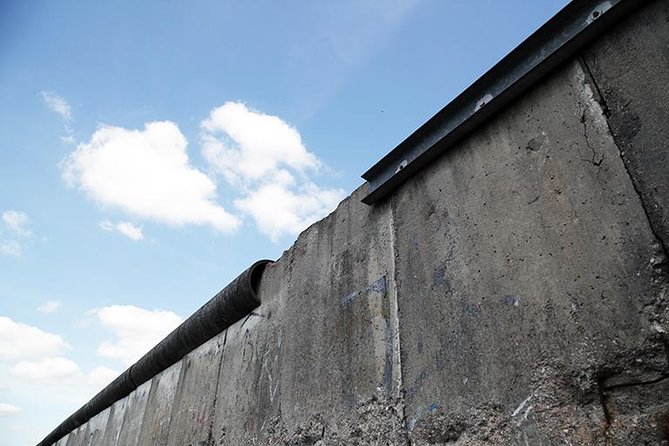
You see a section of the Wall preserved in its original state. You can also touch the remaining concrete, a simple experience that makes the barrier feel like a real object rather than a symbol printed in a guidebook. The memorial includes a view over the former Death Strip, the controlled space between sections of the border where East German shoot-to-kill orders applied to escape attempts.
The site also helps you understand that the Wall was not one thin slab of concrete. It was a guarded border system with multiple barriers, open ground, watch positions, and strict controls. From above, the arrangement makes more sense than it does in old photographs.
Your guide explains escape plans and the people who tried them. Some escaped through tunnels or other carefully prepared routes. Others were caught or killed. Several of the most effective stories focus on individual choices, showing both the courage of escapees and the extent of the system built to stop them.
This is also the section where the tour moves beyond the standard question of why was the Wall built? You learn how the East German government increasingly watched its own population, and how the border affected people who never attempted to flee. The story includes blocked routes, sealed buildings, and the daily pressure of knowing that private life could attract state attention.
The memorial is free, but an hour can pass quickly. If you want to read every panel, study every photograph, and visit related exhibits at a slow pace, plan to return on your own. During the tour, stay close and listen for the guide’s explanation of what you are looking at.
Same city, a completely different kind of day:
- Berlin: Reichstag, Dome and Government District Guided Tour
★ 4.7 · 18,288 reviews - Berlin: 1-Hour City Tour by Boat with Guaranteed Seating
★ 4.3 · 16,993 reviews - Berlin: Boat Tour Along the River Spree
★ 4.4 · 11,252 reviews - Discover Berlin Half-Day Walking Tour
★ 5.0 · 9,624 reviews
The Chapel of Reconciliation and the surviving watchtower
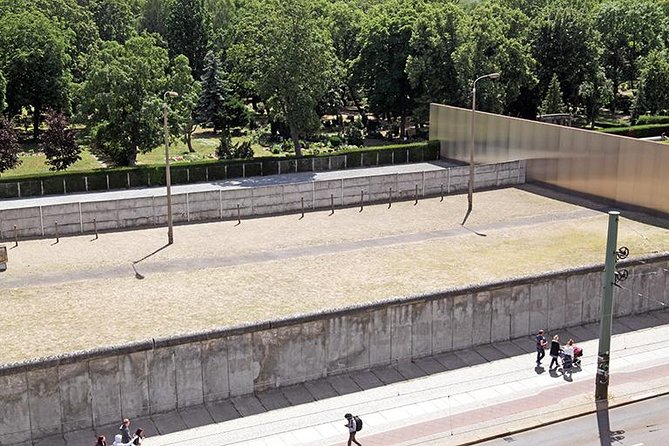
The Chapel of Reconciliation is another short stop along the memorial route. The present chapel marks a site shaped by the Wall and is used for worship. Your guide explains its place in the history of the border.
Nearby, you see a GDR border watchtower described as the oldest remaining relic of the Berlin Wall. It is a modest structure, but it helps complete the picture. The Wall was not just a long concrete surface covered in graffiti. It depended on towers, patrols, clear sightlines, and a system designed to make escape difficult.
These stops are brief, about five minutes each, so you will not have much time for extended interior visits or quiet reflection. Their value comes from the way they fit into the larger route. The memorial’s chapel, open border ground, Wall remains, and watchtower show several parts of the same system within a manageable walk.
Bornholmer Strasse and the night the Wall opened
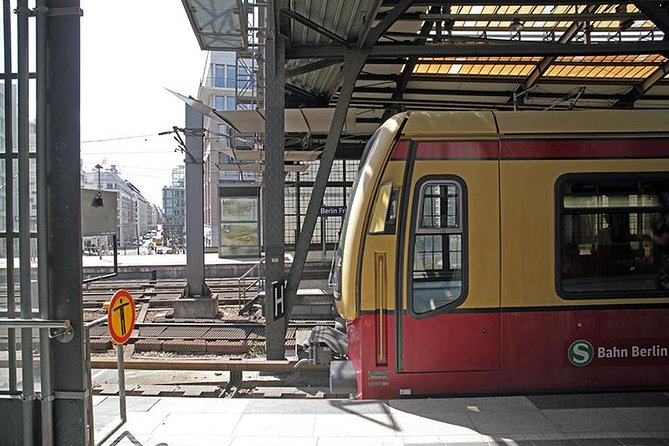
The tour also takes you north to Bornholmer Strasse, the place where the Wall came down on November 9, 1989. This is one of the most useful stops because the end of the Wall was not a carefully staged ceremony with a neat plan.
Your guide explains how a mistake by an East German politician helped set events in motion. A confused announcement suggested that new travel rules were effective immediately. Crowds gathered at the crossing, border guards lacked clear instructions, and the pressure became impossible to contain.
That story gives the fall of the Wall a human sense of uncertainty. Political systems can appear permanent until a small error meets public frustration and a crowd that refuses to go home. You learn how the border opening unfolded, rather than simply memorizing the date.
The route description places Bornholmer Strasse among the major stops, while the detailed meeting information says the walk ends near the Berlin Wall Memorial and Nordbahnhof. Another part of the description refers to Alexanderplatz as the finish, so you should confirm the exact end point and route instructions before setting out. In practical terms, expect the tour to use Berlin public transport to connect central East Berlin with the northern memorial area.
The Stasi and life under surveillance
The itinerary includes the former headquarters of the Stasi, East Germany’s secret police. This section addresses a different kind of border. The Wall controlled movement, while the Stasi aimed to control information, relationships, and private behavior.
You learn how surveillance expanded as the state tried to monitor its own citizens. The point is not only that secret police existed, but that a government could build a system in which neighbors, colleagues, and acquaintances might be drawn into reporting on one another.
The tour does not promise a full interior visit to the Stasi museum or archive. Instead, the guide explains the importance of the headquarters and places it within the wider story of East German rule. If the Stasi is your main interest, set aside another visit for a museum experience with more documents and time.
I find this part especially useful because it prevents the Wall from becoming the entire story of East Berlin. The border was visible and dramatic, but state control also worked through fear, records, questioning, and surveillance. That contrast gives the tour more depth than a simple walk along a preserved wall.
Ackerstrasse and the route toward Alexanderplatz
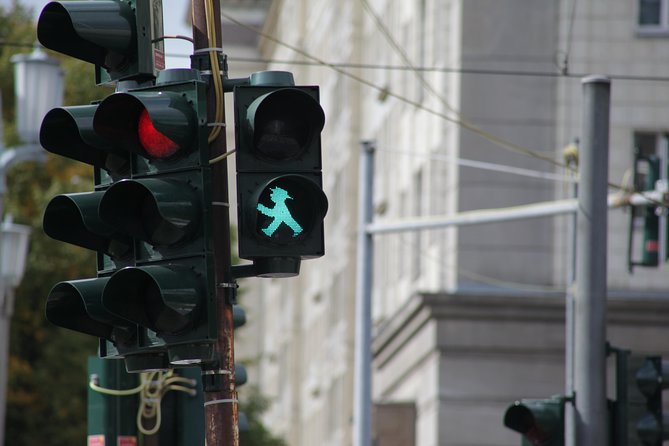
Ackerstrasse is a short explanatory stop connected with the former border area. The guide uses the location to point out details you might otherwise walk past, including traces of how streets and buildings were altered by the division.
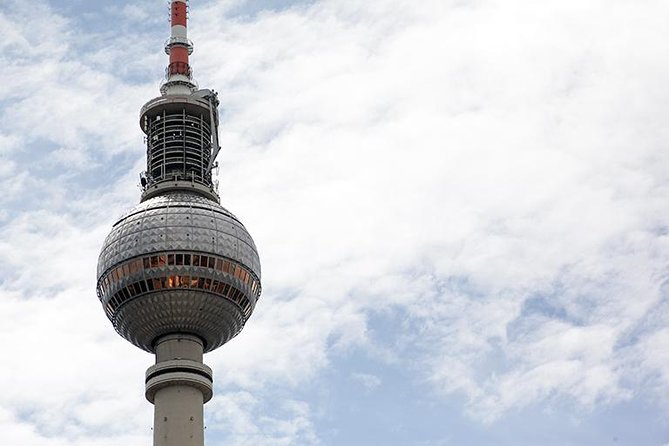
The planned finish is associated with Alexanderplatz and its famous television tower, the landmark at the center of the former East German capital. Alexanderplatz is a practical ending because it puts you near shops, cafes, railway connections, and other East Berlin sights.
At the same time, the supplied end information says the tour ends close to Nordbahnhof, beside the Berlin Wall Memorial. Since those points are not the same, check the meeting message you receive after booking. This is a small but important planning detail, especially if you have a lunch reservation or a timed museum visit afterward.
Walking, trains, weather, and group size
This is a walking tour, but it is not a nonstop march. Stops are spread across central and northern Berlin, and the connection to the Wall Memorial involves public transport. The listed transport requirement is a Berlin AB Zone pass, priced at about 10.60 euros and not included.
Buy or arrange the correct ticket before the tour if possible. One negative account describes confusion when some people needed to purchase tickets and the guide boarded the train before everyone was together. That does not erase the strong feedback about the tour, but it does give you a clear practical lesson: arrive with your transport sorted and stay alert during station changes.
The maximum group size is 20. Some departures have been much smaller, around 10 people, which makes it easier to hear stories and ask questions. Group size can affect the feel of the walk, so do not assume every departure will be equally intimate.
The tour operates in all weather. Berlin rain or cold can make the Wall Memorial feel exposed, and summer sun can be tiring during an outdoor walk. Wear shoes you can comfortably walk in, bring water, and dress for the forecast. Service animals are allowed, and the tour is near public transport. Most people can take part, but the two-hour route still requires ordinary walking stamina.
How the guide shapes the experience
The strongest part of the tour is the guide’s ability to turn facts into scenes. Tom has been praised for combining the broad story with personal accounts. Georgia, Jasper, Nathan, Heidi, and Pip have each been singled out for clear explanations and an engaging manner. Ariel and Dylan have also been noted for answering questions and making the material conversational.
That does not mean every departure will feel identical. One account raises a real concern about poor communication during a train transfer. The lesson is simple: ask where the group is going next, make sure you know the meeting point, and do not let a closing train door separate you from the group.
The best guides also connect Berlin’s architecture to its political past. Susan, for example, has been praised for showing how the city’s buildings reflect periods from earlier Berlin through World War II, the Cold War, and the present. That wider view helps you see the city as an evolving place rather than a collection of isolated memorials.
Is $21.78 good value for Berlin?
Yes, if you want a well-organized introduction to Berlin’s division without paying for several museum admissions. For $21.78, you receive a professional English-speaking guide, about two hours of instruction, and a route covering the Wall Memorial, the Palace of Tears, the former Stasi headquarters area, Bornholmer Strasse, the chapel, and a watchtower.
The additional transport cost matters. At about 10.60 euros for the AB Zone pass, your total outlay is closer to the price of a modest meal, but the tour still offers plenty for the money. The included sites are mostly free, so you are paying primarily for context and storytelling.
I would not choose it if you want a slow, detailed museum visit or a full-day study of East German history. I would choose it early in a Berlin stay, when you want a framework for the city. The guide’s suggestions for other places, restaurants, and nearby parks can also help shape the rest of your visit.
Who should book this East Berlin walk?
I recommend it for first-time visitors who want to understand the Berlin Wall beyond its surviving fragments. It suits families with older children, couples, solo visitors, and anyone who prefers history explained on the street rather than read from display panels.
It is also useful if you have visited Berlin before but never connected the Wall Memorial, Friedrichstrasse, the Stasi, and Alexanderplatz into one story. The tour gives you that structure in a short morning.
You may want another option if you dislike walking in uncertain weather, need a completely step-free experience, or prefer to set your own pace. The tour is offered in English, lasts about two hours, and uses public transport, so it rewards people who arrive prepared.
Free cancellation is available up to 24 hours before the start time for a full refund. Changes or cancellations inside that window are not accepted for a refund.
Should you book it?
Book this tour if you want the human story of divided Berlin delivered alongside the major sites. Its best features are the original Wall remains, the Death Strip viewpoint, Bornholmer Strasse, and guides who explain personal stories as well as political events.
The two-hour limit means you will leave with questions, which is a good reason to treat the walk as a starting point. Bring a valid Berlin AB transport pass, confirm the exact finish point, and allow extra time if you want to explore the memorial afterward. For the price, this is a strong choice for building your Berlin bearings without spending half a day inside a museum.
FAQ
How long is the East Berlin and Berlin Wall tour?
The tour lasts approximately two hours.
Where does the tour begin?
It begins at Neue Promenade 3, 10178 Berlin, next to Hackescher Markt train station.
What time does the tour start?
The scheduled start time is 10:00 a.m.
Where does the tour end?
The detailed end information places the finish near the Berlin Wall Memorial and the S-Bahn station Nordbahnhof. Another description refers to Alexanderplatz as the finish, so confirm the exact endpoint in your booking information.
Is public transportation included?
No. A Berlin Transport AB Zone pass is not included and costs approximately 10.60 euros.
Is the tour offered in English?
Yes. The tour is offered in English.
What sites are covered?
The route includes Hackescher Markt, Friedrichstrasse, the Palace of Tears, the Berlin Wall Memorial, the Chapel of Reconciliation, a GDR watchtower, Ackerstrasse, the former Stasi headquarters area, Bornholmer Strasse, and the Berlin TV Tower area at Alexanderplatz.
Is the tour suitable in bad weather?
Yes. It operates in all weather conditions, so dress appropriately for rain, cold, or sun.
Can I cancel for a full refund?
Yes, if you cancel at least 24 hours before the experience start time. Cancellations or changes made less than 24 hours in advance are not refunded.
More 2-Hour Experiences in Berlin
- Berlin: 2-Hour Lake Oberhavel Cruise from Tegel
★ 4.4 · 577 reviews - Berlin 2-Hour Segway Tour
★ 4.6 · 238 reviews - Berlin: Backyards of Berlin 2-Hour Tour
★ 4.7 · 163 reviews - Berlin: 2-Hour Premium Segway Tour
★ 4.5 · 157 reviews
More Walking Tours in Berlin
- Berlin: Discover Berlin Walking Tour
★ 4.9 · 5,998 reviews - Berlin: Hidden Backyards Guided Walking Tour
★ 4.8 · 5,360 reviews - Berlin: Alternative Berlin Walking Tour
★ 4.6 · 1,204 reviews - Berlin: Third Reich, Hitler, and WWII Walking Tour
★ 4.9 · 1,133 reviews
Just added around Berlin
- Love and War in Berlin: Self-Guided Story Puzzle Walk★ 5.0 · 7 reviews
- Rickshaw Tours Berlin – Groups of up to 16 people with several rickshaws★ 4.0 · 97 reviews
- eSIM for Germany and 34 European Countries★ 4.5 · 16 reviews
- Walking on the Wall: 3-Hour Tour in Berlin★ 4.5 · 34 reviews
- Warnemuende Shore Excursion: Berlin Private Sightseeing Tour from Rostock★ 5.0 · 4 reviews
- Your ticket to The Wall Museum Berlin★ 3.0 · 60 reviews
- Warnemuende Shore Excursion: Private Berlin Tour★ 4.5 · 27 reviews
- Berlin’s Gay, Lesbian, and Queer Scene Small-Group Walking Tour★ 4.5 · 66 reviews
Third Reich & Cold War Tours, compared.



Berlin’s Best: 2 Hour Walking Tour Third Reich and the Cold War
Read our review →

Third Reich Berlin: Hitler and WWII Walking Tour
Read our review →
Skip-the-Line: Berlin Wall Museum at Checkpoint Charlie
Read our review →

Cold War, Berlin Wall, Spies and the East Side Gallery
Read our review →Browse the lists this tour appears in