

Reviewed · SELF-GUIDED TOURS
Love and War in Berlin: Self-Guided Story Puzzle Walk
Berlin’s center becomes the game board on this self-guided history walk, which links Alexanderplatz, Bebelplatz, Gendarmenmarkt, and the Memorial to the Murdered Jews of Europe. Along the way, you tackle simple location-based puzzles and follow a story shaped by Berlin’s wartime past, political changes, and surviving monuments.
I like the freedom to start any time between 5 AM and 9 PM, and I like that you can stop for coffee, lunch, or a museum visit, then return to the game later. At only $6 per person, it offers an inexpensive way to get your bearings while seeing important sites without joining a large group.
The tradeoff is that this is not a guided tour. Some answers need to be entered with exact wording, and a few puzzles may feel too easy while others can be oddly precise. You need a charged phone, a willingness to look closely, and enough patience to solve the clues rather than simply follow a guide.
In This Review
- Key points to know before you start
- How the Alexanderplatz start sets the tone
- Red Town Hall and Neptune Fountain
- Marx and Engels, then the shifting role of public space
- Neue Wache and Bebelplatz’s painful lesson
- Gendarmenmarkt and the route’s architectural high point
- Hamburg’s state representation and Berlin’s working government
- The bunker site and the final approach
- Ending at the Memorial to the Murdered Jews of Europe
- What the $6 price really gives you
- The puzzle mechanics and the small frustrations
- Who should book this Berlin walk
- FAQ
- How long does the Berlin puzzle walk take?
- Where does the activity start?
- Where does the activity end?
- Is a physical tour guide included?
- Can I play without an internet connection?
- What language is the activity offered in?
- Can I cancel for a full refund?
- Should you book Love and War in Berlin?
Key points to know before you start
- Alexanderplatz is the starting puzzle board: The World Clock gives you a clear first challenge in one of Berlin’s easiest places to reach.
- The route links major central sights: You pass the Red Town Hall, Neptune Fountain, Marx-Engels-Forum, Lustgarten, Neue Wache, Bebelplatz, and Gendarmenmarkt.
- The serious history comes later: The route covers Nazi book burning, Hitler’s former war bunker site, and the Memorial to the Murdered Jews of Europe.
- You control the clock: Start when you wish, take breaks, and resume later without waiting for a guide or group.
- Offline play is useful: Once set up, you do not need an internet connection to continue the city game.
- Expect a private activity: Only your own group takes part, with no physical guide and no contact with other participants.
How the Alexanderplatz start sets the tone
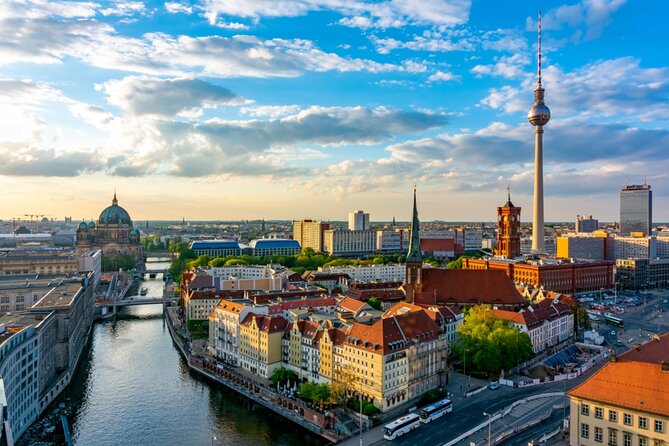
Begin at Alexanderplatz, one of Berlin’s most recognizable public squares. The exact meeting point is Alexanderpl. 1, 10178 Berlin, close to public transportation and easy to identify in the Mitte district.
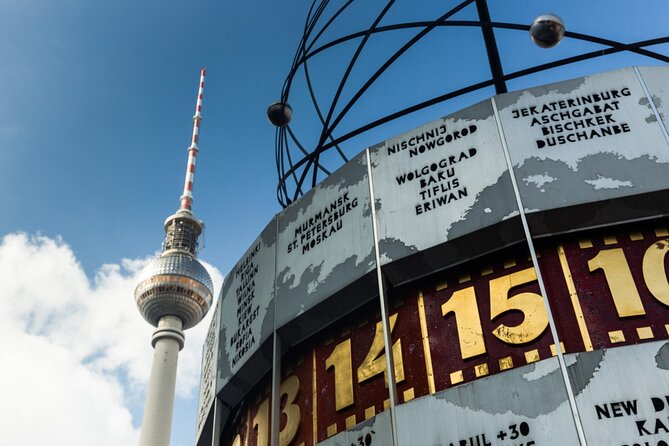
Your first task centers on the Urania World Clock, also called the World Clock. Its metal rotunda displays the current time in 148 major cities. That is not just decoration. The clock provides the sort of visual detail a puzzle walk needs: you must inspect the object, find the relevant information, and enter the answer to move on.
I like this opening because it gets you looking at the city instead of merely walking behind a guide. It also gives you a quick test of how the game works. Read carefully, check the spelling, and do not rush the answer. The puzzle format rewards attention more than speed.
From here, the route moves into Berlin’s civic center. You are not being led straight to one famous monument and then sent home. The game uses a chain of public places, so the walk gradually introduces the architecture and politics of central Berlin.
A few more Berlin trips to weigh up
- Discover Berlin Half-Day Walking Tour
★ 5.0 · 9,624 reviews - Berlin: Third Reich and Cold War 2 Hour Walking Tour
★ 4.9 · 6,830 reviews - Berlin: Discover Berlin Walking Tour
★ 4.9 · 5,998 reviews
Red Town Hall and Neptune Fountain
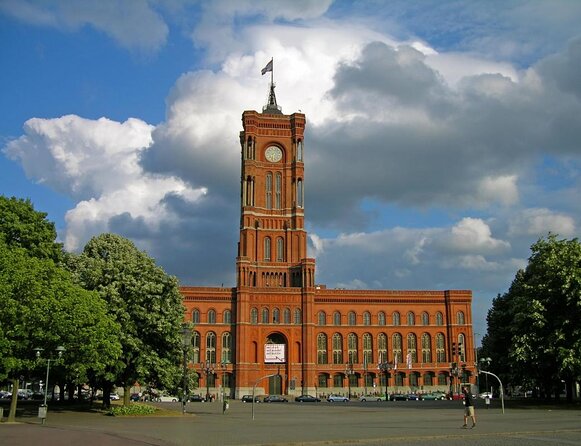
The next sights bring together Berlin’s municipal identity and its imperial past. The Rathaus, or Red Town Hall, was built from 1861 to 1869 in a Northern Italian High Renaissance style. Its design drew on the old town hall of Thorn, now Toruń in Poland, while its tower recalls the cathedral tower at Laon in France.
The building gives you a good reason to look upward and outward. Berlin’s center can feel like a parade of grand facades, but this challenge asks you to notice design details and use them as evidence. If architecture is not your main interest, the puzzle keeps the stop active rather than turning it into a long lecture.
The Neptune Fountain is another short stop, with about 10 minutes allotted. Built in 1891 and designed by Reinhold Begas, it places the Roman god Neptune at the center of the composition. You receive no admission charge here, since the fountain is in public space.
This is a lighter moment in the walk. After the political weight of later stops, Neptune gives you a visual break and a straightforward clue. You may find some questions very easy. That is useful when you are still learning the game, but it also means the challenge level is uneven.
Marx and Engels, then the shifting role of public space
The Marx-Engels-Forum sits in Berlin’s Mitte district and was created by the former East German authorities in 1986. It is named for Karl Marx and Friedrich Engels, whose Communist Manifesto helped shape the socialist movement.
This stop matters because Berlin’s story did not end in 1945. The route also addresses the German Democratic Republic, the former East Germany, and the way governments use monuments and public parks to express political ideas.
The walk then reaches the Lustgarten on Museum Island. The name means Pleasure Garden, and the park has served several purposes over time: part of the former Berlin City Palace grounds, a parade ground, a site for mass rallies, and a public park.
I like this pairing. Marx-Engels-Forum and Lustgarten show two very different uses of open space. One reflects the public language of socialist East Germany. The other has shifted between royal leisure, military display, political gathering, and everyday recreation. You get more from the walk if you pause to consider how each place was used, not just what it looks like now.
Neue Wache and Bebelplatz’s painful lesson
On Unter den Linden, Neue Wache offers a more formal memorial setting. Karl Friedrich Schinkel designed the building between 1816 and 1818 as a guardhouse for the Royal Palace and a memorial to the Liberation Wars. Its clean Prussian Neoclassical design makes it one of the important buildings on the boulevard.
The puzzle here asks you to observe the building and its surroundings. That is helpful on Unter den Linden, where it is easy to hurry from one major sight to the next. You should allow time to stop, read the challenge carefully, and check your answer before moving on.
Bebelplatz is one of the most serious points on the route. It was the site of a Nazi book burning on the evening of May 10, 1933, part of a larger series held in German university cities. The campaign was organized by the nationalist German Student Association and targeted books considered hostile to Nazi ideas.
The place is important because it shows how persecution began with attacks on ideas, writers, and public debate. The experience does not rely only on a museum interior or a long guided talk. Instead, you stand in the square and use the setting as part of the lesson.
The stop is listed at about 10 minutes. That is enough for the challenge, but I would not treat the time as a limit. If the history matters to you, pause longer. A puzzle walk can introduce the subject, but it cannot replace the fuller context available in Berlin’s museums and memorial information panels.
Same city, a completely different kind of day:
- Berlin: Reichstag, Dome and Government District Guided Tour
★ 4.7 · 18,288 reviews - Berlin: 1-Hour City Tour by Boat with Guaranteed Seating
★ 4.3 · 16,993 reviews - Berlin: Boat Tour Along the River Spree
★ 4.4 · 11,252 reviews - Berlin: Hop-on Hop-off Bus Tour with Live Commentary
★ 4.3 · 8,579 reviews
Gendarmenmarkt and the route’s architectural high point
Gendarmenmarkt is one of Berlin’s grandest squares. Its name comes from the Gens d’Armes cuirassier regiment, whose stables once stood here before Friedrich II had them demolished. The square later gained its well-known pair of churches and the concert hall between them.
The location gives the walk a strong visual change. Earlier stops include fountains, parks, and civic buildings. Here, the scale is more formal and carefully framed. You solve another clue by looking around the square, then continue toward the political district and the final memorial.
The stop is scheduled for about 10 minutes and has no admission fee. That makes it a practical place to take a short rest, especially if you are walking with children or a mixed-age group. You can admire the architecture while one person handles the next answer.
The route is generally manageable rather than punishing. Still, this is a one-hour activity on foot, and the total time can stretch if you stop for photos, food, or extra reading. One useful feature is that you do not lose the experience by taking a break.
Hamburg’s state representation and Berlin’s working government
The walk passes the state representation of Hamburg on Jägerstraße. This Classicist town house is used by the Free and Hanseatic City of Hamburg for political meetings, visitors, and public events in Berlin. The building hosts more than 500 events and encounters each year, and it connects Hamburg with federal politics through the Bundesrat.
This is a less famous stop, and that is part of its value. Berlin sightseeing often focuses on palaces, museums, and memorials. A building used for day-to-day political work gives you a glimpse of how Germany’s federal system operates beyond the headline landmarks.
Do not expect an interior visit as part of this activity. The challenge is based on looking around the location and finding the information needed to continue. If you enjoy unusual civic details, this may be one of the more memorable points on the route.
The bunker site and the final approach
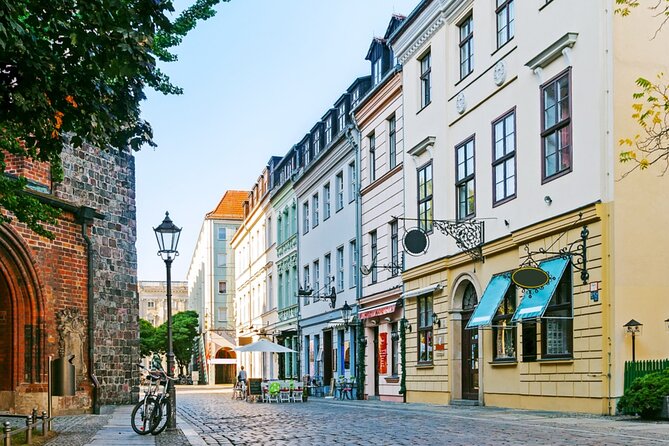
The tour highlights the site of Hitler’s former war bunker. The bunker itself is not presented as an underground attraction, and you should not expect a preserved room-by-room visit. The value is in understanding the place within the final stage of Nazi Germany and connecting it with the surrounding central Berlin sites.
That context gives the walk its central theme. You move from public squares and political symbols toward places tied to dictatorship, war, and remembrance. The story is not limited to military events. It also touches propaganda, censorship, government power, and the physical traces left after the war.
Because the activity is self-guided, the depth depends partly on how much time you give each location. The game offers prompts and historical facts, but it will not pause to answer follow-up questions. You can get a useful overview in about an hour, then return later to the places that deserve more attention.
Ending at the Memorial to the Murdered Jews of Europe
The endpoint is the Memorial to the Murdered Jews of Europe at Cora-Berliner-Straße 1, 10117 Berlin. The memorial was approved by the German parliament in 1999, designed by New York architect Peter Eisenman, and opened in 2005.
This is a powerful place to finish because the route has already introduced the political setting and some of the steps that led to Nazi terror. The memorial itself is made up of concrete blocks arranged across an open site. The experience changes as you move through it, and the setting asks for quiet attention.
The activity ends outside the memorial area. It does not include a separate museum visit or a physical guide, so you should plan extra time if you want to visit the Information Centre. The supplied tour details do not give opening hours for that centre, so check current conditions separately before building your schedule around it.
For many people, this final stop will be the strongest reason to choose this route. It places Berlin’s central monuments into a difficult moral story rather than treating them as disconnected photo stops.
What the $6 price really gives you
At $6 per person, this is a low-cost activity. The price is especially fair for a private group experience, since the same purchase can provide a shared outing for friends or family without paying for a full private guide.
You are paying for a structured route, story, puzzle design, and mobile access. You are not paying for a person who explains each building, adjusts the pace, or answers questions. That difference is important.
I would compare it with a short orientation walk rather than a full historical tour. If you want detailed military history, expert commentary, or a chance to ask about Berlin’s Nazi and Cold War past, you will need another tour or museum visit as well. If you want an inexpensive way to connect major sights and keep your group engaged, the value is strong.
Group discounts are available, though the exact savings are not specified. The booking is available every day, and the experience is listed as operating from 5 AM to 9 PM. Since the game can be played offline, it is practical for a day when you do not want to depend on a constant mobile signal.
The puzzle mechanics and the small frustrations
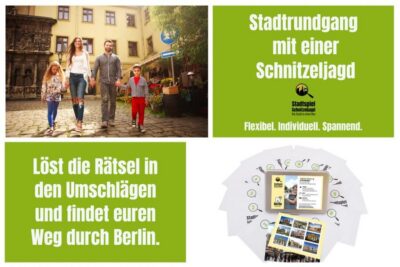
Each location gives you a challenge. You look around, find the relevant detail, enter the answer, and receive the next location and part of the story. This makes the walk more active than following a map from one landmark to another.
The difficulty is not consistent. Some questions are simple, while others require a very exact answer. If the app rejects an answer, try checking spelling, spacing, and the precise form requested rather than assuming the clue is wrong.
Crowds can also affect the experience. A Christmas market once made it necessary to maneuver around the route, and a crowded square could make it harder to spot a sign or object. The flexible format helps, since you can take a break and return at a quieter time, but you should still expect to adapt in busy periods.
A private format is useful for families, couples, and friends who do not want to match the pace of strangers. Service animals are allowed, the route is near public transportation, and the activity states that most people can participate. The description does not provide detailed information about step-free access, seating, or restroom locations, so contact the provider if those points matter to you.
Who should book this Berlin walk
I would recommend it most to first-time visitors who want a quick orientation to central Berlin, families who enjoy solving clues, and repeat visitors who want to see familiar places in a new order. It also suits people who dislike fixed tour times.
Berlin residents can get something from it too. The route includes several places you might pass without stopping, and the political details can add purpose to an ordinary walk through Mitte.
I would hesitate if you want a fully guided history lesson, dislike phone-based activities, or prefer a carefully paced route with no uncertainty. The activity is offered in English, and no physical guide is provided. You need to be comfortable reading instructions, searching the surroundings, and making your own way from stop to stop.
Free cancellation is available if you cancel at least 24 hours before the local start time. Changes or cancellations inside that window are not refunded, so keep the flexible booking in mind when setting your plans.
FAQ
How long does the Berlin puzzle walk take?
The experience lasts approximately one hour. You can take breaks and resume later, so your actual outing may take longer.
Where does the activity start?
It starts at Alexanderpl. 1, 10178 Berlin, Germany, at Alexanderplatz.
Where does the activity end?
It ends at Cora-Berliner-Straße 1, 10117 Berlin, Germany, by the Memorial to the Murdered Jews of Europe.
Is a physical tour guide included?
No. This is a self-guided mobile activity, and only your private group participates.
Can I play without an internet connection?
Yes. The activity is designed for offline play, so you do not need an internet connection while playing.
What language is the activity offered in?
It is offered in English.
Can I cancel for a full refund?
Yes, if you cancel at least 24 hours before the experience start time. Cancellations made less than 24 hours ahead are not refunded.
Should you book Love and War in Berlin?
Book it if you want a cheap, flexible introduction to Berlin’s central sights and like the idea of learning through small challenges. The route covers much more than one period, moving from Prussian architecture to socialist monuments, Nazi repression, wartime history, and modern remembrance.
Skip it if you need an expert guide or detailed historical discussion at every stop. For $6, though, this is a sensible way to spend an hour, especially when you add a museum visit or extra time at the final memorial. Bring a charged phone, read each clue carefully, and give Bebelplatz and the Holocaust Memorial more time than the game clock may suggest.
Just added around Berlin
- Rickshaw Tours Berlin – Groups of up to 16 people with several rickshaws★ 4.0 · 97 reviews
- Walking on the Wall: 3-Hour Tour in Berlin★ 4.5 · 34 reviews
- eSIM for Germany and 34 European Countries★ 4.5 · 16 reviews
- Warnemuende Shore Excursion: Berlin Private Sightseeing Tour from Rostock★ 5.0 · 4 reviews
- Your ticket to The Wall Museum Berlin★ 3.0 · 60 reviews
- Warnemuende Shore Excursion: Private Berlin Tour★ 4.5 · 27 reviews
- Berlin’s Gay, Lesbian, and Queer Scene Small-Group Walking Tour★ 4.5 · 66 reviews
- Karl-Marx-Allee Tour: Life and Architecture in East Berlin★ 5.0 · 19 reviews
Self-Guided Tours, compared.

BVB Signal Iduna Park: Stadium Access and Self-Guided Tour
Read our review →
Solar Powered Sunset Catamaran Cruise & Audio Guide
Read our review →
Neuschwanstein Castle Entry Ticket and Audio Guide
Read our review →
Neuschwanstein Castle Ticket With Audio Guided Tour
Read our review →

Browse the lists this tour appears in