
Reviewed · WALKING TOURS
Walking on the Wall: 3-Hour Tour in Berlin
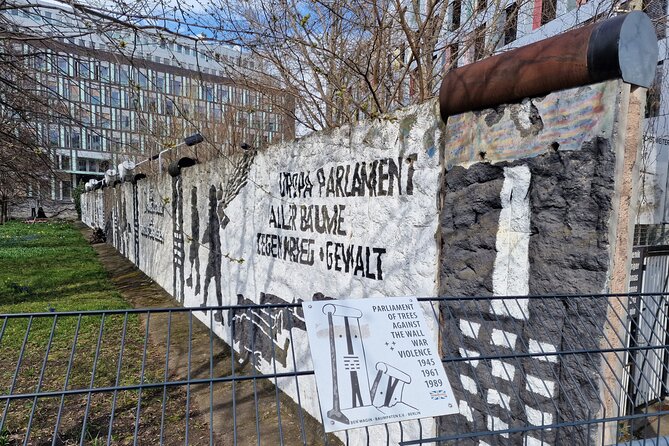
Berlin’s Wall is easiest to understand when you stop treating it as a single slab of concrete. This walk follows the old border through abandoned structures, memorials, death-strip remains, and everyday city spaces, showing how the division cut through real neighborhoods.
I like the small group, capped at 12, and the way guide Behzad connects famous sights with details you could miss on your own. I also like the steady pace and the mid-tour coffee or beer break. The drawback is simple: this is a three-hour walk, and the starting point on Ida-von-Arnim-Straße can feel odd until the guide explains why it matters.
In This Review
- Key points to know before you book
- Why this Berlin Wall walk works better than a quick photo stop
- Starting at Liesenbrücken, an unusual first lesson
- Bernauer Straße and the Berlin Wall Memorial
- A break that keeps the three-hour walk comfortable
- Mauerpark, where the border became city life
- Rabbit Field and the former death strip
- The guide makes the difference
- Price, group size, and overall value
- A few cautions before you reserve
- Who will enjoy this Wall tour most
- Should you book Walking on the Wall?
- FAQ
- How long is the Walking on the Wall tour?
- Where does the tour begin?
- Where does the tour end?
- What language is the tour offered in?
- How many people can join the tour?
- What places are visited?
- Are admission tickets included?
- Is the tour physically demanding?
- Can I cancel for a full refund?
Key points to know before you book
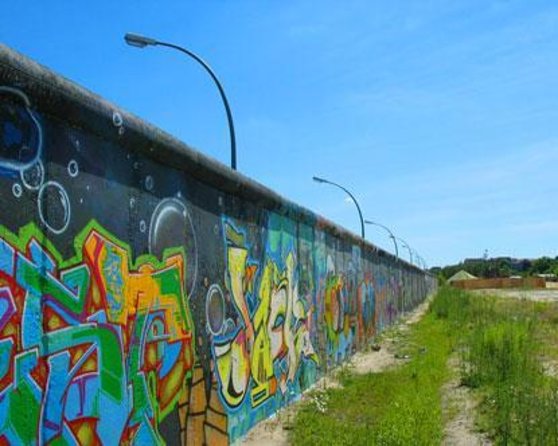
- See more than the famous Wall: The route includes Liesenbrücken, the Berlin Wall Memorial, Mauerpark, and Rabbit Field.
- Expect a personal tour: Groups are limited to 12 people, which makes it easier to hear the guide and ask questions.
- Guide Behzad brings the past to street level: He explains how the Wall shaped homes, streets, families, and daily routines.
- Plan for real walking: You need a moderate level of fitness and comfortable shoes.
- A useful refreshment pause: A coffee, beer, snack, and restroom stop often breaks up the morning or afternoon.
- Allow for weather: Winter can feel cold and exposed, so dress warmly and bring suitable shoes.
Why this Berlin Wall walk works better than a quick photo stop

A short visit to a surviving section of the Berlin Wall can give you a picture, but not much sense of how the border worked. This tour gives you a route, and the route does much of the teaching. You move through several parts of the former border zone, seeing how abandoned infrastructure, memorials, open land, and modern city life now sit side by side.
That matters because the Wall was not just one barrier. The border system included multiple walls, patrol areas, fences, roads, and a restricted strip between them. The stop at Rabbit Field, in the former death strip, helps make that layout clear. It is one of the most useful parts of the walk for anyone who has only seen the Wall in photographs.
Behzad is the guide most closely associated with this experience. His approach is conversational and interactive, with room for questions and small observations. You can expect a mix of established historical facts and local details, including sights that are easy to pass without noticing.
The tone is serious when it needs to be, but the walk is not presented as a dry lecture. The guide uses stories to explain what life was like in East and West Berlin, how people lived with the border, and how the city changed after reunification.
A few more Berlin trips to weigh up
- Discover Berlin Half-Day Walking Tour
★ 5.0 · 9,624 reviews - Berlin: Third Reich and Cold War 2 Hour Walking Tour
★ 4.9 · 6,830 reviews - Berlin: Discover Berlin Walking Tour
★ 4.9 · 5,998 reviews
Starting at Liesenbrücken, an unusual first lesson
The tour begins at Ida-von-Arnim-Straße 2, near Liesenbrücken. This starting point may not look like a major Berlin attraction. That is part of the point.
Liesenbrücken is an abandoned bridge located along the former Wall route. It introduces an important idea right away: Berlin’s division affected transport links, bridges, streets, and ordinary movement across the city. The remains are less polished than the main memorial sites, but they can feel more direct because they are not arranged as a formal monument.
You spend about 30 minutes here. That is enough time to understand the setting without using up the whole tour before reaching the main memorial. Bring your booking confirmation on your phone, and check the address carefully before setting out. One person found the starting location confusing at first, so give yourself a few extra minutes to get your bearings.
The unusual start also helps set expectations. This is not a sightseeing loop built around the best-known postcard views. It is a walk along the Wall’s actual path, including places where the evidence is partial, worn, or easy to overlook.
Bernauer Straße and the Berlin Wall Memorial
The longest stop is the Berlin Wall Memorial on Bernauer Straße, with about 90 minutes set aside for the area. This is the heart of the tour.
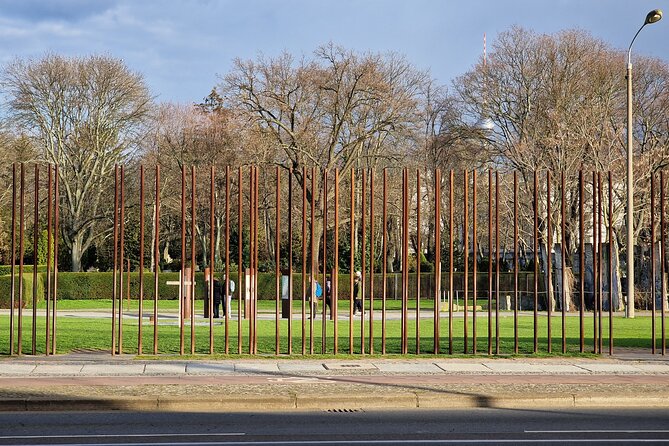
The memorial covers roughly 1.4 kilometers of the former border strip. It includes a 70-meter section of reconstructed border fortifications, an outdoor exhibition, the Chapel of Reconciliation, the Berlin Wall Documentation Centre, the Window of Remembrance, and visitor facilities. The nearby Nordbahnhof S-Bahn station also has an exhibition connected with the memorial.
The key value here is scale. You can see how much space the border system occupied and how it divided streets and buildings. The memorial is not only about the concrete wall. It explains the wider machinery of separation and the human cost, including people who died trying to cross.
The Window of Remembrance is especially important because it keeps the focus on individual lives rather than only political events. The Chapel of Reconciliation offers a quieter place within the memorial grounds. Together, these sites give the history a human measure.
I would pay close attention to the guide’s explanation of the inner wall. Several parts of the route make more sense once you understand that the border was not simply one wall with open ground on either side. The area between the inner and outer barriers, often described as the death strip, was designed to stop escape. Seeing traces of that arrangement can be an eye-opening moment.
The memorial is also the best place to ask questions. If you are visiting Berlin with older children or teenagers, the information here gives them a clear framework for understanding East Germany, West Germany, border controls, and daily life during the division.
A break that keeps the three-hour walk comfortable
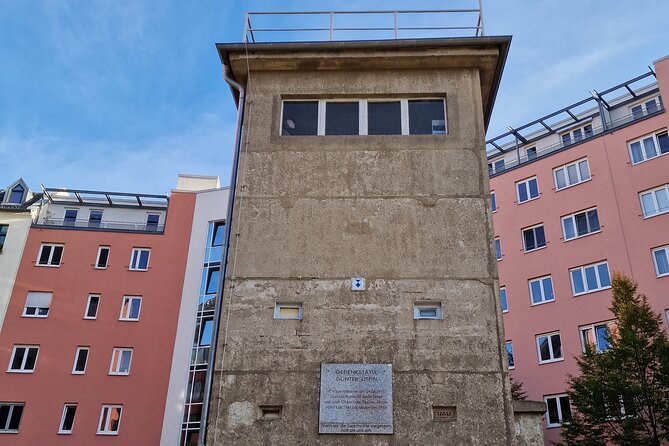
A walking tour about the Berlin Wall needs time for discussion, but three hours can feel long if you never stop. In practice, the route includes a short pause around the middle, often at a small Swiss coffee shop.
You might use the stop for coffee, a beer, a snack, or the restroom. It is not presented as a formal food tour, and the cost of refreshments is not included in the stated tour price. Still, the pause is useful, especially on a cold day.
One practical tip: wear more clothing than you think you need in winter. The tour is outdoors, and one booking took place on a chilly morning. Comfortable walking shoes matter in every season. The route is not described as strenuous, but you should have a moderate level of fitness and be ready to walk for most of the three hours.
Same city, a completely different kind of day:
- Berlin: Reichstag, Dome and Government District Guided Tour
★ 4.7 · 18,288 reviews - Berlin: 1-Hour City Tour by Boat with Guaranteed Seating
★ 4.3 · 16,993 reviews - Berlin: Boat Tour Along the River Spree
★ 4.4 · 11,252 reviews - Berlin: Hop-on Hop-off Bus Tour with Live Commentary
★ 4.3 · 8,579 reviews
Mauerpark, where the border became city life
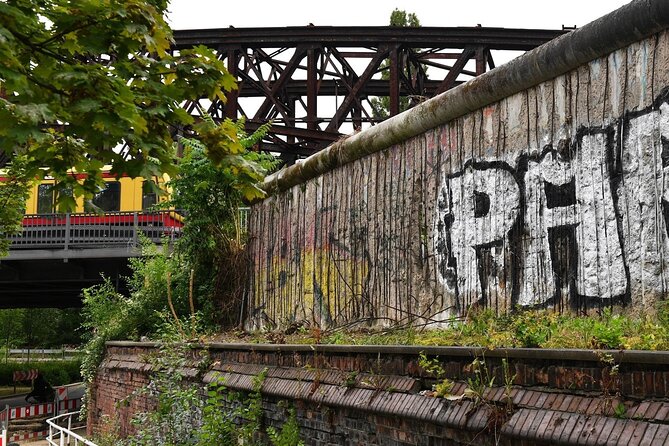
The tour continues to Mauerpark, a public park following the former Wall line along Schwedter Straße. You spend about 30 minutes here.
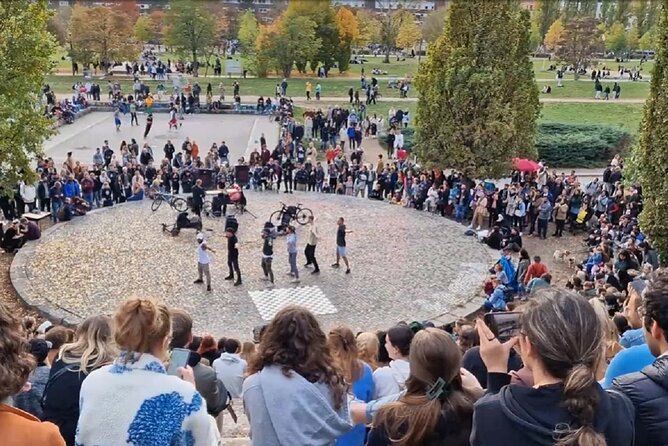
Mauerpark gives the tour a different mood. Instead of a formal memorial setting, you see a popular local recreation area with a flea market and street musicians. The old border line now runs through a place associated with weekends, music, browsing, and open space.
That contrast is useful. Berlin’s Wall history is not frozen in 1989. The city has reused parts of the former border zone in ordinary ways, and Mauerpark shows how a place once linked with restriction and fear can become part of daily life.
The park can also be lively, depending on the day and timing. That may appeal to you if you want history mixed with present-day Berlin. If you prefer a quiet memorial experience, the park can feel less focused than Bernauer Straße.
The guide’s role is especially useful here because the physical Wall remains may be less obvious. You are not simply looking at a large intact barrier. You are learning to read the park, street alignment, open space, and surviving traces as parts of the former border.
Rabbit Field and the former death strip
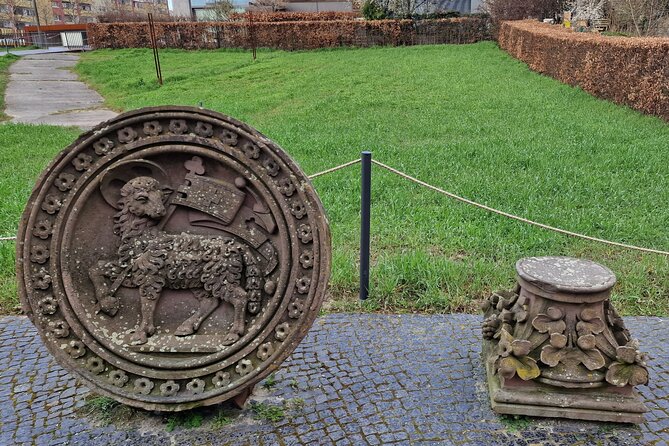
Rabbit Field is the final listed stop, with about 30 minutes devoted to the former death strip. The name points to a striking detail: rabbits lived in the restricted border area when the land was largely cut off from the surrounding city.
This stop helps you picture the border as a controlled zone rather than a single wall. The quiet image of rabbits in an empty strip contrasts sharply with the purpose of the area and makes the space easier to remember.
Rabbit Field is also one of the more unusual parts of the route. Many first-time visitors know about Checkpoint Charlie or the East Side Gallery, but fewer expect to see a place where the former border zone is explained through such an ordinary piece of nature.
The tour ends at Mauerpark, near Bernauer Straße 63. Since the walk does not return to the starting point, think about your plans afterward. The ending is convenient if you want to continue exploring the park and nearby Wall memorial sites, but it is worth noting that this is a point-to-point tour.
The guide makes the difference
Historical walking tours rise or fall on the person leading them. Here, Behzad receives repeated praise for his clear English, passion, humor, patience, and ability to answer both serious and random questions.
That combination matters. A guide can recite dates and names, but you also need help connecting them to the ground beneath your feet. Behzad’s strongest contribution is the link between the physical remains and ordinary life in divided Berlin.
You can expect an interactive walk rather than a speech delivered while the group trails behind. The small group helps. With a maximum of 12 people, you have a better chance of hearing explanations, asking follow-up questions, and staying connected to the guide at each stop.
The guide also points out murals and smaller remains along the route. These details are part of the value. If you walked the same general area alone, you would see some of the major memorials, but you might miss the less obvious signs or fail to understand their purpose.
Price, group size, and overall value
At $24.03 per person, this is a modestly priced way to spend three hours in Berlin. You are not paying for an attraction ticket, since the listed stops have free admission. You are paying for the route, interpretation, local context, and the time saved by having someone explain what you are seeing.
That is good value if the Berlin Wall is a main reason for your visit or if you want a firm historical base early in your stay. It is less useful if you only want a quick look at surviving concrete and prefer to explore at your own pace.
The group limit of 12 improves the value. A large coach group would make an outdoor walking route less personal, while a very large crowd could make it hard to hear at street corners or memorial sites. This size is small enough for questions without requiring the price of a private tour.
The experience is offered in English and includes a mobile ticket. Service animals are allowed, and the route is near public transportation. The meeting and ending points are different, so plan around that when arranging your day.
The tour is usually booked well ahead, with an average booking time of about 45 days. If your Berlin dates are fixed, booking early is sensible, especially if you want a particular morning or afternoon.
A few cautions before you reserve
The overall rating is 4.5 from 34 ratings, but the experience is not without risks. One booking reported waiting 20 minutes at the meeting point because the guide did not arrive. Another was canceled close to the start because the minimum number of participants was not reached.
Those incidents appear to be exceptions rather than the normal experience, but they are worth knowing before you plan an important day around the tour. Keep your meeting details handy, arrive early, and check for last-minute messages before leaving your hotel.
The tour also requires a minimum number of participants. If that minimum is not reached and the activity is canceled, you are offered another date or experience, or a full refund. You can cancel for a full refund up to 24 hours before the start time. Changes or cancellations inside that 24-hour window are not accepted for a refund.
Who will enjoy this Wall tour most
I would recommend this walk to first-time Berlin visitors, history students, families with older children, and anyone who wants more context than a museum visit alone can provide. The route gives you a clear way to understand the Wall as a border system and as a force that shaped everyday life.
It is also a good fit if you enjoy unusual urban details. Liesenbrücken and Rabbit Field are not the standard headline sights, and the walk includes places that may not register on a casual stroll.
Older children and teenagers can benefit from the combination of movement, real locations, and direct explanation. One family found the tour gave a teenage son a useful history lesson outside the classroom. That said, younger children may find three hours of historical discussion and walking demanding.
I would choose something else if you want a short, highly visual tour with lots of free time for photos. This experience is built around explanation. The history is the main event, and the physical remains are there to support it.
Should you book Walking on the Wall?
Book it if you want to understand how Berlin’s Wall worked, why the border occupied so much space, and how the city still carries those marks today. The strongest reasons are the small group, the route beyond the obvious sights, Behzad’s engaging presentation, and the chance to see the former death strip at Rabbit Field.
Wear good shoes, dress for the weather, and keep the point-to-point route in mind. For about $24, this is a sensible buy for anyone who wants Berlin’s recent past explained clearly while walking through the places where it happened.
FAQ
How long is the Walking on the Wall tour?
The tour lasts approximately three hours.
Where does the tour begin?
It begins at Ida-von-Arnim-Straße 2, 10115 Berlin, Germany.
Where does the tour end?
It ends at Mauerpark near Bernauer Straße 63, 13355 Berlin, Germany.
What language is the tour offered in?
The tour is offered in English.
How many people can join the tour?
The maximum group size is 12 people.
What places are visited?
The route includes Liesenbrücken, the Berlin Wall Memorial, Mauerpark, and Rabbit Field in the former death strip.
Are admission tickets included?
Admission is free at the listed stops. Rabbit Field is marked as included, and no separate admission charge is listed for the other stops.
Is the tour physically demanding?
You should have a moderate level of physical fitness. The experience is a three-hour walking tour, so comfortable shoes are recommended.
Can I cancel for a full refund?
Yes. You can cancel up to 24 hours before the experience start time for a full refund. If the tour is canceled because the minimum number of participants is not reached, you are offered another date or experience, or a full refund.
Just added around Berlin
- Love and War in Berlin: Self-Guided Story Puzzle Walk★ 5.0 · 7 reviews
- Rickshaw Tours Berlin – Groups of up to 16 people with several rickshaws★ 4.0 · 97 reviews
- eSIM for Germany and 34 European Countries★ 4.5 · 16 reviews
- Warnemuende Shore Excursion: Berlin Private Sightseeing Tour from Rostock★ 5.0 · 4 reviews
- Your ticket to The Wall Museum Berlin★ 3.0 · 60 reviews
- Warnemuende Shore Excursion: Private Berlin Tour★ 4.5 · 27 reviews
- Berlin’s Gay, Lesbian, and Queer Scene Small-Group Walking Tour★ 4.5 · 66 reviews
- Karl-Marx-Allee Tour: Life and Architecture in East Berlin★ 5.0 · 19 reviews
Walking Tours, compared.





Berlin’s Best: 2 Hour Walking Tour Third Reich and the Cold War
Read our review →


Third Reich Berlin: Hitler and WWII Walking Tour
Read our review →Browse the lists this tour appears in