
Reviewed · THIRD REICH & COLD WAR TOURS
Private Walking Tour: World War 2 and Cold War Sites in Berlin
Berlin’s 20th-century story is written into its streets. This private walking tour connects the Nazi government quarter, the site of Hitler’s bunker, the Holocaust Memorial, Checkpoint Charlie, and surviving sections of the Berlin Wall into one serious, revealing lesson in how a city was broken apart and rebuilt.
I like the private format, which lets your guide slow down for your questions or skip sights you have already seen. I also like the chance to shape the tour around WWII, the Cold War, or both, with guides such as Glen, Hannah, Daniel, Maria, Ariel, and Jamie praised for clear explanations and a friendly pace.
The main caution is the sheer size of the proposed route. Three or four hours is not enough for every listed stop in equal detail, especially since Tempelhofer Feld, Bernauer Strasse, and the East Side Gallery are spread across Berlin. Tell the company your must-see sites before the tour begins, and confirm exactly what will fit.
In This Review
- Key points at a glance
- Why Berlin’s recent past works best with a private guide
- Reichstag, Brandenburg Gate, and the plans for Nazi Berlin
- The Holocaust Memorial and Hitler’s bunker site
- The Reich Air Ministry and the Topography of Terror
- Checkpoint Charlie and the machinery of division
- The Palace of Tears and the personal cost of the Wall
- Bernauer Strasse, escape tunnels, and the Berlin Wall Memorial
- Prenzlauer Berg and the Stasi prison story
- Tempelhofer Feld and the Berlin Airlift
- East Side Gallery and Berlin’s painted Wall
- How much walking and planning should you expect?
- Is the $192.97 price worth it?
- Who should book this Berlin history tour?
- Final call: book it if you plan the priorities
- FAQ
- How long does the private Berlin walking tour last?
- Is the tour private?
- Is hotel pickup included?
- Can I choose a morning or afternoon departure?
- Can I focus only on World War II history?
- Can I focus only on Cold War history?
- Can I combine World War II and Cold War sites?
- Which major Berlin sights can be included?
- Is food included?
- What language is offered?
- Can I cancel for a full refund?
Key points at a glance
- A private history lesson: Only your group joins the tour, so the guide can adjust the route, pace, and level of detail.
- Choose your focus: Build the walk around Nazi Berlin, the Cold War, or a combination of both.
- Powerful central sights: See the Brandenburg Gate, Reichstag, Holocaust Memorial, Hitler’s bunker site, the former Reich Air Ministry, and the Topography of Terror.
- Cold War stories with human scale: Checkpoint Charlie and the Palace of Tears explain division through escape attempts, family separations, and political tension.
- Hotel pickup and drop-off: The experience begins and ends at a central Berlin hotel lobby.
- Plan for plenty of walking: Comfortable shoes, water, and a clear list of priorities will make a real difference.
Why Berlin’s recent past works best with a private guide
You can walk past many of Berlin’s major monuments without understanding what happened there. The Reichstag looks like an impressive government building, the Brandenburg Gate looks like a handsome city symbol, and Checkpoint Charlie can feel like a busy photo stop. A good guide adds the missing connections.
This tour is built around those connections. You move from the Nazi state and its plans for a rebuilt capital to the destruction of WWII, then into the Soviet occupation and the division of Germany. The same streets take on new meaning as the story moves forward.
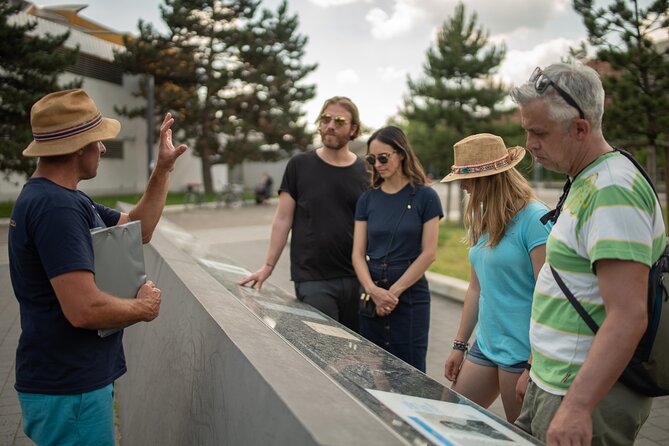
The private setup matters here. You can ask why the Nazi regime gained support, how Berliners lived under dictatorship, or what the Berlin Wall meant in daily life. You can also tell your guide that you have already seen a particular sight and use the time elsewhere.
The strongest part of the experience is the human explanation. The guides are not simply pointing out buildings. They explain resistance figures such as Claus von Stauffenberg, the plans for Albert Speer’s Germania, the battle for Berlin, daring tunnel escapes, and the emotional cost of a divided city.
This is also a useful first full day in Berlin. One guide can give you a broad map of the city and help you decide what deserves a second visit. Jamie, for example, was praised for helping with the U-Bahn and S-Bahn, while Maria was noted for offering ideas for the rest of the stay.
More Third Reich & Cold War Tours in Berlin
- Berlin: Third Reich and Cold War 2 Hour Walking Tour
★ 4.9 · 6,830 reviews - Berlin’s Best: 2 Hour Walking Tour Third Reich and the Cold War
★ 5.0 · 5,486 reviews - Third Reich Berlin: Hitler and WWII Walking Tour
★ 5.0 · 3,301 reviews
Reichstag, Brandenburg Gate, and the plans for Nazi Berlin
The Reichstag is an effective opening point because it links present-day Germany with the country’s darkest period. From here, your guide can explain the Nazi government, the wartime struggle from Stalingrad to Berlin, and the Soviet capture of the capital.
The discussion can also include resistance to Hitler, including Claus von Stauffenberg and others who opposed the regime. This is one of the tour’s strengths: the story is not reduced to Hitler alone. You hear about people who resisted, people who suffered, and the machinery of power that made the regime possible.
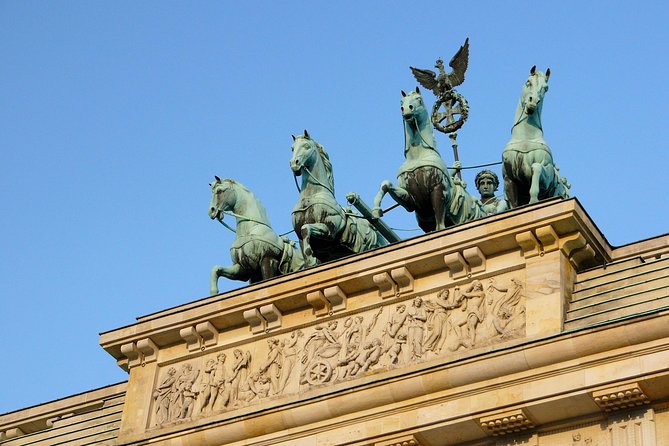
The nearby Brandenburg Gate offers a useful change in tone. It was once a symbol of Berlin’s division, but today it represents German unity and peace. Your guide can use the monument to explain how one structure took on different meanings under the Nazi state, during the Cold War, and after reunification.
The itinerary allows around ten minutes at each of these first two stops. That is enough for an explanation outside, but not for a long architectural visit. Admission is free, yet this tour is mainly about the surrounding history rather than entering the buildings.
The Holocaust Memorial and Hitler’s bunker site
The Memorial to the Murdered Jews of Europe is one of Berlin’s most affecting places. Its 2,711 concrete slabs form a grid near the Brandenburg Gate. As you walk among them, the blocks change height and the ground seems to shift around you.
Your guide can explain the memorial’s purpose and the way its design creates uncertainty and discomfort. You may also have time to visit the underground information center, which presents personal accounts and historical material about the Holocaust. The listed stop allows about 15 minutes, so ask in advance if the information center is important to you.
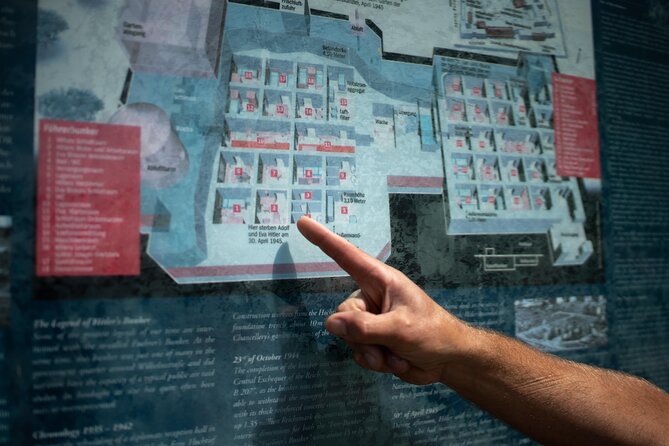
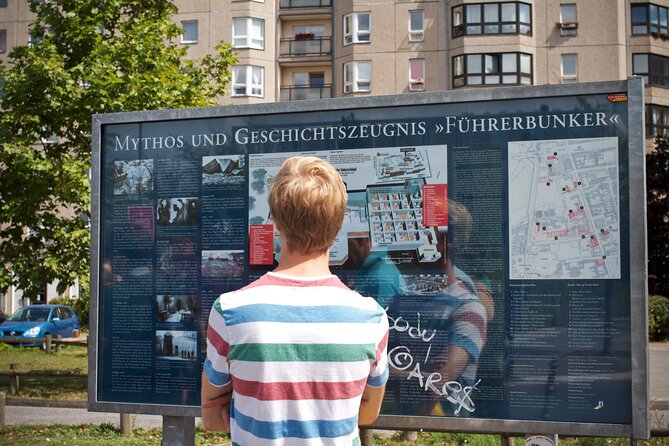
Nearby, you visit the site of Hitler’s bunker. There is no grand preserved chamber to tour. The value lies in understanding the location and the final days of the Nazi leadership as the Battle of Berlin closed in.
That distinction is worth knowing before you book. If you expect an underground bunker interior, you will be disappointed. If you want the setting explained clearly, with the surrounding government district placed into context, the stop is useful.
The Reich Air Ministry and the Topography of Terror
The former Reich Air Ministry is one of the most striking surviving Nazi-era buildings in Berlin. Completed in 1936, the huge structure was tied to Hermann Göring and the Luftwaffe. Its scale was meant to project authority and military power.
The building was damaged during the war but survived. East Germany later used it as the Ministry of Transport, giving the site another layer of political history. Today, the exterior helps you see how Nazi architecture tried to make government appear permanent and overwhelming.
The nearby Topography of Terror shifts attention from grand buildings to the people who carried out Nazi policy. The site once housed the headquarters of the SS, Gestapo, and SD. Its exhibitions focus on the perpetrators and the systems of repression they operated.
This is a valuable correction to the way WWII history is often taught. You are not only looking at battle sites or monuments. You are examining the offices, officials, and institutions that organized terror.
Both stops are free, and each is allotted roughly ten to 15 minutes. That is enough for a focused outdoor explanation, though you should not expect a full museum visit during a short walking tour.
Same city, a completely different kind of day:
- Berlin: Reichstag, Dome and Government District Guided Tour
★ 4.7 · 18,288 reviews - Berlin: 1-Hour City Tour by Boat with Guaranteed Seating
★ 4.3 · 16,993 reviews - Berlin: Boat Tour Along the River Spree
★ 4.4 · 11,252 reviews - Discover Berlin Half-Day Walking Tour
★ 5.0 · 9,624 reviews
Checkpoint Charlie and the machinery of division
Checkpoint Charlie is the best-known former crossing between East and West Berlin. During the Cold War, it was used by Allied personnel, diplomats, and foreign visitors. In 1961, American and Soviet tanks faced each other here during a dangerous standoff.
Your guide can explain how the confrontation unfolded and why it mattered beyond Berlin. The stop also opens the door to stories of espionage, escape attempts, and the ordinary people caught between two political systems.
Checkpoint Charlie is now a busy city location, and the modern setting can feel less solemn than the history deserves. A guide helps you look past the traffic and commercial activity to understand what the crossing meant when Berlin was divided.
The stop is listed at about 15 minutes. That makes it a strong place for a concise explanation, but not a long historical session. If Cold War history is your main reason for booking, tell the company so the guide can give this period enough time.
The Palace of Tears and the personal cost of the Wall
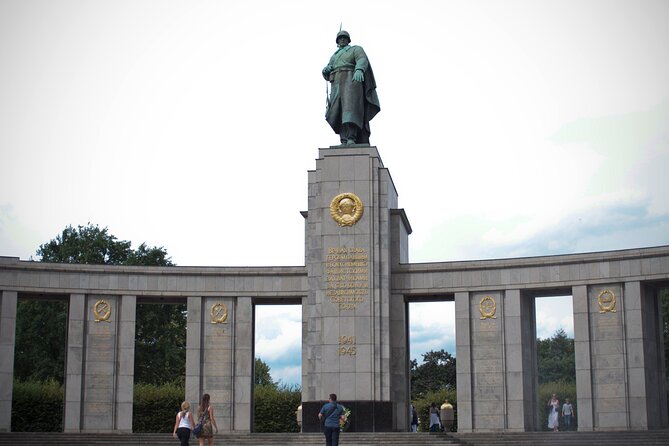
At Friedrichstrasse Station, the Tränenpalast, or Palace of Tears, tells the story of separation through everyday farewells. From 1961 to 1989, East Germans leaving for West Berlin passed through this departure hall. Families and friends often said goodbye there under strict border rules.
The name comes from the tears shed during those departures. The building now contains a museum with displays about the Berlin Wall and personal experiences of division.
I find this stop especially useful after Checkpoint Charlie. Checkpoint Charlie explains the international tension. The Palace of Tears explains what that tension did to parents, children, friends, and couples.
The visit is listed at around 20 minutes and admission is free. Since this is an indoor museum, it can also provide a welcome break from the pavement, though the exact amount of time available depends on your customized route.
Bernauer Strasse, escape tunnels, and the Berlin Wall Memorial
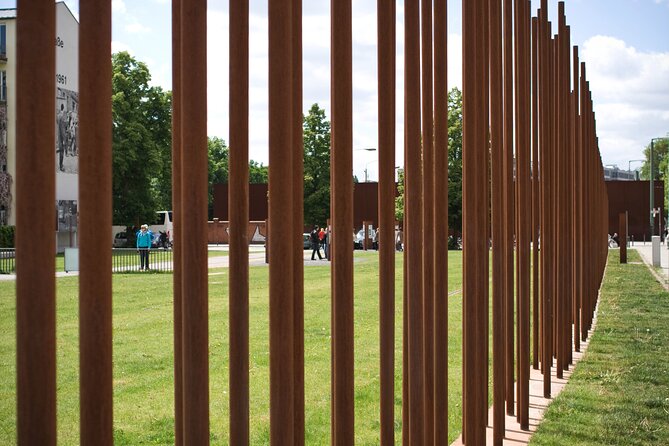
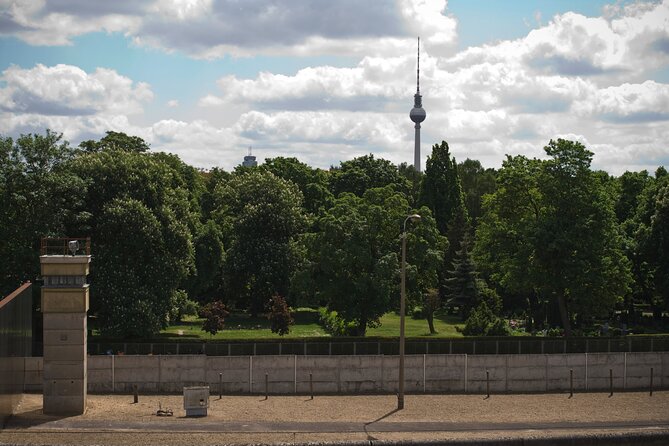
The Berlin Wall Memorial on Bernauer Strasse is among the most important Cold War sites in the city. When the Wall went up in 1961, it cut directly through the street. Some residents were trapped in East Berlin while neighbors across the way watched from the West.
The area became known for escape attempts. Tunnel 29 helped 29 people reach West Berlin in 1962. Tunnel 57 later helped 57 people escape through a narrow passage beneath the Wall.
Today, the memorial preserves sections of the Wall, a watchtower, and a documentation center. The site gives you a clearer idea of how the barrier worked than a painted section of wall alone. You can see the border system as a physical structure, not just a political idea.
The listed stop allows about 25 minutes. That is enough to grasp the layout and hear key stories, but you may want to return on your own if you hope to explore the documentation center carefully.
Prenzlauer Berg and the Stasi prison story
The Prenzlauer Berg portion takes you to a former NKVD prison, later used by East Germany’s secret police, the Stasi. The guide explains how interrogators extracted information from prisoners and how the site is used today.
This stop adds a layer that many general Berlin tours skip. The Cold War was not only about tanks, checkpoints, and political speeches. It also involved surveillance, interrogation, fear, and the pressure placed on people inside East Germany.
The stop is listed at around ten minutes, so it is likely to be a short introduction rather than a full prison visit. Still, it helps explain how Germany faces its difficult past after dictatorship and division.
Tempelhofer Feld and the Berlin Airlift
Tempelhofer Feld brings the WWII and Cold War stories together in a different setting. The former Nazi airport was later used by the Allies during the Berlin Airlift of 1948 and 1949, when supplies reached West Berlin by air.
The airport no longer functions as an airport. Its huge open grounds are now used by the public as a recreation area. The contrast is striking: a place built under dictatorship and later tied to a major Cold War crisis has become open space for everyday city life.
The stop is listed at about 20 minutes. Because the field is enormous, you will likely get an orientation and historical explanation rather than a full walk across it. Its location also makes it difficult to combine with every central Berlin sight in only four hours.
East Side Gallery and Berlin’s painted Wall
The East Side Gallery is the longest remaining section of the Berlin Wall and the world’s longest permanent open-air graffiti gallery. Its murals turn a former barrier into a public display about freedom, justice, and political change.
This is the most colorful stop on the route, but it should not be mistaken for a complete picture of the Wall. The art is powerful, while the remaining barrier is only one part of a much larger border system that once divided the city.
The listed visit lasts about 15 minutes. If you want time to see many murals, take photographs, or read about the artists, ask for a longer visit. The East Side Gallery is also far from several central WWII sites, so it is especially important to name it as a priority before booking.
How much walking and planning should you expect?
The tour lasts about three to four hours and is offered in the morning or afternoon. Hotel pickup and drop-off are included, and the experience is private, with only your group participating.
Despite the pickup, this is still a walking tour. One person described walking for four hours without a rest or drink break, while other guides were praised for adjusting the pace for older participants or jet-lagged arrivals. I would ask for pauses if you need them, and carry water and wear comfortable shoes.
The route is customizable, but customization works best when you are specific. Send a short priority list such as:
- Hitler’s bunker site and the Holocaust Memorial
- Checkpoint Charlie and the Palace of Tears
- Bernauer Strasse and the East Side Gallery
- Nazi architecture and the Topography of Terror
- A balanced mix of WWII and Cold War sites
Do not assume that every location listed will receive equal attention. A prior complaint involved promised expectations about the East Side Gallery and Berlin Wall museum not matching the actual route. The practical lesson is simple: name the sights you care about before the tour, and confirm the plan.
Is the $192.97 price worth it?
At $192.97 per person, this is not a budget walking tour. The price makes the most sense for a small group that wants a private guide, hotel service, and a route shaped around personal interests.
For two people, the total cost is substantial. For a family or group, available group discounts may improve the value. The best reason to pay more is not simply to see famous monuments. It is to get a historian’s explanation at places where the physical evidence can be confusing or incomplete.
You are also paying for time saved. Berlin’s WWII and Cold War sites are spread across a large city. A private guide can help you link them, explain what you are seeing, and steer you away from sights that do not match your interests.
The value drops if you want a slow museum day, a long lunch, or a complete visit to every stop. Food and drinks are not included, and the tour’s short length requires choices.
Who should book this Berlin history tour?
I would recommend it to first-time visitors who want a clear introduction to Berlin’s Nazi and Cold War past. It is also a good choice if you have already walked around the city and found the monuments hard to interpret.
History-focused families should benefit from the private format. Children and teenagers can ask direct questions, while adults can request more detail about politics, resistance, or daily life under dictatorship.
It suits visitors who value conversation over a fixed group script. Guides including Hannah, Glen, Daniel, Ariel, Jamie, Maria, and Joerg were praised for answering questions, using photographs or picture books, and changing the agenda when a group had already seen certain places.
It is less suitable if you dislike walking, want guaranteed access to every museum, or prefer to explore one neighborhood slowly. In that case, choose one district and visit its museums on your own.
Final call: book it if you plan the priorities
Book this private Berlin walking tour if you want the city’s WWII and Cold War sites tied into one understandable story, and if personal attention is worth the price. The guide’s flexibility is the main advantage, not the number of monuments checked off.
Before booking, decide which three or four places matter most. Ask for the East Side Gallery, Bernauer Strasse, Tempelhofer Feld, or the Palace of Tears by name if they are essential. With clear planning, this can give you a strong first framework for Berlin and help you make better choices for the rest of your visit.
FAQ
How long does the private Berlin walking tour last?
The tour lasts approximately three to four hours.
Is the tour private?
Yes. Only your group participates in the activity.
Is hotel pickup included?
Yes. The tour begins with a meet and greet in a central Berlin hotel lobby, and hotel drop-off is included at the end.
Can I choose a morning or afternoon departure?
Yes. The tour offers both morning and afternoon departure times.
Can I focus only on World War II history?
Yes. You can request a WWII-focused route when booking.
Can I focus only on Cold War history?
Yes. You can request a Cold War-focused route when booking.
Can I combine World War II and Cold War sites?
Yes. The tour can combine both periods, subject to the time available and the route you choose.
Which major Berlin sights can be included?
Possible stops include the Reichstag, Brandenburg Gate, Holocaust Memorial, Hitler’s bunker site, the former Reich Air Ministry, Topography of Terror, Checkpoint Charlie, the Palace of Tears, Tempelhofer Feld, Bernauer Strasse, Prenzlauer Berg, and the East Side Gallery.
Is food included?
No. Food and drinks are not included.
What language is offered?
The tour is offered in English.
Can I cancel for a full refund?
Yes. You can cancel at least 24 hours before the experience start time for a full refund. Changes or cancellations made less than 24 hours in advance are not accepted or refunded.
More Walking Tours in Berlin
- Berlin: Discover Berlin Walking Tour
★ 4.9 · 5,998 reviews - Berlin: Hidden Backyards Guided Walking Tour
★ 4.8 · 5,360 reviews - Berlin: Alternative Berlin Walking Tour
★ 4.6 · 1,204 reviews - Berlin: Third Reich, Hitler, and WWII Walking Tour
★ 4.9 · 1,133 reviews
Just added around Berlin
- Rickshaw Tours Berlin – Groups of up to 16 people with several rickshaws★ 4.0 · 97 reviews
- Love and War in Berlin: Self-Guided Story Puzzle Walk★ 5.0 · 7 reviews
- Walking on the Wall: 3-Hour Tour in Berlin★ 4.5 · 34 reviews
- eSIM for Germany and 34 European Countries★ 4.5 · 16 reviews
- Warnemuende Shore Excursion: Berlin Private Sightseeing Tour from Rostock★ 5.0 · 4 reviews
- Your ticket to The Wall Museum Berlin★ 3.0 · 60 reviews
- Warnemuende Shore Excursion: Private Berlin Tour★ 4.5 · 27 reviews
- Berlin’s Gay, Lesbian, and Queer Scene Small-Group Walking Tour★ 4.5 · 66 reviews
Third Reich & Cold War Tours, compared.



Berlin’s Best: 2 Hour Walking Tour Third Reich and the Cold War
Read our review →

Third Reich Berlin: Hitler and WWII Walking Tour
Read our review →
Skip-the-Line: Berlin Wall Museum at Checkpoint Charlie
Read our review →

Cold War, Berlin Wall, Spies and the East Side Gallery
Read our review →Browse the lists this tour appears in