
Reviewed · THIRD REICH & COLD WAR TOURS
Private Third Reich Walking Tour of Berlin
Berlin’s Nazi past is not tucked away in a distant museum. It sits beneath office buildings, beside busy roads, and in the open spaces around Brandenburg Gate. This private two-hour walk connects those places, including the site of Hitler’s bunker and the former Nazi Aviation Ministry.
I like the tour’s personal format and its clear route through central Berlin. I also like that it ends at the Topography of Terror, where you can continue with a free exhibition. The main drawback is time: two hours goes quickly, and the tour can only give each major site a short look.
Guides such as Stefan and Alexander bring strong historical knowledge and an easy manner. Alexander has been especially good at adjusting the walk to a group’s interests, while Stefan has led wide-ranging conversations about Berlin’s past. You should expect serious subject matter, plenty of walking, and room for questions rather than a light sightseeing stroll.
In This Review
- Key points at a glance
- Why this Berlin walk matters
- From Brandenburg Gate into the Nazi capital
- The Führerbunker site, where the story turns personal
- The Holocaust Memorial and Berlin’s difficult remembrance
- The Topography of Terror, a powerful place to finish
- The former Aviation Ministry and Nazi architecture
- Georg Elser and the story of resistance
- A two-hour route with a serious pace
- What the private format is worth
- Who should book this experience
- Booking, timing, and cancellation details
- Should you book the private Third Reich walking tour?
- FAQ
- How long is the Private Third Reich Walking Tour of Berlin?
- Where does the tour begin?
- Where does the tour end?
- Is the tour private?
- What language is the tour offered in?
- Does the tour visit Hitler’s bunker?
- Is admission included at the listed stops?
- Can I cancel for a refund?
Key points at a glance
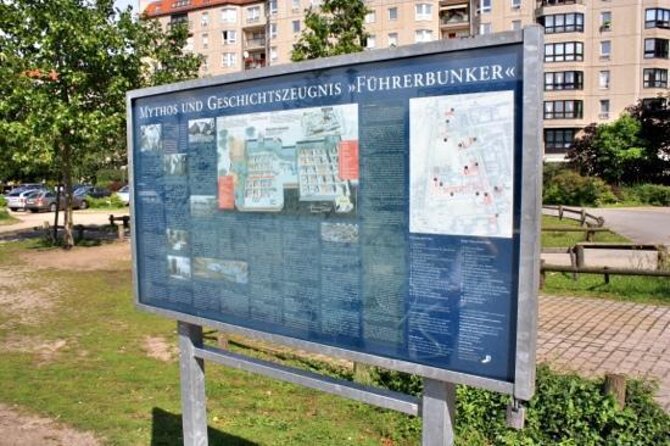
- Hitler’s bunker site: See the ordinary-looking area where the Führerbunker once stood and where Hitler died in the final days of the war.
- A private guide for your group: You avoid a large public group and can ask questions or request more attention to subjects that matter to you.
- Five major stops: The route includes the Topography of Terror, bunker site, Holocaust Memorial, former Aviation Ministry, and Georg Elser memorial.
- A useful ending point: The tour finishes at the Topography of Terror, with a free documentation center available afterward.
- A walk through several memorials: The route can include discussion of the Jewish, Roma, and homosexual victims of Nazi persecution, according to the guide’s chosen route and your interests.
- Good for families with older children: The historical material is serious, but the private setting lets a guide adapt explanations for teenagers.
Why this Berlin walk matters
I find this kind of tour useful because Berlin’s Nazi history is spread across the city rather than gathered in one grand building. A memorial may occupy a broad public square, while the next important site may be marked only by a small plaque or a changed streetscape. Without context, it is easy to walk past both.
A private guide gives you a thread to follow. You can ask how the Nazi government took power, how its institutions worked, and how Berlin dealt with the physical remains after 1945. The walk is not only about Hitler. It also points toward the people who resisted him, the agencies that carried out Nazi policy, and the groups targeted for destruction.
The tone is appropriately grave. This is not a tour for dramatic photos or theatrical storytelling. The value comes from seeing real locations and having a historian explain what happened there, what disappeared, and what Berlin chose to remember.
More Third Reich & Cold War Tours in Berlin
- Berlin: Third Reich and Cold War 2 Hour Walking Tour
★ 4.9 · 6,830 reviews - Berlin’s Best: 2 Hour Walking Tour Third Reich and the Cold War
★ 5.0 · 5,486 reviews - Third Reich Berlin: Hitler and WWII Walking Tour
★ 5.0 · 3,301 reviews
From Brandenburg Gate into the Nazi capital
The meeting point is Brandenburg Gate on Pariser Platz. This is a practical starting place because you are already in the center of Berlin, close to several major monuments and government buildings. It also puts you near places tied to the political life of the German capital.
Your guide may use the opening section to explain the rise of the Nazis and the way Berlin became the center of their regime. The supplied route lists the Topography of Terror as the first formal stop, but the walk begins at Brandenburg Gate, so allow time for an introductory stretch before the main exhibition visit.
Some routes have also included the Reichstag and the memorials to Roma, homosexual people, and Jewish victims of Nazi persecution. Since this is a private activity, you can ask your guide to explain the subjects that interest you most. The exact balance will depend on the guide and your group’s questions.
That flexibility is one of the tour’s real strengths. If your teenagers want to understand how propaganda worked, you can spend more time on that. If you are studying resistance, you can ask about Georg Elser and other opponents of Hitler.
The Führerbunker site, where the story turns personal
The bunker site is one of Berlin’s most striking examples of absence. Hitler spent his final days underground here and committed suicide shortly before the end of the Second World War. Today, the location is not a preserved underground attraction. The site is associated with an ordinary surface setting, including a parking area.
That plain appearance can feel anticlimactic if you expect a dramatic ruin. In fact, it makes the stop more useful. You are forced to imagine the bunker through historical explanation rather than through preserved rooms, heroic displays, or staged effects. Your guide can explain the final days of the Nazi leadership and why the site itself has remained understated.
I would not plan this stop around a photograph. The important part is the conversation. Ask your guide how the bunker was identified, what happened to the structure after the war, and how Berlin handles places connected to dictatorship.
You should also keep your expectations realistic. The tour does not take you underground, and no admission ticket is required. You see the location and learn its place in the final chapter of the regime.
The Holocaust Memorial and Berlin’s difficult remembrance
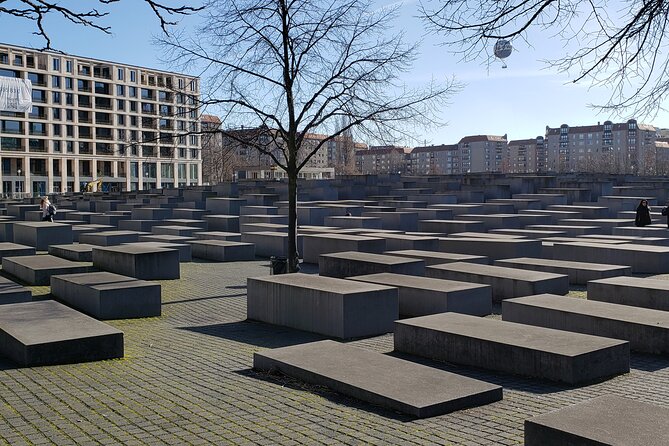
The Memorial to the Murdered Jews of Europe is one of the central stops. Its field of concrete slabs creates a changing experience as you walk through it. From the outside, the layout seems orderly. Inside, the ground and surrounding blocks alter your sense of direction and scale.
Your guide walks through the memorial with you and explains its purpose. This is a place where I value having a guide because the memorial does not provide a single simple message. You may have questions about its design, the names it does not list, and how it fits with other memorials in Berlin.
The scheduled visit takes about 20 minutes. That is enough to enter the memorial and discuss its meaning, but not enough for a long private reflection or a detailed visit to every related facility. Keep your camera away unless it is being used with care. The memorial calls for respectful behavior, and your guide can help set the right tone.
The route may also pass memorials to Roma and Sinti people and to homosexual victims of Nazi persecution. These stops widen the story beyond the Jewish genocide while keeping the victims and the machinery of persecution at the center.
Same city, a completely different kind of day:
- Berlin: Reichstag, Dome and Government District Guided Tour
★ 4.7 · 18,288 reviews - Berlin: 1-Hour City Tour by Boat with Guaranteed Seating
★ 4.3 · 16,993 reviews - Berlin: Boat Tour Along the River Spree
★ 4.4 · 11,252 reviews - Discover Berlin Half-Day Walking Tour
★ 5.0 · 9,624 reviews
The Topography of Terror, a powerful place to finish
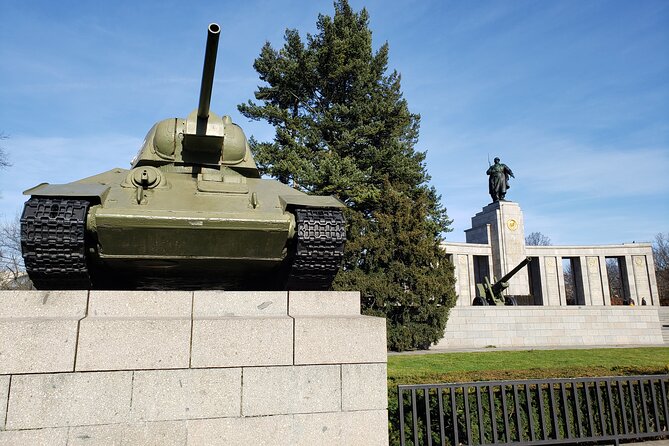
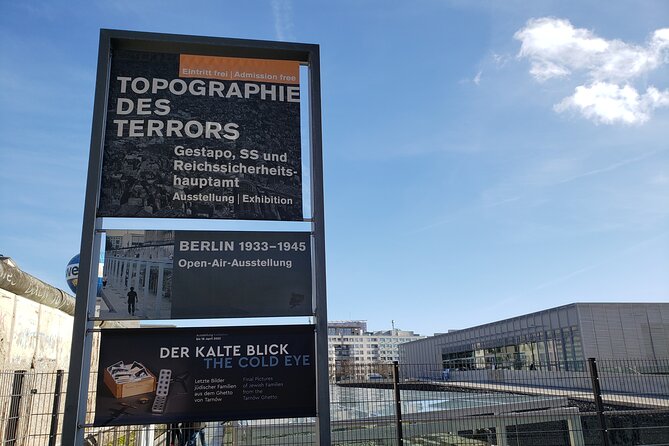
The Topography of Terror occupies the former site of the Nazi regime’s main security and police offices. The site once housed agencies connected with terror and persecution. Today, its documentation exhibition lays out how the Nazi state used police power, surveillance, imprisonment, and violence.
The tour allows about 20 minutes here, and admission is free. That is enough for your guide to introduce the site and point out why it matters. I would then stay longer after the walk if your schedule allows. The exhibition is the best place on this route to turn a broad outdoor overview into a more organized study of the Nazi system.
The ending works well. You finish with a clear sense of place and can continue independently rather than being left at a random street corner. The nearest underground station is about a 10-minute walk away, and the guide can show you how to reach it.
Because the tour starts at Brandenburg Gate and ends here, you cover central Berlin on foot instead of returning to the starting point. That makes the route efficient, but it also means you should wear comfortable shoes and keep your plans flexible after the final stop.
The former Aviation Ministry and Nazi architecture
The Bundesministerium der Finanzen is housed in a large building built in the architectural style favored by the Nazi government. It formerly served as the Aviation Ministry. The building is an important reminder that Nazi power was not limited to rallies, uniforms, and speeches. It also operated through offices, ministries, paperwork, and daily administration.
You view the building from outside. The stop takes about 20 minutes, giving your guide time to discuss its design and function. The architecture is imposing and formal, with the scale and order meant to project state power.
This can be a valuable stop for anyone interested in how politics appears in the built environment. The building still has a working governmental role, which adds another layer to the visit. You are not entering a preserved Nazi interior, so the interest lies in the exterior, the history, and the contrast between its original purpose and its current use.
I like this stop because it avoids reducing the period to one infamous person. It shows the wider system that supported the regime. That kind of context is essential if you want to understand how a dictatorship operated.
Georg Elser and the story of resistance
The Georg Elser sculpture honors a German carpenter who tried to kill Hitler with a bomb in 1939. Elser acted before the war had reached its later scale, and his attempt is a reminder that resistance existed inside Germany from the early years of the regime.
The memorial visit is shorter, about 10 minutes, but it adds an important counterpoint to the sites of Nazi authority. The tour is not only about what the regime did. It also asks who opposed it, what risks they faced, and why some acts of resistance remained little known for so long.
A private guide can make a short stop count by placing Elser’s attempt in the larger story. If resistance interests you, ask for more detail here. This is one of the places where the tour’s adjustable format matters most, since a group fascinated by individual courage may want a longer explanation than the basic schedule allows.
A two-hour route with a serious pace
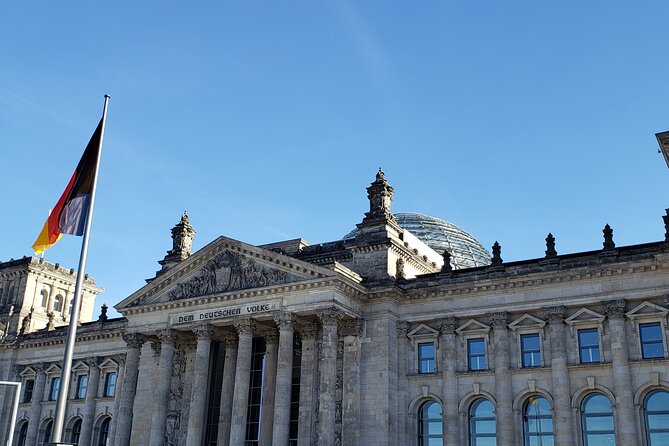
The listed stops add up to about 90 minutes: 20 minutes at the Topography of Terror, 20 at the bunker site, 20 at the Holocaust Memorial, 20 at the former Aviation Ministry, and 10 at the Elser sculpture. The remaining time covers walking, introductions, questions, and transitions.
That sounds comfortable on paper, but the route is still a walking tour through central Berlin. You should not expect long pauses at every location. The guide must keep the group moving to cover the route in roughly two hours.
This pace suits you if you want a focused introduction before visiting museums on your own. It is less suitable if you prefer to spend an hour at each memorial or stop often for extended photography. The private setting helps, but it cannot make two hours longer.
The tour is offered in English and includes mobile ticketing. It is near public transportation, although the final underground station is about a 10-minute walk from the ending point. Most people can take part, and service animals are allowed.
What the private format is worth
The price is listed at $150.51 per person. That is a serious cost for a two-hour walk, so value depends heavily on your group size and priorities.
For one or two people, the price may feel high compared with a standard group walk. For a family or small group, the private format can make more sense because everyone participates in the same conversation and the guide can adjust the material. Group discounts are available, which may improve the calculation.
You are paying mainly for the guide’s time and historical explanation, not for entrance fees. Every listed stop has free admission. The real question is how much you value a tailored discussion at sites that can be confusing or emotionally difficult to interpret alone.
The strongest evidence of value comes from the guide quality. Stefan is described as a passionate historian who can talk broadly about Berlin. Alexander has been friendly, detailed, and willing to adapt the route to a group’s interests, with time for questions and pictures. Those qualities matter more here than flashy extras.
If you already plan to visit the Topography of Terror and Holocaust Memorial on your own, you may prefer to save the money and read the displays independently. If you want a historian to connect the places and answer questions as you walk, the price is easier to justify.
Who should book this experience
I would choose this tour for a first visit to Berlin when you want an organized introduction to the city’s Nazi past. It also suits families with teenagers, especially when a guide needs to explain difficult subjects in a clear, age-appropriate way.
It works well for anyone interested in:
- Nazi political power and administration
- Hitler’s final days
- Memorial design and public remembrance
- German resistance, including Georg Elser
- The physical remains of the former Nazi capital
- A private pace with time for questions
I would be more cautious if you have limited mobility or dislike walking. The activity is outdoors and moves between several central sites. The supplied information says most people can participate, but it does not provide a detailed distance, step count, or accessibility plan.
I would also avoid booking it as a casual sightseeing filler. The subject matter includes genocide, dictatorship, suicide, and political terror. You need to be ready for a sober experience.
Booking, timing, and cancellation details
Confirmation normally arrives when you book. If you book within nine days of the tour, confirmation may take up to 48 hours and depends on availability. You are asked to provide your hotel address during booking, so have that information ready.
The activity is private, meaning only your own group takes part. It is offered in English, includes a mobile ticket, and has free cancellation if you cancel at least 24 hours before the start time. Cancellations or changes made less than 24 hours before the start are not refunded.
The tour begins at Brandenburg Gate, Pariser Platz, 10117 Berlin, and ends at the Topography of Terror, Niederkirchnerstraße 8, 10963 Berlin. Since the end point has a free documentation exhibition, I would avoid scheduling a tight appointment immediately afterward.
Should you book the private Third Reich walking tour?
Book it if you want a serious, guide-led introduction to Berlin’s Nazi sites and value the ability to ask questions. The bunker site, Holocaust Memorial, Aviation Ministry, Elser sculpture, and Topography of Terror make a strong route, and guides such as Stefan and Alexander add the personal context these places need.
Think twice if you want a long museum visit, a low-cost group walk, or a tour with little walking. The price is not small, and two hours only gives you a first layer of understanding.
For a first day in Berlin, a family with older children, or a small group with a strong interest in modern European history, I find the format worthwhile. Stay afterward at the Topography of Terror for the free exhibition, and you will get far more from the day than the scheduled walking time alone.
FAQ
How long is the Private Third Reich Walking Tour of Berlin?
The tour lasts approximately two hours.
Where does the tour begin?
It begins at Brandenburg Gate on Pariser Platz, 10117 Berlin, Germany.
Where does the tour end?
It ends at the Topography of Terror at Niederkirchnerstraße 8, 10963 Berlin, Germany.
Is the tour private?
Yes. Only your own group takes part in the activity.
What language is the tour offered in?
The tour is offered in English.
Does the tour visit Hitler’s bunker?
Yes. You see the former site of the Führerbunker, where Hitler committed suicide shortly before the end of the Second World War.
Is admission included at the listed stops?
The listed stops have free admission. The Topography of Terror also offers a free documentation exhibition that you may visit after the walk.
Can I cancel for a refund?
Yes. You can cancel at least 24 hours before the start time for a full refund. Cancellations or changes made less than 24 hours before the start time are not accepted for a refund.
More Walking Tours in Berlin
- Berlin: Discover Berlin Walking Tour
★ 4.9 · 5,998 reviews - Berlin: Hidden Backyards Guided Walking Tour
★ 4.8 · 5,360 reviews - Berlin: Alternative Berlin Walking Tour
★ 4.6 · 1,204 reviews - Berlin: Third Reich, Hitler, and WWII Walking Tour
★ 4.9 · 1,133 reviews
Just added around Berlin
- Love and War in Berlin: Self-Guided Story Puzzle Walk★ 5.0 · 7 reviews
- Rickshaw Tours Berlin – Groups of up to 16 people with several rickshaws★ 4.0 · 97 reviews
- eSIM for Germany and 34 European Countries★ 4.5 · 16 reviews
- Walking on the Wall: 3-Hour Tour in Berlin★ 4.5 · 34 reviews
- Warnemuende Shore Excursion: Berlin Private Sightseeing Tour from Rostock★ 5.0 · 4 reviews
- Your ticket to The Wall Museum Berlin★ 3.0 · 60 reviews
- Warnemuende Shore Excursion: Private Berlin Tour★ 4.5 · 27 reviews
- Berlin’s Gay, Lesbian, and Queer Scene Small-Group Walking Tour★ 4.5 · 66 reviews
Third Reich & Cold War Tours, compared.



Berlin’s Best: 2 Hour Walking Tour Third Reich and the Cold War
Read our review →

Third Reich Berlin: Hitler and WWII Walking Tour
Read our review →
Skip-the-Line: Berlin Wall Museum at Checkpoint Charlie
Read our review →

Cold War, Berlin Wall, Spies and the East Side Gallery
Read our review →Browse the lists this tour appears in