
Reviewed · THIRD REICH & COLD WAR TOURS
Cold War, Berlin Wall, Spies and the East Side Gallery
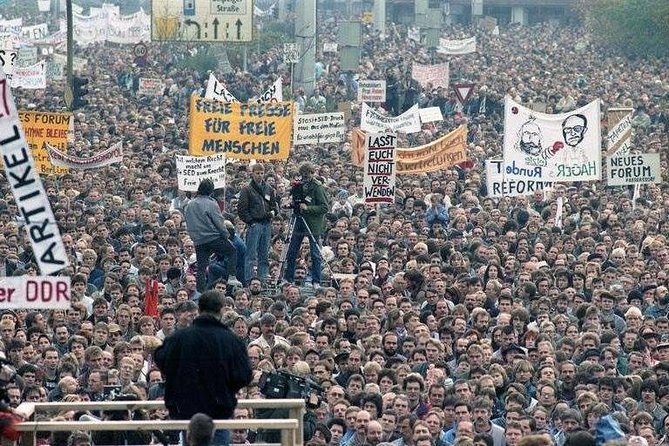
Berlin’s Cold War story feels most powerful when you are walking through the places where it happened. This three-hour tour links the Palace of Tears, Alexanderplatz, Karl-Marx-Allee, and the Berlin Wall, showing how politics shaped ordinary streets and private lives. I like the escape stories and the chance to see the former death-strip area. I also like the way the route ends at the East Side Gallery, where a barrier built to stop people has become an open-air art gallery.
The main drawback is that this is a moving tour, not a slow museum visit. You cover several parts of Berlin by foot and public transport, and the $18 price does not include the required AB day pass. Still, for a low-cost introduction to divided Berlin, the route covers a lot of ground and gives you a useful framework for exploring more on your own.
In This Review
- Key points about this Cold War Berlin tour
- Why the route works so well
- Meeting at the Palace of Tears
- Alexanderplatz and the public face of East Berlin
- Walking Karl-Marx-Allee and the 1953 uprising
- Friedrichshain and the mechanics of escape
- Seeing the former death strip
- The East Side Gallery as the final chapter
- Transport, pace, and what to bring
- Who will get the most from it
- Is $18 good value?
- Should you book this tour?
- FAQ
- How long does the Cold War Berlin tour last?
- Where does the tour begin?
- Is public transportation included?
- Which places does the tour visit?
- What languages are available?
- Is the tour wheelchair accessible?
Key points about this Cold War Berlin tour
- Start at the Palace of Tears: Begin beside Friedrichstrasse station at the former border crossing where families said painful goodbyes.
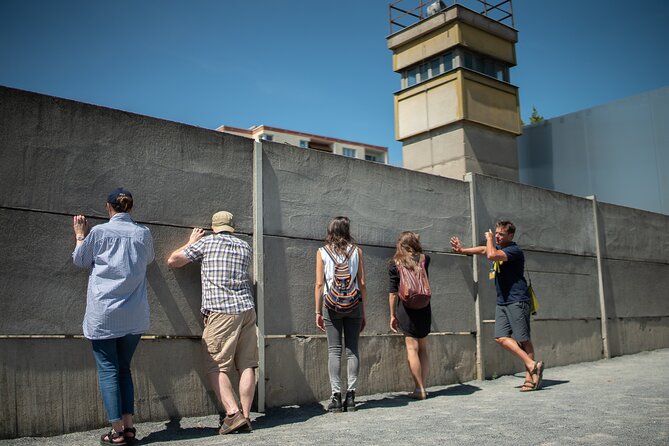
- See the former death strip: Learn how walls, watchtowers, lighting, fences, and patrols turned everyday ground into a deadly barrier.
- Walk Karl-Marx-Allee: Read the propaganda in East Germany’s broad socialist boulevard and hear about the 1953 workers’ uprising.
- Use Berlin public transport: Short train journeys connect the central sites, but you must buy an AB day pass separately.
- Finish at the East Side Gallery: Walk beside the longest remaining stretch of the Berlin Wall and its famous murals.
- Expect a story-led tour: Guides including Paul, Xavier, Tina, Jamie G, and Nikolai are praised for clear explanations, personal stories, and thoughtful answers.
Why the route works so well
A Berlin Wall tour can easily become a parade of surviving concrete panels. This route is better planned than that. It begins at a border crossing, moves through the former East Berlin center, follows the monumental street life of the GDR, and finishes with the wall as art.
That order helps you understand the city in stages. First comes separation and surveillance. Then you see the political theater of East Berlin. Finally, you reach the wall after 1989, when artists turned a symbol of fear into a public gallery.
I especially like the focus on people who tried to escape. You hear about tunnels, rooftops, and dangerous crossings, along with the Stasi network that watched for anyone who questioned the system. These stories give the concrete and architecture a human scale.
The guides also seem to shape the experience. Paul is repeatedly praised for strong storytelling. Xavier is noted for using pictures and checking that the group was comfortable. Nikolai and Klaus have been appreciated for personal insight into life in East Germany, while Tina, Maria, Jim, Eran, and Jamie G are also described as engaging and clear.
Guide assignments can change, of course. The useful point is that the experience depends heavily on the guide’s ability to connect dates and buildings with personal choices. This tour seems designed for that style of teaching.
More Museum & Gallery Tickets in Berlin
- Berlin: Natural History Museum Entrance Ticket
★ 4.6 · 3,382 reviews - Skip-the-Line: Berlin Wall Museum at Checkpoint Charlie
★ 4.1 · 2,041 reviews - Berlin: Museum Island Multiple Museum Entry Ticket
★ 4.4 · 2,007 reviews
Meeting at the Palace of Tears
The usual meeting point is outside Friedrichstrasse train station, on the square beside the Tränenpalast, or Palace of Tears. Look for a guide with a yellow name badge and yellow umbrella.
The name is not poetic decoration. The building was an East German border facility used for departures from East Berlin. Families could meet there, but many farewells were final for an uncertain length of time. The building now serves as a free memorial and exhibition space about the border and divided families.
The tour allows about 20 minutes here. That is enough for an introduction and a focused look, but not enough for a leisurely museum visit. If you want to read every panel inside, plan to return later.
This is a strong place to begin because it presents division through personal separation rather than military strategy. You start with parents, children, spouses, and friends trying to say goodbye under official supervision. The Cold War quickly becomes less abstract.
Arrive early if you can. Friedrichstrasse station is large, and the group gathers outside rather than inside the station concourse. Comfortable shoes matter from the first minute.
Alexanderplatz and the public face of East Berlin
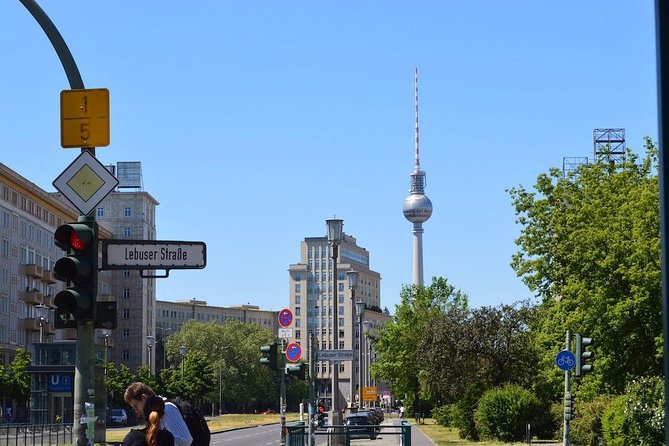
A short train ride takes you toward Alexanderplatz, one of the best places to see how East Germany wanted its capital to appear. The square and its surrounding buildings still carry the broad, functional look of the GDR period.
You spend about 20 minutes here with the guide. Expect an explanation of how Alexanderplatz worked as a civic and political center, not just a transport hub and shopping area. Its scale reflects a government that preferred open public spaces, grand gestures, and architecture that could be read as proof of progress.
The value here is learning to look beyond the famous television tower. The buildings, open pavement, and planned views all formed part of a public message. The guide helps connect those choices to daily life behind the Iron Curtain.
This stop is also useful for orientation. Berlin’s center is spread out, and Alexanderplatz gives you a clear sense of how far the former East and West city centers have changed since reunification. You will not spend long enough here for a full independent visit, so consider returning later if you want shops, food, or more time around the tower.
Walking Karl-Marx-Allee and the 1953 uprising
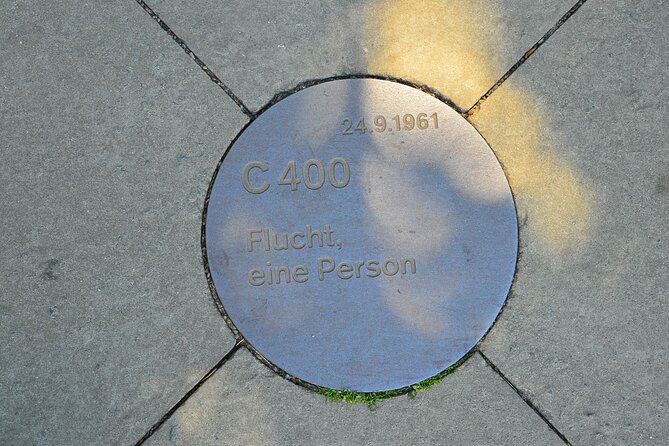
From Alexanderplatz, the route continues along Karl-Marx-Allee. The boulevard is immense, formal, and deliberately impressive. It was built as a showcase of socialist planning, with monumental apartment blocks and a broad avenue intended to express order, strength, and a bright future.
The guide’s job here is to decode that message. Look at the scale of the buildings and the space between them. This was not meant to feel like a small neighborhood street. It was an architectural statement about the state and its people.
Yet Karl-Marx-Allee also became the setting for the 1953 workers’ uprising. Construction workers protested working conditions and state demands, and the unrest spread. The revolt was put down, but it exposed the gap between official claims of worker power and the reality of life under the East German government.
About 20 minutes is devoted to this area. That gives you time to walk and hear the main story, but the boulevard is long. You will see only a section, not study every building.
I find this one of the most useful stops because it shows that the Cold War was not only about spies and border guards. It was also about housing, wages, public space, propaganda, and the tension between the state’s message and people’s experience.
More Third Reich & Cold War Tours in Berlin
- Berlin: Third Reich and Cold War 2 Hour Walking Tour
★ 4.9 · 6,830 reviews - Berlin’s Best: 2 Hour Walking Tour Third Reich and the Cold War
★ 5.0 · 5,486 reviews - Third Reich Berlin: Hitler and WWII Walking Tour
★ 5.0 · 3,301 reviews - Berlin: Third Reich, Hitler, and WWII Walking Tour
★ 4.9 · 1,133 reviews
Friedrichshain and the mechanics of escape
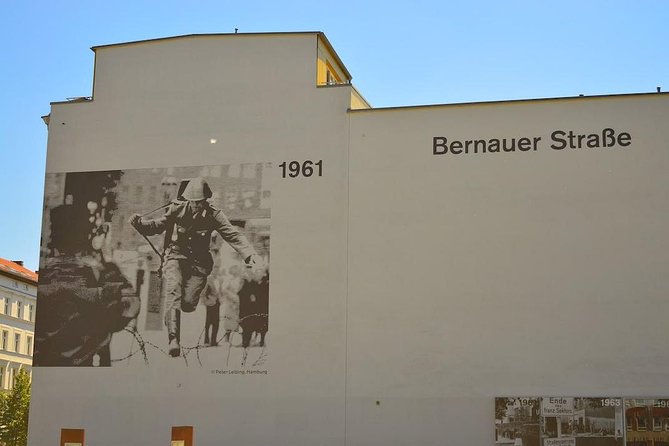
A short train journey brings you to Friedrichshain, where the tour continues on foot for roughly 20 minutes. The exact emphasis can vary with the guide, but this part of the route is tied to the former East Berlin setting and the practical dangers of trying to leave.
The tour explains how escape attempts used tunnels, rooftops, forged plans, and moments of confusion. Some people calculated routes carefully. Others acted quickly when an opportunity appeared. In every case, the risk was severe.
You also hear about the Stasi, East Germany’s secret police. Surveillance did not always look dramatic. Informants could be neighbors, work colleagues, or acquaintances. That fact helps explain why fear reached beyond the wall itself.
For me, this is where the tour’s human stories matter most. A map can show the border, but it cannot fully explain what it meant to suspect that private conversations might be repeated to the authorities. Personal accounts make the system easier to understand without turning the tour into a political lecture.
The walking is not technically described as difficult, but the route is active. You should be ready to walk outdoors, wait at stations, and keep up with the group.
Seeing the former death strip
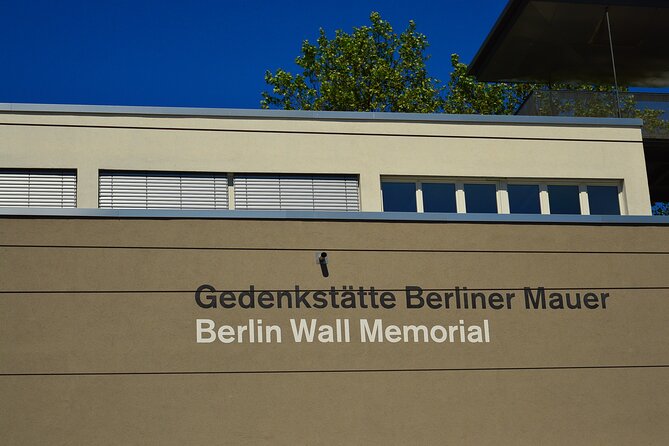
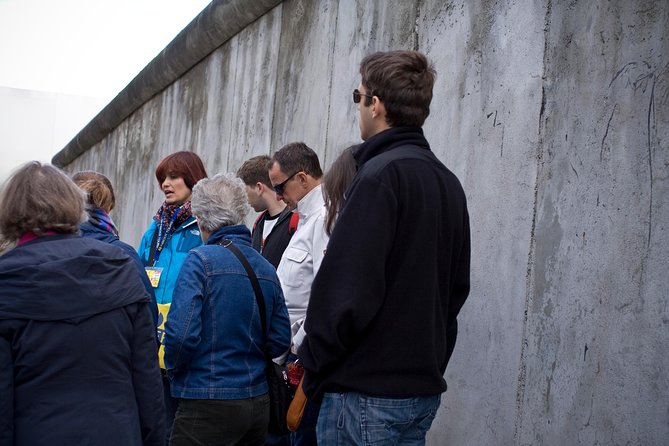
The Berlin Wall section gives you a direct look at what made the border so deadly. The wall was not simply one slab of concrete. The guarded zone included barriers, patrol routes, lighting, fences, open ground, and controlled sightlines.
The tour allows about 16 minutes for the Berlin Wall stop. That sounds brief, but the guide uses the time to explain the layout and the escape attempts connected with it. This is a place where an old photograph or diagram can make a major difference, and several guides have used images on tablets or phones to show how the scene looked before the wall fell.
You should not expect a large intact section of the original border system at every stop. Berlin removed much of the wall after 1989, and today the former route often cuts through ordinary streets and redeveloped areas. That absence is part of the story, but it can surprise visitors who expect a continuous barrier.
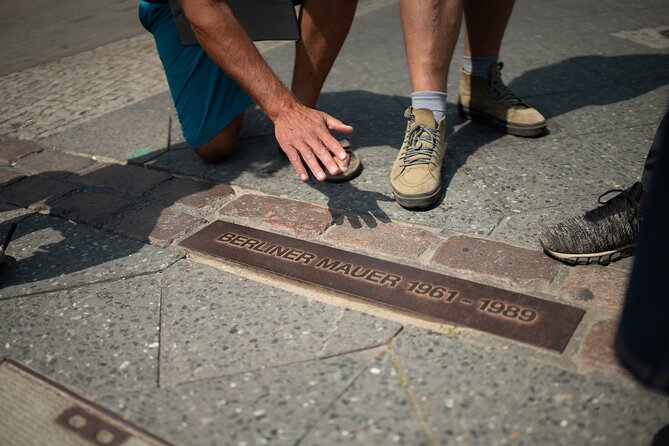
The guide helps you read the remaining traces: memorial markers, surviving sections, the open space of the former border zone, and changes in the street plan. The point is not only to photograph concrete. It is to understand how a city was divided block by block.
The East Side Gallery as the final chapter
The tour ends with about 20 minutes along the East Side Gallery, the best-known surviving stretch of the Berlin Wall. After the wall fell, artists painted this section with murals that range from playful to political.
The setting makes a strong final chapter. Earlier, the wall represents surveillance, restricted movement, and the threat of violence. Here, its surface carries messages made in public and seen by anyone passing by.
You walk beside the murals rather than simply stopping for one photograph. The route gives you a chance to consider how the meaning of the wall changed after reunification. It is still a memorial, but it is also art, public space, and a reminder that Berlin continues to argue with its past.
The scheduled time is enough for an introduction and a walk through part of the gallery. It is not a full art tour, and you may want to stay afterward if particular murals interest you. Check your onward plans, since the listed drop-off options include Bernauer Straße, not hotel return.
Transport, pace, and what to bring
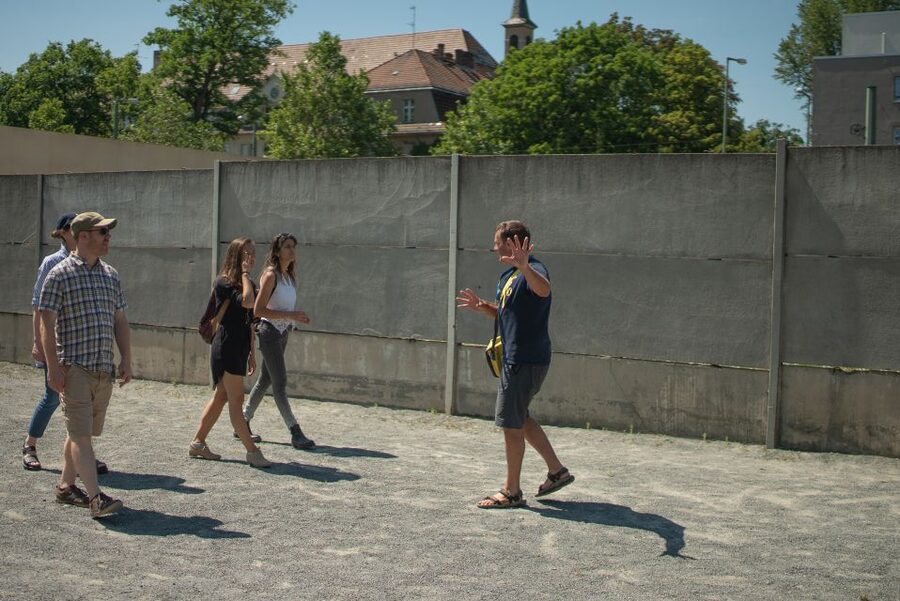
This is not a single continuous walk. Two short train rides are built into the route, one of about five minutes and another of about six minutes. You need an AB public transport day pass, which is separate from the $18 tour price.
The extra ticket is an important practical detail. The tour company can help you purchase it on the day, but you should budget for it and allow time to get it before departure. The day pass can also be useful for your own Berlin sightseeing afterward, depending on your plans.
The tour lasts three hours. That is enough time to connect several sites without taking up an entire day, but the schedule is fairly tight. You have roughly 20 minutes at most major stops, with shorter periods for transport and the Berlin Wall section.
Wear comfortable shoes and weather-ready clothing. The tour runs in poor weather, and much of the experience takes place outdoors. Bring a camera, but do not let photography replace listening. The most valuable parts are often the explanations of what used to occupy an apparently ordinary patch of ground.
The tour is wheelchair accessible according to the activity information. Private and small-group options are available. Hotel pickup is optional for some bookings, while the standard meeting arrangement is outside Friedrichstrasse station. If pickup is part of your selected option, wait in the hotel lobby five minutes before the scheduled time. The stated drop-off arrangement for that option is in front of the Tourist Information at Brandenburg Gate.
Who will get the most from it
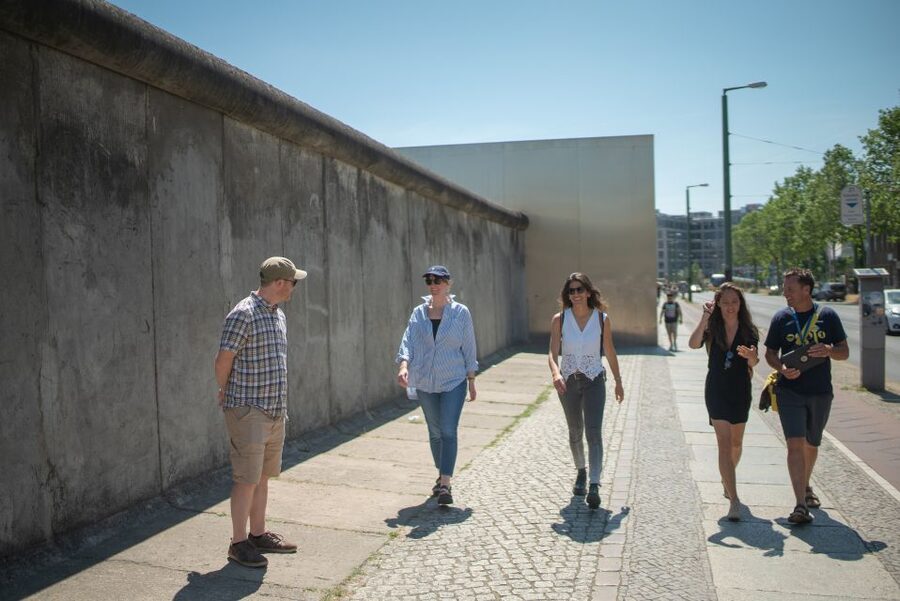
I would choose this tour if you want a clear introduction to the Berlin Wall and Cold War Berlin, especially if you know the broad outline but want the city itself to make sense.
It suits history fans, families with older children, and first-time visitors who prefer stories to long museum labels. Several guides have been praised for answering a large number of questions, so it should work well if you like an interactive tour.
It also suits you if you want more than the wall’s famous photographs. Karl-Marx-Allee and Alexanderplatz add architecture and daily life to the political story. The Palace of Tears brings in family separation. The East Side Gallery adds the post-1989 chapter.
This may be less suitable if your main interest is military history or the wider Cold War outside Germany. One guide was described as focusing more on the wall than on war and high politics. That is a fair expectation to set. The tour is primarily about divided Berlin, escape, surveillance, the GDR, and reunification.
Is $18 good value?
At $18 per person, this is inexpensive for a three-hour guided experience. You still need to add the AB day pass, but the tour covers several districts and includes a guide who explains the connections between them.
The real value is the structure. You could visit Alexanderplatz, Karl-Marx-Allee, and the East Side Gallery on your own, but you might miss why their design matters or how they connect to the Cold War. A good guide turns scattered sights into one story.
The price also makes this a sensible choice early in your Berlin stay. It gives you useful background before visiting other memorials and museums. You can then return to the Palace of Tears or East Side Gallery with better questions.
Should you book this tour?
Book it if you want personal stories, escape attempts, and the physical remains of divided Berlin in one compact outing. The strong guide reports, including praise for Paul, Xavier, Tina, Klaus, Nikolai, and others, suggest that storytelling is a major strength.
Do not book it expecting a slow museum day or a full survey of global Cold War politics. You will walk, use public transport, spend limited time at each stop, and pay separately for the transport pass.
For most first-time Berlin visitors interested in the wall, the $18 price is easy to justify. Bring good shoes, arrive at Friedrichstrasse early, and keep some extra time after the tour for the East Side Gallery or another Berlin Wall memorial.
FAQ
How long does the Cold War Berlin tour last?
The tour lasts three hours, including walking between sites and two short train journeys.
Where does the tour begin?
The standard meeting point is outside Friedrichstrasse train station, on the square beside the Palace of Tears. Look for the guide with a yellow name badge and yellow umbrella.
Is public transportation included?
No. You need an AB public transport day pass separately. On-site staff can help you purchase it on the day.
Which places does the tour visit?
The route includes the Palace of Tears, Alexanderplatz, Karl-Marx-Allee, Friedrichshain, a former Berlin Wall and death-strip area, and the East Side Gallery.
What languages are available?
Live tours are available in English and German.
Is the tour wheelchair accessible?
Yes. The activity information states that the tour is wheelchair accessible. Private and small-group options are also available.
More Museums in Berlin
- Berlin: Interactive DeJa Vu Museum Entrance Ticket
★ 4.1 · 1,338 reviews - Berlin: “Pergamonmuseum. The Panorama” Exhibition Tickets
★ 4.6 · 1,245 reviews - Berlin: East Side Gallery Spree Cruise in a Solar Catamaran
★ 4.0 · 1,039 reviews - Cold War, Berlin Wall, Spies and the East Side Gallery
★ 5.0 · 1,024 reviews
Just added around Berlin
- Love and War in Berlin: Self-Guided Story Puzzle Walk★ 5.0 · 7 reviews
- Rickshaw Tours Berlin – Groups of up to 16 people with several rickshaws★ 4.0 · 97 reviews
- Walking on the Wall: 3-Hour Tour in Berlin★ 4.5 · 34 reviews
- eSIM for Germany and 34 European Countries★ 4.5 · 16 reviews
- Warnemuende Shore Excursion: Berlin Private Sightseeing Tour from Rostock★ 5.0 · 4 reviews
- Your ticket to The Wall Museum Berlin★ 3.0 · 60 reviews
- Warnemuende Shore Excursion: Private Berlin Tour★ 4.5 · 27 reviews
- Berlin’s Gay, Lesbian, and Queer Scene Small-Group Walking Tour★ 4.5 · 66 reviews
Third Reich & Cold War Tours, compared.



Berlin’s Best: 2 Hour Walking Tour Third Reich and the Cold War
Read our review →

Third Reich Berlin: Hitler and WWII Walking Tour
Read our review →
Skip-the-Line: Berlin Wall Museum at Checkpoint Charlie
Read our review →

Cold War, Berlin Wall, Spies and the East Side Gallery
Read our review →Browse the lists this tour appears in