
Reviewed · THIRD REICH & COLD WAR TOURS
Berlin Wall History Small Group Cycling Tour
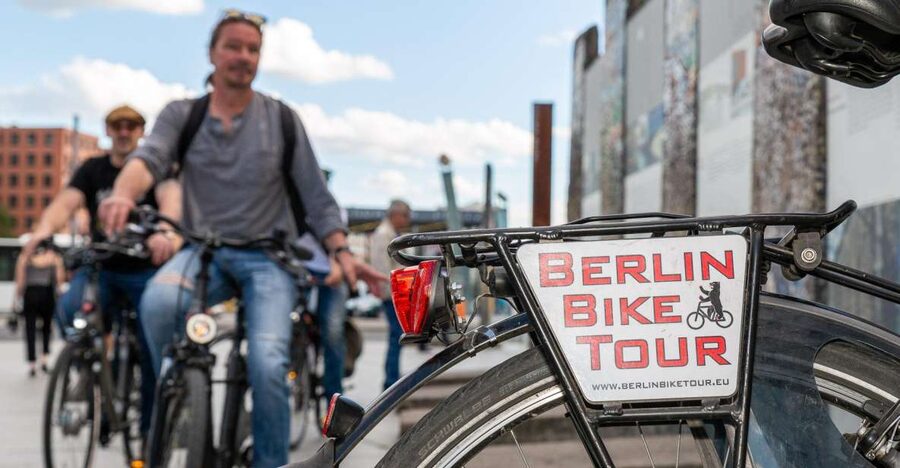
Berlin’s Wall is mostly gone, but this four-hour bike ride shows you where to look for its surviving traces. You’ll see an original watchtower, parts of the old Death Strip, former border crossings, and the places where the Wall finally began to open in 1989. Bornholmer Straße gives the tour a powerful start: it was the first crossing where East German citizens passed through on November 9.
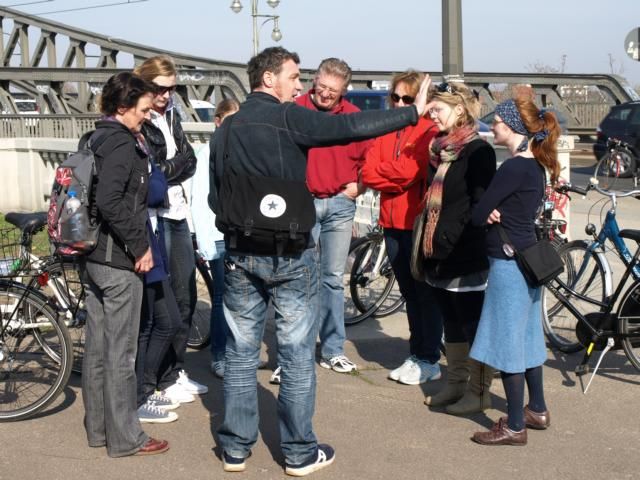
I like the small group of no more than eight, which gives guides such as Marcus and Kathrin room to explain personal and political details without shouting over a crowd. I also like the route itself. It links famous sights such as Brandenburg Gate and Checkpoint Charlie with quieter places, including the Invaliden Graveyard and the Parliament of Trees. The main thing to consider is that this is a long ride in all weather, and the tour is conducted in German.
In This Review
- Key points to know before you book
- Why a bicycle is the right way to see the Wall
- Bornholmer Straße, where the border opened first
- Mauerpark and Bernauer Straße memorials
- Chausseestraße and the city beneath the border
- Invaliden Graveyard and the former Invalidenstraße crossing
- Along the Government Bank to the Parliament of Trees
- Brandenburg Gate, Potsdamer Platz, and Checkpoint Charlie
- Tränenpalast and Friedrichstraße
- Price, group size, and practical value
- Who should book this Berlin Wall ride?
- Should you book it?
- FAQ
- Where does the Berlin Wall cycling tour start?
- Where does the tour finish?
- How long does the tour last?
- What language is the tour conducted in?
- Is a bicycle included?
- What should I bring?
Key points to know before you book
- Start at the first open border crossing: Begin at the Square of the 9th November 1989 on Bornholmer Straße, a fitting place to understand how the Wall came down.
- Ride through real Wall traces: See a watchtower, the former Death Strip, border crossings, memorials, and the route of the Mauerweg.
- Cover a large slice of central Berlin: The itinerary connects Bernauer Straße, Brandenburg Gate, Potsdamer Platz, Checkpoint Charlie, and Friedrichstraße.
- Keep the group personal: The tour accepts at least three and no more than eight participants.
- Expect a German-language tour: Guides including Marcus and Kathrin have been praised for clear explanations and personal insights.
- Plan for four hours outside: Bicycles are provided, and a rain poncho is available when needed, but food and drinks are not included.
Why a bicycle is the right way to see the Wall
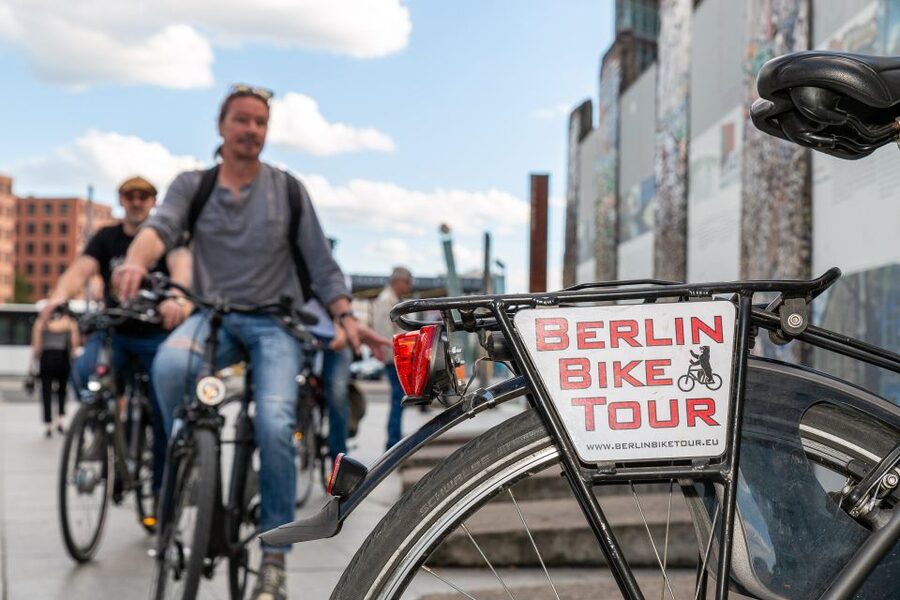
Berlin’s Wall was not one isolated slab of concrete. It ran through neighborhoods, beside railway lines, across streets, and around the western half of the city. A bike makes it easier to connect those scattered points than a walking tour can, while still allowing stops for stories and photographs.
The route follows the Mauerweg, the former Wall path, from northern Berlin toward the historic center. You cover a fair amount of ground, but the ride is not simply a list of monuments. The guide uses the changing streets and surviving structures to show how the border worked.
That matters because very little of the Wall itself remains. If you expect a continuous barrier, you may find the experience less visual than anticipated. Instead, you’ll piece together the story from watchtowers, gaps in the city fabric, memorials, border locations, photographs, and the old division between East and West.
The small group helps here. A maximum of eight people is a useful limit for a history tour on bicycles. You can hear the guide, stop without the delays of a large party, and ask about details that catch your attention. The minimum is three participants, so the outing has a more personal feel than a standard city sightseeing ride.
More Third Reich & Cold War Tours in Berlin
- Berlin: Third Reich and Cold War 2 Hour Walking Tour
★ 4.9 · 6,830 reviews - Berlin’s Best: 2 Hour Walking Tour Third Reich and the Cold War
★ 5.0 · 5,486 reviews - Third Reich Berlin: Hitler and WWII Walking Tour
★ 5.0 · 3,301 reviews
Bornholmer Straße, where the border opened first
Meet at 75 Bornholmer Straße, near the Square of the 9th November 1989. This is not just a convenient starting point. It places you at the spot where the first East German citizens crossed the border after the announcement that travel restrictions were being relaxed.
The moment is easy to misunderstand if you only visit the grand memorials in central Berlin. At Bornholmer Straße, the story feels tied to an ordinary road and a working border station. The tour begins by setting out what happened here and why this crossing became such a decisive point in the night of November 9, 1989.
You’ll also hear how the cherry trees came to be planted along Bornholmer Straße. Their presence adds a quieter layer to a place linked with fear, waiting, and sudden change. Your guide can connect the trees, the crossing, and the surviving Wall structures in a way that a quick photo stop cannot.
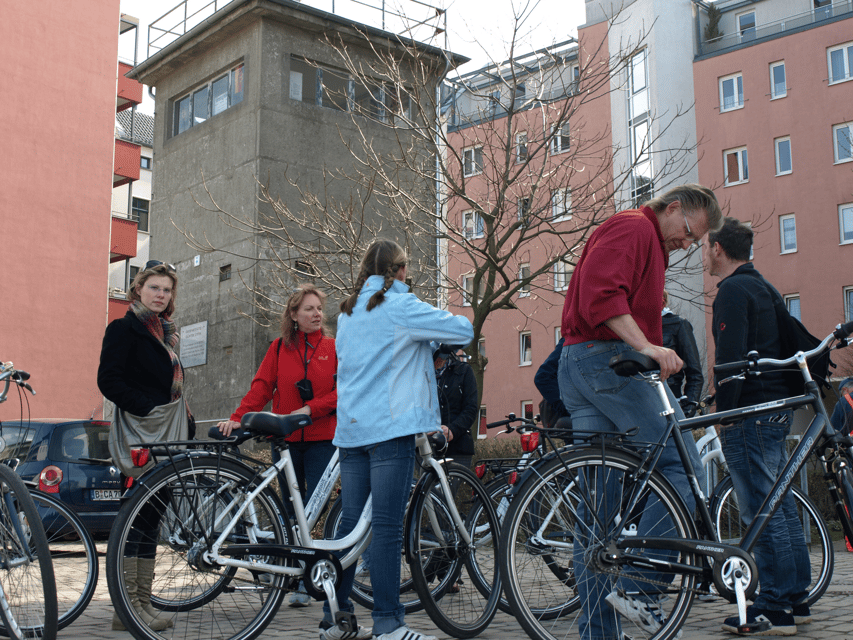
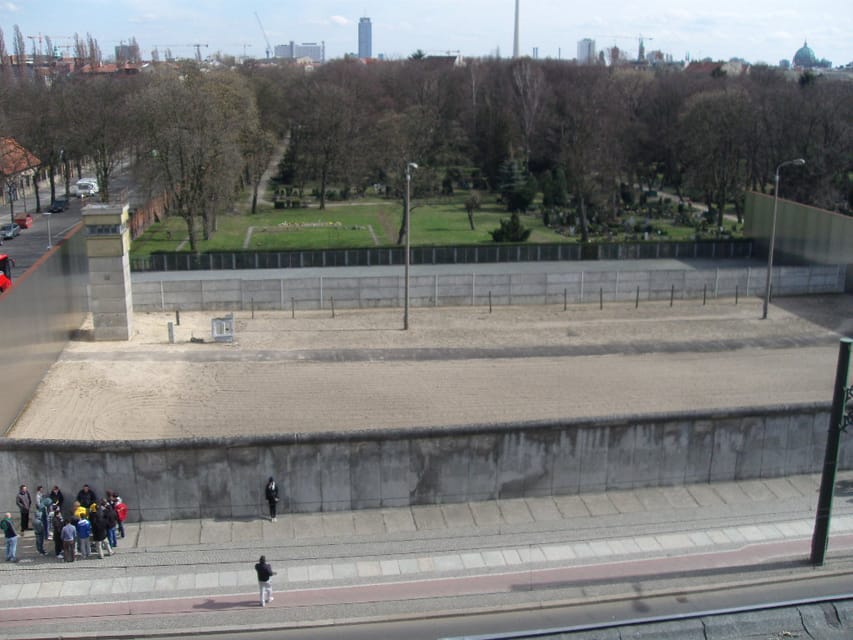
An original watchtower and part of the former Death Strip are among the first major physical traces. These remains help you understand that the border was a wide security zone, not simply a wall you could climb. The term Death Strip refers to the controlled area between sections of the border system, where escape attempts were extremely dangerous.
The tour uses pictures of rabbits painted on the ground as a visual guide toward the center. It is a small, unusual detail, but useful on a cycling route. You are not just following a modern street map. You are being led along a marked trail that ties present-day Berlin to the old border line.
Mauerpark and Bernauer Straße memorials
From Bornholmer Straße, the ride continues through Mauerpark and toward Bernauer Straße. Mauerpark is one of the places where Berlin’s changed identity is especially visible, but the Wall story remains the reason for passing through it on this route.
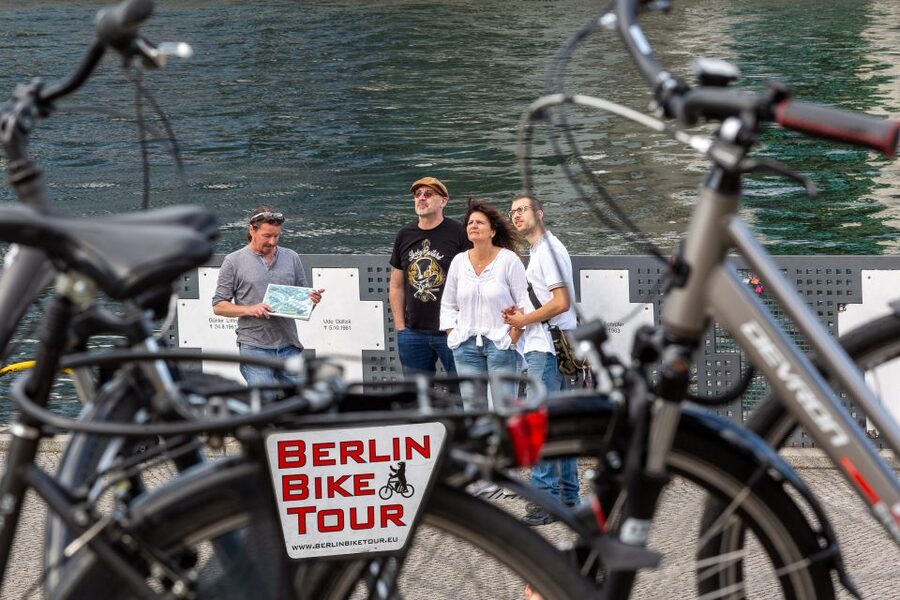
Bernauer Straße offers some of the clearest memorial evidence of the divided city. Here, the Wall ran directly along buildings and streets, forcing residents to deal with the border at close range. The Wall Memorials help you see the physical arrangement and the human cost, rather than treating the barrier as a simple Cold War symbol.
This stop is valuable for anyone who wants more than the famous surviving sections in the center. You’ll hear tragic and fateful stories tied to the border, and the guide can point out how the site preserves the memory of people affected by it.
The bicycle format also lets the tour move between memorial areas without spending the entire afternoon on foot. You should still expect stops for explanation, but the day has a steady rhythm: ride, pause, listen, and continue along the former route.
Chausseestraße and the city beneath the border
The ride reaches Chausseestraße, where you’ll see a former border crossing and visit a ghost station. During Berlin’s division, some railway stations in East Berlin were closed to ordinary passengers on Western lines. They became dark, guarded spaces as trains passed through without stopping.
The ghost-station visit gives you a sense of how the division reached below street level. The Wall was not only a concrete barrier in parks and neighborhoods. It affected rail routes, commutes, crossings, and the simple act of moving through the city.
This is also a point where the German-language guiding matters. The physical remains may be limited, so the explanation supplies the context. Guides such as Marcus and Kathrin have been praised for making the history clear and for adding personal insights. The strongest part of a stop like this is not the size of the surviving structure. It is understanding what ordinary movement looked like before reunification.
You’ll also pass the Friedrichstadt Palace, Museum Island, the New Synagogue, and the Old Berlin Post Office. These sights broaden the ride beyond Wall memorials. The route shows how the old border cut through a city filled with cultural and civic landmarks.
Same city, a completely different kind of day:
- Berlin: Reichstag, Dome and Government District Guided Tour
★ 4.7 · 18,288 reviews - Berlin: 1-Hour City Tour by Boat with Guaranteed Seating
★ 4.3 · 16,993 reviews - Berlin: Boat Tour Along the River Spree
★ 4.4 · 11,252 reviews - Discover Berlin Half-Day Walking Tour
★ 5.0 · 9,624 reviews
Invaliden Graveyard and the former Invalidenstraße crossing
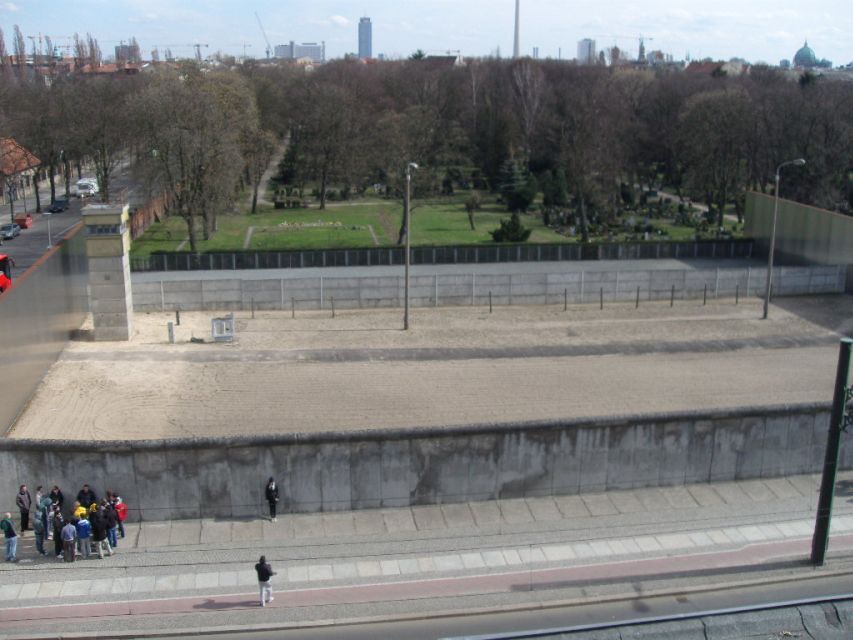
The Invaliden Graveyard brings another kind of atmosphere to the route. It is a quieter stop, away from the biggest central sights, and it helps show how the border occupied spaces that had other histories long before the Wall was built.
You’ll see the former crossing at Invalidenstraße and learn how this location fit into the border system. As with the other crossings, the point is not only to photograph what remains. It is to understand where people could pass, how movement was controlled, and how the city was split into separate zones.
I like this part of the itinerary because it adds variety. Bernauer Straße provides a major memorial setting, while the Invaliden area feels more restrained. Together, they help you avoid the common mistake of thinking the Wall story can be understood from one preserved section.
If your main interest is Berlin’s famous postcard sights, this section may feel slower. If you want the wider story, it earns its place. The guide’s narration is especially important here because much of the meaning comes from location and context.
Along the Government Bank to the Parliament of Trees
The route then follows the Government Bank toward the Parliament of Trees. This stretch puts the former border beside Berlin’s present political center, making the city’s reunification story easier to grasp.
The Parliament of Trees is a memorial connected with the Wall’s victims. Its setting along the former border gives the site a direct link to the events being discussed. You’ll have a chance to pause and consider the human consequences before the route returns to major landmarks and central streets.
Cycling along the Government Quarter also changes the tone of the tour. Earlier stops focus on checkpoints, escape attempts, railway lines, and memorials. Here, modern government buildings and open public spaces sit beside reminders of the city’s divided past.
The route is not designed as a separate architecture tour, so the main focus remains the Wall. Still, this section helps explain why the old border route matters today. You are seeing places that now function as part of one capital, even though the route once marked a hard political divide.
Brandenburg Gate, Potsdamer Platz, and Checkpoint Charlie
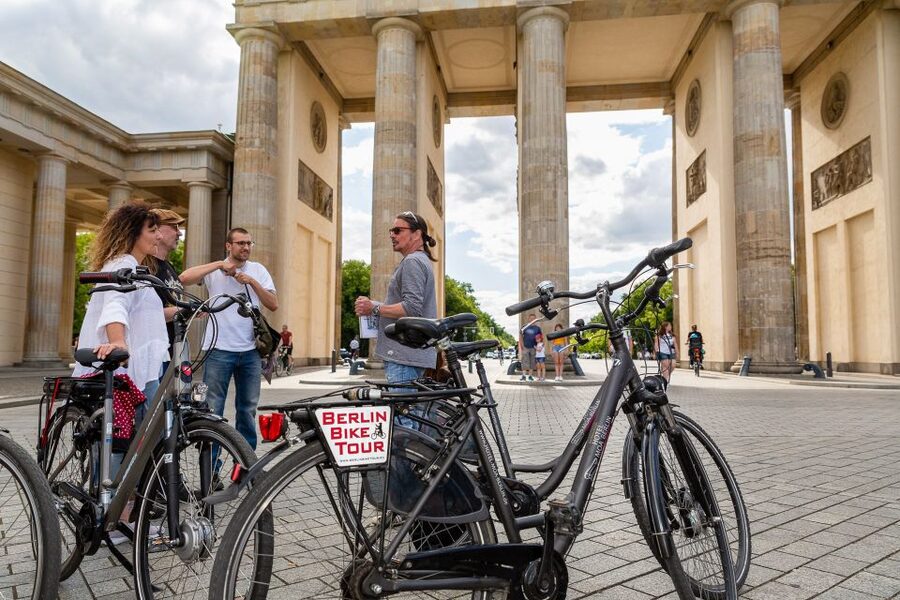
The tour continues through the Brandenburg Gate, one of Berlin’s most recognizable symbols. Passing through the gate on a bicycle is a memorable contrast to the earlier stops, where the border’s presence is felt through surviving structures and memorials.
During Berlin’s division, the gate stood near the Wall and became a powerful symbol of the separated city. Today, it is a major public landmark. The guide’s job is to connect these two views without letting the famous photo opportunity replace the history.
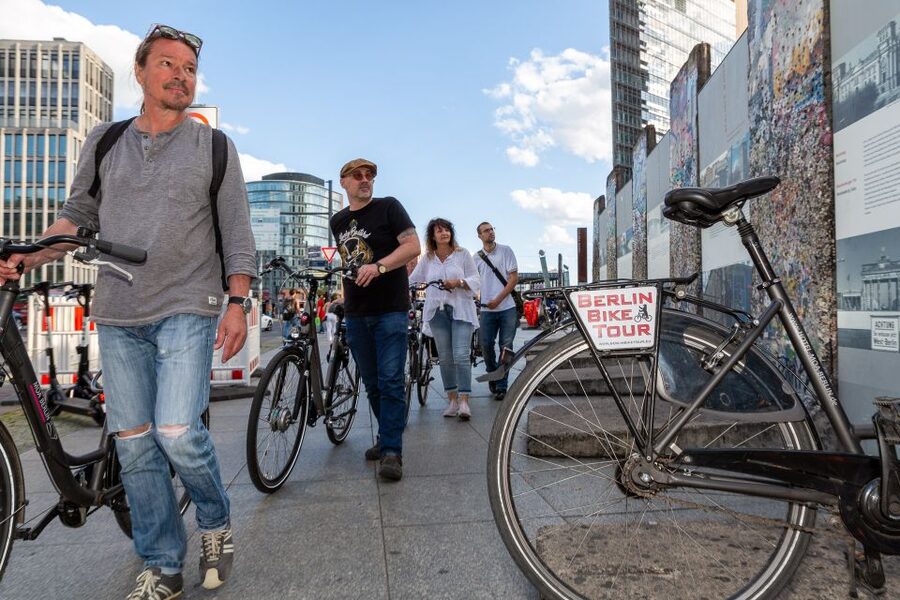
Potsdamer Platz offers another sharp contrast. This central area changed greatly after reunification, and the ride lets you see it in the context of the former Wall route. You’ll pass from places where the border’s remains are still visible into a district shaped by the city’s new unity.
Checkpoint Charlie is the best-known former crossing on the itinerary. It attracts plenty of attention, and the area can feel more polished and commercial than the quieter memorial sites. That is a fair drawback if you prefer only solemn historical settings. Still, the checkpoint belongs in the story, and the tour places it after you have already seen less famous, more substantial traces of the border.
The value of seeing Checkpoint Charlie with this guide is the sequence. You are not meeting the checkpoint as an isolated attraction. You have already followed the route, visited former crossings, and learned how the border operated. That gives this final central stop more meaning.
Tränenpalast and Friedrichstraße
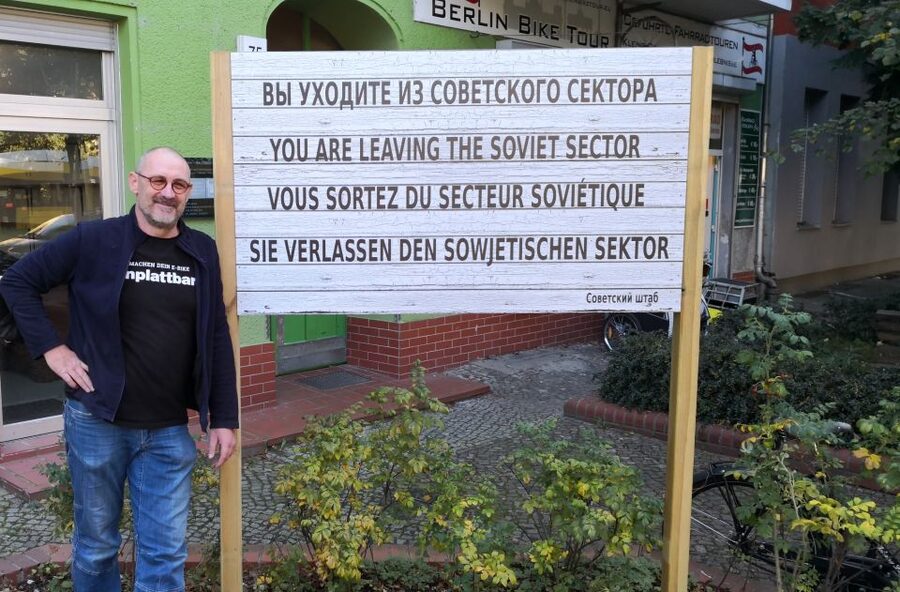
The ride ends its central sightseeing section at the Tränenpalast on Friedrichstraße. Its name means Palace of Tears, a reference to the sadness surrounding farewells at this former border crossing.
The location is useful because it brings the story down to a personal scale. Border politics affected families, friends, commuters, and anyone trying to cross between East and West. The Tränenpalast helps you think about what a crossing meant emotionally, not just how it functioned on a map.
Along Friedrichstraße, you’ll also pass the Friedrichstadt Palace and other central sights. This final stretch links the Wall story with Berlin’s broader city center. You are reminded that the border did not sit in a remote historic park. It ran through the heart of daily life.
The activity ends back at the starting point on Bornholmer Straße. That means you need to allow time for the return ride and should not schedule another fixed activity immediately after the four-hour duration.
Price, group size, and practical value
At $36 per person, the tour offers strong value if you want a guided overview of Berlin’s Wall history. The fee includes the bicycle, tour fees, and a city guide. You are paying for four hours of guided movement through a large area, not simply for bicycle hire.
The route covers more ground than most short walking tours, and the guide supplies the connective tissue between sites. That is the key value. Many Wall locations are separated by ordinary streets, modern buildings, and altered public spaces. Without explanation, you might cycle past important places without knowing what happened there.
Food and drinks are not included, so bring what you need for four hours outside. Large bags and luggage are not allowed. Pack lightly, and bring your passport or ID card, sunglasses, a sun hat, and a camera.
The tour runs in all weather. On rainy days, a rain poncho is provided, but sensible clothing still matters. The route is by bicycle, so you should be comfortable spending a substantial part of the activity riding outdoors. The supplied information does not specify bicycle models, terrain, or special bike arrangements, so ask the provider if you need details before booking.
The meeting point is easy to reach. Björnsonstraße tram stop is about one minute away, served by M1, M13, and M50. Bornholmer Straße S-Bahn station is about two minutes on foot, with S1, S2, S8, S25, and S85. Schönhauser Allee, served by S8, S41, S42, S85, and U2, is about ten minutes away.
The tour is conducted in German, an important point to weigh carefully. The small group and the strong structure may appeal to you, but you need enough German to follow a history-heavy explanation. Guides such as Marcus and Kathrin are associated with especially clear, informative outings, and Marcus has been praised for guiding the group through quieter streets even in the center.
Free cancellation is available up to 24 hours before the activity for a full refund, and you can reserve now and pay later. Those terms are useful in Berlin, where weather and busy sightseeing schedules can change your plans.
Who should book this Berlin Wall ride?
I’d choose this tour if you want a broad, connected account of the Wall rather than one memorial visit. It suits people interested in Cold War history, urban change, border crossings, and the personal stories behind major events.
It also works well if you like seeing a city by bicycle and want quieter streets mixed with headline sights. The route includes famous places, but its most useful moments may be the less familiar ones: the watchtower at Bornholmer Straße, the ghost station, Invalidenstraße, and the Parliament of Trees.
You may prefer a shorter walking tour if four hours on a bike sounds tiring, or if your main goal is to spend a long time inside individual museums. You should also think twice if you need an English-language guide, since the stated tour language is German.
Should you book it?
Book this tour if you want to understand how the Berlin Wall cut through a living city and how its traces still appear between modern streets. The combination of a small group, a supplied bicycle, a well-connected route, and a $36 price makes it a practical choice for a first serious look at Berlin’s divided past.
Skip it if you want only a quick photo at Checkpoint Charlie, dislike cycling in uncertain weather, or cannot follow German. For everyone else, this is a thoughtful way to cover the Wall route while still seeing Brandenburg Gate, Potsdamer Platz, Museum Island, and Friedrichstraße along the way.
FAQ
Where does the Berlin Wall cycling tour start?
The tour starts at 75 Bornholmer Straße, Berlin 10439, near the Square of the 9th November 1989.
Where does the tour finish?
The activity ends back at the meeting point on Bornholmer Straße.
How long does the tour last?
The cycling tour lasts four hours. Starting times vary, so check availability when booking.
What language is the tour conducted in?
The live tour guide conducts the activity in German.
Is a bicycle included?
Yes. The tour price includes a bicycle, tour fees, and a city guide. A rain poncho is provided when necessary.
What should I bring?
Bring a passport or ID card, sunglasses, a sun hat, and a camera. Food and drinks are not included, and luggage or large bags are not allowed.
More Historical Tours in Berlin
- Berlin: Natural History Museum Entrance Ticket
★ 4.6 · 3,382 reviews - Berlin: World Heritage Cruise to Potsdam
★ 4.5 · 1,435 reviews - Berlin Historical Highlights Walking Tour
★ 4.9 · 657 reviews - Berlin Private Complete History All Day Walking Tour
★ 5.0 · 474 reviews
More Cycling Tours in Berlin
- Berlin: Sights and Highlights Bike Tour with a Local Guide
★ 4.8 · 2,698 reviews - Berlin Highlights 3-Hour Bike Tour
★ 5.0 · 948 reviews - Berlin City Bike Tour with Beer Garden Stop
★ 5.0 · 917 reviews - Berlin Highlights: 3-Hour Bike Tour
★ 4.9 · 809 reviews
Just added around Berlin
- Love and War in Berlin: Self-Guided Story Puzzle Walk★ 5.0 · 7 reviews
- Rickshaw Tours Berlin – Groups of up to 16 people with several rickshaws★ 4.0 · 97 reviews
- eSIM for Germany and 34 European Countries★ 4.5 · 16 reviews
- Walking on the Wall: 3-Hour Tour in Berlin★ 4.5 · 34 reviews
- Warnemuende Shore Excursion: Berlin Private Sightseeing Tour from Rostock★ 5.0 · 4 reviews
- Your ticket to The Wall Museum Berlin★ 3.0 · 60 reviews
- Warnemuende Shore Excursion: Private Berlin Tour★ 4.5 · 27 reviews
- Berlin’s Gay, Lesbian, and Queer Scene Small-Group Walking Tour★ 4.5 · 66 reviews
Third Reich & Cold War Tours, compared.



Berlin’s Best: 2 Hour Walking Tour Third Reich and the Cold War
Read our review →

Third Reich Berlin: Hitler and WWII Walking Tour
Read our review →
Skip-the-Line: Berlin Wall Museum at Checkpoint Charlie
Read our review →

Cold War, Berlin Wall, Spies and the East Side Gallery
Read our review →Browse the lists this tour appears in