

Reviewed · HISTORICAL TOURS
Berlin Private Complete History All Day Walking Tour
Berlin’s past is not tucked away in one museum. It is written into streets, empty lots, grand government buildings, memorials, and surviving fragments of the Wall. This private six-hour walk brings those pieces together, from Brandenburg Gate to Alexanderplatz, with World War II and Cold War history at the center.
I like two things right away. First, you get a private guide, so you can ask questions and change the pace instead of following a large group. Second, the route covers a remarkable amount of central Berlin, including the Reichstag, Holocaust Memorial, Topography of Terror, Checkpoint Charlie, Museum Island, and the former East German center.
The main drawback is simple: this is a serious day on foot. One account puts the distance at about 5.5 miles, and the tour includes 22 stops in roughly six hours. If you want a slow museum day or a short introduction, this may feel like too much ground.
In This Review
- Key points at a glance
- Why this walk works as a Berlin introduction
- From Brandenburg Gate to the Reichstag
- Tiergarten, the Soviet Memorial, and a quieter side of the city
- Memorials that require time and care
- Nazi Berlin at the former government and security sites
- The Berlin Wall and Checkpoint Charlie
- Gendarmenmarkt, Bebelplatz, and Unter den Linden
- Museum Island and the route toward East Berlin
- Pace, stamina, and the private format
- Is $253.95 per person fair?
- Who should book this Berlin history walk?
- FAQ
- How long is the Berlin private history walking tour?
- How many stops are included?
- What language is the tour offered in?
- Is this a private tour?
- Does the tour use a vehicle?
- Where does the tour start and end?
- Are food and drinks included?
- Can I cancel for a full refund?
- Should you book it?
Key points at a glance
- A private route through Berlin’s hardest history: Expect careful attention to Nazi rule, the Holocaust, the Battle of Berlin, the Berlin Wall, and the divided city.
- Twenty-two central Berlin stops: You see major sights along with less obvious places such as the Johann Georg Elser sculpture and the Soviet Memorial in Tiergarten.
- A strong first-day choice: The route gives you a working map of Mitte and helps you decide which museums and memorials deserve more time later.
- Flexible pacing: Guides such as Rhys, Paul, Ciaran, Beth, and Eugen have adapted commentary and walking speed to different interests and ages.
- No vehicle and no meal included: Pickup is on foot, and you will need to arrange your own food and drinks during the day.
- Good value for small private groups: At $253.95 per person, the cost is high for one person, but more defensible when shared by a couple, family, or small group that wants individual attention.
Why this walk works as a Berlin introduction
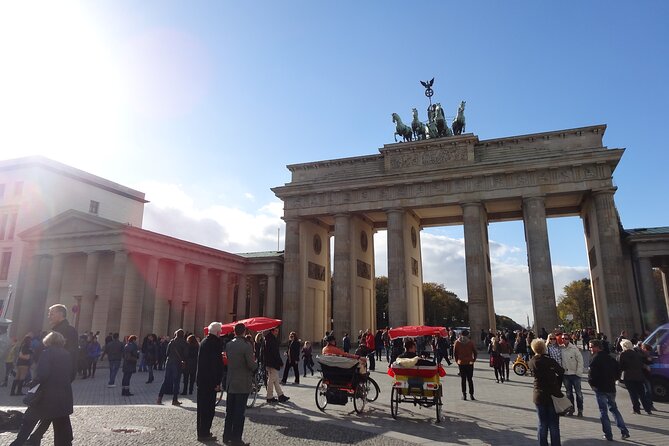
Berlin can be difficult to read at first. A neoclassical gate may represent Prussian power, Nazi spectacle, Cold War division, and modern reunification all at once. A parking lot can mark one of the most infamous places in 20th-century history.
That is where a private guide helps. You are not simply taking photographs at famous sights. You are getting the connections between them. The route moves through monarchy, dictatorship, war, occupation, division, and reunification without treating each era as a separate subject.
The English-language guides have different backgrounds and personalities, but the strongest praise centers on their ability to explain difficult material clearly and answer follow-up questions. Ciaran is described as especially strong on Berlin and World War II. Rhys is noted for an easy manner and flexibility. Paul brings formal European history training, while Beth has been praised for her handling of World War II and Cold War sites.
That variation matters. With a private tour, you are spending six hours with one person, so the guide’s style can shape the day. The available feedback points to guides who are conversational, patient, and willing to adjust the route or emphasis when your group takes an interest in a particular subject.
A few more Berlin trips to weigh up
- Berlin: Natural History Museum Entrance Ticket
★ 4.6 · 3,382 reviews - Berlin: World Heritage Cruise to Potsdam
★ 4.5 · 1,435 reviews - Berlin Historical Highlights Walking Tour
★ 4.9 · 657 reviews
From Brandenburg Gate to the Reichstag
The tour begins on Ebertstrasse, near the Brandenburg Gate. This is an effective starting point because the gate is both a beautiful landmark and a useful key to Berlin’s political story.
You hear why it was built, how it fit into Prussian Berlin, and how its meaning changed as Germany moved through empire, dictatorship, division, and reunification. During the Cold War, the gate sat beside the Wall in a zone that symbolized a divided city. Today it is one of Berlin’s busiest photo stops, so ask your guide to take a picture before moving on.
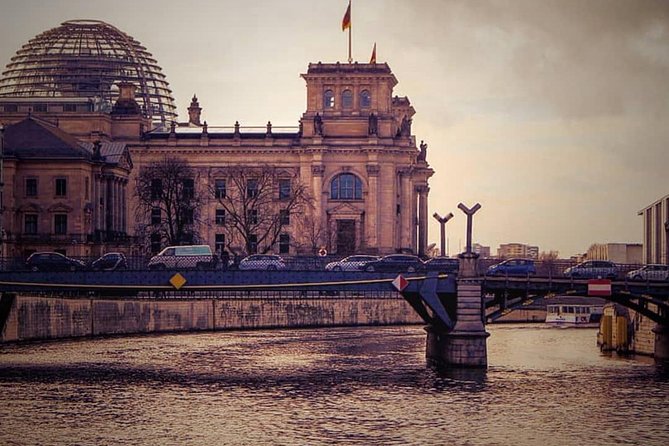
The nearby Reichstag gives the story a second layer. The building connects the Hohenzollern era with the fragile parliamentary system of the early 20th century, the Nazi seizure of power in 1933, the violent final battle for Berlin, and the building’s later role in reunified Germany.
You view the Reichstag from outside on this tour. That means you should not expect a visit to the dome or interior unless separately arranged. Still, the exterior stop is useful because the guide can explain how the building’s symbolism changed over time.
Tiergarten, the Soviet Memorial, and a quieter side of the city
The route then enters part of Tiergarten, Berlin’s large central park. This break from monumental buildings gives your legs a change of surface and shows how the city’s green center was shaped by earlier eras and by wartime destruction.
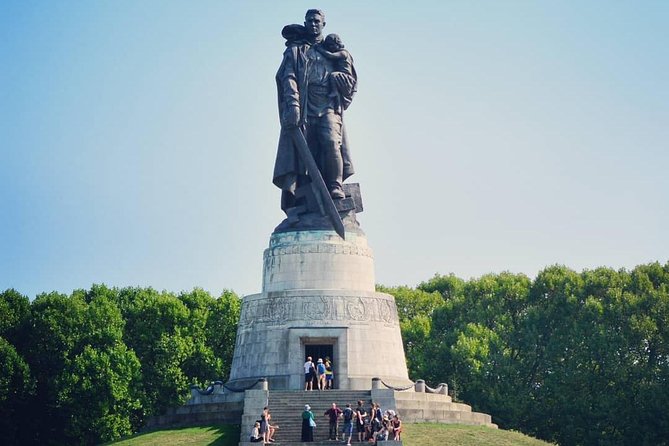
The Soviet Memorial in Tiergarten is one of the more unusual stops. It was built in what became West Berlin, making it a reminder that the postwar division was not just a line on a map. The guide discusses its materials, construction, symbols, and the questions surrounding a Soviet memorial in the former western half of the city.
You also see the Victory Column from a distance. The guide explains why it was built and points out that it was not always located in its current position. This is a short stop, but it helps place Berlin’s 19th-century military ambitions within the larger story.
Memorials that require time and care
The Holocaust Memorial is one of the day’s most important stops. Its field of concrete blocks invites a personal response, but a guide can add the historical frame needed to understand why it was built and how it fits into Berlin’s network of memorials.
You are not rushed through a museum here, and that is both a strength and a limit. The tour can help you approach the memorial thoughtfully, but 15 minutes is not enough for a long visit. If the site matters greatly to you, plan to return on your own.
The former Führerbunker site is now an ordinary parking area, with no surviving bunker interior to visit. That plain setting is part of what makes the stop unsettling. Your guide explains where the bunker was, what happened there during Hitler’s final days, and how the site ended up with such an unremarkable appearance.
The nearby Johann Georg Elser sculpture adds a less familiar wartime story. Elser came close to killing Hitler in an attempted assassination and might have changed the course of history. This short stop keeps the tour from focusing only on major leaders and military events.
Same city, a completely different kind of day:
- Berlin: Reichstag, Dome and Government District Guided Tour
★ 4.7 · 18,288 reviews - Berlin: 1-Hour City Tour by Boat with Guaranteed Seating
★ 4.3 · 16,993 reviews - Berlin: Boat Tour Along the River Spree
★ 4.4 · 11,252 reviews - Discover Berlin Half-Day Walking Tour
★ 5.0 · 9,624 reviews
Nazi Berlin at the former government and security sites
The Aviation Ministry building is an imposing survivor from the Nazi period and has remained in continuous use since 1936. From outside, you learn how the building witnessed some of the most troubled years of the 20th century and what happened to it after the war.
At the Topography of Terror, the tour enters the site of the former SS, Gestapo, and SD headquarters. This is one of the strongest historical stops because the location was directly tied to Nazi terror and persecution. The guide explains what took place there and how the site was treated after the war.
The Topography of Terror also deserves more time than a brief stop if you want to read its displays carefully. The tour gives you an introduction and a sense of place, but you may want to return independently if you are especially interested in Nazi institutions or the mechanics of dictatorship.
The Berlin Wall and Checkpoint Charlie
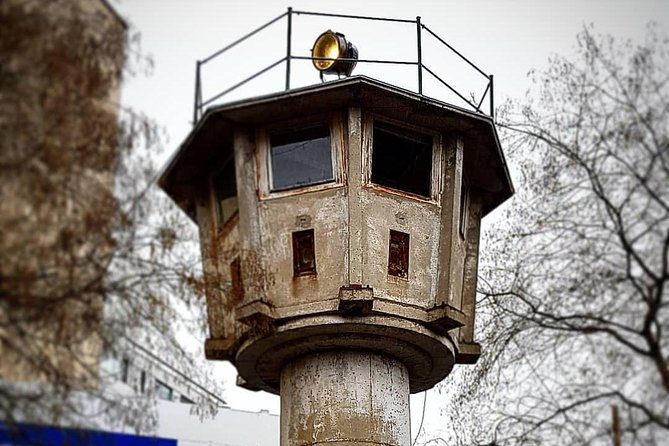
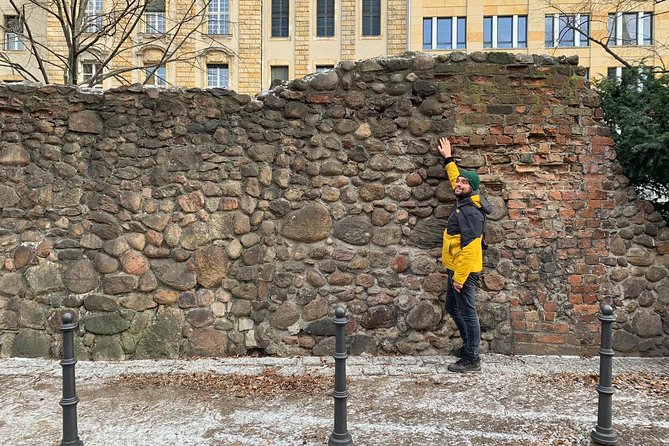
The Wall Memorial section offers a more physical look at the division of Berlin. Rather than seeing only a recreated checkpoint or a painted remnant, you discuss why the Wall was built, how it worked, and the escapes and deaths connected with it.
This is valuable because the Wall can otherwise become a string of dramatic photographs without much explanation. Your guide supplies the human scale: families divided, people attempting escapes, and the risks created by the border system.
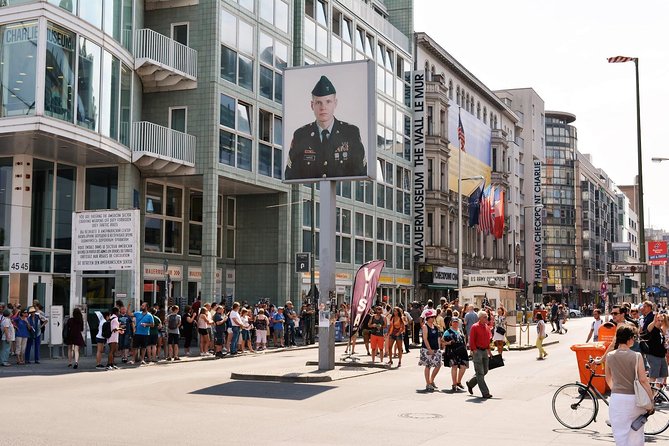
Checkpoint Charlie follows as the most famous Cold War checkpoint. It is a quick stop, and the modern setting can feel commercial compared with the seriousness of the history. Still, the location is important, and a good explanation helps separate the real history from the souvenir shops and staged photo opportunities around it.
The walk down Friedrichstrasse adds another change of mood. Once known as the Cabaret Mile, it shows that Berlin’s story is not only about governments and war. The street also belonged to entertainment, nightlife, commerce, and the changing social life of the capital.
Gendarmenmarkt, Bebelplatz, and Unter den Linden
Gendarmenmarkt is one of Berlin’s most elegant squares. The tour explains how it developed and points out the buildings that give it such a formal character. It is a welcome pause after the heavier wartime and Cold War subjects.
At Bebelplatz, the architecture is beautiful, but the square carries a painful memory. The area includes St. Hedwig’s Cathedral, Humboldt University’s law faculty, and the State Opera House. It was also the site of a major Nazi book burning.
The memorial in the paving is deliberately easy to miss. Your guide points it out and explains its meaning, turning a pleasant-looking square into a place for thinking about censorship, propaganda, and the destruction of ideas.
Humboldt University gives the route another historical thread. You learn about the institution, its building, and the Humboldt family. The stop is brief, so treat it as an introduction rather than a university visit.
Neue Wache is one of the most moving points along Unter den Linden. You go inside when possible to see its current memorial form. The building has changed political meaning several times, making it a useful example of how Berlin repeatedly reinterprets its past.
The Deutsches Historisches Museum is viewed from outside. The guide discusses the building, described here as the oldest surviving building on Unter den Linden, and explains its connection with German history. If you plan to visit the museum, note that this tour does not include an extended indoor visit.
Museum Island and the route toward East Berlin
Museum Island is a UNESCO World Heritage site and one of the most impressive stretches of central Berlin. From outside, you discuss the island’s development, its museums, the cathedral, and the architects who shaped the complex.
This is a good place to ask for advice about your remaining time in Berlin. The tour cannot provide a full visit to every museum, so use the guide’s perspective to decide which collections deserve a separate morning or afternoon.
The Humboldt Forum adds a more recent and complicated chapter. Its history involves the building, the uses of the site, and the modern institution that occupies it. The stop is especially useful if you are trying to understand why Berlin’s reconstruction projects can carry political questions along with architectural ones.
St. Mary’s Church is another brief visit, and you may be able to go inside. It is described as the oldest Berlin church that has remained in continuous use, as well as a fortunate survivor. Since interior access is not guaranteed, consider this a possibility rather than a promise.
The final stop is Alexanderplatz, rebuilt after the war as a showcase of the German Democratic Republic. Ending here gives the tour a clear East Berlin note and brings the story through the Cold War period. It also leaves you in a useful central location for continuing your day.
Pace, stamina, and the private format
The schedule lists 22 stops, but the times shown add up to much less than six hours. That leaves room for the actual walking between sites, questions, photographs, short pauses, and perhaps a meal break. One account specifically describes a lunch break, but food is not included, so ask your guide how the day will be arranged.
The pace is adjusted to the group. That is a major benefit for families and mixed-age parties. A group ranging from teenagers to people in their eighties was accommodated successfully, including a short break that gave younger participants a change of activity.
Still, do not confuse flexible pacing with an easy stroll. One group covered about 5.5 miles, and Berlin’s broad avenues can make distances deceptive. Wear comfortable shoes, bring water, and expect to spend much of the day standing while listening.
There is no vehicle. Pickup and movement are on foot, and the tour walks at the pace of the group. The route is near public transportation, but private transportation is not included. Service animals and pets are allowed, and the operator says most people can participate.
Is $253.95 per person fair?
At $253.95 per person, this is not a budget walking tour. The value depends on your group size and what you want from a guide.
For one person, the price is hard to justify unless you place a high value on private instruction and have limited time. For a couple, family, or small group, the cost buys six hours of exclusive attention, a tailored pace, and a route that covers many of Berlin’s major historical sites in one day. Group discounts may also affect the final price.
You are not paying for admission tickets, transport, food, or a special museum entry. The value is in the guide’s time and interpretation. That can be worthwhile in Berlin, where the meaning of a site is often invisible unless someone explains what happened there.
The tour is especially useful at the start of a stay. You can get your bearings, learn the broad sequence of Berlin’s history, and mark places for later visits. If you already know Berlin well or prefer to explore slowly, the price may be better spent on individual museum entries and public transportation.
Who should book this Berlin history walk?
I would choose this tour for a first visit, especially if you want World War II and Cold War history explained in one connected route. It also suits couples, families, and small groups who ask lots of questions or do not want to be tied to a fixed large-group pace.
It is a strong fit for travelers with only a short stay. You will see the major central landmarks quickly, then return to the places that caught your interest.
I would hesitate if you dislike long walks, want substantial time inside museums, or prefer a relaxed neighborhood tour with cafés and shopping. The route is serious, dense, and packed with stops. It gives you a strong framework, but it cannot replace full visits to the Holocaust Memorial, Topography of Terror, or Museum Island museums.
The cancellation policy is friendly: you can cancel up to 24 hours before the start for a full refund. Changes or cancellations inside that 24-hour window are not accepted.
FAQ
How long is the Berlin private history walking tour?
The tour lasts approximately six hours.
How many stops are included?
The route includes 22 listed stops, ending at Alexanderplatz.
What language is the tour offered in?
The tour is offered in English.
Is this a private tour?
Yes. Only your group participates, and the guide’s attention is not shared with another group.
Does the tour use a vehicle?
No. This is entirely a walking tour, and pickup takes place on foot.
Where does the tour start and end?
It starts near Ebertstrasse 24 in Berlin, close to Brandenburg Gate, and ends at Alexanderplatz.
Are food and drinks included?
No. Food and drinks are not included. A lunch break may be possible, but you must pay for your own meal.
Can I cancel for a full refund?
Yes. You can cancel at least 24 hours before the local start time for a full refund. Cancellations or changes made less than 24 hours before the start are not accepted.
Should you book it?
Book this tour if you want Berlin’s major Nazi and Cold War sites tied into one clear story, and if you can comfortably walk for much of a day. The private format is the real selling point: guides such as Paul, Rhys, Ciaran, Beth, and Eugen have been praised for answering questions, adjusting the pace, and making difficult history understandable.
Skip it if you want a cheap overview, a museum-heavy schedule, or an easy afternoon stroll. At $253.95 per person, the price asks a lot, but for a small group seeking a focused first-day introduction to Berlin, the route and personal attention can make the cost worthwhile.
More Full-Day in Berlin
- Private Full-Day Tour to Meissen and Dresden from Berlin
★ 5.0 · 5 reviews - From Munich: Neuschwanstein & Linderhof Castle Full-Day Trip
★ 4.5 · 12,494 reviews - From Munich: Neuschwanstein Castle Full-Day Trip
★ 4.7 · 3,977 reviews - From Munich: Dachau Memorial Site Full-Day Tour
★ 4.9 · 1,406 reviews
Just added around Berlin
- Love and War in Berlin: Self-Guided Story Puzzle Walk★ 5.0 · 7 reviews
- Rickshaw Tours Berlin – Groups of up to 16 people with several rickshaws★ 4.0 · 97 reviews
- eSIM for Germany and 34 European Countries★ 4.5 · 16 reviews
- Walking on the Wall: 3-Hour Tour in Berlin★ 4.5 · 34 reviews
- Warnemuende Shore Excursion: Berlin Private Sightseeing Tour from Rostock★ 5.0 · 4 reviews
- Your ticket to The Wall Museum Berlin★ 3.0 · 60 reviews
- Warnemuende Shore Excursion: Private Berlin Tour★ 4.5 · 27 reviews
- Berlin’s Gay, Lesbian, and Queer Scene Small-Group Walking Tour★ 4.5 · 66 reviews
Historical Tours, compared.
City History Canal Sightseeing Tour on a Motorboat
Read our review →


Browse the lists this tour appears in