
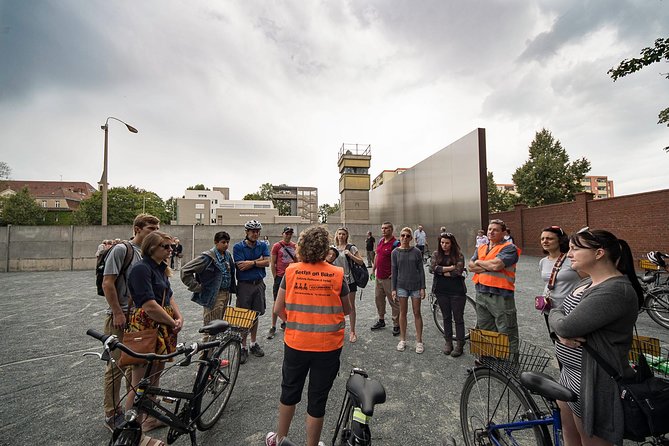
Reviewed · THIRD REICH & COLD WAR TOURS
Berlin Wall and Cold War Bike Tour in Small Groups
Berlin’s Cold War story makes more sense when you move through the city instead of studying isolated memorials. This 3.5-hour ride links Brandenburg Gate, the Berlin Wall Memorial, Checkpoint Charlie, and the Palace of Tears, with smaller traces of the divided city along the way.
I like two things right away: the bike lets you cover a lot of ground without burning half a day on foot, and the guides turn dates into human stories. Guides such as Peter, Giovanni, Gilles, and Monti have been praised for making the subject clear, thoughtful, and engaging.
The main catch is practical: you are outdoors for the full tour, and one stop for refreshments may not be enough for everyone. Dress for the weather, bring water, and be ready to ride roughly 20 kilometers at an easy sightseeing pace.
In This Review
- Key points to know before you ride
- Why a bicycle works so well for Berlin’s Wall story
- Starting at Kulturbrauerei in Prenzlauer Berg
- Brandenburg Gate and the political heart of Berlin
- Berlin Wall Memorial: the clearest look at the border
- Mauerpark and the former border through a neighborhood
- The GDR watchtower at Kieler Eck
- Checkpoint Charlie and the limits of famous sights
- The Palace of Tears and the human side of departure
- The guides make the difference
- Who will get the most from the ride
- Is $43.54 a fair price?
- Small practical details that matter
- Should you book this Berlin Wall bike tour?
- FAQ
- How long does the Berlin Wall bike tour last?
- Where does the tour start and finish?
- Is bicycle equipment included?
- What language is the tour offered in?
- How many people can join the group?
- What happens if the weather is poor?
Key points to know before you ride
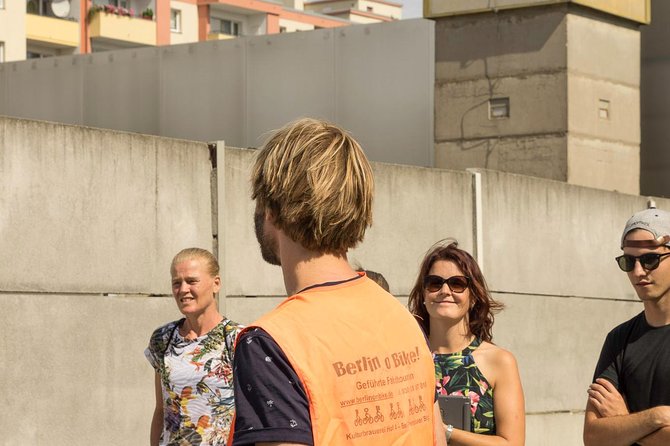
- A broad Wall route: You see major landmarks and less obvious remains, giving you a fuller picture than a quick stop at Checkpoint Charlie.
- Small groups capped at 15: This keeps the ride more personal and makes it easier to hear the guide.
- Guides bring different strengths: Peter is praised for his compassion and storytelling, Giovanni for clear dates and facts, and Gilles for his personal connection to the Wall’s fall.
- About 3.5 hours on a bike: The route covers a lot of Berlin, but the pace is meant for sightseeing rather than sport.
- Bikes and helmets are included: You only need to arrive at the Berlin on Bike depot in Kulturbrauerei.
- Good value at $43.54: You get equipment, a local guide, and several hours of transport between major Cold War sites without paying separate admission fees.
Why a bicycle works so well for Berlin’s Wall story
The Berlin Wall was never just one attraction. It cut across streets, neighborhoods, railway lines, parks, and public squares. That makes a bike tour especially useful. You can follow the former border and see how quickly the setting changes from grand civic monuments to quiet residential corners.
On foot, you could visit one or two central sites and then spend much of the day navigating between them. By bicycle, the movement becomes part of the lesson. You pass from the former East to the former West, then stop to hear what happened at that exact point.
The route lasts about three hours and 30 minutes. One review describes a ride of about 20 kilometers, so you should expect a real outing, not a short spin around one neighborhood. The cycling is generally described as easy, and the route includes stops where the guide explains the setting rather than keeping you pedaling nonstop.
The group limit of 15 is useful here. A large cycling convoy can feel clumsy in city traffic, while a smaller group is easier to manage at crossings and memorials. You also have a better chance of asking questions or telling the guide if you need a short pause.
More Bike Tours in Berlin
- Berlin: Sights and Highlights Bike Tour with a Local Guide
★ 4.8 · 2,698 reviews - Berlin Highlights 3-Hour Bike Tour
★ 5.0 · 948 reviews - Berlin City Bike Tour with Beer Garden Stop
★ 5.0 · 917 reviews
Starting at Kulturbrauerei in Prenzlauer Berg
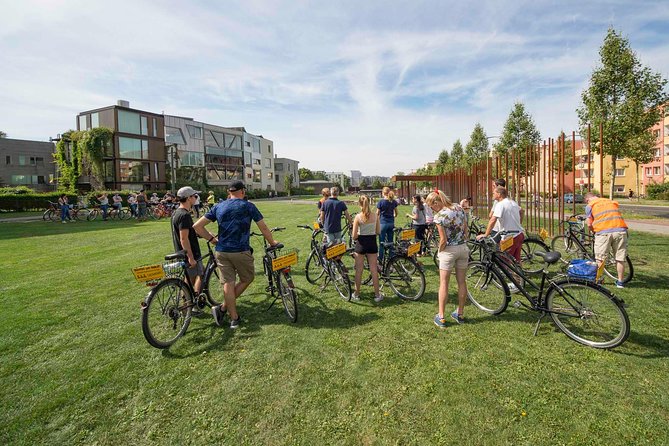
You meet at Berlin on Bike, at Kulturbrauerei on Knaackstraße 97. The depot is both the starting and ending point, which keeps the day simple. There is no hotel pickup, so plan your route to the meeting point before the tour begins.
Kulturbrauerei itself gives you an interesting opening setting. This former brewery complex covers about 25,000 square meters and is known for its courtyards and late 19th-century industrial architecture. It has been protected since 1974, making it one of Berlin’s better-preserved industrial building groups from that period.
The bike depot stop is brief, but the location helps place you in the former East Berlin side of the city. You collect your bicycle and helmet here, then set off with the guide. Since the tour is offered in English, you should be comfortable listening to historical explanations and stories in English for several hours.
A useful tip is to arrive ready to ride. Food and drinks are not included, and the route does not promise a series of planned café breaks. One stop has been described as fast-food style, so bring water and consider eating before you arrive.
Brandenburg Gate and the political heart of Berlin
Brandenburg Gate is an impressive first major landmark. This early classical gate faces Pariser Platz in Mitte and has long served as a symbol of Berlin’s political power and division.
The stop lasts about 10 minutes and admission is free. Do not expect a long museum visit here. The value is in hearing how the gate fits into the Wall era and seeing its position within the city’s central ceremonial zone.
For many people, Brandenburg Gate is familiar from photographs. The bike tour adds useful scale. You see how the gate relates to the former border and to the rest of the route, rather than treating it as a stand-alone photo stop.
This is also where the tour begins to show its range. The day is not limited to Wall fragments. It connects Cold War sites with the wider political geography of Berlin, helping you understand why certain streets and squares mattered so much.
Berlin Wall Memorial: the clearest look at the border
The Berlin Wall Memorial is one of the most important stops. It commemorates the division of Berlin by the Wall and those who died trying to cross it.
The planned stop is about 10 minutes, so the guide has to choose the key points carefully. That short time works best if you want an overview of the Wall’s structure, purpose, and human cost. If you prefer a slow museum visit with extensive reading, you may want to return here on your own after the ride.
This stop gives the tour emotional weight. Guides have been praised for explaining not only dates and political events, but also what daily life felt like on both sides. Giovanni, for example, is known for connecting facts about the Wall with stories of the struggles faced by people in East and West Berlin.
That human focus matters. The Cold War can become a blur of governments, slogans, and dates. Personal stories help you grasp what the border meant to families, commuters, and anyone who lived close to it.
More Third Reich & Cold War Tours in Berlin
- Berlin: Third Reich and Cold War 2 Hour Walking Tour
★ 4.9 · 6,830 reviews - Berlin’s Best: 2 Hour Walking Tour Third Reich and the Cold War
★ 5.0 · 5,486 reviews - Third Reich Berlin: Hitler and WWII Walking Tour
★ 5.0 · 3,301 reviews - Skip-the-Line: Berlin Wall Museum at Checkpoint Charlie
★ 4.1 · 2,041 reviews
Mauerpark and the former border through a neighborhood
Mauerpark translates roughly as Wall Park, and its name comes directly from the Wall that once ran here. The park marked the former border between Prenzlauer Berg and Wedding, now Gesundbrunnen.
The scheduled stop is only about five minutes, but the ride through the area is part of the experience. You get a sense of how the Wall once cut through ordinary neighborhoods, not just famous government districts.
This is a good example of why the bicycle format adds value. You are not simply shown a monument. You move along the former border and see how the route passes through places that now feel like regular parts of Berlin.
The brevity of the stop is also a limitation. You will not have much time to explore Mauerpark itself. Treat it as a geographical and historical marker, not as a separate park visit.
The GDR watchtower at Kieler Eck
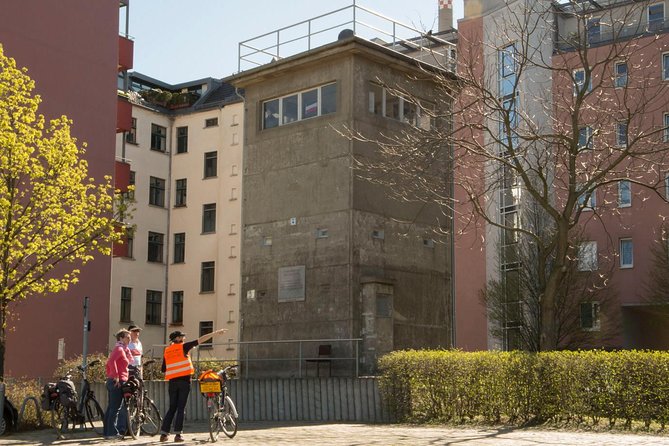
The old GDR watchtower at Kieler Eck is a smaller, more concrete reminder of the former border system. The stop lasts about five minutes, and admission is included.
Unlike Brandenburg Gate or Checkpoint Charlie, this is not a grand symbolic site. That is exactly why it is useful. A watchtower helps you picture the physical machinery of border control, surveillance, and restricted movement.
You should expect a quick explanation and viewing rather than a large indoor attraction. The guide’s narration is important here because the tower itself cannot explain how the border operated or what it meant to people nearby.
Checkpoint Charlie and the limits of famous sights
Checkpoint Charlie was one of the best-known crossings between East and West Berlin. It connected East Berlin’s Mitte district with Kreuzberg in the American sector through Friedrichstraße.
The site is easy to recognize, but it can also feel overexposed and commercial compared with quieter Wall locations. A guide helps you separate the historical importance of the crossing from the modern photo opportunity.
You will hear about its role as a formal border crossing between 1961 and 1990. The stop works best when placed within the whole route. By this point, you have already seen memorials, neighborhood sections, and a watchtower, so Checkpoint Charlie becomes one chapter in the larger story rather than the entire story.
This is also a good place to ask questions. If you want to understand how the different sectors related to one another, or why this crossing became so famous, the guide can connect the site to the wider Cold War setting.
The Palace of Tears and the human side of departure
The Palace of Tears is the informal name for the former exit hall at Friedrichstraße railway station. During the divided city years, this was where people leaving East Berlin said goodbye to family and friends.
The name captures the building’s emotional role. It was not simply a transport hall. It was a place of controlled departures, anxious farewells, and uncertainty.
The stop is not given a separate duration in the supplied schedule, so the amount of time may depend on the guide and the flow of the route. Still, it is one of the most useful places for understanding how the Wall affected ordinary relationships.
This stop pairs well with the more political sites. Brandenburg Gate and Checkpoint Charlie explain power and borders. The Palace of Tears shows what those policies felt like inside a family.
The guides make the difference
The strongest part of this tour is the guide-led interpretation. The subject is serious, and a flat list of dates would make for a tiring ride. The best guides turn the route into a clear story without making light of the suffering involved.
Peter has been praised for being articulate, compassionate, and enjoyable to listen to. His approach encourages you to consider the past from more than one angle, while still keeping sight of the human cost.
Giovanni is a good fit if you like structure. He is described as strong on dates and facts, while also bringing the struggles of East and West Berlin to life. Families may appreciate his kind and patient manner, especially when riding with a 12-year-old.
Gilles brings an unusual personal link to the subject. He experienced the fall of the Wall only a few days after it happened, which can add a direct sense of time and memory to the story.
Other guides, including George and Monti, have also been praised for warmth and clear introductions to Berlin’s past. You cannot choose a particular guide from the information provided, so expect the tone to vary somewhat by day. The common thread is a focus on explanation, stories, and the human side of the Cold War.
Who will get the most from the ride
This tour suits you if you want to see several Berlin districts in one outing and prefer movement to a long indoor museum visit. It is also a smart choice for a first visit, since the route gives you a broad orientation to the Wall’s former path.
Families can benefit from the format. A bicycle ride breaks up a serious subject and keeps younger participants moving. The tour has also worked well for a chronically bored teenager, which is a fair test of any history outing.
You do not need to be a serious cyclist. The ride is described as easy, but you should still be comfortable spending several hours on a bicycle. The reported distance of about 20 kilometers means this is not ideal if you want only a short, effortless pedal.
The tour may be less suitable if you need long periods at each memorial, want an in-depth museum experience, or prefer to avoid riding in changeable weather. The operator says it runs in all weather conditions, so dress properly. If poor weather forces a cancellation, you are offered another date or a full refund.
Is $43.54 a fair price?
At $43.54 per person, the price is reasonable for a 3.5-hour guided outing in central Berlin. Your fee covers the local guide, bicycle, and helmet. Most of the listed stops are free, so you are paying mainly for transport, route planning, equipment, and interpretation.
The value is strongest if you would otherwise use public transport or taxis to reach the Wall Memorial, Checkpoint Charlie, Friedrichstraße, and other sites. You also avoid the work of building a route through a complicated piece of city history.
The price is less compelling if you already know Berlin well, have your own bicycle, and are happy to follow the Wall route without a guide. In that case, the main reason to book is the storytelling and historical context.
Book at least a few weeks ahead if your schedule is fixed. The tour is booked an average of 31 days in advance, suggesting that popular dates can fill early. You receive confirmation at booking, and free cancellation is available until 24 hours before the start time. A minimum group size is required, so a cancellation for low demand is possible, with another date or a full refund offered.
Small practical details that matter
The meeting point is near public transportation, but hotel pickup and drop-off are not included. The tour ends back at the Kulturbrauerei depot, which makes it easier to plan the rest of your day.
Food and drinks are not included. I would eat beforehand, carry water, and ask the guide early about the best point for a bathroom or refreshment break. One stop may be provided, but it is not designed as a full meal break.
The activity is offered in English and uses a mobile ticket. Most people can participate, but the route still requires basic cycling ability and comfort with an outdoor outing. Dress in layers and prepare for rain or cool conditions, since the operator runs the tour in all weather unless conditions lead to cancellation.
Should you book this Berlin Wall bike tour?
Book it if you want a clear, human account of Berlin’s division while seeing far more ground than you could comfortably cover on foot. The combination of major sights, modest Wall remains, neighborhood routes, and guides such as Peter, Giovanni, and Gilles gives the subject useful depth.
I would especially recommend it for first-time visitors, families, and anyone who learns best while moving. The small group and included bike make the price fair, and the 98 percent recommendation rate with a 4.9 rating reflects a consistently strong experience.
Skip it if your priority is a slow museum day, if you are not comfortable cycling for several hours, or if you need guaranteed long breaks. For most visitors, though, this is an efficient and thoughtful way to understand that the Berlin Wall was not just a line on a map. It shaped streets, stations, parks, families, and daily life.
FAQ
How long does the Berlin Wall bike tour last?
The tour lasts approximately three hours and 30 minutes.
Where does the tour start and finish?
It starts and ends at Berlin on Bike, Kulturbrauerei, Knaackstraße 97, 10435 Berlin, Germany.
Is bicycle equipment included?
Yes. The tour includes use of a bicycle and helmet.
What language is the tour offered in?
The tour is offered in English.
How many people can join the group?
The group has a maximum of 15 participants.
What happens if the weather is poor?
The tour operates in all weather conditions, so you should dress appropriately. If the experience is canceled because of poor weather, you are offered a different date or a full refund.
More Cycling Tours in Berlin
- Berlin Highlights: 3-Hour Bike Tour
★ 4.9 · 809 reviews - Berlin Highlights Sightseeing Bike Tour in Small Groups
★ 5.0 · 652 reviews - Berlin: Alternative Bike Tour of Kreuzberg & Friedrichshain
★ 4.7 · 548 reviews - Berlin: Guided Bike Tour of the Berlin Wall and Third Reich
★ 4.7 · 499 reviews
Just added around Berlin
- Love and War in Berlin: Self-Guided Story Puzzle Walk★ 5.0 · 7 reviews
- Rickshaw Tours Berlin – Groups of up to 16 people with several rickshaws★ 4.0 · 97 reviews
- Walking on the Wall: 3-Hour Tour in Berlin★ 4.5 · 34 reviews
- eSIM for Germany and 34 European Countries★ 4.5 · 16 reviews
- Warnemuende Shore Excursion: Berlin Private Sightseeing Tour from Rostock★ 5.0 · 4 reviews
- Your ticket to The Wall Museum Berlin★ 3.0 · 60 reviews
- Warnemuende Shore Excursion: Private Berlin Tour★ 4.5 · 27 reviews
- Berlin’s Gay, Lesbian, and Queer Scene Small-Group Walking Tour★ 4.5 · 66 reviews
Third Reich & Cold War Tours, compared.



Berlin’s Best: 2 Hour Walking Tour Third Reich and the Cold War
Read our review →

Third Reich Berlin: Hitler and WWII Walking Tour
Read our review →
Skip-the-Line: Berlin Wall Museum at Checkpoint Charlie
Read our review →

Cold War, Berlin Wall, Spies and the East Side Gallery
Read our review →Browse the lists this tour appears in