
Reviewed · THIRD REICH & COLD WAR TOURS
Berlin: Guided Bike tour of the Berlin Wall and Third Reich
Berlin’s past makes more sense from a bicycle. In three hours, you can connect the Berlin Wall, Nazi rule, wartime ruins, Holocaust memorials, and today’s government district without spending the day underground or stuck in traffic. The route covers a lot of ground, while local guides such as Paul, Simon, Juliette, Theo, and Simone add personal stories and clear historical context.
I especially like the easy pace and flat streets, along with the chance to reach places such as the Günter Litfin Memorial and Humboldthain Flak Tower that are easy to miss on a standard city tour. I also like that children can join, with infant seats available on request. The main drawback is that the Free Berlin concept lets guides shape their own routes, so you may not visit every advertised stop. If Checkpoint Charlie or the Holocaust Memorial is essential to you, say so at the start.
In This Review
- Key points to know before you ride
- Why a bicycle suits Berlin’s difficult history
- Nikolaiviertel and the Jewish quarter
- Seeing what the Berlin Wall actually did
- Watchtowers, escape routes, and divided cemeteries
- The Reichstag, Holocaust Memorial, and Führerbunker
- Checkpoint Charlie and the Cold War finish
- Guides, bikes, and group size
- Is $42.34 a fair price?
- Who should book this Berlin bike tour?
- Should you book it?
- FAQ
- How long is the Berlin Wall and Third Reich bike tour?
- Where does the bike tour start?
- Is bicycle equipment included?
- Is Checkpoint Charlie included on every tour?
- Can children join the tour?
- What happens if I need to cancel?
Key points to know before you ride
- You cover Berlin’s history by connecting places: The ride links Nazi sites, Wall remains, memorials, former border zones, and modern Berlin.
- Guides bring different strengths: Paul adds a West Berlin perspective, while guides including Simon, Simone, Theo, Juliette, and Constantine are praised for clear explanations, personal stories, and careful group handling.
- The ride is gentle rather than athletic: Berlin is flat, and the tour uses frequent stops. One family covered about 13 kilometers at an easy pace.
- The route can change: Each guide designs a route around the main theme, so the exact stops are not fixed.
- You get the bike and helmet: Bikes have baskets, including rear basket space for water bottles, coats, and small bags.
- Small groups work best: The official group size is 4 to 15 people, though larger bookings may be split into smaller groups.
Why a bicycle suits Berlin’s difficult history
Berlin is spread out, and its historic sites do not sit in one tidy old center. A bicycle lets you move from the former Jewish quarter to the Wall, then from Nazi-era ruins to the government district, seeing how the city’s layers overlap.
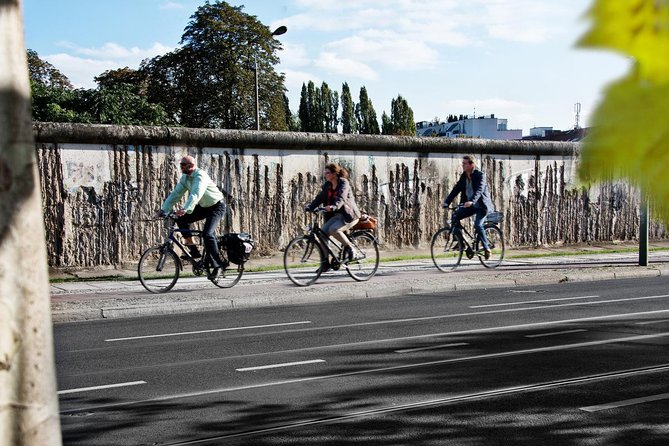
You also get a better sense of distance. The Wall was not a single thin barrier. It cut through streets, cemeteries, parks, canals, and neighborhoods. Riding along parts of its former path helps you understand how much space the border controlled and how sharply it divided daily life.
The ride is not a race. The pace is generally easy, with regular stops for explanations. The city is famously flat, and one family with children aged 10, 14, and 17 covered around 13 kilometers without finding the route hard. That makes this a good option if you want more range than a walking tour but do not want an intense cycling workout.
The practical challenge is city traffic. Some sections use main roads and cycle lanes. Theo was praised for giving clear instructions, waiting at red lights, and keeping the group together. Even so, you should be comfortable riding in an urban setting. Constantine took his group through many park routes, which can make the ride feel calmer.
More Bike Tours in Berlin
- Berlin: Sights and Highlights Bike Tour with a Local Guide
★ 4.8 · 2,698 reviews - Berlin Highlights 3-Hour Bike Tour
★ 5.0 · 948 reviews - Berlin City Bike Tour with Beer Garden Stop
★ 5.0 · 917 reviews
Nikolaiviertel and the Jewish quarter
The tour begins at Free Berlin Bike Tours & Rental on Poststraße 11, near Nikolaiviertel. This is a useful starting point because the neighborhood is presented as Berlin’s only genuine old town area, though its present appearance needs explanation.
War damage destroyed much of central Berlin, and Nikolaiviertel was rebuilt after the war. Your guide can use the neighborhood to explain how Berlin has reconstructed, restored, and sometimes re-created its past. The ten-minute stop is short, so think of it as a scene-setting introduction rather than a full old-town visit.
The next stop is the New Synagogue and Centrum Judaicum. Here, the focus is the night of broken glass, the November 1938 pogroms, and the police officer who used civil courage to protect the building. The stop lasts only about five minutes, but the story gives the tour an important human scale. You are not only hearing about laws and leaders. You are considering the choices made by individuals under pressure.
The itinerary also includes memorials for people deported and killed during the Holocaust, including a memorial designed during the East German period. Its style differs sharply from the better-known Memorial to the Murdered Jews of Europe near the Brandenburg Gate. That contrast matters because it shows how different political systems chose to represent guilt, suffering, and public memory.
Seeing what the Berlin Wall actually did
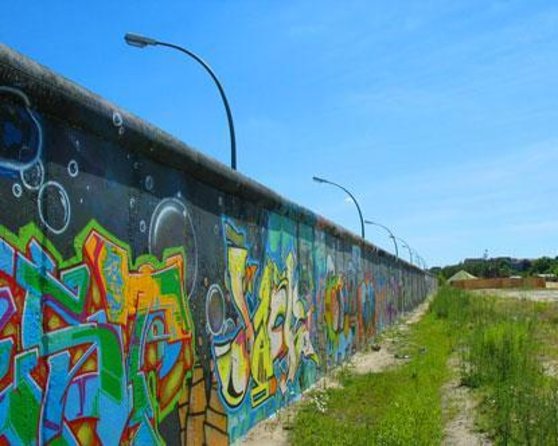
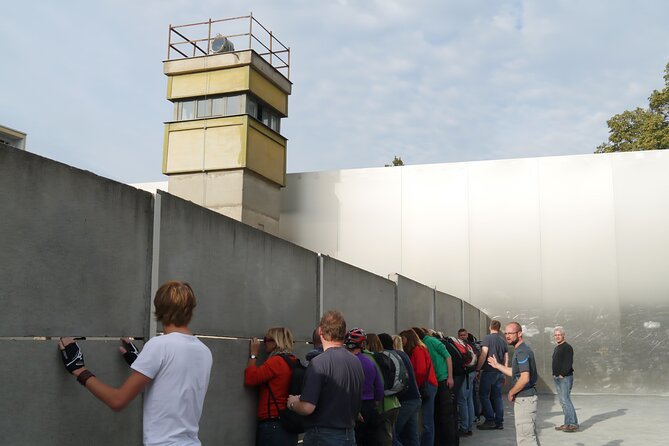
The Berlin Wall Memorial is one of the most important stops. The preserved section here is not just a decorative strip of concrete. It helps you picture the wall system, the space between barriers, and the danger faced by people trying to cross.
This is where the bicycle format pays off. You approach the Wall from different points rather than viewing one isolated fragment in a crowded city square. Your guide can explain how the border affected nearby streets, buildings, and residents. Allow yourself time to look before moving on. The stop is listed at about ten minutes, but a good guide may adjust the timing.
Mauerpark offers a sharp change in mood. Today it is associated with Sunday flea markets and free expression. Its earlier role was far more severe, as part of the border zone that tormented Berlin for 28 years. The stop connects the Wall’s physical presence with the way Berlin reclaimed former restricted ground for ordinary public life.
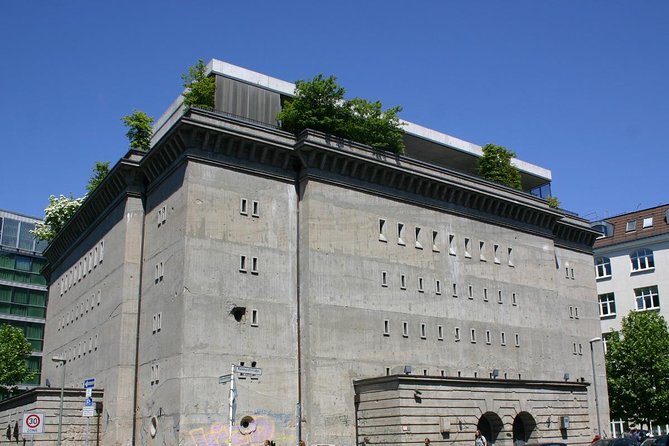
At Humboldthain Flak Tower, you see a massive wartime structure that served as both an anti-aircraft fortress and an air-raid shelter. The site gives you a direct look at Nazi military construction. It also provides a panoramic view, making it one of the tour’s best visual breaks.
The tower is not a polished museum stop. Its power comes from the concrete scale and the questions it raises about how wartime buildings were designed, used, and later absorbed into the city. Your guide discusses Nazi architecture here, so this is a good place to ask how military needs and propaganda shaped the built environment.
Watchtowers, escape routes, and divided cemeteries
The Günter Litfin Memorial preserves an original watchtower. It remembers Günter Litfin, identified here as the first person shot at the Wall. The five-minute stop is brief, but it gives the Wall’s death toll a specific name and face.
At Invalidenfriedhof, the story shifts to a cemetery cut through by the border. The burial ground was created for Prussian military figures, so its history reaches back well before the Cold War. Your guide uses the site to discuss escape attempts, former checkpoints, and the nearby canal that formed a natural boundary between East and West Berlin.
This is one of the tour’s less obvious locations, and that is precisely its value. You are not simply ticking off famous sights. You are seeing how political borders reached into places that normally feel private and permanent, including graves, waterways, and paths through the city.
The route can also include the Spreebogenpark, where you look across at Germany’s modern governing district. From here, the guide discusses Albert Speer’s plans under Hitler, including the proposed Great Hall, which was intended to hold 180,000 people. The present-day view is especially useful because it places Nazi fantasies beside the democratic institutions that now occupy the area.
More Third Reich & Cold War Tours in Berlin
- Berlin: Third Reich and Cold War 2 Hour Walking Tour
★ 4.9 · 6,830 reviews - Berlin’s Best: 2 Hour Walking Tour Third Reich and the Cold War
★ 5.0 · 5,486 reviews - Third Reich Berlin: Hitler and WWII Walking Tour
★ 5.0 · 3,301 reviews - Skip-the-Line: Berlin Wall Museum at Checkpoint Charlie
★ 4.1 · 2,041 reviews
The Reichstag, Holocaust Memorial, and Führerbunker
At the Reichstag, the guide explains Hitler’s rise to power and Germany’s democratic story. You do not go inside during this tour, but the building is still an effective outdoor classroom. You can see the Reichstag in relation to the surrounding government district and hear how the building’s role changed across different periods of German history.
The Holocaust Memorial is one of the tour’s most serious stops. Its field of concrete slabs creates an unsettled experience, and the guide may give you space to consider what the design means rather than simply supplying a fixed interpretation.
The memorial is dedicated to the murdered Jews of Europe and is one of the largest genocide memorials in the world. The tour also refers to other memorials for major victim groups of the Holocaust. This wider context is important, since Nazi persecution targeted several groups, even though the memorial sites have different designs and public roles.
At the Führerbunker, there is almost nothing to see. Today, you see a parking area. The absence is the point, and the guide explains why the bunker was not preserved as a shrine or spectacle. You learn where Hitler spent the final weeks of the war and where he died, while also considering how modern Berlin chose to mark the site without turning it into a destination for glorification.
Do not expect long visits inside museums or memorial buildings. This is an outdoor overview. If you want to study the Holocaust Memorial, the Wall Documentation Center, or the Reichstag in depth, plan separate time before or after the ride.
Checkpoint Charlie and the Cold War finish
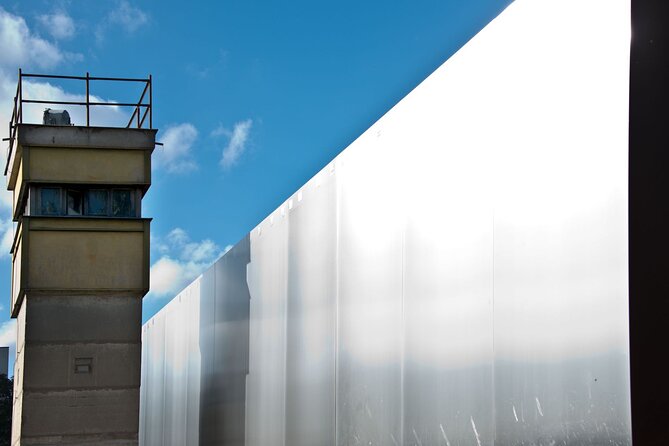
The English version includes Checkpoint Charlie, the best-known Cold War border crossing. The guide explains why this crossing became so famous and how a confrontation involving American and Soviet forces brought the world close to a wider conflict.
The stop is listed as English-only, so check the language option when booking. Also, be aware that the present-day checkpoint area can feel staged and commercial. The historical importance is real, but the modern display is not the same as an untouched border post. The guide’s explanation is what gives the stop its value.
This is also the most important place to state your priorities. Because guides follow the Free Berlin concept and create their own route, the advertised sequence is not guaranteed. One disappointed rider missed several listed stops, including Invalidenfriedhof, the Reichstag, Holocaust Memorial, Führerbunker, and Checkpoint Charlie. The provider acknowledged the issue and said guides should ask guests about must-see places.
That policy gives the ride flexibility. A marathon, road closure, weather problem, or group interest can lead to a different route. It also means you should not assume that every stop will appear. Tell your guide at the meeting point which locations matter most to you.
Guides, bikes, and group size
The guide is central to this experience. Paul, a native of West Berlin, is noted for explaining life on both sides of the Wall before and after reunification. Simon is praised for clear answers, personal warmth, and careful cycling leadership. Simone brings a strong interest in history and memory, while Theo is especially attentive to road safety and group spacing.
Juliette has been praised for balancing stops with riding and for adapting the route to include the Brandenburg Gate. Yonis is described as enthusiastic and generous with his time. Constantine is a good example of a guide who can make a group feel at ease on busy streets by choosing calmer park routes.
These different styles are part of the Free Berlin approach. You are not buying a fully scripted performance with identical timing each day. You are getting a guide-led route shaped by the person leading it, the weather, road conditions, and the group.
The bikes are included, as are helmets. The bikes have baskets, with useful space for a water bottle, coat, or small bag. Food and drinks are not included, so bring water and dress for the forecast. The tour runs in all weather, and light rain will not necessarily cancel it. Simon kept a rainy ride engaging, but proper clothing still makes a major difference.
Children are welcome, but they must be with an adult. Infant seats can be supplied on request. The group limit is 15, and most groups are smaller. If a booking grows large, the company may split it into smaller groups, which makes city riding easier.
Is $42.34 a fair price?
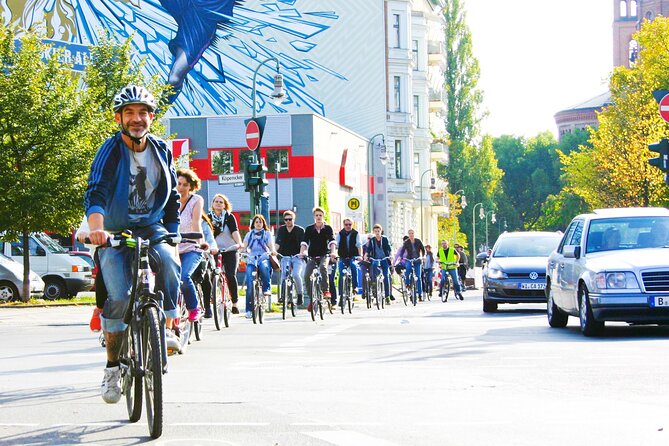
At $42.34 per person, this is a good value if you want an active overview of Berlin’s 20th-century history. The price includes the bicycle, helmet, and guide, and the tour lasts about three hours. You cover far more ground than you could on foot, while avoiding the limits of a bus window.
The value is strongest when you treat the ride as an introduction. You will see many sites, learn how they connect, and collect ideas for later visits. It is less suitable if you expect ten or fifteen minutes at every memorial, or a full indoor tour of the Reichstag and museums.
The 4.8 rating from 160 reviews and 94 percent recommendation indicate strong overall satisfaction, but the lower ratings point to a real issue: route expectations. The advertised list is broad, while the actual ride may focus more heavily on the Wall than on the Third Reich. If you want an exact Nazi-era route, ask before departure how much time will go to the Reichstag, Holocaust Memorial, Führerbunker, and other listed locations.
Who should book this Berlin bike tour?
I would choose this tour for first-time visitors who want a clear introduction to Berlin’s divided past and Nazi-era landmarks. It also suits families with older children and teenagers, history-minded people who prefer movement to lecture halls, and anyone who wants to see less obvious Wall sites.
You should be reasonably comfortable on a city bike. Berlin is flat, but main-road cycling can feel daunting at times. The guides do their part by giving instructions and waiting for the group, yet you remain responsible for riding safely.
I would not make this your only historical activity if you want detailed museum visits or long periods of quiet reflection. Use the ride to get your bearings, then return on your own to the Berlin Wall Memorial, Holocaust Memorial, or other sites that hold your attention.
Should you book it?
Book it if you want three hours of active sightseeing, personal stories, and a broad look at Berlin’s Wall, Nazi, Holocaust, and Cold War sites. The flat route, supplied bike, small-group limit, and strong guide feedback make it a practical choice.
Before setting off, tell the guide your must-see locations. That one step can prevent disappointment under the flexible route system. If you need a fixed itinerary with every listed stop guaranteed, choose a more structured tour. If you want a human-scale introduction to Berlin by bicycle, this is a worthwhile buy.
FAQ
How long is the Berlin Wall and Third Reich bike tour?
The tour lasts approximately three hours and ends back at the starting meeting point.
Where does the bike tour start?
It starts at Free Berlin Bike Tours & Rental, Poststraße 11, 10178 Berlin, Germany.
Is bicycle equipment included?
Yes. The tour includes use of a bicycle and helmet. The bikes have baskets for carrying small items such as water bottles, coats, and bags.
Is Checkpoint Charlie included on every tour?
Checkpoint Charlie is listed for the English version of the tour. Since guides design their own routes under the Free Berlin concept, the exact stops can vary. Tell your guide if it is a priority.
Can children join the tour?
Yes. Children are welcome, but they must be accompanied by an adult. Infant seats can be provided if requested.
What happens if I need to cancel?
You can receive a full refund if you cancel at least 24 hours before the experience start time. Cancellations or changes made less than 24 hours before the start are not refunded or accepted.
More Cycling Tours in Berlin
- Berlin Highlights: 3-Hour Bike Tour
★ 4.9 · 809 reviews - Berlin Highlights Sightseeing Bike Tour in Small Groups
★ 5.0 · 652 reviews - Berlin: Alternative Bike Tour of Kreuzberg & Friedrichshain
★ 4.7 · 548 reviews - Berlin: Guided Bike Tour of the Berlin Wall and Third Reich
★ 4.7 · 499 reviews
Just added around Berlin
- Love and War in Berlin: Self-Guided Story Puzzle Walk★ 5.0 · 7 reviews
- Rickshaw Tours Berlin – Groups of up to 16 people with several rickshaws★ 4.0 · 97 reviews
- Walking on the Wall: 3-Hour Tour in Berlin★ 4.5 · 34 reviews
- eSIM for Germany and 34 European Countries★ 4.5 · 16 reviews
- Warnemuende Shore Excursion: Berlin Private Sightseeing Tour from Rostock★ 5.0 · 4 reviews
- Your ticket to The Wall Museum Berlin★ 3.0 · 60 reviews
- Warnemuende Shore Excursion: Private Berlin Tour★ 4.5 · 27 reviews
- Berlin’s Gay, Lesbian, and Queer Scene Small-Group Walking Tour★ 4.5 · 66 reviews
Third Reich & Cold War Tours, compared.



Berlin’s Best: 2 Hour Walking Tour Third Reich and the Cold War
Read our review →

Third Reich Berlin: Hitler and WWII Walking Tour
Read our review →
Skip-the-Line: Berlin Wall Museum at Checkpoint Charlie
Read our review →

Cold War, Berlin Wall, Spies and the East Side Gallery
Read our review →Browse the lists this tour appears in