
Reviewed · THIRD REICH & COLD WAR TOURS
The Cold War and The Wall – Private Tour with Jacob
Berlin’s Cold War story is easiest to grasp when you connect the landmarks instead of seeing them as isolated photo stops. This private tour links the Brandenburg Gate, Checkpoint Charlie, Friedrichstrasse, the Palace of Tears, and Alexanderplatz into one clear account of a divided city.
I like the private format, which lets you ask questions and adjust the pace for your own group. I also like the practical extras: pickup in Berlin, a picture folder, a large subway map, and help planning the rest of your visit. The main consideration is time. Ten stops in 2 hours 45 minutes means several visits are brief, and some movement may depend on public transport.
In This Review
- Key points at a glance
- Why this private Berlin Cold War tour works
- From the Victory Column to the 1953 uprising
- Brandenburg Gate and the Wall’s rise and fall
- Potsdamer Platz and a city split in two
- The former Aviation Ministry and an escape attempt
- The Trabi Museum and everyday East Germany
- Checkpoint Charlie and the most famous crossing
- Friedrichstrasse, the street of checkpoints
- Unter den Linden and the road toward the border
- The Palace of Tears and the personal cost of separation
- Alexanderplatz, the TV tower, and the space race
- What the $310 group price really gives you
- Who should book this experience
- My call on Jacob’s Cold War tour
- FAQ
- How long does the Cold War and the Wall tour last?
- How many people can join the private tour?
- Where does the tour start and finish?
- Is public transportation included?
- Are admission tickets included?
- Does the tour operate in bad weather?
- Can I cancel the booking?
Key points at a glance
- A compact Cold War route: Cover ten important stops, from the Victory Column to Alexanderplatz, in less than three hours.
- A private group of up to six: Ask questions freely and keep the conversation focused on your interests.
- A useful starting service: Pickup is offered from a Berlin hotel, apartment, train station, or airport.
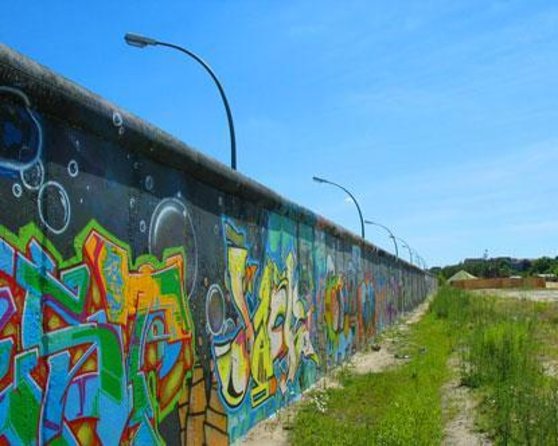
- Stories beyond the usual wall photos: Hear about the 1953 East German uprising, escape attempts, communist ideals, and the space race.
- Public transport is extra: Budget about €3 to €11 for a two-hour or day ticket, depending on the ticket you choose.
- A helpful first-day option: The tour ends at Alexanderplatz and includes a subway map and guidance for exploring Berlin afterward.
Why this private Berlin Cold War tour works
This is not simply a walk to a remaining section of wall. It is a city tour built around political power, daily life, protest, escape, and reunification. That approach matters in Berlin, where many of the key Cold War places are separated by busy streets and modern buildings.
The tour is designed for a private group of up to six people. That is a good size for a history-heavy route. You can stop to ask what a place meant, request more detail about East Berlin, or move on when a subject has been covered. A large group can make this kind of tour feel like a lecture. Here, the conversation should be easier to follow.
The tour lasts about 2 hours 45 minutes and includes ten stops. You should think of it as a guided overview, not a slow museum visit. The listed times range from 10 to 30 minutes, so the value comes from the guide’s explanations and the way the places fit together.
Jacob is the name used for the experience, and the provider is Nadav Jacobs Berlin experience. One account identifies the guide as Nadav Jacobs. The guide is also available for questions and help with the rest of your Berlin visit, which makes this especially useful near the beginning of a trip.
More Third Reich & Cold War Tours in Berlin
- Berlin: Third Reich and Cold War 2 Hour Walking Tour
★ 4.9 · 6,830 reviews - Berlin’s Best: 2 Hour Walking Tour Third Reich and the Cold War
★ 5.0 · 5,486 reviews - Third Reich Berlin: Hitler and WWII Walking Tour
★ 5.0 · 3,301 reviews
From the Victory Column to the 1953 uprising
The first stop is the Siegessaule, or Victory Column, on Straße des 17. Juni. You get about 15 minutes here, with no admission fee.
The important point is not only the column itself. The street name recalls the East German uprising of June 17, 1953, when workers protested against the communist government and were suppressed. This gives the tour an early example of the pressure building inside East Germany, long before the Wall came down.
Because the stop is short, you should not expect a full treatment of the uprising. Still, it is a useful opening. You begin with a public avenue and a political protest, then move toward the physical division of Berlin.
Brandenburg Gate and the Wall’s rise and fall
At Brandenburg Gate, the tour spends about 10 minutes explaining the erection and fall of the Berlin Wall. Admission is free.
The gate is one of Berlin’s most famous sights, but its Cold War meaning can be missed if you only take a photograph. Once located beside the Wall, it became a powerful symbol of a closed city. After reunification, it became a symbol of the border opening and Germany’s new direction.
This is one of the tour’s most familiar stops, so the guide’s context is important. A short explanation can turn the gate from a grand monument into a marker of changing power. The drawback is that 10 minutes is not long enough for a detailed discussion of the Wall’s construction, border system, and fall. If that is your main interest, use the tour to identify questions for a later visit.
Potsdamer Platz and a city split in two
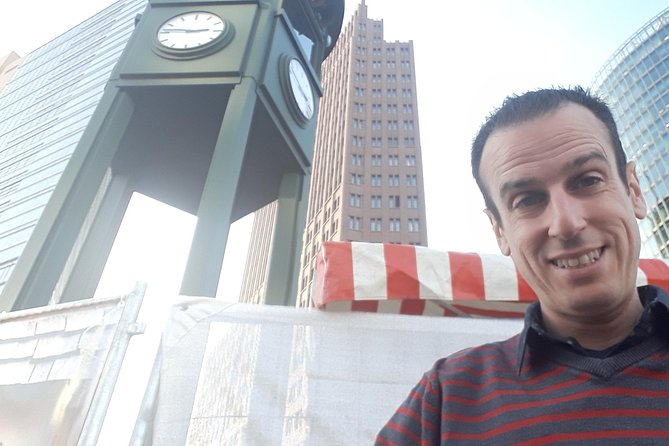
Potsdamer Platz receives about 15 minutes. The stop focuses on the divided city and a freedom concert held after the Cold War.
Potsdamer Platz is a good place to discuss how much Berlin changed after reunification. During the division, the area sat near the border and lost its earlier role as a central city crossroads. After the Wall fell, it became associated with renewal and a more open Berlin.
This stop helps you see that the Cold War was not only about checkpoints and concrete barriers. It also changed the use of land, the flow of people, and the feel of the city center. If you enjoy architecture and urban change, you may want to linger longer than the scheduled time, though doing so could shorten later stops.
Same city, a completely different kind of day:
- Berlin: Reichstag, Dome and Government District Guided Tour
★ 4.7 · 18,288 reviews - Berlin: 1-Hour City Tour by Boat with Guaranteed Seating
★ 4.3 · 16,993 reviews - Berlin: Boat Tour Along the River Spree
★ 4.4 · 11,252 reviews - Discover Berlin Half-Day Walking Tour
★ 5.0 · 9,624 reviews
The former Aviation Ministry and an escape attempt
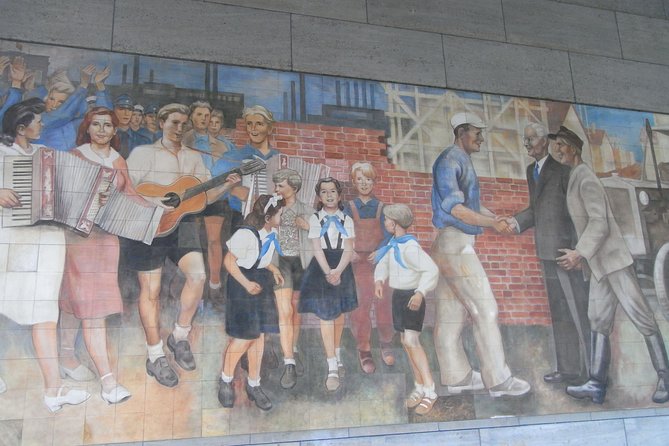
The former Aviation Ministry of Berlin is allotted about 10 minutes. Here, the guide discusses communist ideas of an ideal society through Max Lingner and tells the story of Heinz Holzapfel’s escape attempt.
This is one of the less predictable stops on the route. Instead of focusing only on headline landmarks, it connects political art and personal resistance. Max Lingner’s vision of a communist utopia offers a look at how the state wanted society to appear. Holzapfel’s escape attempt brings the discussion back to the human cost of state control.
The short timing means you will rely heavily on the guide rather than on a long visual visit. That is not a problem if you want a guided explanation, but it does mean this stop works best for people who enjoy specific stories and political ideas, not only major monuments.
The Trabi Museum and everyday East Germany
The Trabi Museum is given 30 minutes, the longest stop on the tour. Admission is listed as free.
The Trabant, commonly called the Trabi, was the East German car that became an everyday symbol of life behind the Iron Curtain. A car can explain an economic system in a way that political dates often cannot. Production limits, waiting, shortages, and the gap between official ideals and ordinary life all become easier to discuss through an object people used daily.
The museum stop also gives the route a change of pace. You move from open streets and landmarks into a place centered on material culture. I like this part because it puts faces and routines behind the larger Cold War story.
One practical note: the tour information lists the museum admission as free, but it does not describe the displays in detail. The 30-minute allocation suggests a proper visit rather than a quick exterior stop, but your guide will determine how much time is spent inside.
Checkpoint Charlie and the most famous crossing
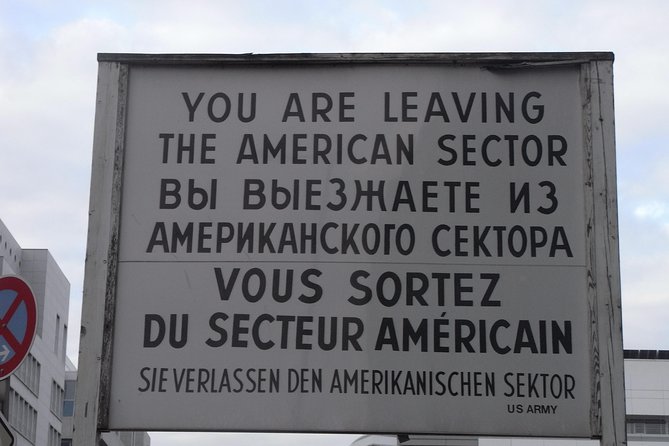
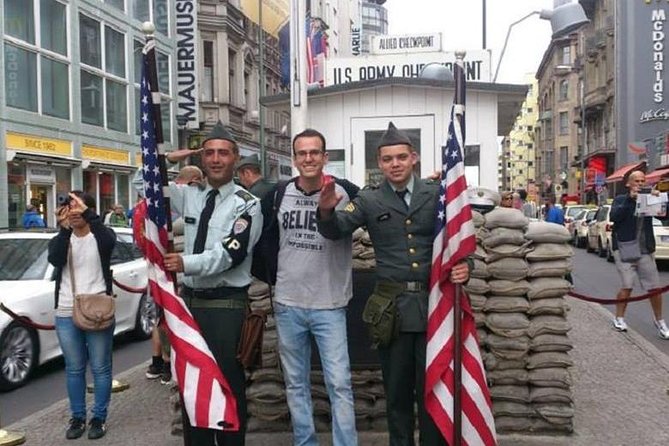
Checkpoint Charlie takes about 10 minutes. The guide presents it as the main crossroads between East and West and explains its Cold War role.
This is probably the stop many people picture first when they think about divided Berlin. The checkpoint became a symbol of confrontation between the United States and the Soviet Union, as well as the daily restrictions placed on movement through the city.
The site is also one of Berlin’s most commercialized Cold War locations. That makes a guide useful. Without context, you may see a recreated checkpoint setting, nearby displays, and crowds without understanding which parts relate to the original border system. The tour can help separate the historical importance of the place from its modern presentation.
Ten minutes is enough for orientation and explanation, but not for a long museum visit. If you want a detailed look at escape stories and border technology, you may need extra time elsewhere.
Friedrichstrasse, the street of checkpoints
Friedrichstrasse receives 20 minutes and is described as the checkpoints street. This stop expands the story beyond the better-known Checkpoint Charlie.
Friedrichstrasse was a major route through the divided city, with border controls shaping how people moved between East and West Berlin. The street lets you consider the practical side of division: documents, inspections, waiting, and the anxiety of crossing.
I find this kind of stop valuable because it shifts attention from a single famous landmark to the wider border system. A city can be divided by many control points, not just one iconic booth. The 20-minute timing gives the guide room to explain the street’s role without rushing quite as much as at Brandenburg Gate or Checkpoint Charlie.
Unter den Linden and the road toward the border
The tour spends about 20 minutes on Unter den Linden, East Germany’s main avenue leading toward the border.
This grand boulevard gives you a sense of the former East German capital’s public face. Wide avenues and official buildings helped present Berlin as a center of socialist government and power. The route also points toward the border, linking the ceremonial heart of East Berlin with the restrictions that shaped it.
This is a good place to ask about how East Berlin functioned as a capital, rather than treating it only as the enclosed half of a divided city. You may find that the modern street is difficult to read without guidance, since the visible city has changed so much. The guide’s map and picture folder should help connect present-day views with earlier scenes.
The Palace of Tears and the personal cost of separation
The Palace of Tears gets 20 minutes. It was a major checkpoint for citizens leaving East Berlin, and its name reflects the farewells that took place there.
This is one of the most emotionally direct stops. Unlike a broad avenue or government building, the site brings the division down to families and friends who had to separate after a visit. Border control was not only a matter of international politics. It affected ordinary people at train stations, crossings, workplaces, and homes.
The stop is also useful because it shows how control worked in daily life. You can think about who was allowed to leave, who had to return, and how a simple goodbye could become a painful event. Twenty minutes gives the subject enough room to breathe.
Alexanderplatz, the TV tower, and the space race
The final stop is Alexanderplatz, where the tour ends after about 10 minutes. The focus includes the TV tower and the space race.
Alexanderplatz was a major public center of East Berlin. The TV tower was built as a strong visual statement of modernity and technical achievement. Its connection to the space race shows how the Cold War was fought through science, engineering, public display, and national pride, not only through soldiers and borders.
Ending here makes practical sense. Alexanderplatz is a major point for continuing your visit, and the tour provides a large subway map to help you get around. The short final stop may feel quick, but it leaves you in a useful part of the city rather than returning you to the starting point.
What the $310 group price really gives you
The price is $310 per group of up to six people. For a full group, that works out to about $52 per person. For two people, it is about $155 each, so the value changes sharply with group size.
I see the strongest value for families or small groups who want a private conversation and a tailored pace. You are paying for the guide’s time, pickup, and route planning rather than for admission to a collection of paid attractions. All listed stops have no admission charge.
Public transport is not included. The estimated ticket cost is about €3 to €11 for a two-hour or day ticket. The exact amount depends on the ticket you choose, so you should allow for that extra expense. A private van and driver can be arranged on request, but that is also not part of the standard price.
Pickup is offered from a Berlin hotel, apartment, train station, or airport. This can save time on your first morning, particularly if you are still learning Berlin’s transport system. Since the tour ends at Alexanderplatz, you should plan what you want to do afterward rather than expecting a return to your hotel.
Who should book this experience
I would choose this tour if you want a clear introduction to Berlin’s Cold War past and prefer asking questions to following a fixed group. It suits first-time visitors, families, and small groups with different levels of interest in history.
It is also a good choice if you want help with the rest of your stay. The picture folder, subway map, and guide availability can make the tour useful beyond its official duration. One person who took the tour found that it covered the major sights while also offering ideas for future independent visits. That is exactly how I would use it: as a well-organized starting point, not the only Berlin history experience you book.
You may want something else if you prefer long museum visits, a very slow walking pace, or a tour focused almost entirely on the Wall itself. Ten stops in less than three hours requires movement and short explanations. The route is broad, with political, social, and urban themes, rather than a narrow study of border engineering.
The tour operates in all weather. Bring an umbrella or suitable rain gear, since several stops are outdoors. Most people can participate, and service animals are allowed. The route is near public transportation, which matters because public transport may be part of the movement between locations.
My call on Jacob’s Cold War tour
I would book this private experience if you are visiting Berlin for the first time, have up to six people, and want the city’s Cold War story explained in a connected way. The combination of personal pickup, a private guide, unusual stories, and a practical subway map gives it more use than a simple landmark walk.
The best value comes with a full group. If you are only two people, compare the per-person cost with other guided options before booking. Also remember that the tour gives you an overview. If the Wall, escape tunnels, or checkpoint procedures are your main passion, plan extra time for a more specialized museum or memorial afterward.
You can cancel for a full refund up to 24 hours before the start time. If your schedule is firm and you want a private introduction to Berlin’s divided past, this is a sensible, focused way to begin.
FAQ
How long does the Cold War and the Wall tour last?
The tour lasts approximately 2 hours and 45 minutes.
How many people can join the private tour?
The standard private tour is for up to six people per group. Bookings larger than 10 people require contacting the provider.
Where does the tour start and finish?
The tour starts in Berlin, with pickup offered from a hotel, apartment, train station, or airport. It ends at Alexanderplatz, 10178 Berlin.
Is public transportation included?
No. Public transport tickets are not included. The estimated cost is about €3 to €11 for a two-hour or day ticket.
Are admission tickets included?
The listed stops have no admission fee. The tour price includes your private guide, but it does not list paid attraction tickets.
Does the tour operate in bad weather?
Yes. The experience operates in all weather conditions, so bring an umbrella or other suitable rain protection.
Can I cancel the booking?
Yes. You can cancel at least 24 hours before the local start time for a full refund. Cancellations or changes made less than 24 hours in advance are not accepted for a refund.
Just added around Berlin
- Love and War in Berlin: Self-Guided Story Puzzle Walk★ 5.0 · 7 reviews
- Rickshaw Tours Berlin – Groups of up to 16 people with several rickshaws★ 4.0 · 97 reviews
- eSIM for Germany and 34 European Countries★ 4.5 · 16 reviews
- Walking on the Wall: 3-Hour Tour in Berlin★ 4.5 · 34 reviews
- Warnemuende Shore Excursion: Berlin Private Sightseeing Tour from Rostock★ 5.0 · 4 reviews
- Your ticket to The Wall Museum Berlin★ 3.0 · 60 reviews
- Warnemuende Shore Excursion: Private Berlin Tour★ 4.5 · 27 reviews
- Berlin’s Gay, Lesbian, and Queer Scene Small-Group Walking Tour★ 4.5 · 66 reviews
Third Reich & Cold War Tours, compared.



Berlin’s Best: 2 Hour Walking Tour Third Reich and the Cold War
Read our review →

Third Reich Berlin: Hitler and WWII Walking Tour
Read our review →
Skip-the-Line: Berlin Wall Museum at Checkpoint Charlie
Read our review →

Cold War, Berlin Wall, Spies and the East Side Gallery
Read our review →Browse the lists this tour appears in