
Reviewed · THIRD REICH & COLD WAR TOURS
Hitler to Stalin – WWII & Cold War Tour (Small Group)
Berlin’s past is not locked away in a museum. It is under your feet, beside busy streets, and hidden in plain sight. This 2.5-hour walk from Brandenburg Gate to Checkpoint Charlie connects Nazi power, the Battle of Berlin, Soviet occupation, the Holocaust, and the Cold War in one tight route.
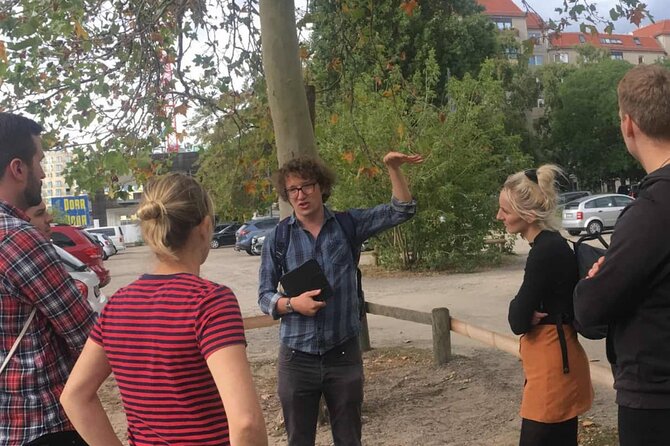
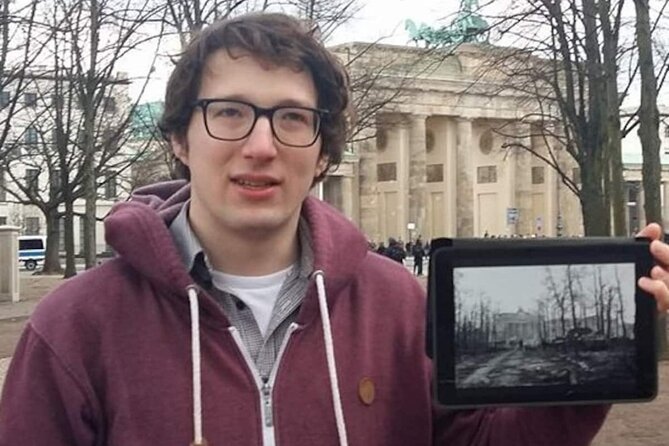
I like two things here. First, the tour visits real sites rather than relying on a classroom lecture. Second, guide Mark uses historical photographs to show how these places looked during the war. The main drawback is equally clear: this is a walking tour with many stops, so the pace and outdoor format may feel demanding in poor weather.
In This Review
- Key points
- Why this route gives Berlin’s history a clear shape
- Brandenburg Gate sets the political stage
- The Reichstag connects empire, dictatorship, and democracy
- The Soviet Memorial remembers the Battle of Berlin
- The Holocaust Memorial asks you to slow down
- The Führerbunker site shows how little remains
- The North Korean embassy adds a Cold War oddity
- June 17, 1953, reveals East German resistance
- The Berlin Wall Memorial makes division personal
- Checkpoint Charlie finishes with Cold War theater
- What the $23 price really gets you
- Timing, walking, and weather
- Who will get the most from this walk
- Should you book Hitler to Stalin?
- FAQ
- Where does the tour begin?
- Where does the tour end?
- How long does the tour last?
- What is the maximum group size?
- Is admission included at the stops?
- Does the tour include Checkpoint Charlie?
- Does the tour visit the Holocaust Memorial?
- Is the tour suitable for most people?
- What happens if I need to cancel?
Key points
- Brandenburg Gate to Checkpoint Charlie: The route links Berlin’s most recognizable symbols in a single walk.
- Hitler’s bunker site: You learn what happened at Hitler’s final headquarters, now marked only by an unremarkable location.
- A serious look at the Holocaust: The Memorial to the Murdered Jews of Europe gets time for quiet reflection, not just a quick photograph.
- Cold War Berlin in context: The 1953 uprising, Berlin Wall Memorial, and Checkpoint Charlie show how division shaped daily life.
- Small group setting: The tour accepts no more than 15 people, giving you a better chance to hear the guide and ask questions.
- Strong guide-led storytelling: Mark is singled out for his clear explanations, enthusiasm, and use of before-and-after images.
Why this route gives Berlin’s history a clear shape
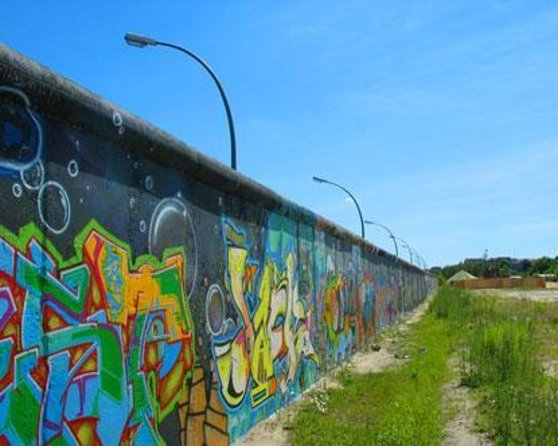
Berlin can feel like a collection of powerful but disconnected monuments. One moment you are at a royal gateway, then at a parliament building, then beside a concrete memorial to murdered Jews. Without context, the city’s landmarks can blur together.
This tour gives you a usable timeline. You begin with the political center of imperial and modern Germany, move through the Nazi period and the destruction of 1945, then follow the division of Berlin and the Cold War to Checkpoint Charlie.
That order matters. It helps you see that Berlin’s story was not simply one war followed by another. The city moved from monarchy to democracy, dictatorship, defeat, occupation, partition, protest, and reunification. A good guide can make those changes easier to follow, and the feedback about Mark points to that being a major strength.
The route also keeps the focus on people. You hear about Berliners living through bombardment, Jews murdered across Europe, East German workers protesting communist rule, and families divided by a wall. That human focus keeps the tour from becoming just a parade of dates.
More Third Reich & Cold War Tours in Berlin
- Berlin: Third Reich and Cold War 2 Hour Walking Tour
★ 4.9 · 6,830 reviews - Berlin’s Best: 2 Hour Walking Tour Third Reich and the Cold War
★ 5.0 · 5,486 reviews - Third Reich Berlin: Hitler and WWII Walking Tour
★ 5.0 · 3,301 reviews
Brandenburg Gate sets the political stage
The walk begins at Brandenburg Gate, on Pariser Platz. Built in the 18th century under Frederick William II, it originally marked a city entrance. Today it is one of Berlin’s clearest symbols of unity and peace.
The gate works well as a starting point because it has carried several meanings over time. It belonged to the old Prussian capital, later became linked with German power, and was caught up in the dramatic events of the 20th century. Its location near Unter den Linden and the Reichstag places you in the heart of Berlin’s political district from the first minute.
You get about 10 minutes here. That is enough for an introduction and orientation, but not a long architectural study. If you arrive early, take a moment to look across Pariser Platz and note how open the area feels today. The openness contrasts sharply with the city’s later division.
The Reichstag connects empire, dictatorship, and democracy
The Reichstag Building is only a short distance away. It was built for the Imperial Diet of the German Empire and opened in 1894. After the fire of 1933, it became tied to the Nazi seizure of power, even though the building’s full political story is more complicated than the fire alone.
The structure suffered serious damage during World War II and was fully restored in 1999. Today it houses the Bundestag, Germany’s lower house of parliament.
Your stop lasts about 15 minutes, and the tour focuses on the building’s historical role rather than an interior visit. That distinction is important. This is not a Reichstag dome tour, and no admission ticket is included because the group is viewing the building from the outside.
I like this stop because it gives you a way to think about how democratic institutions can be weakened or destroyed. The Reichstag is not just an impressive façade. It represents Germany’s changing political system, from empire to republic, dictatorship, division, and renewed democracy.
The Soviet Memorial remembers the Battle of Berlin
The Soviet War Memorial in the Großer Tiergarten was erected in 1945 to commemorate Soviet soldiers killed in the Battle of Berlin. The site is a reminder that the final defeat of Nazi Germany came with enormous military and civilian suffering.
You spend around 15 minutes here. The memorial adds a necessary Soviet perspective to a tour that might otherwise focus mainly on German and Western Allied experiences. The Battle of Berlin was not an abstract final chapter. It was fought street by street, and the Soviet army paid a heavy price in taking the city.
This is also a useful place to consider the uneasy position of memorials in Berlin. The monument honors the dead soldiers of a regime that would soon impose its own political control over East Germany. Commemoration and power often overlap here.
The location in the Tiergarten provides some breathing room after the dense political center, but remember that the tour remains outdoors. Comfortable shoes are a sensible choice.
Same city, a completely different kind of day:
- Berlin: Reichstag, Dome and Government District Guided Tour
★ 4.7 · 18,288 reviews - Berlin: 1-Hour City Tour by Boat with Guaranteed Seating
★ 4.3 · 16,993 reviews - Berlin: Boat Tour Along the River Spree
★ 4.4 · 11,252 reviews - Discover Berlin Half-Day Walking Tour
★ 5.0 · 9,624 reviews
The Holocaust Memorial asks you to slow down
The Memorial to the Murdered Jews of Europe is one of the tour’s most important stops. Architect Peter Eisenman designed a field of 2,711 concrete slabs across about 19,000 square meters.
The blocks vary in height, and the ground slopes and shifts beneath them. As you walk among the slabs, the surroundings can disappear. The memorial offers no simple statue or single sentence that tells you how to feel. Its abstract form leaves room for personal response, while the uneven ground can create a sense of uncertainty.
The group spends about 15 minutes here. That is enough for the guide to explain the memorial and give you time to look around, though you may want to return alone later if you prefer a longer, quieter visit.
I value the stop because it treats remembrance as more than a photograph. You are asked to pay attention to space, absence, and discomfort. The memorial is also close to several other major sites, which makes it easy to revisit after the tour.
Be respectful here. This is not a backdrop for loud conversation or casual posing. The concrete field is public space, but it is also a national memorial to millions of murdered Jews.
The Führerbunker site shows how little remains
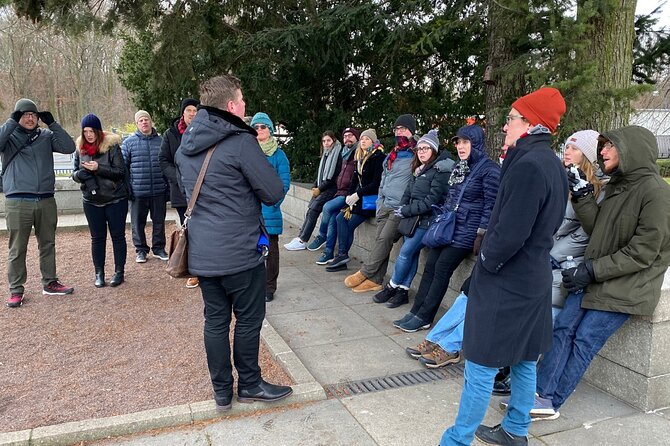
The former Führerbunker is a striking stop precisely because there is almost nothing to see. It was an air raid shelter and Hitler’s final headquarters. Hitler moved into the bunker on January 16, 1945, married Eva Braun on April 29, and the couple died by suicide less than 40 hours later.
The old Chancellery buildings were destroyed by the Soviets, and the underground complex remained largely undisturbed until 1988. The site is now associated with an ordinary urban setting rather than a grand monument to Nazi power.
You spend about 15 minutes here. The guide’s explanation is essential because the physical location does not tell the story by itself. Mark’s use of old photographs is particularly helpful at a stop like this. Seeing the former buildings alongside the present setting helps you understand how completely Berlin tried to remove the visual presence of the Nazi headquarters.
This stop also supports an important lesson: not every major historical place has a dramatic ruin. The absence of a grand memorial is part of the point. Germany has generally avoided turning Hitler’s final headquarters into a shrine or spectacle.
The North Korean embassy adds a Cold War oddity
The route then includes the embassy of the Democratic People’s Republic of Korea at Glinkastraße 5 in Mitte. On its own, this may seem like an unusual addition to a WWII tour. In the wider story of divided Berlin, it makes more sense.
Berlin was a front line in the global contest between communist and Western powers. A North Korean diplomatic presence in the city offers a small but unusual reminder that the Cold War was international, not simply a dispute between East and West Germany.
The stop lasts about 10 minutes. Do not expect a major monument or a long sightseeing visit here. Its value is historical context. The location helps show how Berlin became connected to conflicts far beyond Germany.
June 17, 1953, reveals East German resistance
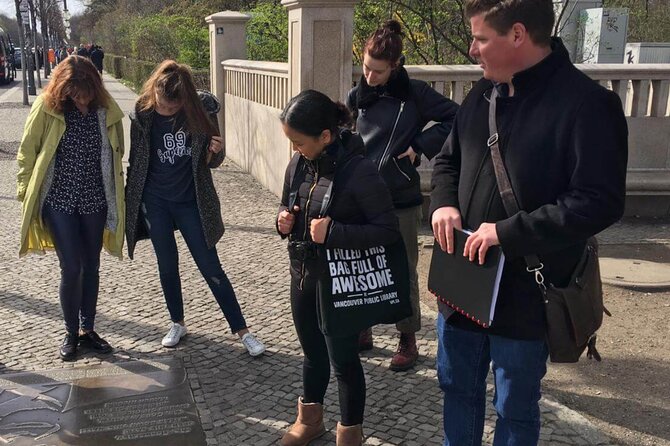
At the memorial to the June 17, 1953 uprising, the tour turns to one of the first major challenges to communist rule after the war. The uprising began with workers’ protests and grew into a broader revolt. Soviet tanks suppressed it, and about 15,000 people were arrested afterward.
You get roughly 15 minutes at the memorial. This is one of the route’s most useful Cold War stops because it puts ordinary East Germans at the center of the story. The Cold War was not only about leaders, missiles, and diplomatic crises. It also involved workers who challenged the government and faced severe punishment.
The uprising helps explain why the East German state depended so heavily on control and force. It also gives you a better framework for understanding later unrest, including the pressures that eventually helped bring down the Berlin Wall.
The Berlin Wall Memorial makes division personal
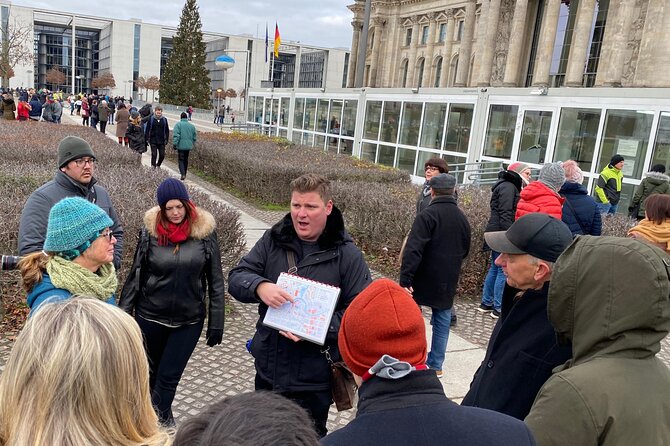
The Berlin Wall Memorial commemorates the division of the city and the people who died trying to cross it. This is a more meaningful stop than simply seeing a decorated piece of surviving wall.
The memorial focuses on the physical border and the human cost of that border. Berlin’s division affected where people worked, lived, studied, and visited family. A wall could split a street, a neighborhood, and sometimes a household.
You spend about 15 minutes here. The guide can connect this location to the wider events that produced the wall and the later developments that led to its fall. The learning goal is not just to identify concrete and barbed wire. It is to understand why Berlin’s partition mattered across Europe and around the world.
The time is fairly short for such a serious subject. If the wall is a main reason for your visit, you may want to return to this area independently after the tour.
Checkpoint Charlie finishes with Cold War theater
The final stop is Checkpoint Charlie on Friedrichstraße, where the walk ends. Western Allies called this crossing point Checkpoint C, while the nickname Charlie came from the NATO phonetic alphabet.
It became the best-known crossing between East and West Berlin. The site now sits in a busy central area, and its fame can make it feel more like a city attraction than a preserved border post. That is exactly why context helps.
The tour gives you about 20 minutes here, the longest stop on the route. You can use that time to understand the checkpoint’s role in the Cold War and how the division of Berlin became a global symbol.
Checkpoint Charlie is a fitting ending because it brings the political story into one visible point. The earlier stops explain how Germany reached dictatorship and defeat. The later stops show how victory over Nazism did not bring simple freedom or unity. The checkpoint represents the tense division that followed.
What the $23 price really gets you
At $23, this is a low-cost way to cover a large amount of central Berlin. All listed stops are viewed from public areas, and admission tickets are free. You are paying mainly for the guide’s organization, historical explanation, and ability to connect places that you could visit separately.
That is good value if you want a clear introduction to Berlin’s 20th-century story. A self-guided walk would cost less, but you would need to research the sites, find old images, build a route, and decide how the events fit together. The guide saves you that work.
The small group limit of 15 also matters. It is not a private tour, but it is more manageable than a large group. You have a better chance of hearing the explanation and asking a question, especially at busy sites such as Brandenburg Gate and Checkpoint Charlie.
The tour does not include museum entry, transport, food, or a Reichstag interior visit. Its value depends on how much you want guided interpretation rather than access to indoor attractions.
Timing, walking, and weather
The advertised duration is about two hours and 30 minutes. The nine stops add up to roughly two hours and 10 minutes of stated stop time, leaving only limited room for walking between locations, introductions, and questions.
That tells you something useful about the pace. You will not spend an hour at each site. Instead, you get concise explanations across a broad route. Wear comfortable shoes and keep your expectations realistic. This is a focused overview, not a slow museum-style study of every monument.
The tour starts at Brandenburg Gate and finishes at Checkpoint Charlie, both in central Berlin. That makes the end point useful if you plan to continue sightseeing in Mitte.
Service animals are allowed, the route is near public transportation, and the information says most people can participate. The experience requires good weather, so outdoor conditions matter. If poor weather cancels the tour, you are offered another date or a full refund.
You can cancel for a full refund up to 24 hours before the start time. Changes or cancellations within 24 hours are not accepted for a refund. The tour also requires a minimum number of participants, so an insufficient group can lead to a new date, another experience, or a full refund.
Who will get the most from this walk
I would choose this tour if you are visiting Berlin for the first time and want a firm historical framework. It is also a good fit if you prefer places connected to real events over a general city orientation.
The tour suits anyone interested in:
- Nazi Germany and the final days of World War II
- The Holocaust and public remembrance
- Soviet power in postwar Berlin
- East German resistance
- The Berlin Wall and divided Europe
- Political landmarks in central Berlin
It may be less suitable if you dislike outdoor walking, want long periods of quiet at memorials, or expect entry into the Reichstag or other buildings. The tour is also emotionally serious. The Holocaust Memorial, bunker site, and accounts of repression are not light sightseeing.
Mark appears to be the guide to look for when booking dates that he leads. His strongest qualities are his command of the subject, enthusiasm, and use of photographs showing Berlin during the war compared with the city today. He also handles questions well, which matters on a subject where one answer often leads to another.
Should you book Hitler to Stalin?
Book it if you want Berlin’s major WWII and Cold War sites explained in a logical sequence for $23. The combination of Brandenburg Gate, Reichstag, Soviet Memorial, Holocaust Memorial, Führerbunker site, the 1953 uprising memorial, Berlin Wall Memorial, and Checkpoint Charlie gives you a lot in one morning or afternoon.
I would especially recommend it early in your Berlin visit. The tour can help you understand later museum visits and make the city’s memorials easier to place in time.
Skip it if you need an indoor activity, want detailed access to buildings, or prefer to explore each memorial alone. For most people seeking an affordable, serious introduction to Berlin’s 20th-century past, the small group size and strong guide-led storytelling make this a sensible choice.
FAQ
Where does the tour begin?
The tour begins at Brandenburg Gate, Pariser Platz, 10117 Berlin, Germany.
Where does the tour end?
The tour ends at Checkpoint Charlie, Friedrichstraße 43-45, 10117 Berlin, Germany.
How long does the tour last?
The tour lasts approximately two hours and 30 minutes.
What is the maximum group size?
The tour accepts a maximum of 15 participants.
Is admission included at the stops?
The listed stops have free admission. The experience does not state that it includes entry into the Reichstag or any other indoor attraction.
Does the tour include Checkpoint Charlie?
Yes. Checkpoint Charlie is the final stop, with about 20 minutes scheduled there.
Does the tour visit the Holocaust Memorial?
Yes. The tour visits the Memorial to the Murdered Jews of Europe, designed by Peter Eisenman and made up of 2,711 concrete slabs.
Is the tour suitable for most people?
The tour information says most people can participate. It is an outdoor walking experience, and service animals are allowed.
What happens if I need to cancel?
You receive a full refund if you cancel at least 24 hours before the start time. Cancellations or changes made less than 24 hours before the experience are not refunded.
Just added around Berlin
- Love and War in Berlin: Self-Guided Story Puzzle Walk★ 5.0 · 7 reviews
- Rickshaw Tours Berlin – Groups of up to 16 people with several rickshaws★ 4.0 · 97 reviews
- Walking on the Wall: 3-Hour Tour in Berlin★ 4.5 · 34 reviews
- eSIM for Germany and 34 European Countries★ 4.5 · 16 reviews
- Warnemuende Shore Excursion: Berlin Private Sightseeing Tour from Rostock★ 5.0 · 4 reviews
- Your ticket to The Wall Museum Berlin★ 3.0 · 60 reviews
- Warnemuende Shore Excursion: Private Berlin Tour★ 4.5 · 27 reviews
- Berlin’s Gay, Lesbian, and Queer Scene Small-Group Walking Tour★ 4.5 · 66 reviews
Third Reich & Cold War Tours, compared.



Berlin’s Best: 2 Hour Walking Tour Third Reich and the Cold War
Read our review →

Third Reich Berlin: Hitler and WWII Walking Tour
Read our review →
Skip-the-Line: Berlin Wall Museum at Checkpoint Charlie
Read our review →

Cold War, Berlin Wall, Spies and the East Side Gallery
Read our review →Browse the lists this tour appears in