
Reviewed · THIRD REICH & COLD WAR TOURS
Explore The Berlin Wall: Cold War Berlin and Behind the Berlin Wall
Berlin’s Wall is easy to misunderstand if you only see a painted fragment beside a busy street. This tour connects the surviving pieces, escape stories, watchtowers, death strip, and vanished border into one clear three-hour story. The most powerful stop is the Berlin Wall Memorial, where a preserved cross-section shows how the barrier actually worked.
I like the way the tour reaches several sites without asking you to plan a complicated route. I also like the guides’ personal teaching style. Ciaran, Eugen, Paul, Steve, and Aurel G. are praised for explaining difficult Cold War politics in plain English and answering questions rather than rushing through a script.
The main consideration is pace. You cover a lot of ground, sometimes by subway or tram, with quite a bit of walking. The tour is a strong choice for history-minded visitors, but it may feel brisk if you want long museum visits or many photographs at every stop.
In This Review
- Key points to know before booking
- Why this Berlin Wall tour works better than a quick photo stop
- Starting at Ebertstraße at 10 a.m.
- Berlin Wall Memorial: the clearest view of the border system
- Checkpoint Charlie: famous, useful, and best understood with context
- Topography of Terror: a surviving fragment with two layers of history
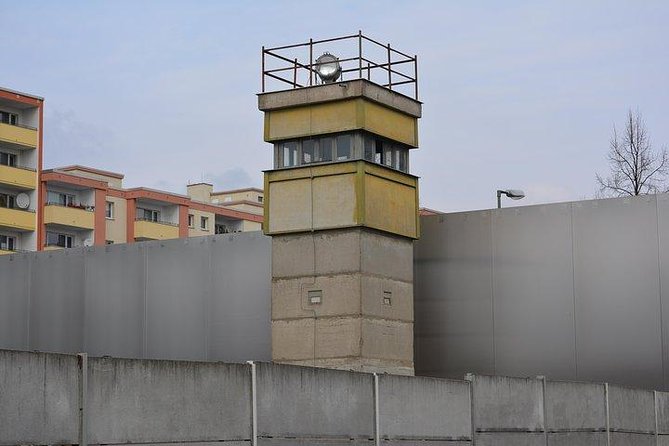
- The GDR watchtower: a rare piece of the border apparatus
- Potsdamer Platz: from death strip to modern Berlin
- The guides are the main reason to book
- Price, value, and what the three hours include
- Who should book this experience?
- Cancellation and booking details
- Should you book the Berlin Wall tour?
- FAQ
- How long does the Berlin Wall tour last?
- Where does the tour begin and end?
- Which Berlin Wall sites are included?
- Is admission included?
- Can I use a mobile ticket?
- Can I cancel for a full refund?
Key points to know before booking
- The Berlin Wall Memorial is the tour’s anchor: You see the only preserved complete cross-section of the Wall and death strip.
- Escape stories give the history a human face: The route includes sites tied to both failed and successful attempts to reach West Berlin.
- Several guides receive especially strong praise: Ciaran, Eugen, Paul, Steve, and Aurel G. are noted for clear explanations, warmth, and patience.
- You visit more than the famous photo spots: The route includes a surviving watchtower, the Wall beside the Topography of Terror, and Potsdamer Platz.
- Public transport is part of the experience: Previous groups have used subway and tram connections to link the sites.
- The small-group format matters: The stated maximum varies between 15 and 21 people, so check your confirmation, but either size is manageable for a walking tour.
Why this Berlin Wall tour works better than a quick photo stop
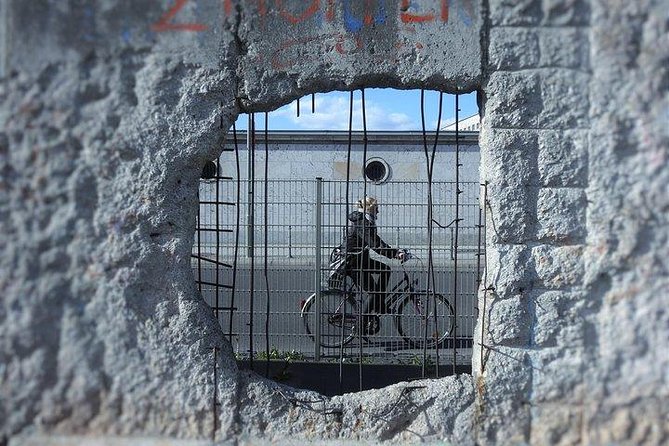
A Berlin Wall tour should do more than point out a strip of concrete. The Wall was a system of barriers, patrol roads, fences, lights, towers, and open ground known as the death strip. Much of it disappeared after reunification, so a visitor moving around central Berlin can easily miss how severe the division once was.
This route helps you reconstruct that lost border. You see the best-preserved memorial area, then compare it with famous but more commercial places such as Checkpoint Charlie. You also see how land once used to divide Berlin has become ordinary city space again.
That contrast is one of the tour’s best features. At Potsdamer Platz, high-rise offices and entertainment buildings occupy what was once a desolate area near the border. You are not simply looking at old concrete. You are seeing how the city changed after reunification.
The guides also add value by linking political decisions to daily life. Reviews of the tour repeatedly praise Ciaran, Eugen, Paul, Steve, and Aurel G. for explaining the complexity of East and West Berlin without making the subject dull or confusing. Steve is described as a public historian, while Aurel G. brings a personal connection to the subject. Ciaran has used old family photographs from a visit to the Wall in the early 1980s to show how the same places looked before the Wall fell.
That kind of comparison can make the past easier to picture. It is especially useful for teenagers and for anyone who knows the basic dates but wants to understand what the division felt like on the ground.
More Third Reich & Cold War Tours in Berlin
- Berlin: Third Reich and Cold War 2 Hour Walking Tour
★ 4.9 · 6,830 reviews - Berlin’s Best: 2 Hour Walking Tour Third Reich and the Cold War
★ 5.0 · 5,486 reviews - Third Reich Berlin: Hitler and WWII Walking Tour
★ 5.0 · 3,301 reviews
Starting at Ebertstraße at 10 a.m.
The meeting point is Birchys Berlin Tours at Ebertstraße 24, 10117 Berlin. The start time is 10 a.m., and the tour returns to the same meeting point at the end.
You should arrive ready to walk and to use public transportation. The group may travel by subway and tram between parts of the route. That is practical because the surviving Wall sites are scattered, and it lets you see how present-day Berlin connects areas that were once separated.
A three-hour tour can pass quickly when the guide is explaining escape attempts, border controls, and the 1961 confrontation between American and Soviet forces. You will likely spend more time outdoors than inside, so dress for the weather. One highly praised tour took place in snow and ice, and the group still found the experience worthwhile, but cold conditions will make the walking feel harder.
Snacks and bottled water are not included. Bring your own water, especially if you are visiting in warm weather or prefer not to stop during the tour.
The group size is described inconsistently as a maximum of 15 or 21 people. That difference is worth checking after booking. Either way, this is not presented as a huge coach excursion, and a smaller group makes it easier to hear the guide and ask questions.
Berlin Wall Memorial: the clearest view of the border system
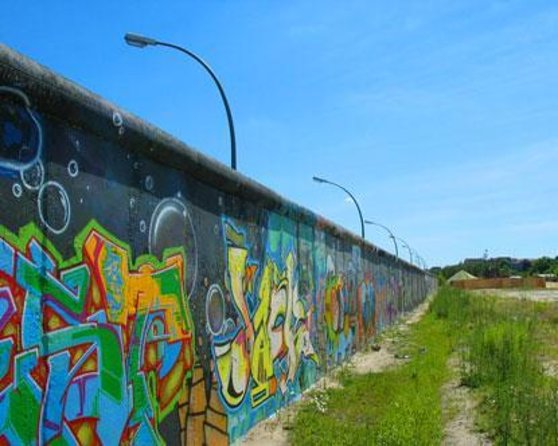
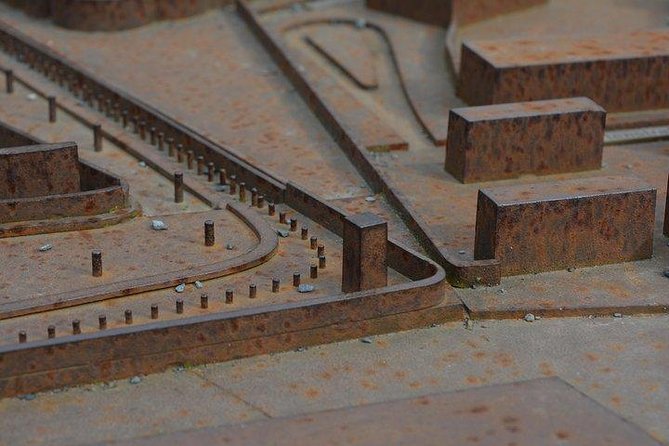
The first stop receives about one hour and 20 minutes, making it the heart of the experience. The Berlin Wall Memorial stretches for more than a kilometer and includes the only preserved complete cross-section of the Wall and death strip.
This is where the tour moves beyond the familiar image of a graffiti-covered barrier. A complete section helps you understand the layered design of the border and the space between East and West. Your guide can explain how that arrangement affected escape attempts and why crossing was so dangerous.
The site is also linked to tragic deaths and remarkable escapes. Those stories matter because the Wall was not an abstract Cold War line. It cut through neighborhoods, separated families, and turned ordinary movement into a serious risk.
Allow yourself to look carefully rather than treating the memorial as a quick stop. The long memorial area gives the guide room to explain how the border changed and how the surrounding city was reshaped. You may also find that this is the point where the history becomes easiest to follow, since the physical evidence is more complete than at many central locations.
The free admission is another practical benefit. You are paying for the guide’s interpretation and route planning, not for a special entry ticket.
Checkpoint Charlie: famous, useful, and best understood with context
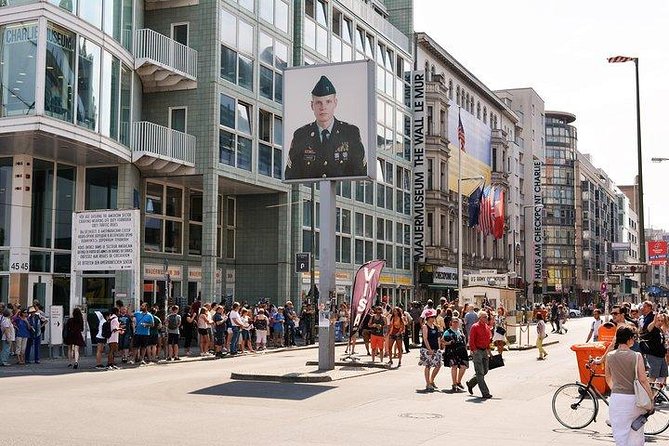
Checkpoint Charlie takes about 15 minutes. It is the best-known crossing point between East and West Berlin and the site of an extraordinary American-Soviet face-off in autumn 1961.
The stop is brief for a reason. Checkpoint Charlie is a famous symbol, but it does not preserve a full stretch of the former border in the same way as the Wall Memorial. If you visit alone, you might take a photograph and leave without understanding why the checkpoint mattered.
A guide can supply that missing context. You hear about failed and successful escapes and the tension between the American and Soviet forces. That turns a quick photo stop into a lesson about how close the Cold War could come to direct conflict.
You should keep your expectations sensible. This is an urban landmark, not a large preserved border complex. Its value on this tour comes from the explanation and its place in the wider route.
Same city, a completely different kind of day:
- Berlin: Reichstag, Dome and Government District Guided Tour
★ 4.7 · 18,288 reviews - Berlin: 1-Hour City Tour by Boat with Guaranteed Seating
★ 4.3 · 16,993 reviews - Berlin: Boat Tour Along the River Spree
★ 4.4 · 11,252 reviews - Discover Berlin Half-Day Walking Tour
★ 5.0 · 9,624 reviews
Topography of Terror: a surviving fragment with two layers of history
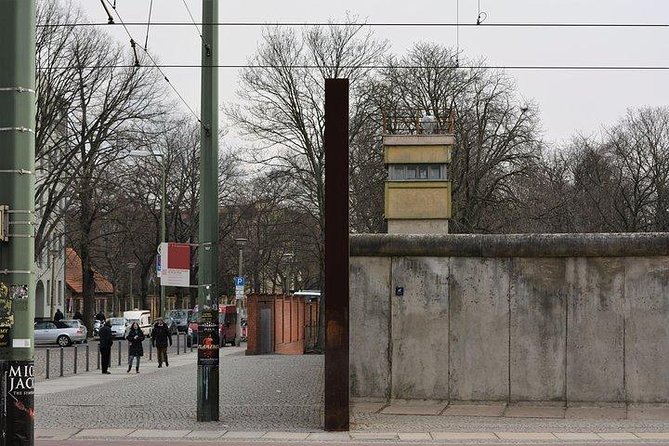
The next stop lasts around 10 minutes and takes you to the Wall fragment on Niederkirchnerstrasse. It is described as the only surviving section of the Wall in this part of Berlin.
The location is especially useful because the Wall is beside the former Luftwaffe Headquarters, later used during the East German period as the House of Ministries. That setting puts Nazi Germany, East Germany, and the divided city close together in one place.
The stop also connects to one of the more remarkable escapes into West Berlin. The guide’s job here is to explain how the surrounding buildings and border line fit together, rather than leaving you with a random piece of concrete.
Ten minutes is not enough for a full visit to every nearby exhibit, so do not expect this portion to replace a longer museum visit. Still, it adds an important layer to the tour and shows why Berlin’s history cannot be neatly divided into separate chapters.
The GDR watchtower: a rare piece of the border apparatus
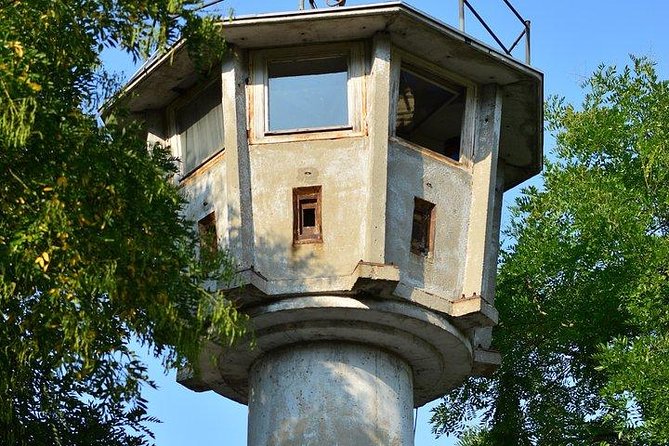
You spend about 15 minutes at the surviving GDR watchtower. This is the last of the BT variant watchtowers that once surrounded West Berlin, saved through private action.
The tower helps complete the picture begun at the memorial. A wall fragment shows the barrier, but a watchtower suggests the surveillance system around it. The possibility of ascending the tower makes this stop more than another pavement-side explanation, although the information says you may be able to ascend rather than promising it every time.
Admission to the watchtower is included. That is a small but useful value point, since there are no extra entry costs at the main stops.
This is also one of the less obvious parts of the route. Many first-time visitors know about Checkpoint Charlie and the East Side Gallery, but fewer know where to see a surviving border tower. If you have already visited Berlin, this stop may add something genuinely new.
Potsdamer Platz: from death strip to modern Berlin
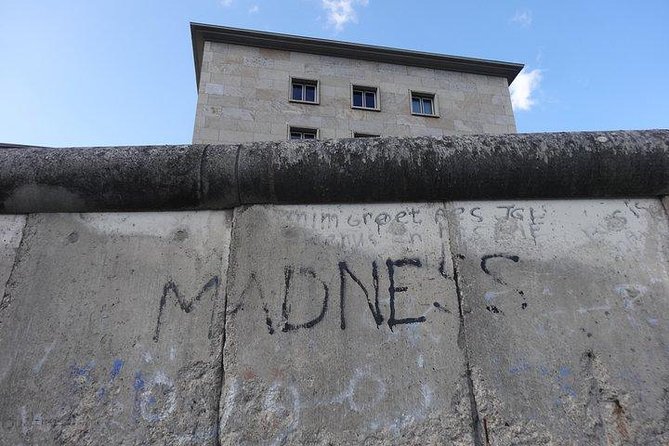
The final stop takes about 10 minutes. Potsdamer Platz once sat in and beside the death strip, an empty and heavily divided part of the city. Today it is a high-rise business and entertainment district.
The change is dramatic, but the point is not simply that modern buildings replaced old ones. Your guide shows how reunified Berlin rebuilt a central area that had been left desolate by the border. You can look at the present-day streets while learning what was missing here before 1989.
This is a fitting final stop because it shifts the story from division to reunification. The Wall Memorial shows the human cost. Potsdamer Platz shows the physical result of a city trying to reconnect and rebuild.
The short visit works best as a closing comparison. If you want extensive time for architecture or shopping, you can return later on your own. During the tour, the important thing is seeing the sharp change in use and atmosphere.
The guides are the main reason to book
The route is strong, but the guide makes the difference. The most consistent praise goes to Ciaran, Eugen, Paul, Steve, and Aurel G. They are described as clear, friendly, passionate, and able to handle detailed questions.
Eugen is praised for bringing the Wall and its people to life, while also helping with practical matters such as train tickets. Paul receives credit for explaining Berlin’s complicated history in an interesting way. Steve is noted for linking different strands of history and explaining the differences between East and West Berlin.
Ciaran appears often in the praise for his enthusiasm and depth of explanation. One family found his use of older photographs particularly effective, including images taken by his mother during a visit to the Wall in the early 1980s. That is the kind of personal touch that can make a familiar subject feel immediate.
You should not expect every departure to have the same guide. Names are given as examples of the team, not as a guarantee for your date. Still, the repeated emphasis on teaching skill is encouraging. The guides do not seem limited to memorized facts. They answer questions and can discuss related historical issues when the group wants more detail.
This tour will suit you best if you enjoy asking questions. It also works for families with older children and teenagers, since the stories and visual comparisons can make the subject easier to grasp than a textbook account.
Price, value, and what the three hours include
At $32.67 per person, the tour is reasonably priced for a guided three-hour route covering several parts of Berlin. You are not paying for museum admission at most stops, but you are paying for route planning, public transport guidance, and interpretation at sites that can be confusing on your own.
The value is strongest if this is your first serious look at the Berlin Wall. You avoid spending part of your morning figuring out which fragments are worth seeing and how to connect them. You also get historical context at places that might otherwise seem disconnected.
The price is less compelling if you already know the Wall sites well and prefer to explore at your own pace. You will have limited time at each of the shorter stops, and you must follow the group’s movement between locations.
The tour includes admission to the GDR watchtower. Snacks and bottled water are not included, so plan for those yourself.
Who should book this experience?
I would choose this tour if you want a focused introduction to Cold War Berlin rather than a general city sightseeing walk. It is especially well suited to:
- History buffs interested in the Cold War, escape attempts, and the division of Berlin
- First-time visitors who want to see several Wall locations efficiently
- Families with teenagers who respond better to stories, photographs, and real places
- Repeat visitors who have seen the headline sights but want lesser-known Wall remains
- Visitors who prefer a small group and the chance to ask questions
You may want a different format if you dislike walking, need long periods indoors, or want to spend an hour at every stop. The tour is active and information-heavy, even though most people can participate and service animals are allowed.
A mobile ticket is accepted, and confirmation is issued at booking. The meeting point is near public transportation, which helps with arrival and the return journey.
Cancellation and booking details
Free cancellation is available if you cancel at least 24 hours before the 10 a.m. start time. Cancellations made less than 24 hours ahead are not refunded, and late changes are not accepted.
The tour needs a minimum number of participants. If that minimum is not reached and the experience is canceled, you are offered another date or experience, or a full refund.
Should you book the Berlin Wall tour?
Book it if you want the Berlin Wall explained as a connected story, not as a series of isolated photo stops. The preserved memorial cross-section, the watchtower, escape accounts, Checkpoint Charlie, and the changed Potsdamer Platz give you a useful range of evidence in one morning.
I especially like the balance between major sights and less obvious remains. The guides’ ability to explain complex politics in clear English is another strong reason to go, with Ciaran, Eugen, Paul, Steve, and Aurel G. all receiving strong praise for their teaching.
Skip it if you want a slow, self-guided morning with lots of museum time. For most visitors who want to understand what divided Berlin, how people tried to cross, and what reunification changed, the $32.67 cost is fair and the three-hour route is well spent.
FAQ
How long does the Berlin Wall tour last?
The experience lasts approximately three hours.
Where does the tour begin and end?
It begins at Birchys Berlin Tours, Ebertstraße 24, 10117 Berlin, Germany, at 10 a.m., and ends back at the same meeting point.
Which Berlin Wall sites are included?
The route includes the Berlin Wall Memorial, Checkpoint Charlie, the Wall fragment at the Topography of Terror, a GDR watchtower, and Potsdamer Platz.
Is admission included?
Admission is free at the Berlin Wall Memorial, Checkpoint Charlie, the Topography of Terror stop, and Potsdamer Platz. Admission to the GDR watchtower is included.
Can I use a mobile ticket?
Yes. You can present either a paper voucher or an electronic voucher.
Can I cancel for a full refund?
Yes, if you cancel at least 24 hours before the experience start time. Cancellations made less than 24 hours before the start are not refunded.
Just added around Berlin
- Love and War in Berlin: Self-Guided Story Puzzle Walk★ 5.0 · 7 reviews
- Rickshaw Tours Berlin – Groups of up to 16 people with several rickshaws★ 4.0 · 97 reviews
- Walking on the Wall: 3-Hour Tour in Berlin★ 4.5 · 34 reviews
- eSIM for Germany and 34 European Countries★ 4.5 · 16 reviews
- Warnemuende Shore Excursion: Berlin Private Sightseeing Tour from Rostock★ 5.0 · 4 reviews
- Your ticket to The Wall Museum Berlin★ 3.0 · 60 reviews
- Warnemuende Shore Excursion: Private Berlin Tour★ 4.5 · 27 reviews
- Karl-Marx-Allee Tour: Life and Architecture in East Berlin★ 5.0 · 19 reviews
Third Reich & Cold War Tours, compared.



Berlin’s Best: 2 Hour Walking Tour Third Reich and the Cold War
Read our review →

Third Reich Berlin: Hitler and WWII Walking Tour
Read our review →
Skip-the-Line: Berlin Wall Museum at Checkpoint Charlie
Read our review →

Cold War, Berlin Wall, Spies and the East Side Gallery
Read our review →Browse the lists this tour appears in