
Reviewed · THIRD REICH & COLD WAR TOURS
Cold War and Berlin Wall Tour in Italian
Berlin’s Cold War story comes into focus when you move through the city itself. This Italian-language walking tour links the Wall Memorial, Alexanderplatz, Karl-Marx-Allee, and the East Side Gallery, so you see both the machinery of division and the public spaces where that system began to crack.
I like the route’s range: one tour covers several major sites, and the guide explains the meaning behind them instead of leaving you to piece together plaques and maps. I also like the human side of the program, from stories of escape attempts to the victims of the Wall. The main thing to consider is that transport between some stops is not included, and the tour ends across town at the East Side Gallery.
In This Review
- Key points
- From Potsdamer Platz into Berlin’s divided past
- Berlin-Nordbahnhof and the story beneath the streets
- The Berlin Wall Memorial, where the history becomes personal
- Alexanderplatz and the public pressure of 1989
- The Berlin TV Tower, a symbol of the GDR
- Karl-Marx-Allee and the GDR in grand form
- The East Side Gallery and the Wall after 1989
- What the Italian guide adds
- Timing, walking, and transport between stops
- Is $27.87 a fair price?
- Who should book this Berlin Wall walk?
- FAQ
- Where does the tour begin?
- What time does the tour start?
- How long does the experience last?
- Where does the tour end?
- Is the tour conducted in Italian?
- What sights are included?
- Is transportation included?
- What is the maximum group size?
- Can I cancel for a full refund?
- Should you book it?
Key points
- Ghost stations reveal a hidden side of divided Berlin: Hear how Berlin’s underground system was affected by the Wall and the sealed borders.
- The Wall Memorial gives the clearest historical picture: Spend about 50 minutes on the section that explains construction, escape systems, and deaths at the border.
- Alexanderplatz connects public protest with political change: Learn how a major demonstration helped lead to the Wall’s fall.
- Karl-Marx-Allee shows GDR power in brick and stone: Its Stalinist-era buildings offer a strong contrast to the later murals.
- The East Side Gallery provides the tour’s visual finish: See the longest remaining section of the Wall, covered with murals linked to freedom.
- Italian commentary is the central service: The experience suits Italian speakers who want a guided account rather than a self-guided walk.
From Potsdamer Platz into Berlin’s divided past
The tour begins at Potsdamer Platz 10 at 10:00 in the morning. Look for the blue bicycle beside Vive Berlin Tours and the flag with the company logo. That detail matters in a busy city center, especially if you are arriving by public transport and want to get settled before the group moves off.
Potsdamer Platz is a fitting starting point. It is one of Berlin’s most heavily rebuilt areas, but the tour quickly shifts your attention from modern city life to the political split that shaped Berlin for decades. Your guide sets the scene before leading you toward the first historical stop.
The walk lasts about three and a half hours. The listed visits add up to a little over two hours, leaving time for moving between places and for explanations along the route. You should expect a full morning on your feet, with several changes of setting rather than one long talk in a single museum.
The group can include up to 25 people. That is small enough for a more personal walk than a large coach outing, though it is not a private tour. You will want comfortable shoes, and you should allow enough time to stay with the group as it crosses central Berlin.
More Third Reich & Cold War Tours in Berlin
- Berlin: Third Reich and Cold War 2 Hour Walking Tour
★ 4.9 · 6,830 reviews - Berlin’s Best: 2 Hour Walking Tour Third Reich and the Cold War
★ 5.0 · 5,486 reviews - Third Reich Berlin: Hitler and WWII Walking Tour
★ 5.0 · 3,301 reviews
Berlin-Nordbahnhof and the story beneath the streets
One of the tour’s most unusual stops is Berlin-Nordbahnhof subway station. The visit lasts about 10 minutes, but it opens a window onto the strange daily reality of divided Berlin through the story of the ghost stations.
The guide explains how some underground stations were closed or heavily controlled during the division of the city. Trains could pass through parts of East Berlin without stopping, leaving platforms sealed and watched. It is a powerful idea because it shows that the Wall was not only a barrier on the street. It also affected the transport system below ground.
This brief stop works best as a piece of the larger story. You will not spend a long time here, and the tour does not include a transport ticket. Still, the station gives the route an unusual angle before the group reaches the main Wall memorial.
The Berlin Wall Memorial, where the history becomes personal
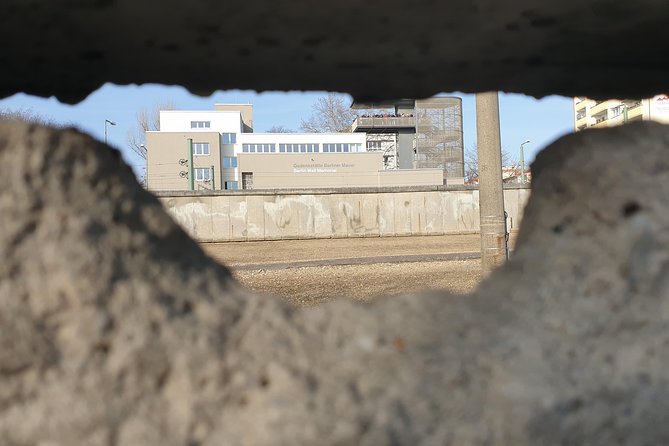
The Berlin Wall Memorial receives the longest visit, about 50 minutes, and rightly so. This is the point where the tour explains how the Wall was built, how the border system worked, and how people tried to escape.
A surviving section of the border area helps you understand the physical structure. The Wall was not simply one slab of concrete dividing two neighborhoods. It involved barriers, controlled zones, watch systems, and obstacles designed to stop people from crossing. The guide’s explanation helps you read the remains as part of a larger border system.
The human stories are just as important. You hear about people who died trying to cross and about the methods used in escape attempts. These accounts give the memorial a serious tone, and they keep the subject from becoming only a story about buildings and political dates.
I would give this stop your full attention. The Wall Memorial is the place where you gain the clearest sense of the cost of division. The tour’s Italian commentary is especially useful here if you want to follow detailed explanations without having to translate exhibit text as you go.
Alexanderplatz and the public pressure of 1989
At Alexanderplatz, the focus shifts from border controls to life in the German Democratic Republic, or GDR. The guide points out examples of typical GDR architecture and explains how the square functioned as a major public space.
You also learn about the large popular demonstration held here in 1989. That protest formed part of the growing pressure that led to the fall of the Berlin Wall. The stop lasts about 15 minutes, so the discussion is focused rather than sprawling.
Alexanderplatz helps you connect the political system to ordinary city life. The buildings are not simply a backdrop. They show how the GDR presented its values through broad public spaces and monumental design. After the Wall Memorial, this stop also gives the story a wider civic frame.
The square can feel much more modern and commercial today than the city described by the guide. That contrast is useful. You are looking at a place that changed sharply, not a preserved historical set.
Same city, a completely different kind of day:
- Berlin: Reichstag, Dome and Government District Guided Tour
★ 4.7 · 18,288 reviews - Berlin: 1-Hour City Tour by Boat with Guaranteed Seating
★ 4.3 · 16,993 reviews - Berlin: Boat Tour Along the River Spree
★ 4.4 · 11,252 reviews - Discover Berlin Half-Day Walking Tour
★ 5.0 · 9,624 reviews
The Berlin TV Tower, a symbol of the GDR
The Berlin TV Tower is visited from the outside for about 10 minutes. It remains the tallest building in Berlin and is one of the most recognizable structures linked with the former GDR.
Its value on this tour is symbolic. The tower represented technological ambition and state power, while its height made it visible across much of the city. You do not go inside or receive an observation-deck visit, so this is a short architectural and historical stop rather than a tower attraction.
That limitation is worth noting if you hoped to see Berlin from above. The tour uses the tower to explain the GDR’s public image, not to provide a separate sightseeing ticket. You can enjoy the exterior without adding an admission charge, since no paid attraction entry is part of the tour.
Karl-Marx-Allee and the GDR in grand form
The route continues to Karl-Marx-Allee for about 20 minutes. This broad boulevard is lined with buildings from the Stalinist era, and it offers one of the clearest examples of how the early GDR used architecture to express political authority.
The scale is the point. The buildings were designed to project order, strength, and a formal vision of society. Your guide explains the beginnings of the GDR while you look at the boulevard and its architecture. This makes the stop more useful than a quick photo pause.
Karl-Marx-Allee also balances the tour’s focus on the Wall itself. Berlin’s Cold War story was not only about the concrete border. It was also about the state that built it and the public image that state wanted to create. Here, you can read that message in the street plan and building fronts.
You will spend only 20 minutes at this stop, so do not expect a full architectural survey. The guide’s commentary is what gives the view its meaning.
The East Side Gallery and the Wall after 1989
The tour ends at the East Side Gallery, where you see the longest section of the Berlin Wall and its famous murals. The visit lasts about 20 minutes.
This is a very different encounter from the Wall Memorial. At the memorial, the Wall is tied to surveillance, escape attempts, and death. At the East Side Gallery, the remaining section has become an open-air display of paintings associated with freedom and the changes that followed the Wall’s fall.
The murals give the final part of the walk a strong visual finish. You can see how the same structure that once divided Berlin was later used to express political hope and public memory. The art is the reason this part of the Wall is so well known, but the guide also helps you connect the paintings to the events of 1989.
Twenty minutes is enough for an introduction, not a slow inspection of every painted section. If a particular mural catches your attention, you may want to return later on your own. The tour ends here, and the guide can advise you about public transport for the rest of your day.
What the Italian guide adds
The guide is the main reason to choose this experience over a self-guided route. The program is built around spoken explanation at each stop, and the topics require context. A wall fragment, subway entrance, or boulevard can mean little without the story behind it.
Antonella is named as one of the Italian guides, and her presentation has been praised for bringing the emotions of 1989 to life. Another Italian-language assessment describes the guide as very well prepared and particularly strong when explaining the key moments of that difficult period.
Those comments point to the tour’s strongest quality: the guide links places to events and people. You are not simply collecting Cold War locations. You are following a narrative from the hidden underground stations, to the border system, to public protest, and finally to the Wall’s new role as a symbol of freedom.
The tour is best suited to Italian speakers who want history explained in their own language. If you already have a strong background in Berlin’s Cold War past, some sections may cover familiar ground. The benefit then comes from seeing the locations in sequence and from having the route handled for you.
Timing, walking, and transport between stops
The start time is 10:00 in the morning, and the experience lasts about three hours and 30 minutes. A morning schedule leaves the rest of your day open, but you should not treat this as a quick orientation walk. The route covers a wide stretch of Berlin and includes several stops with commentary.
Transportation to and from the attractions is not included. Hotel pickup and drop-off are also not included. You meet the guide at Potsdamer Platz and finish at the East Side Gallery, so plan for your own journey to the starting point and your onward trip after the final stop.
The guide can advise you which public transport to take at the end. That is helpful because the tour does not return you to Potsdamer Platz. Your mobile ticket makes entry and check-in simple, but it does not cover train or subway fares.
The route includes outdoor locations and a subway station. Most people can participate, and service animals are allowed. Since the group may reach 25 people, arrive a little early and look for the blue bicycle rather than waiting for the group to find you.
Is $27.87 a fair price?
At $27.87 per person, this is a sensible price for a three-and-a-half-hour guided walk covering seven Cold War-related stops. You are paying for the Italian-language guide, route planning, and the explanations that turn separate sights into one connected story.
No food, drinks, attraction admissions, or transport are included. In this case, that is not a serious weakness because the major stops are viewed from public areas, and the Berlin TV Tower visit is outside only. Still, you should budget for your own refreshments and public transport.
The value is strongest if you would otherwise spend time researching the Wall Memorial, Alexanderplatz, Karl-Marx-Allee, and the East Side Gallery separately. The tour lets you see them in one morning and keeps the subject focused. It is less useful if you only want a short photo stop at the Wall or prefer to explore each location at your own pace.
The experience has a top rating from 81 reviews and a 100 percent recommendation rate. That record supports the idea that the guide quality and historical explanation are the main strengths, though you should still weigh the walking time and transport arrangements against your plans.
Who should book this Berlin Wall walk?
I would recommend it to Italian-speaking visitors who want a clear introduction to Berlin’s Cold War story. It suits first-time visitors especially well because it covers the main locations in a logical order and removes the work of planning a route across the city.
It is also a good fit if you care more about context than about entering attractions. The tour spends time on victims, escape systems, GDR architecture, protests, and the meaning of the Wall’s murals. Those subjects give you more than a list of landmarks.
You may prefer an independent visit if you want to linger at the East Side Gallery, enter the TV Tower, stop for a meal, or photograph every section of the Wall. The fixed route and limited time at each stop are useful for coverage, but they do not allow much wandering.
Free cancellation is available if you cancel at least 24 hours before the start time. Cancellations within 24 hours are not refunded, and changes in that period are not accepted.
FAQ
Where does the tour begin?
The meeting point is Potsdamer Platz 10, 10785 Berlin, Germany, near the Potsdamer Platz S-Bahn and U-Bahn station. Look for the blue bicycle and the Vive Berlin Tours flag.
What time does the tour start?
The tour starts at 10:00 am.
How long does the experience last?
It lasts approximately three hours and 30 minutes.
Where does the tour end?
The tour ends at the East Side Gallery in Berlin, postal code 10243. The guide can advise you about public transport afterward.
Is the tour conducted in Italian?
Yes. An Italian-speaking guide leads the tour. Antonella is one of the guides associated with this experience.
What sights are included?
The route includes Berlin-Nordbahnhof, the Berlin Wall Memorial, Alexanderplatz, the Berlin TV Tower from outside, Karl-Marx-Allee, and the East Side Gallery.
Is transportation included?
No. Transportation to and from the attractions is not included. Hotel pickup and drop-off are also not included.
What is the maximum group size?
The tour can have a maximum of 25 participants.
Can I cancel for a full refund?
Yes, if you cancel at least 24 hours before the experience begins. Cancellations made less than 24 hours before the start time are not refunded.
Should you book it?
Book this tour if you want Berlin’s Cold War story explained in Italian and prefer a planned route to solo research. The strongest parts are the 50-minute Wall Memorial visit, the ghost station story, and the contrast between Karl-Marx-Allee’s state architecture and the East Side Gallery’s freedom murals.
Skip it if you need a private pace, want to visit the TV Tower interior, or dislike crossing the city without included transport. For most Italian-speaking visitors who want a focused morning with serious history and several major sights, $27.87 is good value.
Just added around Berlin
- Love and War in Berlin: Self-Guided Story Puzzle Walk★ 5.0 · 7 reviews
- Rickshaw Tours Berlin – Groups of up to 16 people with several rickshaws★ 4.0 · 97 reviews
- Walking on the Wall: 3-Hour Tour in Berlin★ 4.5 · 34 reviews
- eSIM for Germany and 34 European Countries★ 4.5 · 16 reviews
- Warnemuende Shore Excursion: Berlin Private Sightseeing Tour from Rostock★ 5.0 · 4 reviews
- Your ticket to The Wall Museum Berlin★ 3.0 · 60 reviews
- Warnemuende Shore Excursion: Private Berlin Tour★ 4.5 · 27 reviews
- Berlin’s Gay, Lesbian, and Queer Scene Small-Group Walking Tour★ 4.5 · 66 reviews
Third Reich & Cold War Tours, compared.



Berlin’s Best: 2 Hour Walking Tour Third Reich and the Cold War
Read our review →

Third Reich Berlin: Hitler and WWII Walking Tour
Read our review →
Skip-the-Line: Berlin Wall Museum at Checkpoint Charlie
Read our review →

Cold War, Berlin Wall, Spies and the East Side Gallery
Read our review →Browse the lists this tour appears in