
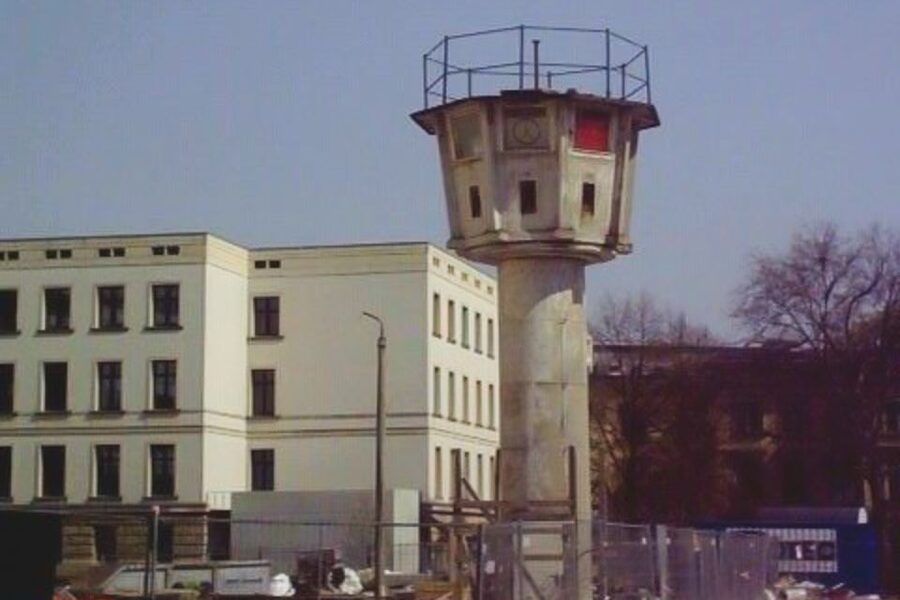
Reviewed · THIRD REICH & COLD WAR TOURS
Berlin Wall: City Tour of Divided Germany
Berlin’s Cold War border did not sit in some far-off corner. It cut through stations, government buildings, parks, and ordinary streets. This two-hour city tour follows that line from Friedrichstraße station to Checkpoint Charlie, showing how a political split shaped daily life in the capital.
I like the route for two reasons: it links famous sights to less obvious border sites, and it puts personal stories at the heart of the walk. Guides Stefan and Stephan are associated with especially warm feedback, and the small-group format can make the history feel direct. The main drawback is clear: the tour is conducted in German, so it is not a good choice if you need English commentary.
In This Review
- Key points to know before booking
- Starting at the Palace of Tears and Friedrichstraße
- Following the Spree toward the government district
- Brandenburg Gate at the former border
- The Holocaust Memorial and the former death strip
- Potsdamer Platz and the Tiergarten Triangle
- Seeing the longest remaining stretch of the Wall
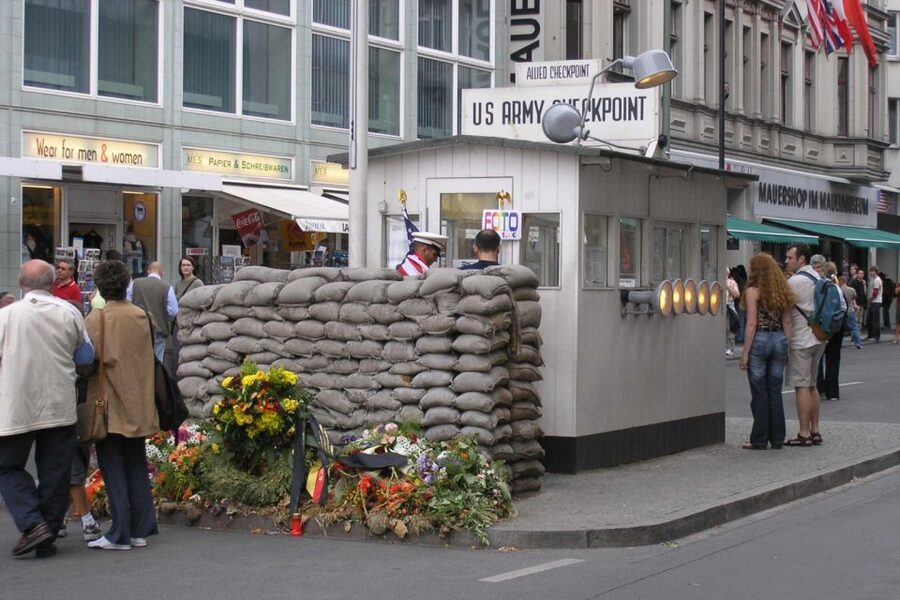
- Ending at Checkpoint Charlie
- What the guide adds in German
- Is $21 a fair price for two hours?
- Who should book this Berlin Wall walk?
- Should you book the City Tour of Divided Germany?
- FAQ
- Where does the Berlin Wall city tour meet?
- Does Tränenpalast have more than one entrance?
- How long does the tour last?
- What language is the tour in?
- Which Berlin sights are included?
- What should I bring?
- Can I cancel for a full refund?
Key points to know before booking
- The Palace of Tears is the starting point: Meet at the one entrance of Tränenpalast, beside Friedrichstraße station.
- The route connects major landmarks: You will see the Spree, the parliament and government district, Brandenburg Gate, Potsdamer Platz, the Wall, and Checkpoint Charlie.
- The border shaped normal life: The tour focuses on stations, streets, buildings, and the practical effects of division, not just political dates.
- Personal accounts add weight: The guides are noted for sharing stories that go beyond the basic facts.
- The walk may be longer than two hours: One small group received an extra hour from its guide, though you should plan around the stated two-hour duration.
- Comfortable shoes matter: This is a city walk, and the route covers several locations.
Starting at the Palace of Tears and Friedrichstraße
Your meeting point is the entrance to Tränenpalast, the Palace of Tears, on Reichstagufer, outside Friedrichstraße station. The building’s name comes from the emotional farewells that took place there when people crossed between East and West Berlin.
The meeting point is specific, so take care to use the correct entrance. Tränenpalast has only one entrance, which removes some confusion, but Friedrichstraße station is large enough that you should allow time to find the riverfront side at Reichstagufer.
Beginning here is smart. The station was the single border station during the Cold War, making it an ideal place to understand how Berlin’s division worked at street level. This was not only a wall separating neighborhoods. It was also a controlled system of checkpoints, documents, departures, waiting rooms, and sudden goodbyes.
You will want comfortable shoes from the start. The exact route is presented as a city tour, and the schedule is two hours, but the number of stops means you will be on your feet for much of the experience.
More Third Reich & Cold War Tours in Berlin
- Berlin: Third Reich and Cold War 2 Hour Walking Tour
★ 4.9 · 6,830 reviews - Berlin’s Best: 2 Hour Walking Tour Third Reich and the Cold War
★ 5.0 · 5,486 reviews - Third Reich Berlin: Hitler and WWII Walking Tour
★ 5.0 · 3,301 reviews
Following the Spree toward the government district
From Friedrichstraße, the route follows the Spree toward the parliament and government district. This part helps you see how the border ran through a central area that now feels open and connected.
The government buildings were situated partly along the former border strip. That detail gives the walk a useful sense of scale. You are not only looking at a memorial or a preserved wall segment. You are seeing a former dividing line pass through the center of civic power.
I like this section because it shows how Berlin’s split was woven into the city’s structure. The border affected where people could go, how they reached work, and which parts of the capital felt close or unreachable. A guide can point out the relationship between the river, public buildings, and the old border area in a way that a self-guided stroll may miss.
The setting also gives the tour some breathing room. Berlin’s Cold War story can become a list of dramatic events, but the walk keeps returning to physical places. You see where the division ran, then move through the city along that line.
Brandenburg Gate at the former border
Brandenburg Gate is one of Berlin’s most familiar sights, but this tour uses it for a different purpose. The gate was located where the border ran, making it a strong symbol of Berlin’s division and later reunification.
You will see why a famous landmark can carry several meanings at once. Today, Brandenburg Gate reads as a city symbol. During the division, it represented a restricted and heavily charged space. The tour places the monument inside that political story rather than treating it as a quick photo stop.
This is also a good point for asking questions if the guide allows time. The value here is not just seeing the gate. It is understanding how an open-looking public monument became tied to separation and the fate of the city.
The stop can be busy because Brandenburg Gate is a major Berlin attraction. That may make the guide’s explanation especially useful. Instead of trying to work out the history from a plaque while people pass by, you can focus on the account and the exact location of the former border.
The Holocaust Memorial and the former death strip
The route continues from Brandenburg Gate to the Holocaust Memorial, which occupies part of what was once the death strip. This is one of the more serious sections of the tour, and it brings two difficult chapters of German history into the same physical area.
The tour does not treat the former border as an isolated Cold War subject. It places the Wall and the divided city within the broader story of Berlin’s twentieth-century past. That connection matters, but it also means you should expect a sober tone at this point.
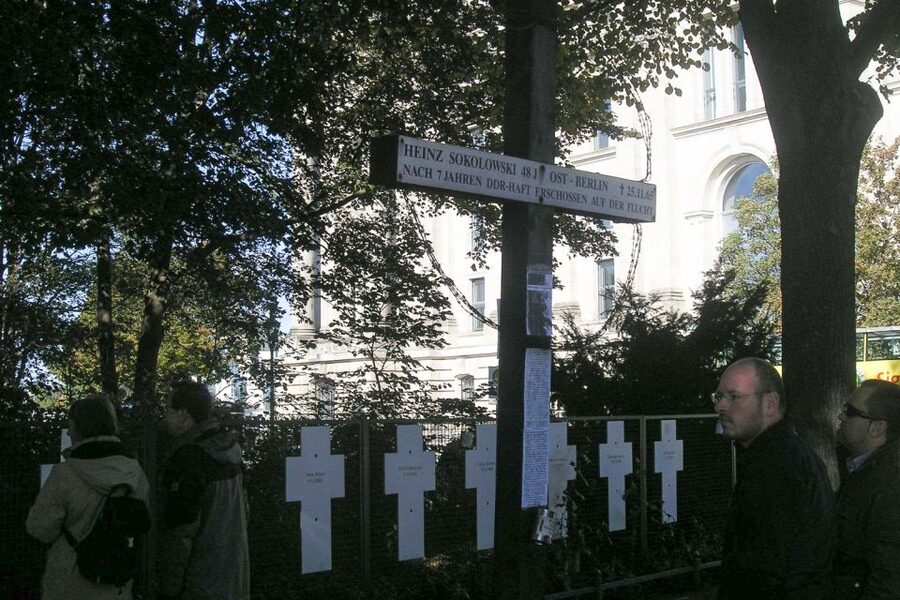
The phrase former death strip refers to the restricted zone associated with the Berlin Wall, not simply the concrete barrier itself. The space between barriers was designed to prevent escapes. Walking through an area that once served that purpose can make the city’s division feel less abstract.
I appreciate this stop because it broadens the tour without losing its main subject. You are still following the border, but you are also being reminded that Berlin’s difficult past did not begin with the Wall and did not end when it fell.
Same city, a completely different kind of day:
- Berlin: Reichstag, Dome and Government District Guided Tour
★ 4.7 · 18,288 reviews - Berlin: 1-Hour City Tour by Boat with Guaranteed Seating
★ 4.3 · 16,993 reviews - Berlin: Boat Tour Along the River Spree
★ 4.4 · 11,252 reviews - Discover Berlin Half-Day Walking Tour
★ 5.0 · 9,624 reviews
Potsdamer Platz and the Tiergarten Triangle
At Potsdamer Platz, the split is particularly visible in the former Tiergarten Triangle. This section is valuable for readers who want to understand how radically Berlin changed after division.
Potsdamer Platz is associated with a modern central Berlin, but the tour points you toward the former border and the space created by decades of separation. The contrast is the point. You can compare the current city with the gap and division that once marked this part of Berlin.
The route helps you read the city rather than simply pass through it. A modern building may tell you little on its own, but its position along the old border can reveal how the city was cut apart and later brought back together.
Do not expect every stop to offer a preserved wall segment or a large museum display. Much of the evidence here is spatial. You are learning to notice where the line ran and how Berlin’s shape was affected. That makes a live guide useful, especially if you have limited time in the city.
Seeing the longest remaining stretch of the Wall
The tour includes the longest remaining stretch of the Berlin Wall. This is likely to be one of the most tangible points on the route because you can see the physical barrier itself rather than only its former position.
A surviving section gives the history a firm object. You can look at the wall, consider its scale, and connect it with the stories heard earlier about stations, crossings, and the border strip.
Still, the preserved concrete is only part of the lesson. The tour’s strength is the way it connects this remaining section to the rest of the route. Friedrichstraße station, the government district, Brandenburg Gate, the Holocaust Memorial, and Potsdamer Platz show that the Wall was never just one structure in one place. It affected the whole city.
This is a good moment to pay attention to the guide’s pacing. The experience is designed to cover several sites within two hours, but the guide may spend extra time on subjects that matter to the group. One small-group tour was extended by an hour, so the stated duration should be treated as the main plan rather than an absolute ceiling.
Ending at Checkpoint Charlie
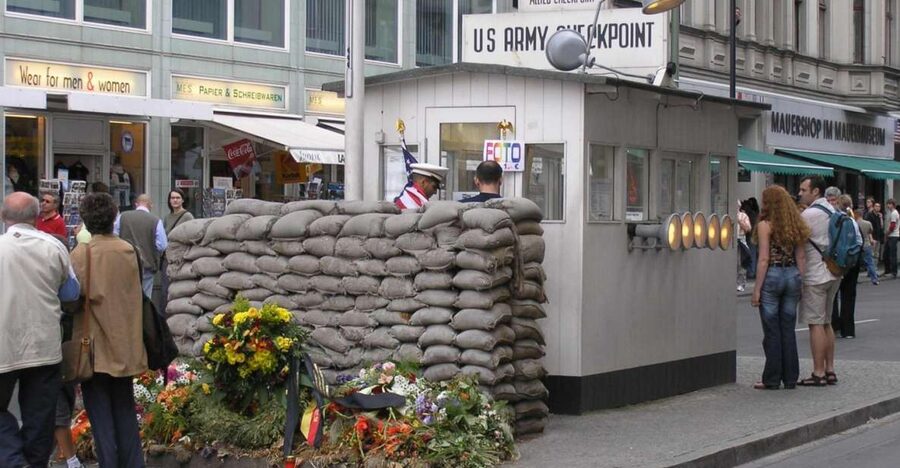
Checkpoint Charlie is the tour’s final major stop. Its name is famous well beyond Berlin, and it remains one of the clearest symbols of the Cold War border.
The value of ending here is narrative. You begin at a functioning border station tied to departures and family farewells, then finish at the crossing point most closely linked with the confrontation between East and West. Along the way, the tour shows how the border moved through the city and affected both public life and personal choices.
Checkpoint Charlie is also a place where expectations matter. It is a well-known city sight, so you will not be visiting an unknown corner of Berlin. The distinctive benefit is having the stop explained as part of a connected route rather than seeing it on its own.
By the end, you should have a clearer sense of the difference between a border crossing, a border strip, a preserved wall, and the broader urban line that divided Berlin. That framework is more useful than collecting a few isolated Cold War facts.
What the guide adds in German
The live guide speaks German, and that is the most important booking consideration. If you understand German well, the tour offers a chance to hear the story in its original language and to ask questions as you go.
The strongest aspect of the guiding is the use of personal accounts. The tour is built around the fate of Berlin’s people, so stories from daily life can make the political division easier to grasp. You are likely to get more than a date-and-name lecture, particularly in a small group.
Stefan and Stephan are names connected with positive experiences on this tour. The guide may vary by departure, so do not assume a particular person will lead your date. Still, the emphasis on personal information is a useful clue about the style to expect.
If you do not speak German, this activity is a poor fit unless you are comfortable following a tour without understanding the commentary. The supplied information lists German as the only language. That is not a small detail. The guide’s explanations are the main reason to book rather than simply walk the route independently.
Is $21 a fair price for two hours?
At $21 per person, the price is reasonable for a focused city walk covering this many central locations. You are paying for a live guide, a planned route, and interpretation at places that can be hard to understand from their present appearance.
The value is strongest if Berlin’s division is a main interest. You will visit several famous sights, but the tour is not simply a highlights walk. It uses those places to explain the former border and the daily effects of division.
The price is less attractive if you only want photo stops or a general introduction to Berlin. The subject is specific, and the commentary is in German. You should also remember that the listed cost includes the city tour, but no other inclusion is specified.
The tour’s high rating, 4.9 from 103 ratings, supports the sense that the guiding is its strongest feature. I would still judge the value by language and subject first. A well-rated German tour is not useful to you if you cannot follow the story.
Who should book this Berlin Wall walk?
I would recommend it to you if you want a compact, history-focused route through central Berlin. It suits visitors who prefer real city streets and former border locations to a museum-only experience.
It is also a good fit if you like history explained through individual lives. The focus on daily routines, personal stories, and the fate of Berlin’s people gives the tour more human weight than a simple list of Cold War events.
You should think twice if you need English, if walking for two hours is difficult, or if your schedule has no flexibility. Comfortable shoes are required, and the tour can run longer than planned. Cold weather also deserves attention, since the experience takes place outdoors and one group remained satisfied despite low temperatures, but that does not make warm clothing optional.
For the best experience, arrive at the correct Tränenpalast entrance with enough time to find it. Wear shoes suited to city walking, dress for the weather, and come ready to listen rather than rush from one famous landmark to the next.
Should you book the City Tour of Divided Germany?
Book this tour if you understand German and want the human story of Berlin’s division tied to the actual streets, stations, monuments, and border remains. The $21 price is fair for a live, focused walk that covers Friedrichstraße, the Spree, the government district, Brandenburg Gate, the former death strip, Potsdamer Platz, the longest remaining Wall section, and Checkpoint Charlie.
Skip it if you need English commentary or want a broad, easygoing sightseeing tour. For the right audience, this is a compact and serious way to understand how the Wall shaped ordinary life, not just Berlin’s map.
FAQ
Where does the Berlin Wall city tour meet?
Meet at the entrance of Tränenpalast, the Palace of Tears, in front of Friedrichstraße station on Reichstagufer, 10117 Berlin, Germany.
Does Tränenpalast have more than one entrance?
No. Tränenpalast has only one entrance, which is the designated meeting point.
How long does the tour last?
The stated duration is two hours. A guide may extend the tour, as happened on one small-group departure, so allow some flexibility if your schedule is tight.
What language is the tour in?
The live tour guide speaks German. German is the only language listed for this activity.
Which Berlin sights are included?
The route includes Friedrichstraße station and Tränenpalast, the Spree, the parliament and government district, Brandenburg Gate, the Holocaust Memorial, Potsdamer Platz, the former Tiergarten Triangle, the longest remaining stretch of the Wall, and Checkpoint Charlie.
What should I bring?
Bring comfortable shoes for the city tour.
Can I cancel for a full refund?
Yes. You can cancel up to 24 hours in advance for a full refund. You can also reserve now and pay later.
Just added around Berlin
- Love and War in Berlin: Self-Guided Story Puzzle Walk★ 5.0 · 7 reviews
- Rickshaw Tours Berlin – Groups of up to 16 people with several rickshaws★ 4.0 · 97 reviews
- Walking on the Wall: 3-Hour Tour in Berlin★ 4.5 · 34 reviews
- eSIM for Germany and 34 European Countries★ 4.5 · 16 reviews
- Warnemuende Shore Excursion: Berlin Private Sightseeing Tour from Rostock★ 5.0 · 4 reviews
- Your ticket to The Wall Museum Berlin★ 3.0 · 60 reviews
- Warnemuende Shore Excursion: Private Berlin Tour★ 4.5 · 27 reviews
- Berlin’s Gay, Lesbian, and Queer Scene Small-Group Walking Tour★ 4.5 · 66 reviews
Third Reich & Cold War Tours, compared.



Berlin’s Best: 2 Hour Walking Tour Third Reich and the Cold War
Read our review →

Third Reich Berlin: Hitler and WWII Walking Tour
Read our review →
Skip-the-Line: Berlin Wall Museum at Checkpoint Charlie
Read our review →

Cold War, Berlin Wall, Spies and the East Side Gallery
Read our review →Browse the lists this tour appears in