
Reviewed · THIRD REICH & COLD WAR TOURS
Berlin & The Third Reich Private Guided Tour
Berlin’s darkest history is unusually easy to miss. A polished square, a modern office block, or an ordinary parking lot can mark a place where Hitler seized power, planned war, or spent his final days. This four-hour private walking tour connects those quiet clues into one clear story, from the Nazi rise to the defeat of 1945 and the later division of Berlin.
I especially like the route’s strong sense of place and the fact that your own group gets the guide’s attention. I also like how the tour links Nazi Germany with the Cold War, rather than treating 1945 as the end of Berlin’s story. The main consideration is that this is a serious outdoor walk with several brief stops, and the non-refundable booking policy leaves little room for a change of plans.
In This Review
- Key points to know before booking
- Why this Berlin history walk works
- Pariser Platz and the first view of power
- The Reichstag and the fire that changed Germany
- Brandenburg Gate, from royal entrance to national symbol
- The Holocaust Memorial and the limits of words
- The Führerbunker, now an ordinary parking lot
- Potsdamer Platz and the city erased by war
- Checkpoint Charlie and the Cold War after 1945
- Four hours on foot, with time to ask questions
- What the private price means for your group
- Who will get the most from this tour
- Should you book the Berlin and the Third Reich Private Guided Tour?
- FAQ
- Where does the tour begin?
- Where does the tour end?
- How long does the tour last?
- How many people can join the private tour?
- Does the tour include admission tickets?
- Can I cancel or change the booking?
Key points to know before booking
- The route begins at Brandenburg Gate and returns to the same meeting point after about four hours.
- The Führerbunker site is now a parking lot, marked only by a simple sign, which makes the location especially stark.
- You visit eight major central Berlin sites, including the Reichstag, Holocaust Memorial, Potsdamer Platz, and Checkpoint Charlie.
- Your group is private, with space for up to 15 people and no unrelated participants joining you.
- The tour is built around explanation, with time to stop and talk rather than simply pass monuments.
- No admission tickets are required for the listed stops, though the tour does not indicate entry into the Reichstag dome or other interiors.
Why this Berlin history walk works
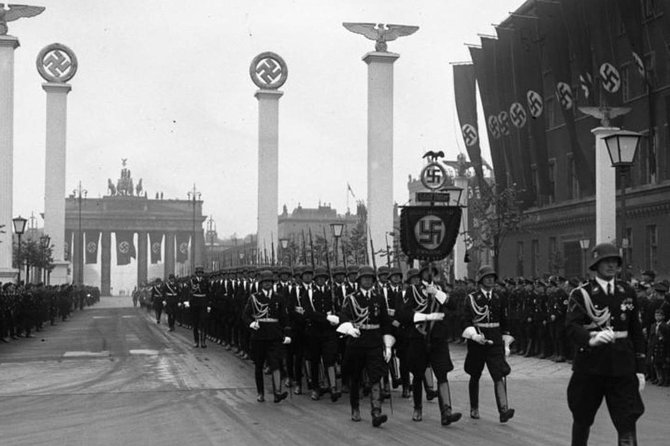
The best part of this experience is its ability to turn Berlin’s center into a readable historical map. You are not just looking at famous buildings. You are following the path of political power, wartime destruction, genocide, defeat, and Cold War tension.
That matters in Berlin because the city often gives you fragments rather than a single preserved historic district. One corner may be elegant and imperial, the next marked by war damage, and the next filled with glass towers built after reunification. A guide helps connect those pieces.
The tour also avoids the usual problem of a large group straining to hear a guide beside a busy street. Since only your party participates, you can ask questions and request more explanation at the places that matter most to you. The route is still brisk, but the pauses are built into the experience.
Previous guide assignments have included Walid, Campbell, and Gregor. The available feedback gives each a different strength: Walid led a full four-hour walk with regular stops, Campbell made the route useful even for people who had already passed many of the monuments, and Gregor provided a clear account of Berlin’s modern history. Guide assignments can vary, so treat those names as examples rather than a promise of who will lead your visit.
More Third Reich & Cold War Tours in Berlin
- Berlin: Third Reich and Cold War 2 Hour Walking Tour
★ 4.9 · 6,830 reviews - Berlin’s Best: 2 Hour Walking Tour Third Reich and the Cold War
★ 5.0 · 5,486 reviews - Third Reich Berlin: Hitler and WWII Walking Tour
★ 5.0 · 3,301 reviews
Pariser Platz and the first view of power
The tour starts at Pariser Platz, Berlin’s most prestigious square and the eastern end of Unter den Linden. This is a good starting point because the square gives you the grand political setting before the tour moves into the darker details.
The Brandenburg Gate is here, but the opening discussion also places the square within Berlin’s royal and national story. You begin with the old city of the Hohenzollern family, then move toward the twentieth-century struggle that changed Germany and Europe.
You have about 15 minutes at this first stop. That is enough for an introduction and orientation, though not enough for a long architectural lecture. If you want photographs without rushing, arrive a little early.
The Reichstag and the fire that changed Germany
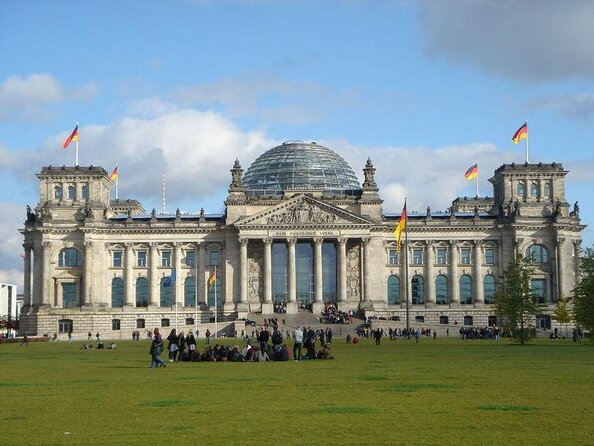
The Reichstag is one of the most important stops because its history connects a familiar government building with Hitler’s move toward total control. The fire in 1933 helped the Nazis suspend civil liberties and crush political opposition.
The building was also fought over during the Battle of Berlin, when German and Soviet forces battled for the city in the final stage of the Second World War. Today, its glass dome, designed by British architect Sir Norman Foster, gives the building a very different character from its wartime image.
The scheduled stop lasts about 10 minutes. You should expect to view and discuss the building from outside, not take a guided visit through the dome. The tour information lists no admission for this stop and does not include dome entry, so book a separate Reichstag visit if you want to go inside.
Brandenburg Gate, from royal entrance to national symbol
The Brandenburg Gate receives its own stop after the opening at Pariser Platz. That may sound repetitive, but the extra time makes sense. The gate is not simply a photograph-friendly monument. It has carried several meanings over the centuries.
It began as a royal entrance, one of 18 former gates into Berlin. It survived Napoleon and the Second World War, then spent almost 30 years beside the Berlin Wall, trapped within the divided city. Today it represents reunified Germany.
I like this stop because it gives you a quick lesson in how political symbols change. The stonework did not change much, but the meaning attached to it changed from royal power to national division and finally to reunification.
You have around 15 minutes here. Since this is one of Berlin’s busiest public spaces, a private guide is useful for keeping the explanation focused rather than letting the stop become only a photo break.
Same city, a completely different kind of day:
- Berlin: Reichstag, Dome and Government District Guided Tour
★ 4.7 · 18,288 reviews - Berlin: 1-Hour City Tour by Boat with Guaranteed Seating
★ 4.3 · 16,993 reviews - Berlin: Boat Tour Along the River Spree
★ 4.4 · 11,252 reviews - Discover Berlin Half-Day Walking Tour
★ 5.0 · 9,624 reviews
The Holocaust Memorial and the limits of words
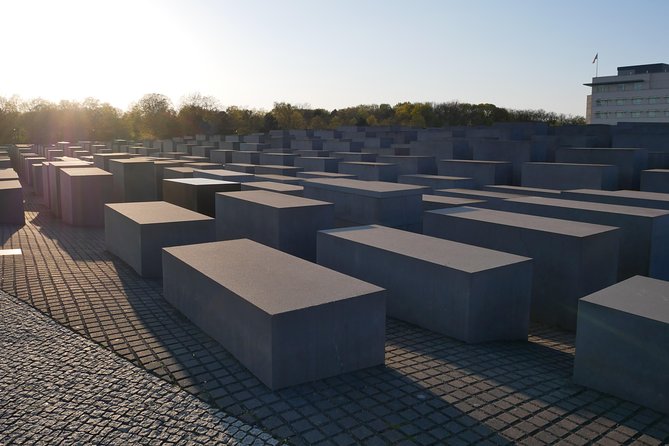
The Memorial to the Murdered Jews of Europe is a large field of stone stelae near the Brandenburg Gate. It is Germany’s central memorial to Jewish victims of the Holocaust, and its spare design leaves room for reflection rather than offering a long written narrative at the site.
The tour allows about 20 minutes here, one of the longer pauses on the route. That gives your guide time to explain the memorial and its place in Berlin’s public memory.
This is not a stop to rush through with a camera. The memorial’s scale and regular rows of concrete blocks create a powerful physical experience, but the meaning is not self-explanatory. A guide can help you understand the purpose of the site without turning it into a theatrical performance.
You should also know what this tour does not claim to be. The schedule names the memorial but does not include a separate museum visit. If you want a longer examination of Nazi persecution and the Holocaust, you will need additional time elsewhere in Berlin.
The Führerbunker, now an ordinary parking lot
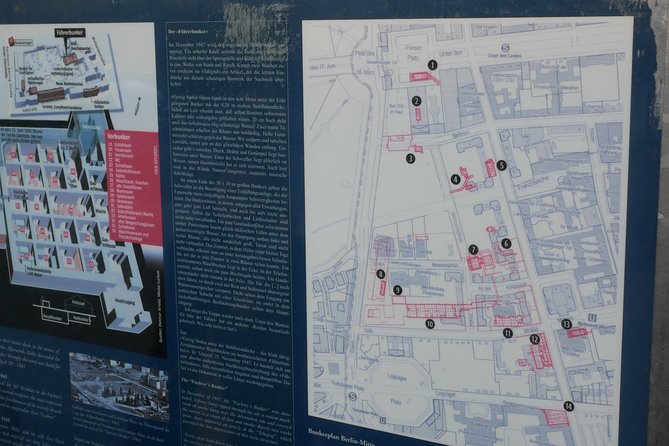
The Führerbunker site may be the most startling stop because there is so little to see. The location where Hitler spent his final days, married, and committed suicide in the last days of the war is now a parking lot with a simple sign.
That plain setting is the point. There is no grand ruin and no preserved underground chamber presented as a shrine. The ordinary surroundings make the distance between the myths of Nazi power and its final collapse especially clear.
The stop lasts roughly 15 minutes. Your guide supplies the historical context, since the site itself offers very little visual information. This is one place where a private tour earns its keep: without explanation, you could walk past it without knowing what happened there.
Expect a sober discussion. The subject is grim, and the stop is valuable because it treats the location as history rather than spectacle.
Potsdamer Platz and the city erased by war
Potsdamer Platz shows how completely Berlin was damaged and how quickly the city later remade itself. In the 1920s, it was one of Europe’s busiest traffic intersections. The Second World War destroyed most of it, and the area was rebuilt as a modern precinct during the 1990s and early 2000s.
The contrast is sharp. Here, you move from the physical traces of Nazi rule and wartime ruin into a district shaped by redevelopment after reunification. The tour gives you about 10 minutes, enough to explain the transformation and place the modern buildings within the older story.
This stop is especially useful if you are trying to understand why central Berlin can feel so new. Much of what you see is not old Berlin restored, but Berlin rebuilt after destruction and decades of division.
The drawback is that Potsdamer Platz has fewer visible wartime remains than the Führerbunker location or the Reichstag. Its value depends on the guide’s explanation and your interest in how cities recover and rebuild.
Checkpoint Charlie and the Cold War after 1945
Checkpoint Charlie shifts the story from Nazi Germany to the postwar division of Berlin. The site was a frontline crossing operated by American and Soviet forces during the Cold War.
That makes it a useful final historical chapter. The city’s defeat in 1945 did not bring a simple return to normal life. Berlin was divided, occupied, and eventually cut by the Berlin Wall. Checkpoint Charlie became one of the best-known symbols of that confrontation.
The stop lasts about 10 minutes. You will not get a full Cold War walking tour from this route, but the guide can show how the political story continued after the fall of the Nazi regime.
I appreciate this broader frame. A tour focused only on Hitler and the war can leave you with the impression that Berlin’s twentieth-century story ended in 1945. Ending at Checkpoint Charlie reminds you that the city remained a global flashpoint for decades.
Four hours on foot, with time to ask questions
The tour lasts approximately four hours and uses stops of 10 to 20 minutes. The schedule adds up to about 105 minutes at named locations, leaving the rest for walking between them and for transitions in the city center.
That pacing is sensible. You get enough time to pause and talk, but the day does not become a series of long lectures at one monument. The route also covers a great deal of ground, so comfortable shoes are a smart choice.
Pickup is offered, while the listed starting point is Brandenburg Gate at Pariser Platz and the activity ends back there. Confirm the exact pickup arrangement when booking, especially if you expect door-to-door collection rather than meeting at the gate.
The tour is near public transportation, and most people can participate. Service animals are allowed. No special physical restrictions are stated, but you should be prepared for a central-city walk lasting several hours.
What the private price means for your group
The cost is $329.92 per group of up to 15 people, not per person. For a full group, that works out to about $22 per person, which is strong value for a four-hour private experience. A couple pays much more per person, but gains a fully private guide and the ability to ask questions without a larger group setting.
The value depends on what you want. If you prefer a fast overview and plan to spend most of your time inside museums, a shorter public walk may suit you better. If you want one guide to connect the Reichstag fire, the Nazi headquarters, wartime destruction, the Führerbunker, and the Cold War, the private format is easier to justify.
Every listed stop is free to access, which keeps the price focused on guiding rather than admissions. That also means you should not assume the fee includes entry to the Reichstag’s glass dome or any museum. The experience is primarily an outdoor history walk.
Because the booking is non-refundable and cannot be changed, I would not reserve it until your Berlin schedule is firm. It is often booked about 12 days ahead, so planning early helps, but the strict policy makes last-minute changes costly.
Who will get the most from this tour
I would choose this tour if you want a clear introduction to Berlin’s Nazi and Cold War history in one outing. It is particularly useful on a first visit, when the city’s major landmarks can otherwise feel disconnected.
It also suits families or private groups with mixed interests. The route includes famous sights for first-time sightseers, while the guide adds the political and human context that you will not get from a quick photograph.
History students, teachers, and visitors with a strong interest in the Second World War may want more time at individual memorials and museums. This tour gives you breadth rather than an exhaustive study of any one subject.
I would be more cautious if you dislike walking, need a relaxed pace, or want access to interiors. The itinerary is built around streets, squares, exterior views, and short talks. Its strength is the connected route, not private entry or long museum sessions.
Should you book the Berlin and the Third Reich Private Guided Tour?
Book it if you want Berlin’s central sights explained as one difficult but important story. The Führerbunker parking lot, the Holocaust Memorial, and the Reichstag become far more meaningful when you understand how they fit together.
The private format and four-hour length make the price reasonable for a group, especially if you are sharing it among several people. Just confirm the pickup details, wear comfortable shoes, and reserve only when your schedule is stable.
Skip it if you want a lighter sightseeing walk, a museum-heavy experience, or a tour that ends with a visit inside the Reichstag dome. For a serious, place-based introduction to Nazi Berlin and the Cold War city that followed, this is a focused choice.
FAQ
Where does the tour begin?
The tour begins at Brandenburg Gate, Pariser Platz, 10117 Berlin, Germany.
Where does the tour end?
The activity ends back at the meeting point at Brandenburg Gate.
How long does the tour last?
The tour lasts approximately four hours.
How many people can join the private tour?
The private tour is for your group only and can include up to 15 people.
Does the tour include admission tickets?
All listed stops have free admission. The tour information does not state that it includes entry into the Reichstag’s glass dome or other interiors.
Can I cancel or change the booking?
No. The experience is non-refundable and cannot be changed for any reason.
Just added around Berlin
- Love and War in Berlin: Self-Guided Story Puzzle Walk★ 5.0 · 7 reviews
- Rickshaw Tours Berlin – Groups of up to 16 people with several rickshaws★ 4.0 · 97 reviews
- eSIM for Germany and 34 European Countries★ 4.5 · 16 reviews
- Walking on the Wall: 3-Hour Tour in Berlin★ 4.5 · 34 reviews
- Warnemuende Shore Excursion: Berlin Private Sightseeing Tour from Rostock★ 5.0 · 4 reviews
- Your ticket to The Wall Museum Berlin★ 3.0 · 60 reviews
- Warnemuende Shore Excursion: Private Berlin Tour★ 4.5 · 27 reviews
- Berlin’s Gay, Lesbian, and Queer Scene Small-Group Walking Tour★ 4.5 · 66 reviews
Third Reich & Cold War Tours, compared.



Berlin’s Best: 2 Hour Walking Tour Third Reich and the Cold War
Read our review →

Third Reich Berlin: Hitler and WWII Walking Tour
Read our review →
Skip-the-Line: Berlin Wall Museum at Checkpoint Charlie
Read our review →

Cold War, Berlin Wall, Spies and the East Side Gallery
Read our review →Browse the lists this tour appears in