
Reviewed · WALKING TOURS
Private walking Tour: Berlin Architecture Tour
Berlin is a city where architecture explains politics better than any textbook. On this private tour, you move from imperial domes and grand neoclassical squares to Cold War apartment blocks and daring post-reunification buildings. The most useful part is the comparison between the former East and West, where different building styles reveal two very different political ideas.
I like the private format, since your guide can adjust the route and spend more time on the buildings that matter to you. I also like the hotel pickup and the choice of walking or cycling, especially if you want to cover more ground. The main drawback is the price: at $191.87 per person, it is a serious outlay, particularly for one or two people, and four hours can feel rushed if you want to enter several sites.
In This Review
- Key points to know before booking
- Why Berlin architecture makes such a good tour subject
- Museum Island: five museums, one extraordinary urban composition
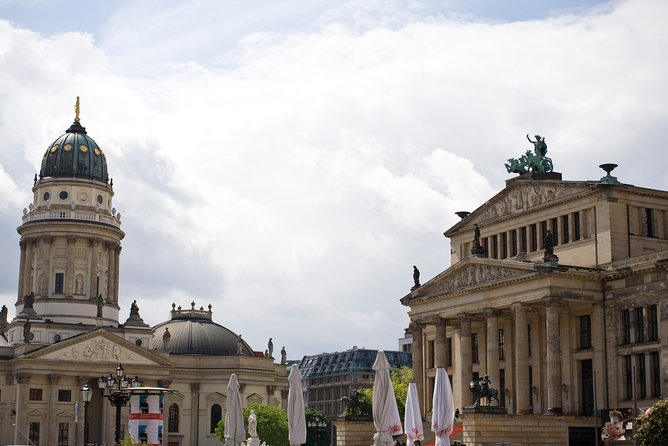
- Gendarmenmarkt and the art of a symmetrical square
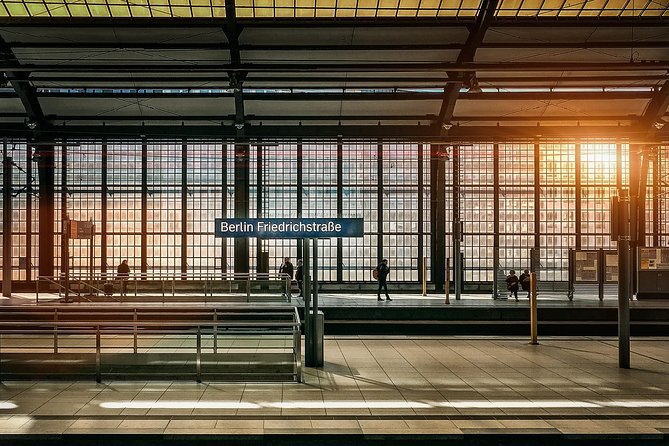
- Friedrichstrasse: old glamour meets New Berlin
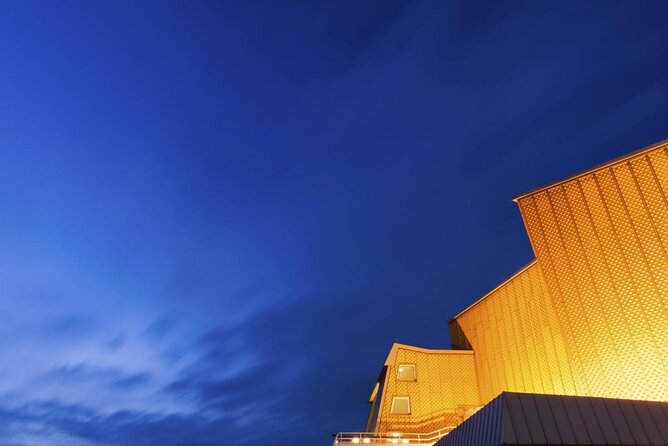
- Kulturforum and the expressive Philharmonie
- Reichstag and Pariser Platz: old symbols with new messages
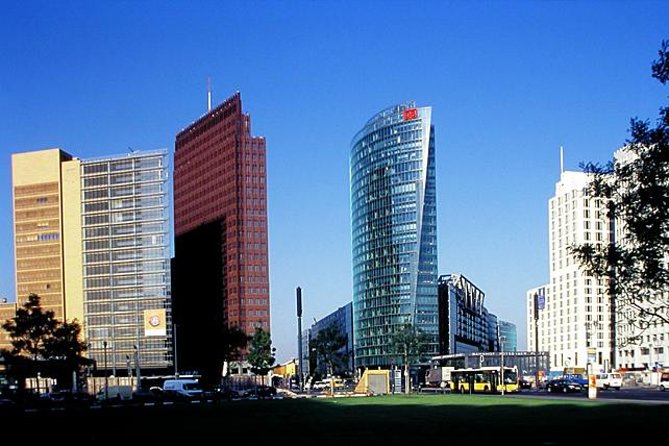
- Potsdamer Platz and the city rebuilt from the ground up
- Kreuzberg and Friedrichshain: architecture with street-level character
- Hackescher Markt and the courtyards of Hackescher Höfe
- How the four hours work in practice
- What the $191.87 price means
- Who should book this private Berlin tour?
- Should you book it?
- FAQ
- How long is the Berlin architecture tour?
- Is this a private tour?
- Where does the tour begin?
- Can I choose between walking and cycling?
- Is hotel pickup and drop-off included?
- Is the tour offered in English?
- Are food and drinks included?
- Can the itinerary be customized?
Key points to know before booking
- A private four-hour route: Only your group takes part, with hotel pickup and drop-off included.
- Berlin’s political story through buildings: Compare former East German apartment blocks with West Berlin’s modern cultural projects.
- Major landmarks without admission fees: See Museum Island, the Reichstag, Philharmonie, Berliner Dom, and Brandenburg Gate from outside.
- A flexible guide-led experience: Tell the guide your priorities, since the route can be adapted to specific interests.
- Walking or biking available: Choose the format that suits your energy and the amount of ground you want to cover.
- Strong guide lineup: Sara, Thomas, Tom, Daniel, Heiko, and Tarek Ibrahim are praised for clear explanations, warmth, and flexibility.
Why Berlin architecture makes such a good tour subject
Berlin rewards anyone who looks up. A grand 19th-century façade may sit beside a plain socialist housing block, a glass office tower, or a building rebuilt almost from scratch after wartime destruction. The city’s architecture is not one tidy style. It is a record of monarchy, dictatorship, division, destruction, reunification, and experimentation.
A guide adds the missing links. At Friedrichstrasse, for example, you do not just see shops and offices. You learn how a famous central street tries to connect the old city with New Berlin. At Kulturforum, the buildings make more sense once you understand that West Berlin created a new cultural center after many collections and institutions were left on the other side of the Wall.
That historical frame is the real value here. Even if you are not an architecture specialist, you can follow the basic questions: Who built this? For whom? What did it replace? Why does this building look so different from the one across the street?
The tour is private, so you can ask those questions without holding up a large group. Guides who have led the route, including architect Sara and guides such as Thomas and Tom, are described as especially strong at connecting design with history and daily life.
A few more Berlin trips to weigh up
- Discover Berlin Half-Day Walking Tour
★ 5.0 · 9,624 reviews - Berlin: Third Reich and Cold War 2 Hour Walking Tour
★ 4.9 · 6,830 reviews - Berlin: Discover Berlin Walking Tour
★ 4.9 · 5,998 reviews
Museum Island: five museums, one extraordinary urban composition
The tour begins, or includes a stop, at Museum Island, where Berlin gathers several of its most important cultural buildings on the Spree. The allotted time is about 20 minutes, so think of this as an exterior architecture stop rather than a museum visit.
The Altes Museum gives you the clearest neoclassical opening. Its long row of columns and broad portico create a calm, formal face beside the river. Your guide can point out how the building was designed to feel like a public temple for art and learning.
The Pergamon Museum has monumental classical façades, while the Bode Museum brings a rounded dome and more decorative curves to the island’s skyline. The Neues Museum is especially useful for understanding Berlin’s approach to damaged historic buildings. Its restoration combines surviving elements with modern work instead of pretending that the war never happened.
The Berliner Dom, also on the island, provides a grander Baroque and Renaissance Revival counterpoint. Its huge dome, stone details, columns, and sculpture make it one of the easiest Berlin landmarks to recognize. The itinerary allows about 15 minutes there, enough for exterior views and photographs, but not a full interior visit.
I would bring a wide-angle camera lens if you use one. The river, domes, columns, and long façades give you plenty of strong views, but the short timing means you will want to move efficiently.
Gendarmenmarkt and the art of a symmetrical square
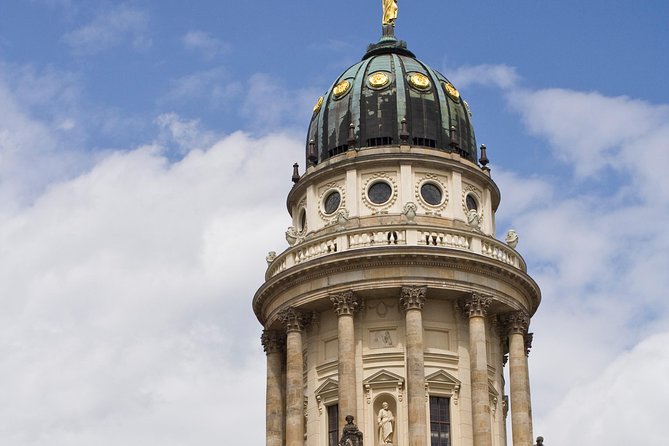
Gendarmenmarkt is one of the tour’s best stops for seeing how a public square can be built around balance. The Französischer Dom and Deutscher Dom face one another, with Schinkel’s Konzerthaus between them. Friedrich Schiller’s statue occupies the center.
The three buildings create a clear architectural conversation. The two domed cathedrals frame the square, while the concert hall supplies a classical center. The guide can explain the history and meaning of each building, including details that are easy to miss when you simply walk through the square.
Only about 15 minutes is assigned here, so you will mainly walk, listen, and take photographs. If the square is busy with an event or construction, the sense of symmetry may be harder to appreciate, but the stop still gives you one of Berlin’s most satisfying architectural views.
Friedrichstrasse: old glamour meets New Berlin
Friedrichstrasse is where the tour shifts from monumental landmarks to urban renewal. It is a major shopping and cultural street, associated with the elegance of Berlin’s Golden Twenties and with the city’s later effort to rebuild a central commercial axis.
You will see decorated historic buildings, offices, cafés, restaurants, boutiques, department stores, and Galeries Lafayette. The interest is not simply in the storefronts. Friedrichstrasse shows how architecture works at street level, where grand plans meet shopping, transport, business, and everyday movement.
Ask your guide about which parts of the street reflect older Berlin and which were planned during the city’s later rebuilding. The route is customized, so this is a good place to state your interests. Designers may want to focus on materials and façades. First-time visitors may prefer the political story and the way the street changed after reunification.
Same city, a completely different kind of day:
- Berlin: Reichstag, Dome and Government District Guided Tour
★ 4.7 · 18,288 reviews - Berlin: 1-Hour City Tour by Boat with Guaranteed Seating
★ 4.3 · 16,993 reviews - Berlin: Boat Tour Along the River Spree
★ 4.4 · 11,252 reviews - Berlin: Hop-on Hop-off Bus Tour with Live Commentary
★ 4.3 · 8,579 reviews
Kulturforum and the expressive Philharmonie
At Kulturforum, West Berlin’s postwar cultural ambition becomes visible. Built largely in the 1950s and 1960s near the former Wall, the district gathered museums, concert halls, libraries, and research institutions in a new cultural center.
The Berliner Philharmonie is the visual prize. Its tent-like, asymmetrical form looks unlike the formal buildings around Museum Island or Gendarmenmarkt. The bright, angular exterior reflects a modern approach to public culture, while the concert hall’s interior places the orchestra at the center, surrounded by the audience.
The stop lasts about 15 minutes and is mainly for exterior viewing and photos. You should not assume that a concert or interior visit is included. Still, the building is worth seeing from outside, especially if you enjoy modern design that refuses to be quiet.
This is also one of the clearest examples of the former West Berlin using architecture to make a political and cultural statement. The district was not just a collection of useful buildings. It was an attempt to create a new center for institutions whose old homes were inaccessible or politically separated.
Reichstag and Pariser Platz: old symbols with new messages
The Reichstag combines a heavy 19th-century exterior with Norman Foster’s glass dome. The contrast is the point. The classical façade recalls imperial Germany, while the transparent dome suggests a more open democratic government after reunification.
The itinerary gives the Reichstag about 10 minutes. That is enough to examine the exterior, hear the basic story, and take photographs. It is not enough for a leisurely dome visit, and the tour information does not include dome admission. If entering the dome is a priority, ask the operator before booking and make separate arrangements if needed.
Nearby Pariser Platz gives you another concentrated look at Berlin’s changing identity. The Brandenburg Gate dominates the square, surrounded by the Hotel Adlon, French Embassy, American Embassy, Academy of Arts, and the DZ Bank building designed by Frank Gehry.
Gehry’s building is especially useful for comparison. Its fluid glass and steel design pushes against the formal order of the gate and the embassies. In a few steps, you can read several eras of Berlin architecture without entering a museum.
Potsdamer Platz and the city rebuilt from the ground up
Potsdamer Platz may be the most direct expression of Berlin’s post-Cold War transformation. Before World War II, it was a major city center. After wartime destruction and Cold War division, it became associated with the Wall and the empty space between East and West.
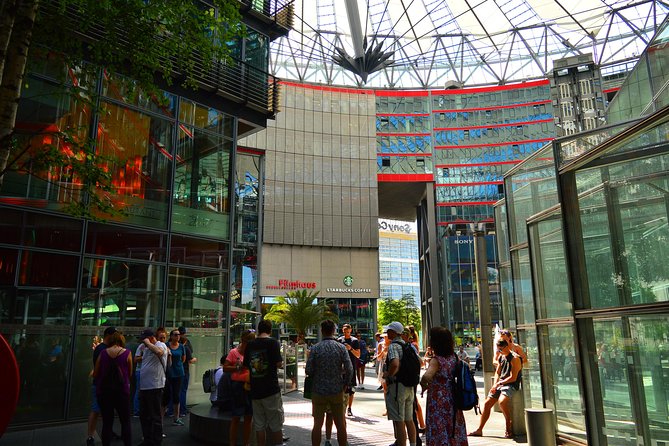
Today, glass towers, office buildings, public spaces, and large commercial projects fill the area. The Sony Center’s sweeping glass roof is the most recognizable feature, while the DB Tower adds a tall, sleek presence. The Panoramapunkt offers city views, but the tour does not include admission.
The stop lasts about 20 minutes. I would use the time to ask how the redevelopment dealt with such a difficult site. Potsdamer Platz can feel polished and corporate compared with older neighborhoods, and that is part of the discussion. It shows both Berlin’s appetite for new construction and the challenge of creating a convincing city center on ground marked by war and division.
Kreuzberg and Friedrichshain: architecture with street-level character
The eastern neighborhoods provide a useful change of pace. In Kreuzberg, older Altbau apartment buildings sit beside industrial conversions and newer urban projects. Look for tall windows, ornate façades, and the proportions that give 19th-century apartment blocks their particular charm.
The Oberbaum Bridge is the main visual landmark in this section. Its red-brick towers and Gothic-inspired arches connect Kreuzberg with Friedrichshain across the Spree. The bridge is a strong photo stop, and its location helps explain how neighborhoods once divided by the Wall are now linked by ordinary city life.
The route allows about 30 minutes in Kreuzberg, followed by another 30 minutes in Friedrichshain. That gives you more time to see neighborhood streets than the central landmark stops, though the exact path can change because the tour is private.
Friedrichshain brings together restored prewar Altbau buildings, socialist-era structures, cafés, shops, and newer projects. The East Side Gallery, painted on a remaining section of the Berlin Wall, adds a major layer of political art. It is not architecture in the narrow sense, but it shows how Berlin reuses physical traces of division rather than hiding them.
This part of the tour will suit you if you want more than polished central monuments. It also gives the guide room to explain how design affects housing, commerce, and neighborhood identity.
Hackescher Markt and the courtyards of Hackescher Höfe
Hackescher Höfe is a compact architectural surprise near Hackescher Markt. The eight connected courtyards were built in 1906 and designed by August Endell, with Art Nouveau façades, colorful ceramic tiles, ironwork, and decorative patterns.
The first courtyard is the most immediately dramatic, but do not stop after the first photograph. Each courtyard has its own treatment, with geometric details, brickwork, and practical commercial spaces arranged around the shared passages.
The planned time is about 20 minutes. Shops and cafés occupy parts of the complex, but food and drinks are not included. This is a good place to look closely at details rather than spend the whole stop trying to cover distance.
Hackescher Höfe also helps balance the tour. After the monumental scale of the Reichstag and Potsdamer Platz, you see how architectural ideas work in courtyards and mixed-use buildings used by ordinary residents, businesses, and shoppers.
How the four hours work in practice
The itinerary covers a wide section of Berlin, from Museum Island to the western cultural district and then into Kreuzberg and Friedrichshain. That range is a strength, but it also means the experience is closer to a guided overview than a slow architectural study.
The listed stop times add up to roughly three hours, leaving about an hour for walking, transfers, explanations, hotel pickup, and drop-off. You should expect a brisk pace. Comfortable shoes matter, and cycling may be the better option if you want to cover the full route without spending much of the tour walking between districts.
Hotel pickup and drop-off simplify the start and finish. The meeting point is a central Berlin hotel lobby, and the tour is offered in English. Public transportation is nearby, but the arrangement does not require you to find the guide across town at the start.
The guide can adjust the experience. Past guests have singled out Sara, Thomas, Tom, Daniel, Heiko, and Tarek Ibrahim for clear communication, historical insight, warmth, and flexibility. One group of interior designers had its route adjusted to fit its design interests, while another guide changed the timing to meet the group’s needs.
That flexibility is the most important thing to confirm at the beginning. Tell the guide if you care most about modern architecture, socialist planning, historic restoration, photography, urban design, or Berlin’s political past.
What the $191.87 price means
At $191.87 per person, this is not a budget introduction to Berlin. The price makes more sense for a small group that wants a private specialist-style orientation, especially when several people share the cost and the guide can tailor the route.
You are paying for the private guide, hotel pickup and drop-off, route flexibility, and the ability to ask questions throughout. You are not paying for meals, drinks, or stated admission to the interiors of the museums, cathedral, Reichstag dome, or Panoramapunkt.
For an architecture student, designer, historian, or serious first-time visitor, the price can be justified because a good guide turns scattered buildings into a readable story. One guide, Heiko, was especially effective at combining history, politics, and architecture into a useful first-day orientation.
For a couple on a tight budget, the cost may be harder to defend. You could see many of these exterior landmarks independently using public transportation. The private option earns its keep when you value explanation, customization, and efficient routing more than low cost.
Who should book this private Berlin tour?
I would recommend it most strongly to:
- Architecture and design enthusiasts who want ideas behind the buildings, not just names and dates.
- First-time Berlin visitors who want a city orientation before choosing where to return.
- Families or mixed-interest groups who benefit from a private pace and a guide who can adjust explanations.
- History-minded visitors who want the division of Berlin woven into the streets and buildings.
- Small groups sharing the cost of a private guide.
It may not suit you if you want extended museum visits, a relaxed café-filled walk, or a low-cost overview. The tour passes many major buildings, but its short stops focus on context and exterior design rather than interior exploration.
Most people can participate, and service animals are allowed. Free cancellation is available up to 24 hours before the start time. If you cancel later, the amount paid is not refunded.
Should you book it?
Book this tour if you want Berlin to make sense as a city shaped by competing political systems and repeated rebuilding. The strongest feature is not any single stop. It is the link between places: Museum Island and Kulturforum, the Reichstag and Brandenburg Gate, Potsdamer Platz and the former Wall, old Altbau buildings and new development.
I would book it for a private group with a clear interest in architecture, urban planning, or 20th-century history. Ask for a guide whose experience matches your focus, and mention your preferred sights before the tour begins. If price matters more than personal guidance, use public transportation and visit the exterior landmarks independently. If you want a sharp, flexible introduction with hotel pickup and a guide who can explain why Berlin looks the way it does, this is a worthwhile splurge.
FAQ
How long is the Berlin architecture tour?
The tour lasts approximately four hours, including the guided route, movement between areas, hotel pickup, and hotel drop-off.
Is this a private tour?
Yes. Only your group participates, and the experience includes a private professional guide.
Where does the tour begin?
The guide meets you in the lobby of your central Berlin hotel.
Can I choose between walking and cycling?
Yes. The experience can be done on foot or by bike.
Is hotel pickup and drop-off included?
Yes. Professional hotel pickup and drop-off are included.
Is the tour offered in English?
Yes. The tour is offered in English.
Are food and drinks included?
No. Food and drinks are not included in the tour price.
Can the itinerary be customized?
Yes. You should discuss specific attractions or interests with the guide because the private route can be adjusted to your requests.
Just added around Berlin
- Love and War in Berlin: Self-Guided Story Puzzle Walk★ 5.0 · 7 reviews
- Rickshaw Tours Berlin – Groups of up to 16 people with several rickshaws★ 4.0 · 97 reviews
- Walking on the Wall: 3-Hour Tour in Berlin★ 4.5 · 34 reviews
- eSIM for Germany and 34 European Countries★ 4.5 · 16 reviews
- Warnemuende Shore Excursion: Berlin Private Sightseeing Tour from Rostock★ 5.0 · 4 reviews
- Your ticket to The Wall Museum Berlin★ 3.0 · 60 reviews
- Warnemuende Shore Excursion: Private Berlin Tour★ 4.5 · 27 reviews
- Berlin’s Gay, Lesbian, and Queer Scene Small-Group Walking Tour★ 4.5 · 66 reviews
Walking Tours, compared.





Berlin’s Best: 2 Hour Walking Tour Third Reich and the Cold War
Read our review →

