
Reviewed · WALKING TOURS
Private Berlin Walking Tour
Berlin’s story comes into sharp focus on this private central walking route, which links the Brandenburg Gate, the Holocaust Memorial, Hitler’s bunker site, Checkpoint Charlie, and Bebelplatz. In about two and a half hours, you move from Prussian grandeur to Nazi terror, then into the divided city of the Cold War.
I like the personal format and the way the route tackles difficult history at the actual places where it happened. I also like the chance to ask questions and get local suggestions, including restaurant and nightlife advice from guides such as Marc. The main drawback is the price: at $285.09 per person, this makes the most sense for a small group that values private attention.
In This Review
- Key points to know before booking
- Why this route tells Berlin’s story well
- Starting at the Brandenburg Gate
- Walking through the Holocaust Memorial
- Finding the Berlin Wall in today’s city
- The unmarked site of Hitler’s bunker
- Reading Nazi power in the Aviation Ministry
- Checkpoint Charlie and the limits of a famous symbol
- Gendarmenmarkt’s elegant change of pace
- Ending at Bebelplatz and the book-burning memorial
- What the private format is worth at $285.09
- Timing, walking, and who will enjoy it most
- Booking details that affect your decision
- Should you book this Berlin walking tour?
- FAQ
- How long is the private Berlin walking tour?
- What language is the tour offered in?
- Where does the tour begin?
- Where does the tour end?
- Is hotel pickup or drop-off included?
- Is this a private tour?
- Are entrance tickets included?
- Can I cancel for a full refund?
Key points to know before booking
- Eight central stops cover Berlin’s best-known political and historical sights, ending at Bebelplatz.
- Marc and Jenny are named guides connected with the experience, with a style that emphasizes clear explanations and local recommendations.
- The tour is private, so only your group takes part and the guide can respond to your questions directly.
- All listed sights are viewed from outside, with free admission shown for every stop.
- The route is delivered in English and lasts about 2 hours and 30 minutes.
- Hotel pickup and drop-off are not included, so you begin at Hotel Adlon Kempinski and finish at Bebelplatz.
Why this route tells Berlin’s story well
Berlin can feel like a city of scattered monuments. One street recalls the Prussian kingdom, the next points to dictatorship, and a few blocks later you are standing where the Cold War split Europe in two. This tour gives those places a connecting thread.
The route begins at the Brandenburg Gate and ends at Bebelplatz, with the major stops arranged around Berlin’s central Mitte district. That makes the experience useful early in your visit. You get a basic map of the city, a set of historical reference points, and a clearer sense of how the Nazi and Cold War periods overlap in the modern streetscape.
The private setup matters here. Berlin’s history can raise hard questions, and a one-group tour gives you room to stop and ask them. A guide can also adjust the explanation to your interests. If you want more context on the Berlin Wall, for example, you can use your time there for questions rather than following a fixed group schedule.
The route is also efficient, but do not expect a slow architectural tour or a series of long indoor visits. The listed stop times add up to the full 150-minute duration. Walking between sites is part of the experience, and each stop is relatively brief.
A few more Berlin trips to weigh up
- Discover Berlin Half-Day Walking Tour
★ 5.0 · 9,624 reviews - Berlin: Third Reich and Cold War 2 Hour Walking Tour
★ 4.9 · 6,830 reviews - Berlin: Discover Berlin Walking Tour
★ 4.9 · 5,998 reviews
Starting at the Brandenburg Gate
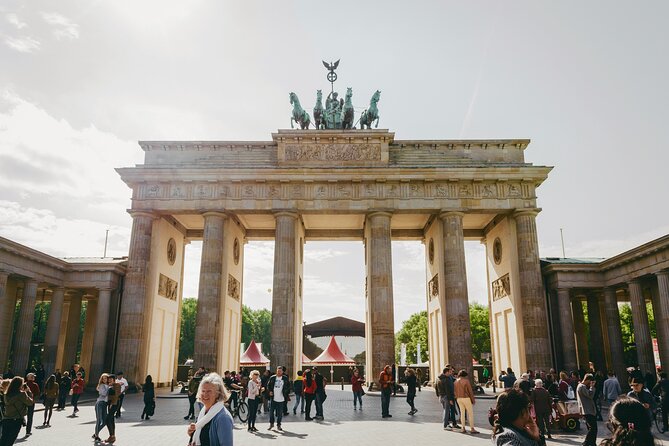
You meet at Hotel Adlon Kempinski Berlin on Unter den Linden, close to the Brandenburg Gate. This is a practical starting point, since the gate is one of the easiest places in Berlin to recognize and reach by public transportation.
The gate was built in the 18th century as a neoclassical triumphal arch. Its columns and formal proportions reflect Berlin’s earlier role as a royal capital, but its later meaning is much more political. It became a symbol of division during the Cold War and then of unity after the Berlin Wall fell.
You get about 20 minutes here. That is enough time to hear the main story, look closely at the structure, and take photos, but not enough for a long architectural lecture. I like that the tour uses the gate as a starting point rather than treating it as an isolated photo stop. It sets up the larger question running through the day: how can one place carry such different meanings across time?
Walking through the Holocaust Memorial
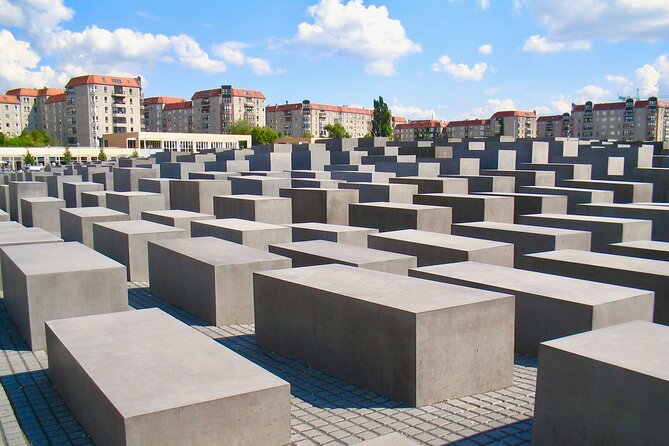
The Memorial to the Murdered Jews of Europe is only a short walk from the gate, yet the mood changes sharply. The site consists of 2,711 concrete slabs arranged in a grid over sloping ground.
You can walk among the slabs during the 20-minute stop. The abstract design does not provide a simple statue or a single message. Instead, the changing height and narrow passages create a sense of unease and uncertainty. The experience is physical as well as visual.
This is a place where a guide’s explanation can help, but you should also allow yourself some quiet time. I appreciate that the memorial is not presented as a quick photo opportunity. Its meaning is difficult, and the plain setting makes the subject feel close to the everyday city around it.
The memorial is outdoors, and the tour does not list an admission charge. Wear shoes you can walk in, since the ground is uneven in places and the route continues on foot.
Finding the Berlin Wall in today’s city
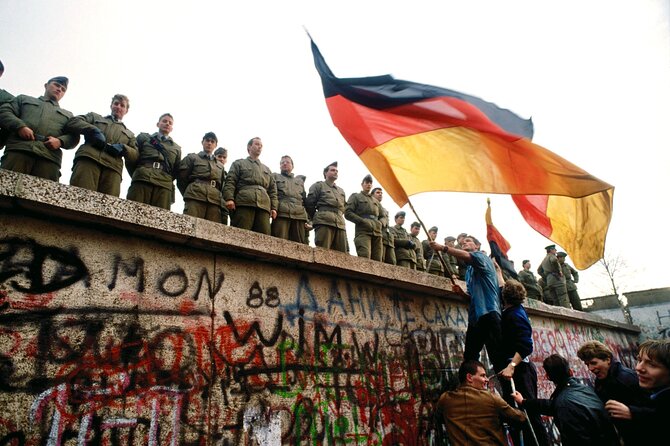
The Berlin Wall stop brings you into the Cold War portion of the tour. The wall once divided East and West Berlin, separating families, neighborhoods, and political systems. Today, preserved sections across Berlin help you understand that the division was not an abstract line on a map. It cut through ordinary streets.
You have about 20 minutes for this part of the route. The description refers to preserved wall sections across the city and identifies the East Side Gallery as the best-known example because of its murals. The exact stop on this tour is listed as the Memorial of the Berlin Wall, so you should not assume this short visit includes a full walk along the East Side Gallery.
The strongest feature here is the chance to connect the wall’s physical remains with the guide’s wider explanation of how Germany was divided after World War II. Marc is especially noted for explaining the division with a hand-drawn map. That kind of simple visual lesson can be useful if the political geography feels confusing.
I would ask the guide to clarify the difference between the wall memorial, the former crossing points, and the East Side Gallery. They are related, but they are not the same sight.
Same city, a completely different kind of day:
- Berlin: Reichstag, Dome and Government District Guided Tour
★ 4.7 · 18,288 reviews - Berlin: 1-Hour City Tour by Boat with Guaranteed Seating
★ 4.3 · 16,993 reviews - Berlin: Boat Tour Along the River Spree
★ 4.4 · 11,252 reviews - Berlin: Hop-on Hop-off Bus Tour with Live Commentary
★ 4.3 · 8,579 reviews
The unmarked site of Hitler’s bunker
The former Führerbunker is one of the tour’s most striking stops precisely because so little remains to see. The bunker site is now an ordinary parking area, marked by information boards rather than a grand memorial.
You spend about 20 minutes here. The boards explain the bunker’s role during the final days of World War II, when Hitler and other Nazi leaders remained underground as Berlin fell. The plain setting makes a useful point: places connected with major events do not always look important today.
This stop requires a serious tone. It is not a place for dramatic presentation or sensational detail, and a good guide should keep the focus on the historical record and the human cost of the regime. The information boards give you a chance to read at your own pace, while the guide can explain how the site fits into the surrounding area.
Do not book this tour expecting a preserved bunker interior. The experience is an outdoor visit to the location and its explanatory boards.
Reading Nazi power in the Aviation Ministry
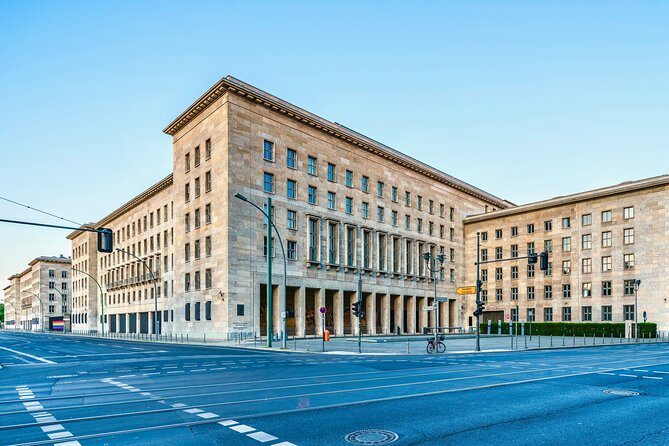
The former Aviation Ministry, once the headquarters of the Luftwaffe, offers a different view of the Nazi period. Instead of a ruin or memorial, you see a massive government building that still serves a public function. It now houses the German Finance Ministry.
The 15-minute stop focuses on the building’s scale and architecture. Its imposing design reflects the ambitions of the Nazi state, which used government buildings to project authority and control. Seeing the structure in its present role adds another layer. Berlin did not erase every difficult building. In many cases, the city gave those places new civic uses.
This is a short stop, so I would listen for the details that explain the building’s purpose and design rather than expect a full architectural tour. It also works well beside the bunker stop. One site is nearly invisible, while the other remains a large physical reminder of the government that once operated there.
Checkpoint Charlie and the limits of a famous symbol
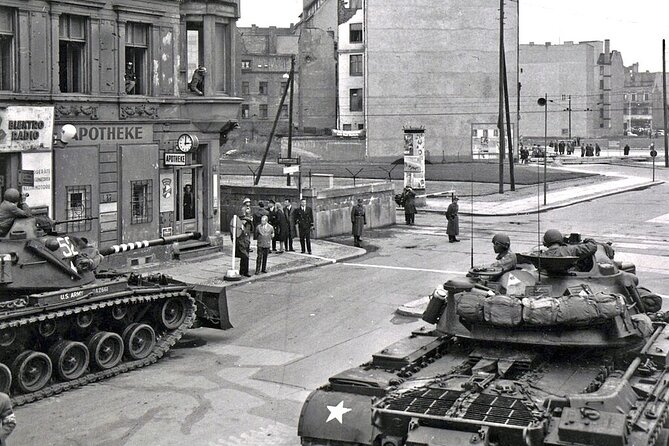
Checkpoint Charlie was the best-known crossing point between East and West Berlin. During the Cold War, it represented the tense divide between the American and Soviet spheres. Today, the site includes a replica guardhouse and a tourist-oriented display, with a museum nearby that covers escape attempts and Cold War events.
The stop lasts about 15 minutes. That is enough for an introduction, photos, and a short explanation, but not enough to visit every museum display in detail. Admission to the walking tour’s listed stops is free, and the tour does not include separate museum admission.
Checkpoint Charlie can feel more commercial than the Berlin Wall memorial or the Holocaust Memorial. I would treat it as a place to understand the political symbolism rather than as an untouched historical site. The guide’s context is particularly useful here, since the modern presentation can otherwise distract from the danger and tension of the original crossing.
If Cold War history is your main interest, ask questions during this stop. The private format gives you a better chance to focus on escape stories, the role of the crossing, or how the divided city worked.
Gendarmenmarkt’s elegant change of pace
Gendarmenmarkt gives the route a welcome shift in tone. The square is framed by the French Cathedral, the German Cathedral, and the Concert House. Its formal design shows another side of Berlin, one tied to architecture, music, religion, and civic life.
You spend around 20 minutes here. The square is a good place to look at the relationship between the three major buildings rather than simply photograph one façade. The guide can also explain how this part of central Berlin fits into the city’s earlier development.
The square hosts cultural events and markets during the year, though the tour itself does not promise a particular event. It is also a useful place to pause after the heavier Nazi and Cold War sites. I like this contrast. Berlin’s identity is not only made of memorials and political scars. Its grand public spaces help explain the city before, between, and after those dark periods.
Ending at Bebelplatz and the book-burning memorial
The tour ends at Bebelplatz, one of Berlin’s most meaningful squares. It is surrounded by important cultural buildings and contains the Book Burning Memorial, which recalls the Nazi book burning of 1933.
The memorial is easy to miss if you are not looking down. A transparent panel set into the cobblestones reveals empty bookshelves below, symbolizing the books and ideas that were destroyed or suppressed. You have about 20 minutes here, giving the guide time to explain the event and the memorial’s design.
Ending at Bebelplatz works well because it leaves you with a question about culture and freedom, rather than simply a final landmark photo. It is also a practical finish. The square has services and amenities nearby, so you can continue sightseeing, find a meal, or make your way onward.
The end point is not the same as the starting point. Since hotel pickup and drop-off are not included, plan to meet the guide at Hotel Adlon Kempinski and arrange your own return from Bebelplatz.
What the private format is worth at $285.09
At $285.09 per person, this is not a budget walking tour. The price needs to be judged against the group size, not just the number of sights. You are paying for a private experience with a certified expert guide, not for admission tickets. Every listed stop has free admission, and the tour does not include hotel transportation.
The value improves if you are traveling with family or friends and can use the stated group discounts. A private group can share the guide’s time, ask more questions, and avoid being held to the interests of strangers. For one or two people, the cost is harder to justify unless personal attention is especially important to you.
I would also compare this tour with the value of exploring these outdoor sights on your own. Berlin’s central landmarks are accessible, and many have information boards. The tour earns its price through explanation, connection, and convenience, not through exclusive access.
The guide quality is central to that calculation. Marc is associated with especially clear explanations, including his map lesson on Germany’s division, and with useful suggestions for restaurants, clubs, and other places to visit. Jenny is also associated with engaging commentary that brings the city’s past into the present. You should confirm your guide at booking if a named guide matters to you, since the available information does not promise that Marc or Jenny will lead every departure.
Timing, walking, and who will enjoy it most
The tour lasts about 2 hours and 30 minutes. The listed stops range from 15 to 20 minutes, so you get a brisk overview rather than long visits at any one place. You should be ready to walk outdoors for the entire experience.
I would book this for a first visit, especially if you want a clear introduction before returning to selected sites on your own. It also suits families, couples, and small groups who prefer asking direct questions instead of listening quietly in a large crowd.
The route is heavily focused on political history. If you mainly want museums, art collections, food, or neighborhood life, this will not cover enough of those subjects. The local recommendations from guides such as Marc can help you plan beyond the tour, but they are an added benefit rather than the main activity.
Most people can participate, the tour is near public transportation, and service animals are allowed. Since the itinerary includes memorial grounds and city streets, practical walking shoes are the sensible choice.
Booking details that affect your decision
The experience is offered in English and includes a mobile ticket. Your booking confirmation is received at the time of booking, and only your group takes part.
Free cancellation is available if you cancel at least 24 hours before the start time. A cancellation made less than 24 hours before the start time is not refunded, and changes within that same period are not accepted. The cut-off follows Berlin local time, so pay attention if you are booking from another time zone.
There is no hotel pickup or drop-off. Start at Hotel Adlon Kempinski Berlin, Unter den Linden 77, and finish at Bebelplatz. Since the route is central and near public transportation, arranging your own way to the start and onward from the finish should be straightforward, but it remains your responsibility.
Should you book this Berlin walking tour?
Book it if you want Berlin’s major political landmarks explained as one connected story, and if your group will benefit from a private guide. The route is especially strong for first-time visitors who know pieces of German history but want them placed in the right order and location.
I would be more cautious if you are traveling alone on a tight budget or want substantial indoor sightseeing. The price is high for an outdoor tour with no included admissions, and the short stops leave little time to linger.
For a small group that values personal questions, clear historical explanation, and practical city advice, this can be a useful first step in Berlin. You will leave Bebelplatz with a stronger map of the city and a better sense of why its ordinary streets carry such weight.
FAQ
How long is the private Berlin walking tour?
The tour lasts approximately 2 hours and 30 minutes.
What language is the tour offered in?
The tour is offered in English.
Where does the tour begin?
The meeting point is Hotel Adlon Kempinski Berlin, Unter den Linden 77, 10117 Berlin, Germany.
Where does the tour end?
The tour ends at Bebelplatz in Berlin. Services and amenities are available near the square.
Is hotel pickup or drop-off included?
No. Hotel pickup and drop-off are not included.
Is this a private tour?
Yes. Only your group participates in the activity.
Are entrance tickets included?
The listed stops show free admission. The experience does not include separate museum admission.
Can I cancel for a full refund?
Yes, if you cancel at least 24 hours before the experience’s start time. Cancellations made less than 24 hours in advance are not refunded.
Just added around Berlin
- Love and War in Berlin: Self-Guided Story Puzzle Walk★ 5.0 · 7 reviews
- Rickshaw Tours Berlin – Groups of up to 16 people with several rickshaws★ 4.0 · 97 reviews
- Walking on the Wall: 3-Hour Tour in Berlin★ 4.5 · 34 reviews
- eSIM for Germany and 34 European Countries★ 4.5 · 16 reviews
- Warnemuende Shore Excursion: Berlin Private Sightseeing Tour from Rostock★ 5.0 · 4 reviews
- Your ticket to The Wall Museum Berlin★ 3.0 · 60 reviews
- Warnemuende Shore Excursion: Private Berlin Tour★ 4.5 · 27 reviews
- Berlin’s Gay, Lesbian, and Queer Scene Small-Group Walking Tour★ 4.5 · 66 reviews
Walking Tours, compared.





Berlin’s Best: 2 Hour Walking Tour Third Reich and the Cold War
Read our review →

