
Reviewed · WALKING TOURS
Private Berlin: Iconic Sights and Hidden Gems Walking Tour
Berlin’s past is not tucked away in one museum. It is under your feet, on ordinary streets, and beside monuments that once divided a nation. This private tour links the Brandenburg Gate, Hitler’s bunker site, the Berlin Wall, Checkpoint Charlie, Museum Island, and other key places into one guided walk.
I like the hotel pickup and drop-off, especially on a first day when Berlin’s broad avenues and scattered sights can feel confusing. I also like the private format: you can ask more questions, slow down for a family member, or steer the tour toward Nazi Germany, the Cold War, architecture, or less familiar parts of Mitte.
The main drawback is the amount of ground covered in only three or four hours. Some stops are brief, and the experience is not designed for long museum visits or leisurely meals. At $192.97 per person, it makes the most sense for a small group that values personal guiding and wants a strong introduction rather than the cheapest way to sightsee.
In This Review
- Key points to know before booking
- A private introduction to Berlin’s difficult past
- Brandenburg Gate and the meaning of Pariser Platz
- The Führerbunker site and the Nazi period
- The Memorial to the Murdered Jews of Europe
- Checkpoint Charlie and the divided city
- Bernauer Strasse and the Berlin Wall Memorial
- East Side Gallery and reunification through art
- Reichstag Building and the new German republic
- Gendarmenmarkt, Bebelplatz, and Berlin’s cultural heart
- Museum Island and Berliner Dom
- Hackescher Höfe and the less formal side of Berlin
- What the guides do best
- Is $192.97 per person fair value?
- Practical details that affect your day
- Who should book this Berlin walking tour?
- Should you book it?
- FAQ
- How long is the private Berlin walking tour?
- Where does the tour begin?
- Is the tour private?
- What language is the tour offered in?
- Can I customize the itinerary?
- Are admissions included?
- Is the tour suitable for people with limited walking ability?
- What is the cancellation policy?
Key points to know before booking
- Berlin’s major eras in one walk: Connect the Nazi period, the Cold War, reunification, and modern Berlin through real sites.
- A route shaped around you: Ask for WWII history, architecture, local corners, family-friendly pacing, or attractions you have not yet seen.
- A useful first-day tour: The guide helps you understand how Berlin’s central districts and landmarks fit together.
- Strong guide-to-guest attention: Guides including Tina, Xavier, Daniel, Ariel, Will, and Rebecca are praised for clear explanations and a warm manner.
- Three hours or four: Choose a brisk city overview or allow more time for questions and added stops.
- Free cancellation up to 24 hours ahead: Changes or cancellations inside that window are not accepted for a refund.
A private introduction to Berlin’s difficult past
This is not a tour that treats Berlin as a string of pretty façades. Its real subject is power: how the Nazi dictatorship used the city, how the Wall split families and political systems, and how reunification changed the meaning of old symbols.
Your guide meets you in the lobby of a central Berlin hotel. Several departure times are offered, and the tour ends with a return to your hotel. Since the activity is private, only your party takes part, which gives you room to ask direct questions without holding up a large group.
The three-hour option is the better choice if you want the main sights and a clear framework. The four-hour option gives the guide more time to explain context, adjust the pace, and include extra places such as Kaiser Wilhelm Memorial Church, the former East German government quarter, or Unter den Linden.
The route can be physically manageable, but it is still a city walk. Ronja adapted a tour for a person with limited walking ability, and other guides have adjusted routes around events and road closures. Tell the company about mobility needs when you book, rather than hoping the route can be changed on the spot.
A few more Berlin trips to weigh up
- Discover Berlin Half-Day Walking Tour
★ 5.0 · 9,624 reviews - Berlin: Third Reich and Cold War 2 Hour Walking Tour
★ 4.9 · 6,830 reviews - Berlin: Discover Berlin Walking Tour
★ 4.9 · 5,998 reviews
Brandenburg Gate and the meaning of Pariser Platz
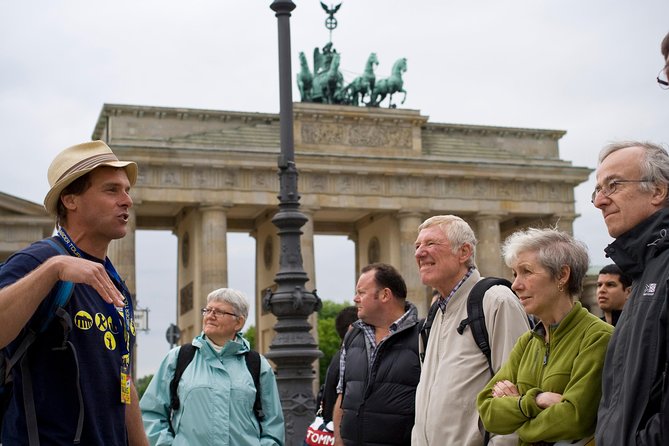
Begin at Brandenburg Gate, where Berlin’s grand ceremonial side meets its twentieth-century scars. The neoclassical gate was once associated with Prussian power, later became a symbol of Cold War division, and now represents German unity.
The guide usually has about ten minutes here, enough for an explanation and photographs. Pariser Platz gives you a useful first look at modern Berlin, with cafés, shops, performers, and formal buildings gathered around the gate.
The Quadriga on top shows a chariot drawn by four horses. It is easy to admire the architecture and move on, but the guide’s context makes this more than a photo stop. You begin to see how the same monument can carry different meanings under different governments.
The Führerbunker site and the Nazi period
Near the former Reich Chancellery, you visit the location of the Führerbunker. The bunker itself is not open as a tourist attraction, and the site is largely unmarked apart from a small plaque.
That limitation is important. You are not touring an underground chamber or examining preserved rooms. Instead, the guide explains the final days of Hitler’s regime and places the bunker within the wider story of Berlin during World War II.
A good guide keeps the focus on history rather than fascination with Hitler. Ariel, Artie, Rebecca, and Grayson are among the guides who have been praised for using stories, visual material, and careful explanation to make the period understandable without turning it into spectacle.
The Memorial to the Murdered Jews of Europe
The tour also covers the Memorial to the Murdered Jews of Europe, a field of concrete slabs near Brandenburg Gate. The site needs time and quiet, so the quality of the explanation matters as much as the structure itself.
The memorial is a place to consider the scale of the Holocaust and the problem of remembering mass murder in a public city space. Your guide can connect it to the Nazi sites nearby, including the former government district and the bunker location.
This is one reason a private guide can be useful. You can pause for questions or keep moving if the subject is too heavy for younger children. The tour is educational, but it does not remove the emotional weight of these places.
Same city, a completely different kind of day:
- Berlin: Reichstag, Dome and Government District Guided Tour
★ 4.7 · 18,288 reviews - Berlin: 1-Hour City Tour by Boat with Guaranteed Seating
★ 4.3 · 16,993 reviews - Berlin: Boat Tour Along the River Spree
★ 4.4 · 11,252 reviews - Berlin: Hop-on Hop-off Bus Tour with Live Commentary
★ 4.3 · 8,579 reviews
Checkpoint Charlie and the divided city
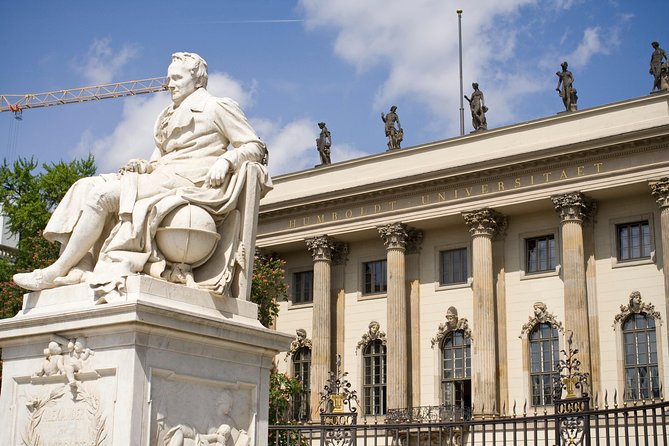
Checkpoint Charlie is one of Berlin’s best-known Cold War locations. It was a crossing point between East and West Berlin, and today the replica guard booth and surrounding displays draw plenty of attention.
The stop lasts about 15 minutes. You will hear about escape attempts, the political tension between the two sides, and the daily reality of a city divided by walls, checkpoints, and competing governments.
Checkpoint Charlie can feel theatrical, since the booth is a reconstruction and the area is heavily geared toward sightseeing. That makes your guide’s role especially useful. The historical explanation helps separate the real border system from the modern photo opportunity.
Bernauer Strasse and the Berlin Wall Memorial
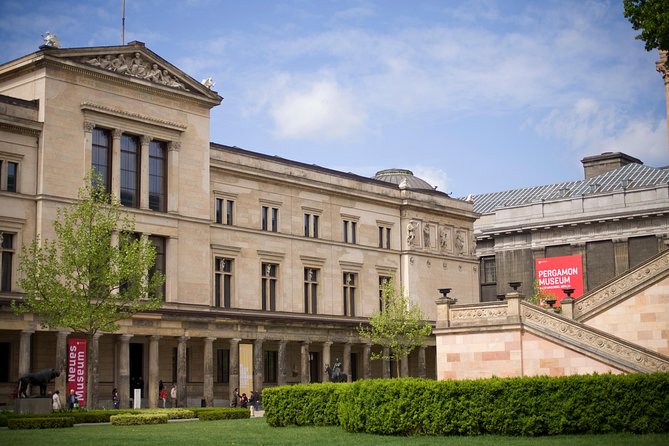
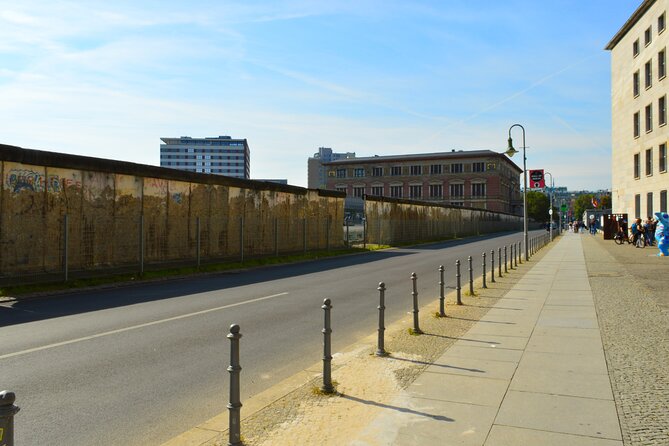
The Berlin Wall Memorial on Bernauer Strasse is a more serious and substantial Wall site. It includes a preserved section of the border, exhibits, photographs, and personal accounts of people who tried to escape from East Berlin.
You have about 30 minutes here, making it one of the longer stops. That extra time allows you to understand how the Wall affected ordinary homes and streets, not just national politics.
For many people, this is the clearest Wall experience on the tour. The memorial shows the physical structure and the human cost. If your main interest is the Cold War, tell the guide in advance so the route can give this subject more attention.
East Side Gallery and reunification through art
The East Side Gallery presents a different side of the Wall. Along a remaining 1.3-kilometer section, artists painted more than 100 murals after the Wall fell in 1989.
Your scheduled time here is around 20 minutes, enough to see several major works but not the entire stretch at a slow pace. The Fraternal Kiss, showing Soviet leader Leonid Brezhnev and East German leader Erich Honecker, is the best-known image.
I like the contrast between Bernauer Strasse and the East Side Gallery. One explains the Wall as a system of control. The other shows how a structure built to divide people became a public canvas for hope and political expression.
Reichstag Building and the new German republic
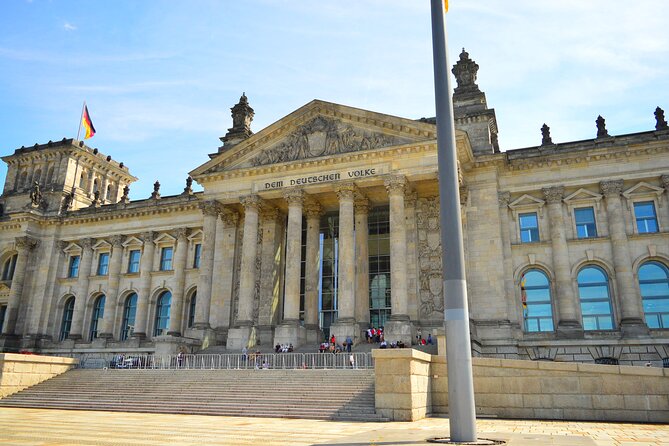
The Reichstag is Germany’s federal parliament and one of Berlin’s most important political buildings. Its story includes the 1933 fire, the Nazi rise to power, wartime destruction, postwar neglect, and restoration before the Bundestag returned in 1999.
The tour allows about ten minutes at the building. That is enough to discuss its role and view the exterior, but do not expect a full visit inside or guaranteed access to the glass dome.
The dome, designed by Norman Foster, represents openness in government and offers city views when visited separately. If seeing the interior is important to you, ask about arranging it before booking. It is not listed as an included admission on this walking experience.
Gendarmenmarkt, Bebelplatz, and Berlin’s cultural heart
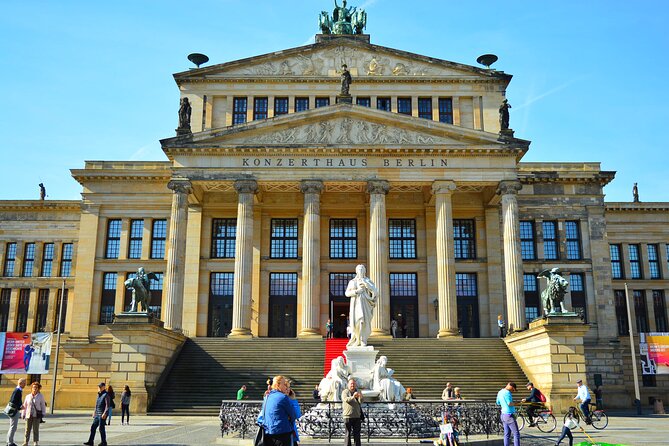
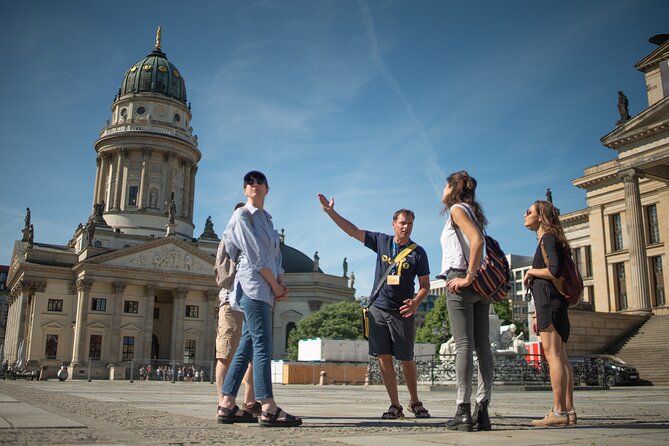
Gendarmenmarkt gives the tour a change of mood. The French Cathedral, German Cathedral, and Concert Hall frame one of Berlin’s most elegant squares.
You get around ten minutes here, so treat it as a guided architectural glance rather than a long café break. The square has also hosted markets and public events, including a Christmas market.
Nearby Bebelplatz brings the tour back to the darker side of public space. On May 10, 1933, Nazi supporters and students burned more than 20,000 books here, including works by Einstein, Freud, and Marx.
The Empty Library memorial is visible through a glass panel in the pavement. Empty shelves represent the books and ideas destroyed by censorship. The stop is short, around 12 minutes, but it gives you a powerful lesson about how political extremism attacks culture and thought.
Museum Island and Berliner Dom
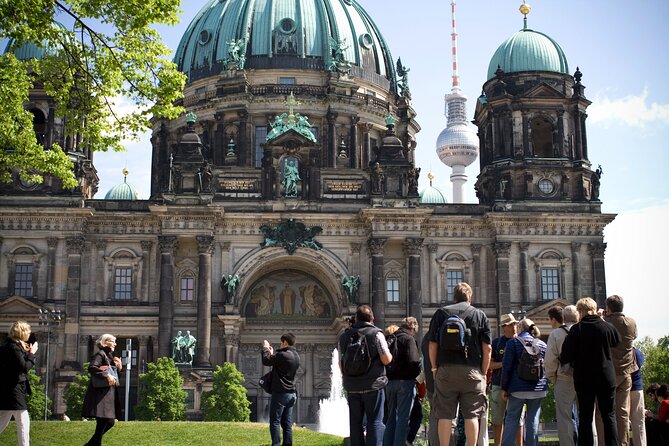
Museum Island offers some of Berlin’s grandest architecture beside the Spree. The island contains major museums, formal façades, gardens, and views that reward a camera, even if you do not enter any museum during this tour.
The visit lasts about 15 minutes. That is enough to orient you to the area and decide which museums deserve a return visit. Museum admission is not included, and food and drinks are also excluded.
The nearby Berliner Dom is a large Protestant cathedral completed in 1905. Its Baroque design, decorated interior, mosaics, altar pieces, and large organ make it one of the city’s most memorable buildings.
The tour gives the cathedral about ten minutes, normally for exterior explanation and orientation. You may later choose to pay for entry and climb to the dome for panoramic views, but that is separate from this experience.
Hackescher Höfe and the less formal side of Berlin
Hackescher Höfe is a useful counterpoint to Berlin’s government buildings and memorials. The complex contains eight connected courtyards with art nouveau details, tilework, iron decoration, shops, galleries, restaurants, and theaters.
You have around 20 minutes to look around. It is not a secret corner, but it feels more lived-in and creative than the formal sights around Brandenburg Gate.
The courtyards began as a mixed residential, commercial, and artistic development in 1906. Today, they offer a glimpse of Berlin’s design culture and everyday city life. If your interests run beyond war and politics, request more time here or ask to include Unter den Linden and the former East German government quarter.
What the guides do best
The strongest part of this tour is the human explanation between the landmarks. Guides are praised for clear English, good pacing, humor, and the ability to adjust the story to the group.
Tina is a strong fit for a first day in Berlin because she combines broad coverage with practical suggestions for what to see next. Xavier is especially suited to mixed-age groups, explaining complex events in a way that keeps children and adults involved.
Daniel has been described as attentive and well prepared, while Will uses humor and plain language to make difficult history easier to follow. Ariel, Rohan, Giles, Callum, and Rebecca are also praised for turning a standard route into a more personal history lesson.
These names do not guarantee who you will receive. They do show the range of guiding styles available. Mention your interests clearly when booking, and ask for a guide who can focus on WWII, the Cold War, architecture, family pacing, or less familiar places.
Is $192.97 per person fair value?
At $192.97 per person, this is not a budget walking tour. The price pays for a private guide, hotel pickup and drop-off, a tailored route, and the ability to set the pace for your own party.
The value improves when several people share the experience, especially if you have only one day in Berlin. You are paying to make sense of a city whose major sights are spread across different areas, not simply to be led from one photo stop to the next.
It is less attractive if you enjoy researching places yourself, prefer public transport, or want long visits inside museums. It is also worth remembering that food, drinks, and admissions are not included.
The 3-hour option gives the best balance for most first-time visitors. Choose four hours if you have a strong interest in twentieth-century history or want room for questions and added stops.
Practical details that affect your day
The tour is offered in English and comes with a mobile ticket. Confirmation is normally issued at booking, though reservations made within two days of departure may be confirmed within 48 hours, subject to availability.
Service animals are allowed, public transportation is nearby, and most people can take part. Since this is a private activity, you do not share the guide with another group.
Free cancellation applies until 24 hours before the start time. Inside that window, cancellations and changes are not accepted for a refund, so allow extra care when arranging flights and other fixed plans.
Who should book this Berlin walking tour?
I would choose this tour for a first visit, a short stay, or a family group that wants history explained without joining a large crowd. It is also a smart fit for anyone who wants to connect Nazi Germany, the Berlin Wall, reunification, and present-day Berlin in one session.
You should consider another option if your main goal is museum interiors, a slow food-focused walk, or a low-cost overview. The tour’s strength is its flexible storytelling and broad coverage, not long time at any single attraction.
Should you book it?
Book it if you want a private guide to give Berlin’s monuments a clear human context. Request the four-hour option for a serious WWII or Cold War focus, and choose three hours if you need a brisk orientation on your first day.
The hotel meeting and return remove much of the stress, while the private format lets you ask questions and adjust the pace. For a small group that values expert explanation over bargain pricing, this is a thoughtful and useful way to get your bearings in Berlin.
FAQ
How long is the private Berlin walking tour?
You can choose a tour lasting approximately three or four hours. The three-hour option provides a broad overview, while the four-hour option allows more detailed explanations and a more extensive route.
Where does the tour begin?
The guide meets you in the lobby of your central Berlin hotel. Hotel pickup and drop-off are included.
Is the tour private?
Yes. Only your group participates, so you receive personal attention from the guide and can ask questions freely.
What language is the tour offered in?
The tour is offered in English.
Can I customize the itinerary?
Yes. You should provide specific requests and desired attractions when booking. Possible additions include Kaiser Wilhelm Memorial Church, the former East German government quarter, and Unter den Linden.
Are admissions included?
The listed walking stops have no admission charge for the tour, but entry to places such as museums or the Berliner Dom is not included. Food and drinks are also excluded.
Is the tour suitable for people with limited walking ability?
Most people can participate, and guides can adjust the pace or route for limited walking ability. Mention your needs at the time of booking.
What is the cancellation policy?
You can cancel up to 24 hours before the start time for a full refund. Cancellations or changes made less than 24 hours ahead are not accepted for a refund.
Just added around Berlin
- Love and War in Berlin: Self-Guided Story Puzzle Walk★ 5.0 · 7 reviews
- Rickshaw Tours Berlin – Groups of up to 16 people with several rickshaws★ 4.0 · 97 reviews
- Walking on the Wall: 3-Hour Tour in Berlin★ 4.5 · 34 reviews
- eSIM for Germany and 34 European Countries★ 4.5 · 16 reviews
- Warnemuende Shore Excursion: Private Berlin Tour★ 4.5 · 27 reviews
- Warnemuende Shore Excursion: Berlin Private Sightseeing Tour from Rostock★ 5.0 · 4 reviews
- Your ticket to The Wall Museum Berlin★ 3.0 · 60 reviews
- Berlin’s Gay, Lesbian, and Queer Scene Small-Group Walking Tour★ 4.5 · 66 reviews
Walking Tours, compared.





Berlin’s Best: 2 Hour Walking Tour Third Reich and the Cold War
Read our review →

