
Reviewed · THIRD REICH & COLD WAR TOURS
Munich: Third Reich Guided City Walking Tour
Munich’s Nazi past is not hidden in a distant museum. It is written into the city center, from the beer hall tied to Hitler’s early political career to the buildings used for propaganda and diplomacy. This 2.5-hour walking tour connects those places in a clear route from Marienplatz to Königsplatz.
I like two things right away: the route covers both Nazi power and German opposition, and the Spanish-speaking guide keeps the tour focused on events that happened in the streets around you. The price, about $23 per person, is also fair for a guided history walk of this length.
The main thing to consider is the subject matter. This is a serious tour about dictatorship, propaganda, political violence, and resistance, not a light city stroll. It is also offered only in Spanish, and children under 13 cannot join.
In This Review
- Key points at a glance
- Why Munich is the right place for this history
- Starting at Marienplatz and following Hitler’s early path
- Hofbräuhaus and the Beer Hall Putsch
- Odeonsplatz and the failed seizure of power
- Haus der Kunst and the politics of art
- German resistance, Georg Elser, and the White Rose
- Führerbau and the Munich Agreement
- Finishing at Königsplatz
- How much value do you get for $23?
- Who should book this Munich history walk?
- Practical advice before you go
- Should you book it?
- FAQ
- Where does the Munich Third Reich tour begin?
- Where does the tour end?
- How long does the walking tour last?
- What language is the tour offered in?
- How much does the tour cost?
- Are food and drinks included?
- Can children join the tour?
- What happens if fewer than four people book?
Key points at a glance
- The Beer Hall Putsch comes to life at Hofbräuhaus: Learn how Hitler’s failed 1923 coup shaped the Nazi movement in Munich.
- Haus der Kunst shows how art became a political tool: Hear why the regime promoted some art and condemned other work as degenerate.
- The White Rose and Georg Elser add the resistance story: The tour does not stop with Nazi leaders and official buildings.
- Führerbau links Munich to the 1938 Munich Agreement: See where Britain, France, Italy, and Germany signed the agreement that handed over the Sudetenland.
- The walk begins at Marienplatz and ends near Königsplatz: You get a connected route through central Munich rather than isolated facts.
- Spanish is the only tour language: This is important to confirm before booking.
Why Munich is the right place for this history
Munich was more than the setting for later Nazi rule. It was a key place in the movement’s early growth. Adolf Hitler came to Munich after the First World War, entered local political life, and helped turn a small nationalist group into the National Socialist German Workers’ Party.
That makes the city center useful for understanding the sequence of events. You are not simply shown a collection of plaques. You move from the places where political meetings and attempted coups took place to buildings that expressed state power, then to sites connected with resistance.
I find this kind of walking tour helpful because geography gives the story shape. A lecture can explain dates and names, but walking from one location to the next lets you see how close these places are to ordinary Munich streets, major squares, and familiar city sights.
The guide’s role matters here. The subject requires clear explanation and a steady tone. The tour has received a 4.9 rating from 34 reviews, with particular praise for its friendly presentation, strong historical detail, and well-paced structure. That suggests a useful balance: plenty of information without turning the walk into a rapid list of dates.
More Third Reich & Cold War Tours in Munich
- Munich: Third Reich & WWII Walking Tour
★ 4.6 · 6,181 reviews - Third Reich Walking Tour Munich
★ 4.5 · 4,291 reviews - Munich: Birthplace of the Third Reich Guided Walking Tour
★ 4.6 · 771 reviews
Starting at Marienplatz and following Hitler’s early path
Meet your guide in front of the Tourist Information Office at Marienplatz. This is a practical starting point because the square is easy to find and well known to anyone staying in central Munich.
From here, the guide sets the political scene. You will begin tracing Hitler’s connection to Munich and the early growth of the Nazi party. The opening section matters because it explains how a movement that later controlled Germany first built support through speeches, party organization, propaganda, and public unrest.
Do not expect the opening stop to function as a full museum visit. This is a walking tour, so the guide uses the city itself as the setting. You will spend much of the time outdoors, listening while moving between locations.
Wear comfortable shoes. Two and a half hours on Munich pavements is manageable for most people, but this is not a short orientation walk. You should also allow yourself enough attention for the topic. The value comes from following the connections between places, not from taking a quick photograph at each one.
Hofbräuhaus and the Beer Hall Putsch
The route continues toward Hofbräuhaus, one of Munich’s best-known beer halls. Here, the guide explains the background to Hitler’s putsch and the early development of the National Socialist German Workers’ Party.
The Beer Hall Putsch took place in November 1923. Hitler and his supporters tried to seize control of Bavaria and use Munich as a launching point for a wider takeover. The attempt failed, but its political effects were lasting. Hitler gained national attention, and the later Nazi movement turned the failed coup into part of its political mythology.
This stop is especially useful because it separates the dramatic story from the later propaganda built around it. A beer hall can sound like an entertaining setting, but the political meeting, intimidation, and attempted seizure of power were serious events. Your guide should help you see both sides: the theatrical public politics and the dangerous intent behind them.
Hofbräuhaus is also a working city attraction, not a preserved 1923 scene. You will be viewing the location in a modern setting. That can be a strength, since it shows how difficult it is to isolate history from daily life in Munich. It can also mean noise and crowds, depending on the time of the tour, so listen closely when the guide speaks.
Odeonsplatz and the failed seizure of power
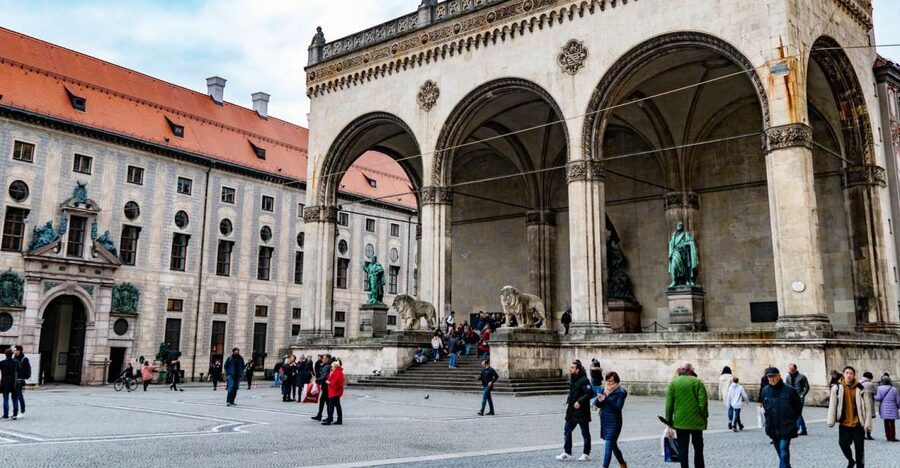
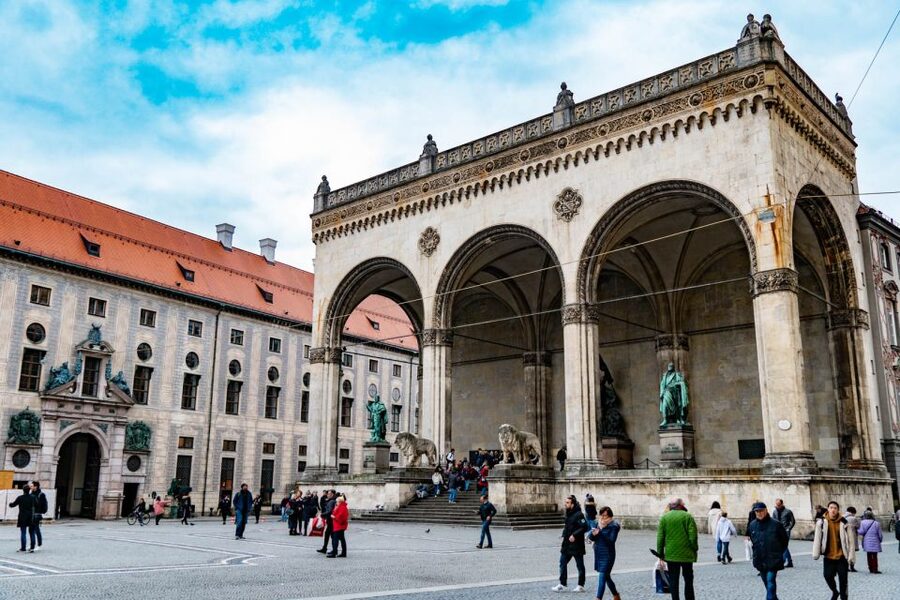
The walk reaches Odeonsplatz, another key location in the story of the Beer Hall Putsch. The square became the scene of a confrontation between Nazi supporters and state police.
This is where the guide can explain the difference between a political movement gaining influence and actually controlling a government. Hitler’s attempt to force a change of power failed in Munich. He was arrested, tried, and imprisoned, yet the failed action helped him build a public profile.
For you, the value of this stop is the connection between street-level events and later political strategy. The Nazi movement learned from its defeat. Instead of relying only on an armed uprising, it later used elections, legal institutions, propaganda, and political deals to gain power.
Odeonsplatz is also a place where the tour’s physical route helps. Seeing the distance from one point to another gives the confrontation a real setting. You can better understand that this was not an abstract political crisis. It happened in a public square where people had to make quick decisions about authority and force.
Same city, a completely different kind of day:
- From Munich: Neuschwanstein & Linderhof Castle Full-Day Trip
★ 4.5 · 12,494 reviews - Neuschwanstein & Linderhof Castle-Fairytale Day Tour from Munich
★ 4.5 · 7,275 reviews - Dachau Concentration Camp Memorial Site Tour from Munich by Train
★ 4.5 · 5,637 reviews - Neuschwanstein Castle Tour from Munich
★ 4.5 · 5,117 reviews
Haus der Kunst and the politics of art
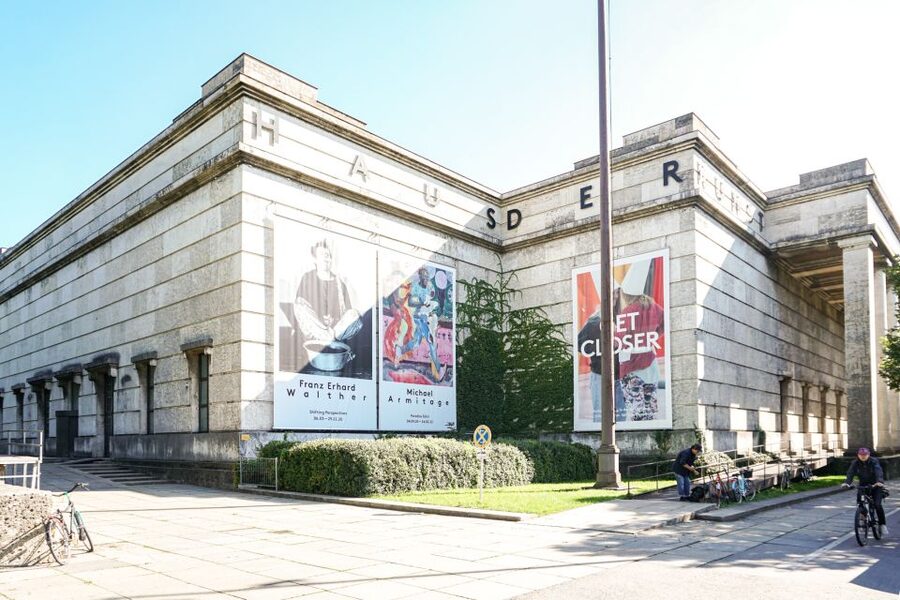
Next, the guide takes you to the front of Haus der Kunst. The building was the first major propaganda building in Nazi Germany, and its role shows that the regime cared deeply about culture and public image.
The Nazi government did not treat art as a private matter. It promoted work that fit its racial and political ideals, while banning or attacking art it labeled degenerate. The guide explains how exhibitions, architecture, and public institutions helped the regime present its values as normal and official.
This stop adds a needed layer to the tour. If you only study Nazi politics through speeches, uniforms, and military sites, you miss how dictatorship shaped everyday ideas about beauty, national identity, and acceptable behavior. Haus der Kunst shows how a government can use culture to support political control.
You will see the building from outside rather than take part in a dedicated museum visit. That keeps the walk moving, but it also limits how much time you can spend examining the art or architecture. If art history is your main interest, you may want to pair the tour with a separate visit to a Munich museum.
German resistance, Georg Elser, and the White Rose
One of the strongest parts of the route is its attention to German resistance. The guide introduces figures such as Georg Elser and the White Rose, giving you a view of Munich that is not centered only on Hitler and the Nazi leadership.
Georg Elser attempted to kill Hitler with a bomb in 1939. His plan failed because Hitler left the site earlier than expected. Elser was later imprisoned and killed by the Nazi regime. His story shows that opposition existed before Germany’s defeat and that resistance could come from an individual acting without the support of a large political organization.
The White Rose was a student-led resistance group connected with Munich. Its members distributed leaflets opposing Nazi rule and calling on Germans to resist. Several members were arrested and executed.
Including these stories changes the tone of the walk. You hear about courage, but also about the cost of opposition under a police state. I appreciate that the tour places resistance within the same city streets as the rise of the Nazi movement. Munich was not only a birthplace of Nazi politics. It was also a place where people tried to challenge the regime.
The amount of detail will depend on the guide and the group’s pace. Still, these subjects are listed as central parts of the tour, not quick footnotes. If you want a tour that covers both perpetrators and opponents, this route is better suited to you than a walk focused only on Hitler.
Führerbau and the Munich Agreement
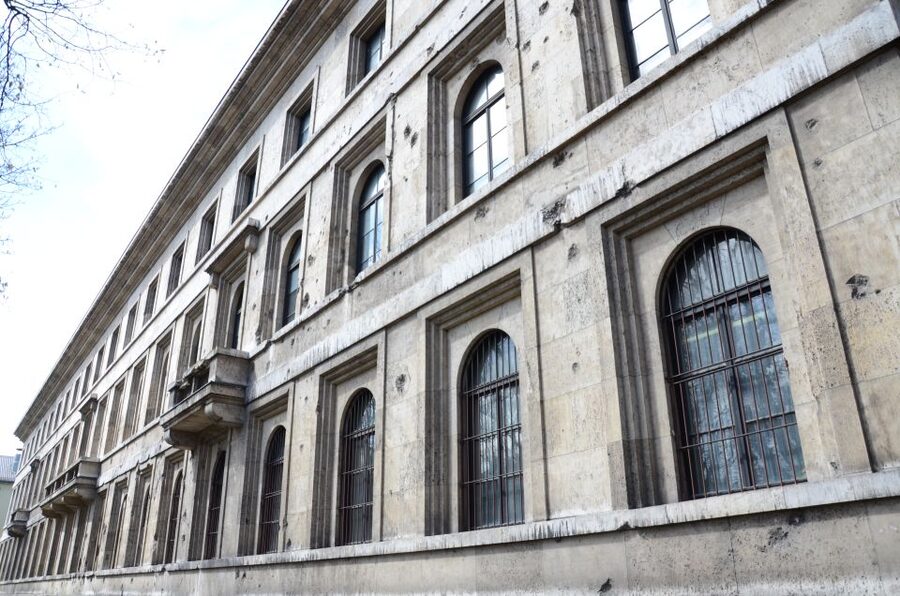
The tour then reaches Führerbau, the building where the Munich Agreement was signed in 1938. The agreement allowed Nazi Germany to take the Sudetenland from Czechoslovakia.
This stop places Munich in the wider European story. The agreement is often remembered through the policy of appeasement, as Britain and France accepted Hitler’s demands in the hope of avoiding war. The building gives the guide a concrete place to explain how diplomatic decisions made in Munich affected the future of Europe.
Führerbau is important because it shows the regime at a different stage. At Hofbräuhaus and Odeonsplatz, you are looking at the movement’s early struggle for power. At Führerbau, you are looking at a government dealing with major European powers and reshaping borders.
The building is seen from the outside, so the stop depends on the guide’s explanation. This is common on historical city walks, and it means the quality of the storytelling matters as much as the structure itself. The high overall rating and praise for clear pacing are encouraging here, but you should still come prepared to listen rather than expect a large indoor display.
Finishing at Königsplatz
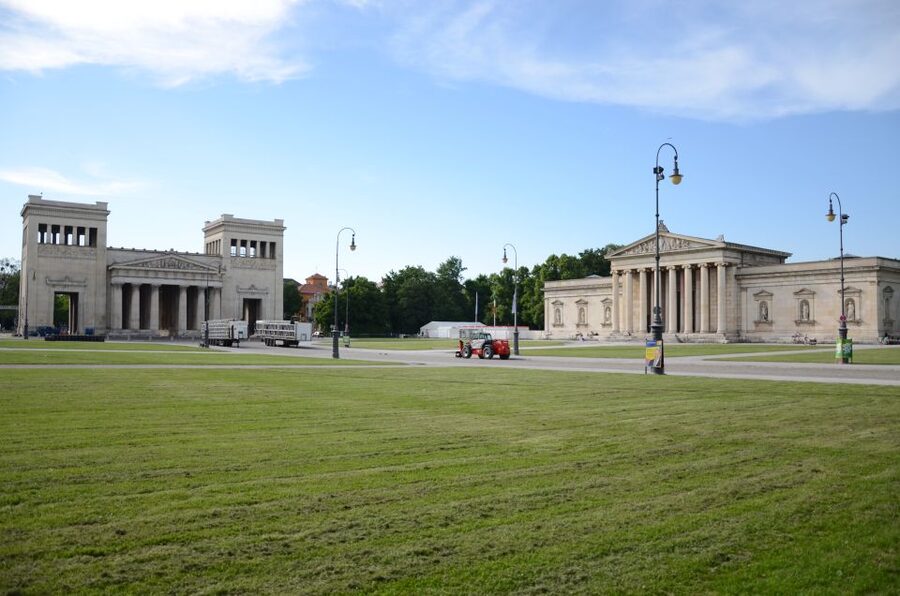
The walk concludes at Königsplatz, an important public space in Munich’s Nazi-era story. The square gives the tour a fitting final setting because it reflects the regime’s use of architecture, ceremony, and public space.
By this stage, you have followed a broad arc: Hitler’s political beginnings, the Beer Hall Putsch, the use of art for propaganda, the suppression of opposition, and the diplomatic confidence of Nazi Germany before the Second World War.
The supplied details also say that the activity ends back at the meeting point, while the route description places the final stop at Königsplatz. Because those points do not match perfectly, confirm the exact end arrangement when you book. Either way, the route remains within central Munich, and the main final location is given as Königsplatz.
Do not plan a tight connection immediately afterward until you know where your group will finish. A small amount of extra time is sensible for a walking tour with several stops.
How much value do you get for $23?
At $23 per person, this is a reasonably priced guided city walk. You are paying for a live Spanish-speaking guide and two and a half hours of connected historical explanation, not admission to museums or food and drinks.
The value is strongest if you would otherwise walk past these buildings without knowing their significance. A self-guided route can show you Marienplatz, Hofbräuhaus, Haus der Kunst, Führerbau, and Königsplatz, but it may not explain how they fit into the same political story.
The price is less attractive if you want indoor access, exhibits, or a small specialist seminar. Those are not included. The tour is also dependent on a minimum of four participants. If fewer than four people book, the local partner will contact you and offer an alternative.
A 4.9 rating from 34 reviews supports the idea that the experience delivers strong value, especially for its clear pacing and amount of historical information. I would still judge it by your language needs and interest in the subject first. A good price cannot fix a tour that is not offered in a language you understand well.
Who should book this Munich history walk?
I would recommend it to adults and older teenagers who want a focused introduction to Munich’s Nazi past. It suits you especially well if you prefer learning through places and movement rather than spending a full afternoon in a museum.
It is also a good choice if you want more than a Hitler biography. The route covers party origins, the Beer Hall Putsch, propaganda, art policy, diplomacy, and resistance. That range gives you a more useful picture of how the Nazi movement developed and how people opposed it.
The tour may not suit families with younger children, since children under 13 are not allowed. It is also not suitable for anyone who does not speak Spanish. The guide language is Spanish, with no other language option stated.
You should also think about the emotional weight. The subject includes persecution, dictatorship, failed resistance, and executions. The tone is likely to be serious, and that is appropriate. I would not book it if you want a relaxed sightseeing walk with only a few historical comments.
Practical advice before you go
Meet in front of the Tourist Information Office at Marienplatz. Arrive with comfortable shoes, since the experience lasts 2.5 hours and takes place on foot.
Food and drinks are not included. You can arrange those before or after the walk, but the tour itself is built around movement and explanation rather than a meal stop.
Spanish ability is essential. This is not an occasional Spanish option attached to a multilingual tour. The information states that the tour is not open to people who do not speak Spanish.
You can cancel up to 24 hours before the tour for a full refund, and the reserve-now-pay-later option lets you hold a place without paying at once. The minimum group size is four, so keep an eye out for messages from the local partner if the tour does not reach that number.
Should you book it?
Book this tour if you want a Spanish-language history walk that connects Munich’s Nazi origins with the Beer Hall Putsch, Nazi art policy, the White Rose, Georg Elser, the Munich Agreement, and Königsplatz. The route is focused, the price is fair, and the well-paced format should give you a solid framework for understanding the city.
Skip it if you do not speak Spanish, need an indoor museum experience, or are looking for a casual family outing. For the right audience, this is a serious and useful way to see how Munich became central to the Nazi movement, and how opposition existed within the same city.
FAQ
Where does the Munich Third Reich tour begin?
The tour begins in front of the Tourist Information Office at Marienplatz.
Where does the tour end?
The route description says the tour concludes at Königsplatz. The activity details also say it ends back at the meeting point, so confirm the precise end arrangement when booking.
How long does the walking tour last?
The tour lasts 2.5 hours.
What language is the tour offered in?
The tour is offered in Spanish with a live Spanish-speaking guide.
How much does the tour cost?
The listed price is $23 per person.
Are food and drinks included?
No. Food and drinks are not included.
Can children join the tour?
Children under 13 are not allowed to participate.
What happens if fewer than four people book?
The tour requires a minimum of four participants. If that number is not reached, the local partner will contact you and offer an alternative.
More Walking Tours in Munich
- Munich: Old Town & Viktualienmarkt City Walk in German
★ 4.7 · 2,304 reviews - Munich: Night Watchman Walking Tour
★ 4.7 · 2,092 reviews - Munich Ghosts and Spirits Evening Walking Tour
★ 5.0 · 1,900 reviews - Munich Old Town Walking Tour
★ 4.5 · 1,287 reviews
Just added around Munich
- Pub crawl incl. Oktoberfest museum guided tour with beer tasting (private)★ 5.0 · 5 reviews
- South Tyrolean specialties and wine tasting★ 5.0 · 5 reviews
- Size Matters Beer Tour Munich★ 4.6 · 105 reviews
- Short & sweet: Tasting the Viktualienmarkt★ 4.8 · 37 reviews
- Secret Food Tours Munich★ 4.8 · 5 reviews
- Munich: Romantic Wine Experience for Two at Viktualienmarkt★ 4.2 · 14 reviews
- Munich: Resistance against Hitler – Historical Walking Tour★ 5.0 · 5 reviews
- Residence of Munich private tour with skip the line ticket★ 5.0 · 4 reviews
Third Reich & Cold War Tours, compared.



Berlin’s Best: 2 Hour Walking Tour Third Reich and the Cold War
Read our review →

Third Reich Berlin: Hitler and WWII Walking Tour
Read our review →
Skip-the-Line: Berlin Wall Museum at Checkpoint Charlie
Read our review →

Cold War, Berlin Wall, Spies and the East Side Gallery
Read our review →Browse the lists this tour appears in