
Reviewed · WALKING TOURS
Jewish Life in Berlin – Private Walking Tour
Berlin’s Jewish story is written into ordinary streets, courtyards, churches, workshops, and memorials. This private walk takes you through the former Jewish quarter from the 17th-century arrival of Jewish immigrants to the Holocaust and the city’s Jewish life today. The most moving stop is the Blindenwerkstatt Otto Weidt, where a workshop owner tried to protect blind and deaf Jewish workers from Nazi persecution.
I like the private format because your guide can adjust the pace and answer questions without a fixed group slowing things down. I also like the route’s focus on daily Jewish life before World War II, not only the better-known memorials. The main drawback is that three hours passes quickly, and some people may expect a fuller museum visit or a stop at Berlin’s Holocaust Memorial, neither of which is part of this walk.
In This Review
- Key points to know before booking
- Why this walk matters in Berlin
- Meeting at Hackescher Markt
- Hackesche Höfe and the women’s protest memorial
- Otto Weidt’s workshop and a story of protection
- Scheunenviertel and the former Jewish quarter
- Sophienstraße and Sophia Church
- Große Hamburger Straße and the lost community
- Auguststraße and the city’s changing Jewish presence
- The New Synagogue and Centrum Judaicum
- How much value does $355.25 offer?
- Pace, weather, and practical planning
- Who should book this private walk?
- Should you book it?
- FAQ
- Where does the Jewish Life in Berlin tour begin?
- Where does the tour end?
- How long does the walking tour last?
- Is this a private tour?
- What is included in the price?
- Does the tour visit the New Synagogue?
- Does the tour visit the Holocaust Memorial?
- How much walking is involved?
- Does the tour operate in bad weather?
- Can I cancel for a refund?
Key points to know before booking
- Otto Weidt’s workshop gives the tour its most personal story: Learn how one Berlin employer helped shield blind and deaf Jewish workers.
- The route covers the former Scheunenviertel: You see where Jewish families lived, worked, worshipped, and built community.
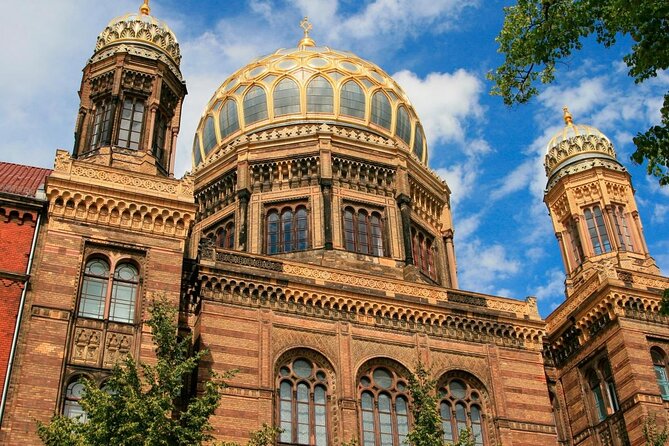
- The New Synagogue is the final landmark: Your guide explains its role, the 1938 pogrom, and the Centrum Judaicum.
- This is a private tour for your group: The price is $355.25 for up to 15 people, so the value improves with a larger party.
- Expect a flat but fairly active walk: The route lasts about three hours, with roughly ten minutes at each listed stop.
- Guides shape the experience: Caroline, Carlos, Finn, and Marriette have been singled out for warmth, clear explanations, patience, and sensitivity.
Why this walk matters in Berlin
Berlin can be hard to read. A street may look like a pleasant Mitte neighborhood, yet the same block may hold traces of a Jewish school, a cemetery, a deportation site, or a vanished synagogue. This tour helps you connect those pieces.
The route begins with the first Jewish immigrants who settled in Berlin in the 17th century. It then moves through the growth of the Jewish community, the cultural life of prewar Berlin, Nazi persecution, and the city’s Jewish present. Along the way, you hear about figures such as Albert Einstein and Moses Mendelssohn. Mendelssohn founded the first modern public school for Jewish boys, a detail that helps show how Jewish life in Berlin was shaped by education, ideas, and public debate as well as religious practice.
I appreciate that the tour does not treat Jewish Berlin as a story that begins and ends with the Holocaust. The Nazi period is central and cannot be softened, but the earlier chapters give you a better sense of what was destroyed. You learn about people who lived, worked, taught, argued, worshipped, and helped shape Berlin long before 1933.
The subject is serious, and the guide’s approach matters. The strongest guides on this route have been described as calm, candid, patient with questions, and able to handle groups ranging widely in age. Carlos has been praised for combining facts, perspective, and appropriate humor. Caroline has been noted for a thoughtful, pleasant style, while Finn’s strong command of the subject helped keep the walk engaging even in very hot weather.
A few more Berlin trips to weigh up
- Discover Berlin Half-Day Walking Tour
★ 5.0 · 9,624 reviews - Berlin: Third Reich and Cold War 2 Hour Walking Tour
★ 4.9 · 6,830 reviews - Berlin: Discover Berlin Walking Tour
★ 4.9 · 5,998 reviews
Meeting at Hackescher Markt
You meet your guide at Neue Promenade 3, outside the Hackescher Markt S-Bahn station area, with the listed meeting instruction pointing to the Starbucks in front of the station. This is a useful central starting point, close to public transportation and easy to fit into a day in Mitte.
The opening introduction takes about ten minutes. Use this moment to tell your guide what interests you most. You may want more on family history, architecture, resistance, religious life, or the fate of Jewish Berlin under the Nazis. Since this is a private activity, your questions can help shape the emphasis.
Hackescher Markt is also a practical place to begin because the route quickly moves into courtyards and side streets. You leave behind the immediate station area and start looking at Berlin through the history of its Jewish residents.
Hackesche Höfe and the women’s protest memorial
The next stop is the Hackesche Höfe, a series of courtyards known for their architecture and shops today. Your guide explains the history of the site and discusses the memorial connected with the women’s protest.
This stop is useful because it shows how Berlin’s attractive, everyday spaces can carry difficult stories. The courtyards are not presented simply as pretty architecture. Your guide connects the area with Jewish life and with acts of resistance during the Nazi period.
Expect about ten minutes here, followed by more walking. The tour’s pattern is clear: short explanations at significant locations, then a move to the next piece of the story. If you prefer long museum visits with time to read displays, this format may feel brisk. If you like seeing places in context, the street-to-street movement works well.
Otto Weidt’s workshop and a story of protection
The Museum Blindenwerkstatt Otto Weidt is the emotional center of the walk. Otto Weidt ran a workshop in the 1940s and employed blind and deaf Jewish workers. He tried to protect them from persecution, using his position and personal effort to help people facing the Nazi system.
Your guide explains both Weidt’s actions and the wider resistance to Nazi rule. This is not a broad lecture about the Holocaust detached from place. The workshop gives the subject a human scale. You are dealing with a workplace, an employer, and workers whose disabilities placed them in an especially vulnerable position.
The listed stop lasts about ten minutes. That timing is worth noting. The experience includes the workshop as a key location, but you should not assume that you will have a long, self-guided museum visit. One person found the tour less satisfying because the museum visit at the old synagogue was not included, so clarify with the operator what access is planned if entering exhibits is important to you.
Same city, a completely different kind of day:
- Berlin: Reichstag, Dome and Government District Guided Tour
★ 4.7 · 18,288 reviews - Berlin: 1-Hour City Tour by Boat with Guaranteed Seating
★ 4.3 · 16,993 reviews - Berlin: Boat Tour Along the River Spree
★ 4.4 · 11,252 reviews - Berlin: Hop-on Hop-off Bus Tour with Live Commentary
★ 4.3 · 8,579 reviews
Scheunenviertel and the former Jewish quarter
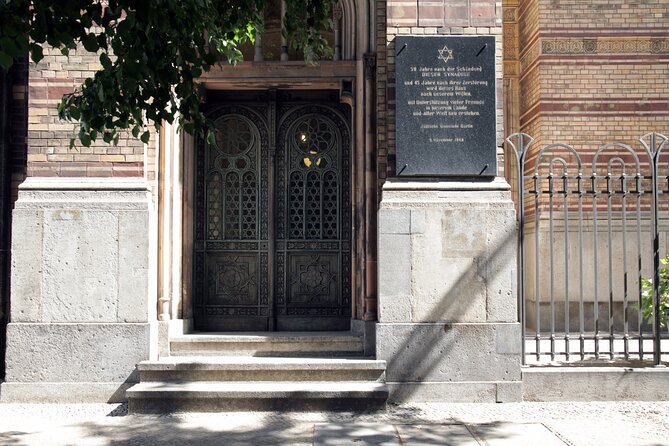
The walk then reaches the Scheunenviertel, the former Jewish quarter. Your guide explains how Berlin’s Jewish community developed in the old city and how Jewish residents lived in the area before the war.
This is where the tour’s attention to ordinary life pays off. You are not only shown major monuments. You hear about homes, streets, institutions, and community patterns that are easy to miss when you explore Berlin on your own.
The area also helps correct a common mistake in planning. Berlin’s Jewish heritage is not confined to one building or a single memorial. It is spread through the city, often in fragments. The guide’s commentary supplies the connection between those fragments.
The tour takes about three hours, and much of that time is spent walking between stops. The route is flat, which makes it manageable for most people, but it is still a substantial amount of time on your feet. Wear comfortable shoes, carry water in warm weather, and bring rain protection. The walk operates in all weather, and heavy rain has affected the final stops for some groups.
Sophienstraße and Sophia Church
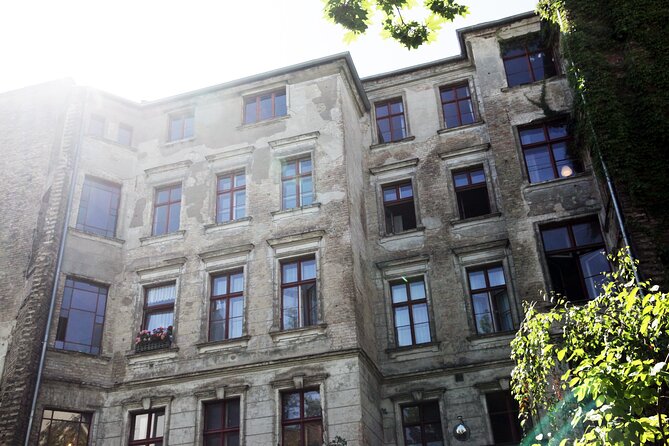
Sophienstraße offers a change of mood. Your guide explains the history of this picturesque street, named for Queen Sophie. It is one of the quieter, more attractive stretches of the route, but the point is not simply to admire the buildings.
The walk then continues to Sophia Church. Here you hear about the church’s history and its connection with Martin Luther King. That subject broadens the tour beyond Jewish history alone and places Berlin’s religious and civic life in a wider setting.
This pair of stops is a reminder that Jewish Berlin cannot be understood in isolation from the surrounding city. Churches, streets, schools, cemeteries, and Jewish institutions existed in the same urban world. The connections can be surprising, and they give the route more range than a simple synagogue-to-synagogue walk.
Große Hamburger Straße and the lost community
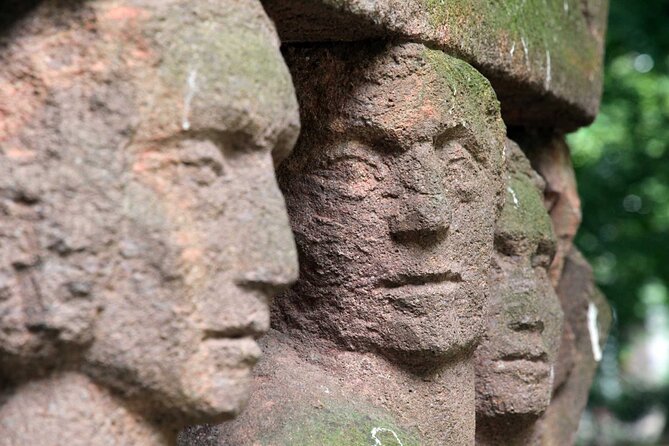
Große Hamburger Straße brings the darker chapters into sharper focus. Your guide explains the former Jewish cemetery, the Jewish school, and the deportation of Berlin’s Jews during the Nazi era.
The cemetery and school are especially important because they point to community life before persecution. A school suggests children, teachers, families, and a future. A cemetery points to generations already rooted in the city. Deportation then shows how the Nazi regime attacked not an abstract population, but a settled community with institutions and memories.
The stop lasts about ten minutes, so listen closely and ask questions while you can. The route is not built around long periods of private reflection at every location. It depends on the guide to explain what is no longer visible and why the site matters.
Auguststraße and the city’s changing Jewish presence
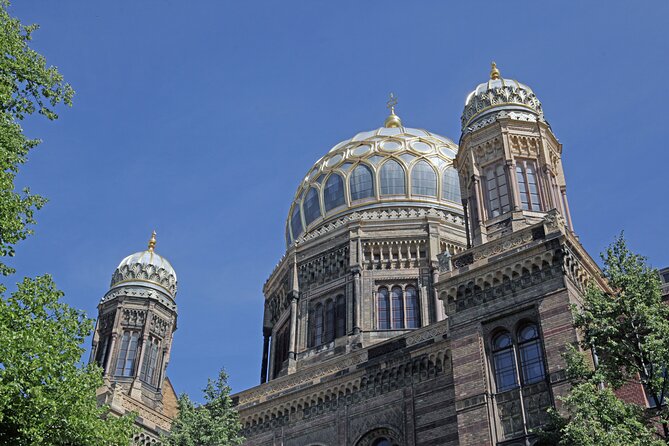
Auguststraße is known today for art galleries and important buildings connected with the old Jewish community. Your guide uses the street to explain how Jewish life once occupied this part of Berlin and how the area has changed over time.
This stop works best if you are interested in the layers of modern Berlin. The street is not frozen in the past. It combines present-day cultural life with traces of an older community that was shattered during the Holocaust.
I like this part of the route because it makes the subject less abstract. You are walking through a living neighborhood, not a preserved historical set. The tradeoff is that remnants can be subtle. You may not see a single grand site that explains everything. The guide’s narration is essential.
The New Synagogue and Centrum Judaicum
The final stop is the New Synagogue on Oranienburger Straße, one of Berlin’s most important Jewish landmarks. Built in the 19th century, it served as the main synagogue of Berlin’s Jewish community and is also a major example of late 19th-century Berlin architecture.
Your guide explains the building’s history, the events of Kristallnacht in 1938, and the people who helped Jewish residents. Today, the building is home to the Centrum Judaicum, which traces the synagogue’s story and the lives connected with it.
The synagogue is a strong ending because it gathers several strands of the tour in one place: faith, architecture, public Jewish life, Nazi persecution, and postwar remembrance. But pay attention to the wording of the experience. The final stop is included, while the itinerary lists admission as free and the walk generally presents the site through the guide’s explanation. If you want time inside the Centrum Judaicum, ask before booking rather than assuming a full museum visit is included.
The tour ends at Oranienburger Straße 28 to 30. That leaves you in a central part of Berlin with public transportation nearby, though the activity does not include a return transfer.
How much value does $355.25 offer?
The price is $355.25 per group of up to 15 people. That is a significant cost for three hours if you are traveling alone or as a couple. For a family or group of friends, the calculation changes: divided among 10 people, it is about $35.53 each, and divided among 15, about $23.68 each.
The private format is the main value. You are not simply paying for a route. You are paying for a guide who can slow down, explain a difficult point again, respond to family questions, and adjust the discussion to your group. That matters on a subject with many names, dates, and emotional turns.
The value is lower if you want extensive interior access. The tour includes a professional guide, but no separate inclusions are listed beyond that. One person specifically wanted more time in the old synagogue museum. If museum displays are your priority, consider pairing this walk with a separate visit to the Centrum Judaicum.
Pace, weather, and practical planning
Plan on three hours of walking, with about ten minutes at each of the nine listed stops and additional time between them. The route is flat, and most people can participate, but you should still treat it as an active morning or afternoon rather than a quick sightseeing loop.
The experience runs in all weather. Comfortable shoes are essential, and a waterproof layer is sensible. In hot weather, the lack of shade at some points may make the walk tiring. In wet weather, the last two stops can be affected by a downpour, so dress for conditions instead of relying on a good forecast.
A mobile ticket is provided, and confirmation is normally received at booking. If you book within three days of the tour, confirmation may arrive within 48 hours and depends on availability. Service animals are allowed, and the meeting point is near public transportation.
Free cancellation is available up to 24 hours before the start time. Within 24 hours, you do not receive a refund, and changes are not accepted.
Who should book this private walk?
I would choose this tour if you want a focused introduction to Jewish Berlin and prefer a human guide over an audio app. It suits families, adult learners, history-minded visitors, and anyone with a personal connection to Berlin or Jewish heritage.
It is also a good choice for groups with mixed ages. A strong guide can explain the Holocaust without reducing the whole story to dates and statistics. The best guiding on this route combines serious facts with calm delivery and enough flexibility for questions.
I would hesitate if you want to see the Holocaust Memorial, visit several museums, or spend a long time inside the New Synagogue. Those are reasonable goals, but they are not the focus here. I would also think twice if your group dislikes walking or plans to visit during extreme heat or rain.
Should you book it?
Book this walk if you want to understand how Jewish life shaped Berlin before the Holocaust and how traces of that community remain today. The Otto Weidt workshop, the Scheunenviertel, Große Hamburger Straße, and the New Synagogue give the route a strong human and historical arc.
The best reason to book is the private guide. Names such as Caroline, Carlos, Finn, and Marriette have been associated with the kind of clear, thoughtful, and sensitive approach this subject needs. Just set your expectations correctly: this is a guided street history walk, not a full museum tour or a general Holocaust Memorial tour.
FAQ
Where does the Jewish Life in Berlin tour begin?
The tour begins at Neue Promenade 3 in Berlin, near the Hackescher Markt S-Bahn station. The meeting instructions specify meeting outside Starbucks.
Where does the tour end?
The tour ends at the New Synagogue Berlin, Centrum Judaicum, at Oranienburger Str. 28 to 30, 10117 Berlin.
How long does the walking tour last?
The tour lasts approximately three hours.
Is this a private tour?
Yes. Only your group participates, and the group can include up to 15 people.
What is included in the price?
A professional guide is included. The tour information does not list additional inclusions.
Does the tour visit the New Synagogue?
The route ends at the New Synagogue Berlin, also called the Centrum Judaicum. The guide explains the building’s history, but you should confirm in advance if you specifically want admission and extended time inside the museum.
Does the tour visit the Holocaust Memorial?
No. The Holocaust Memorial is not included in the stated route.
How much walking is involved?
The tour includes quite a lot of walking over about three hours. The route is flat, and most people can participate.
Does the tour operate in bad weather?
Yes. The tour operates in all weather conditions, so dress appropriately for rain, heat, or cold.
Can I cancel for a refund?
You can cancel for a full refund up to 24 hours before the experience starts. Cancellations or changes made less than 24 hours before the start time are not accepted and are not refunded.
Just added around Berlin
- Love and War in Berlin: Self-Guided Story Puzzle Walk★ 5.0 · 7 reviews
- Rickshaw Tours Berlin – Groups of up to 16 people with several rickshaws★ 4.0 · 97 reviews
- Walking on the Wall: 3-Hour Tour in Berlin★ 4.5 · 34 reviews
- eSIM for Germany and 34 European Countries★ 4.5 · 16 reviews
- Your ticket to The Wall Museum Berlin★ 3.0 · 60 reviews
- Warnemuende Shore Excursion: Private Berlin Tour★ 4.5 · 27 reviews
- Warnemuende Shore Excursion: Berlin Private Sightseeing Tour from Rostock★ 5.0 · 4 reviews
- Berlin’s Gay, Lesbian, and Queer Scene Small-Group Walking Tour★ 4.5 · 66 reviews
Walking Tours, compared.





Berlin’s Best: 2 Hour Walking Tour Third Reich and the Cold War
Read our review →

