
Reviewed · WALKING TOURS
Death and Chocolate: Walking Tour of Munich’s Old South Cemetery
Munich’s Old South Cemetery turns a simple city walk into a lively lesson in death, memory, and local life. You’ll pass a medieval gate, quiet memorials, chocolate shops, and centuries-old graves while hearing stories of plague, revolution, accidents, and Munich’s most notable citizens.
I like the small group of up to 15 people, which gives a guide room to answer questions. I also like the unusual mix of serious history and one hot drinking chocolate, a welcome sweet note after time among the tombs.
The main thing to consider is the subject matter. This is a tour about death, disease, war, and tragedy, so it may not suit anyone looking for a light sightseeing stroll. The walking route also lasts roughly 90 minutes to two hours, mostly outdoors.
In This Review
- Key points at a glance
- Why this Munich tour feels different
- Starting near Sendlinger Tor and Devil’s Gate
- Glockenbachviertel adds cafes, memorials, and chocolate
- Old South Cemetery is the heart of the walk
- What the guide adds
- Is $53.92 a fair price?
- Timing, meeting point, and practical planning
- Who should book Death and Chocolate?
- Should you book it?
- FAQ
- Where does the tour start?
- What time does the tour begin?
- Where does the tour end?
- How long does the experience last?
- Is the tour offered in English?
- What is included in the price?
- Are tips for the guide included?
- How large is the tour group?
- Is the tour suitable for children?
- Can I cancel for a full refund?
- Are service animals allowed?
- Is the tour near public transportation?
Key points at a glance
- Old South Cemetery stories: Hear about five centuries of Munich history through the lives and deaths of people buried there.
- Sendlinger Tor opening: Begin near one of Munich’s old city gates, known in local lore as Devil’s Gate.
- Glockenbachviertel chocolate stop: Visit chocolate shops and enjoy one included hot drinking chocolate.
- Serious modern history: See reminders of people lost to a deadly virus and victims of the Nazi regime.
- English and small-scale: The tour is offered in English and accepts no more than 15 people.
- Short but substantial: The experience fits into half a day, leaving plenty of time for other Munich sights.
Why this Munich tour feels different
Many Munich walks focus on grand buildings, royal history, or the city’s better-known wartime sites. This one takes a more personal route. It asks you to look at how Munich remembers ordinary people, public figures, victims, rebels, and those lost in epidemics.
The title gives you the basic formula: death and chocolate. That sounds odd at first, but the contrast works. Munich’s history is not only a list of dates and rulers. It is also found in cemetery inscriptions, small memorials, local legends, and the everyday pleasure of sitting down with a warm drink.
I especially like the way the route connects different parts of the city. You move from Sendlinger Tor to the cafes and chocolate shops of Glockenbachviertel, then into the Old South Cemetery. The walk is not confined to one attraction, so you get a better feel for central Munich along the way.
Your guide matters here. Katrina is specifically named in the feedback, and she is described as energetic, clear, and able to handle a long list of questions. The guide is expected to explain the setting rather than simply point at graves, which is important in a cemetery where the meaning of each stone may not be obvious at first glance.
A few more Munich trips to weigh up
- Cologne: Chocolate Museum Entrance Ticket
★ 4.4 · 2,790 reviews - Dresden: Guided Walking Tour and Chocolate Museum Ticket
★ 4.5 · 385 reviews - Biggesee: Boat Tour with All-inclusive cake buffet
★ 4.4 · 20 reviews
Starting near Sendlinger Tor and Devil’s Gate
The listed meeting point is St. Stephan, Stephansplatz 2, with an 11 a.m. start. The route information begins with Sendlinger Tor, so check the exact meeting instructions carefully when you book. Both locations are in central Munich and near public transportation, but you do not want to waste the start of a short tour finding the group.
Sendlinger Tor is one of Munich’s old city gates, with origins reaching back to the early 14th century. The tour uses the gate as an entry into the darker side of the city’s past. Local stories connect it with the nickname Devil’s Gate, giving the opening a touch of folklore alongside the historical setting.
This first stop lasts about 15 minutes. That is enough time for an introduction and a few stories, not a long architectural study. If you are looking for an extended explanation of Munich’s medieval defenses, this will feel brief. If you want a quick orientation before the walk begins, it works well.
The stop also includes a memorial to people who died from a deadly virus. This detail makes the tour’s focus broader than old graves and ghost stories. It shows how public memory changes as new crises become part of a city’s story.
Glockenbachviertel adds cafes, memorials, and chocolate
The next part takes you through Glockenbachviertel, an area known for cafes and sunny terraces. The mood shifts here. Instead of cemetery silence, you see a neighborhood where people meet, eat, and enjoy the day.
That change is one of the tour’s best features. Death is not treated as a sealed-off subject. It sits beside daily life, food, shopping, and conversation. You may find the contrast a little strange, but it gives the experience a human scale.
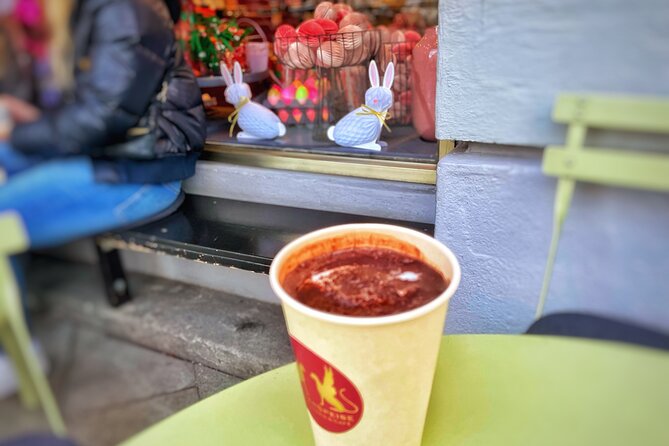
The chocolate stop includes a hot drinking chocolate, and one serving is included in the price. The drink is not just a token extra. It gives you a proper pause during the walk and helps keep the tone from becoming too heavy.
The available details do not specify one fixed chocolate shop or the exact timing of the drink, so you should think of this as a chocolate portion of the route rather than a full food tour. The experience is not designed for tastings at many shops or a full meal.
Dietary needs may be manageable. One family specifically noted that the hot chocolate offered something for every taste, including a vegan option. Still, if you have a strict allergy or special requirement, confirm the available choice before setting out.
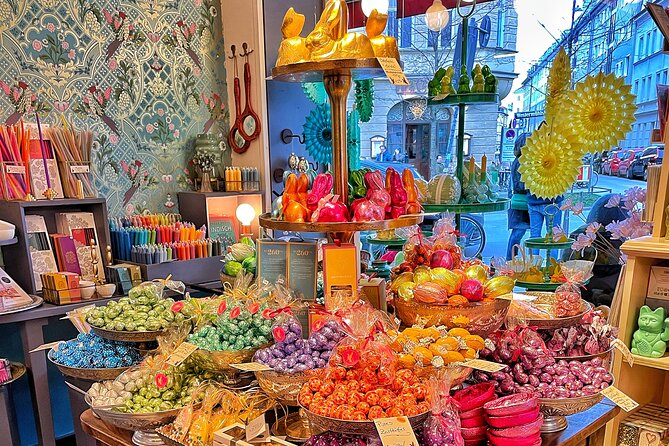
Glockenbachviertel also contains quiet reminders of fallen cultural figures and people targeted by the Nazi regime. These are easy to miss when you walk through the neighborhood on your own. A guide can point out the small signs and explain why they matter.
Old South Cemetery is the heart of the walk
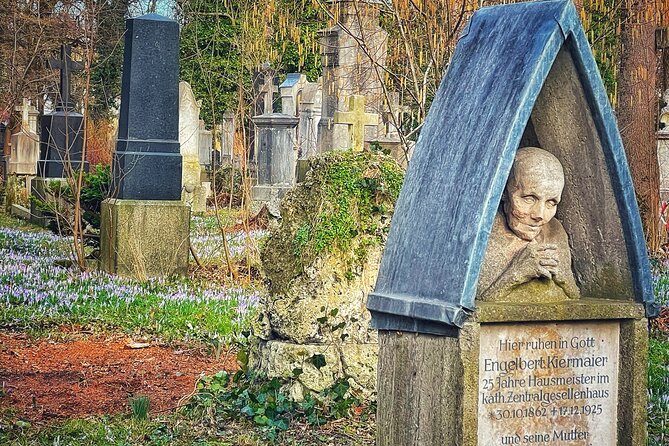
The largest portion of the tour, about 1 hour and 15 minutes, takes place in Alter Südfriedhof, or the Old South Cemetery. This is where the experience earns its price.
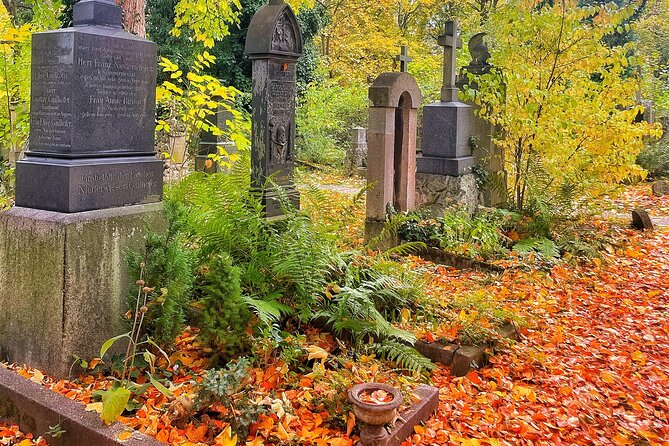
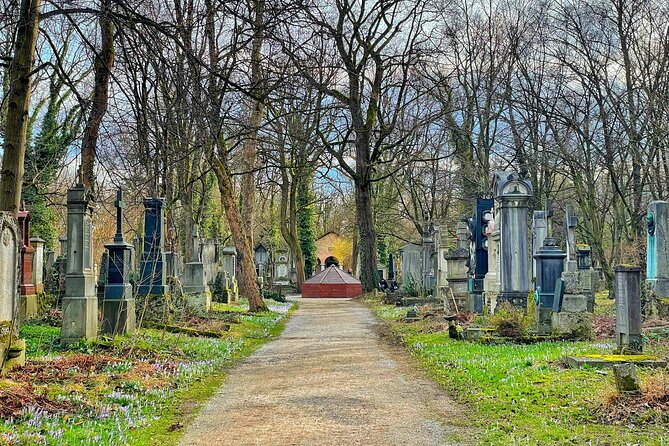
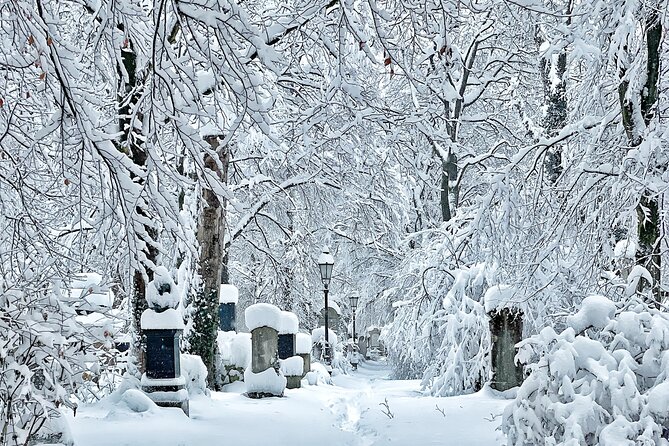
The cemetery operated for five centuries, and the tour uses its graves to tell the story of Munich through individual lives. You hear about prominent local figures, plague, revolutions, tragic accidents, and other events that shaped the city.
A cemetery can be difficult to understand without context. Rows of names and dates may interest you for a few minutes, but a story gives them weight. A guide can explain who a person was, what happened to them, and why their grave belongs in Munich’s larger story.
The cemetery also rewards curiosity after the tour. One visitor noted that each headstone seemed to invite further research, and that is a useful way to approach this walk. You do not need to recognize the names in advance. You can simply note a few that catch your attention and read more later.
The stories include some frightening episodes, but the tour is not presented as a pure ghost walk. Expect history with a darker edge, not a staged horror show. That distinction matters if you are choosing between a serious city-history experience and an evening entertainment activity.
Because the cemetery is the main stop, the pace may feel different from a standard sightseeing tour. You spend time listening, looking closely, and moving between stories. Comfortable shoes are sensible, though the supplied information does not specify the exact walking surface or distance.
Same city, a completely different kind of day:
- From Munich: Neuschwanstein & Linderhof Castle Full-Day Trip
★ 4.5 · 12,494 reviews - Neuschwanstein & Linderhof Castle-Fairytale Day Tour from Munich
★ 4.5 · 7,275 reviews - Munich: Third Reich & WWII Walking Tour
★ 4.6 · 6,181 reviews - Dachau Concentration Camp Memorial Site Tour from Munich by Train
★ 4.5 · 5,637 reviews
What the guide adds
The guide is the main reason to choose this tour instead of visiting the cemetery alone. The setting provides the material, but the guide supplies the links between people, events, places, and dates.
Katrina receives especially strong praise for her energy and ability to explain Munich’s history in a way that works for different ages. A family with children aged 10 and 7 found the tour accessible and enjoyable, which suggests that the presentation is not limited to serious adult historians.
That said, the subject remains serious. Children who enjoy spooky stories or unusual history may have a good time, while children who dislike cemeteries, illness, or wartime themes may not. Parents should decide based on the child, not only on the promise of chocolate.
The maximum group size is 15. That is small enough for a more personal feel than a large city group, and it should make questions easier. The guide can respond to individual interests, such as Munich’s Bavarian roots, cemetery customs, or the history of a particular memorial.
The tour is offered in English. If you want detailed historical explanation but are not comfortable listening to English for up to two hours, this may not be the best fit.
Is $53.92 a fair price?
At $53.92 per person, this is not the cheapest way to spend two hours in Munich. The cemetery itself has free admission, as do the other listed stops. You are paying for the guide, the structure of the route, the stories, and the included drink.
I see the value if you want more than a quick look at the cemetery. The Old South Cemetery is free to enter, but its importance is not always obvious from a self-guided stroll. A strong guide can save you research time and help you notice memorials and people you would otherwise pass.
The price makes less sense if you mainly want chocolate or a casual walk through Glockenbachviertel. You could explore cafes and shops on your own, and the hot drink alone does not justify the full cost.
This is best viewed as a compact specialist tour. It combines local history, social memory, and a small food element in a short format. For a first visit to Munich, I would not replace the city’s major sights with it. I would add it for a second day, or for a traveler who prefers unusual stories to famous viewpoints.
The tour is often booked about 60 days ahead. That booking pattern suggests you should reserve early if the 11 a.m. time fits an important day in your schedule. Free cancellation is available up to 24 hours before the start time, which gives you some planning flexibility.
Timing, meeting point, and practical planning
The advertised start time is 11 a.m., and the total duration is about 1 hour 30 minutes to two hours. That makes it easy to pair with lunch or an afternoon museum visit.
The day begins at St. Stephan, Stephansplatz 2, 80337 München, and the activity is listed as ending back at the meeting point. Since the route itself includes Sendlinger Tor and the Old South Cemetery, confirm how the group moves between the named points before arriving.
The tour is near public transportation, and most people can take part. Service animals are allowed. No special admission fees are listed for the stops.
Plan for outdoor conditions. One person took the tour on a very hot day and chose ice cream instead of the usual hot chocolate. That suggests the food element may have some flexibility, but it does not promise a specific substitute. On a warm day, carry water and expect the walking portion to feel more demanding.
The small group limit helps, but it does not turn the tour into a private walk. If you prefer complete control over pace and stops, a self-guided visit may suit you better. If you enjoy asking questions and hearing a planned sequence of stories, the group format is a fair trade.
Who should book Death and Chocolate?
I would recommend this tour to you if you like:
- Local history told through real people
- Cemeteries, memorials, and unusual city stories
- A guide who can answer questions rather than recite a script
- Small groups and short walking experiences
- A mix of serious history and food
- Family activities that can hold the attention of older children
It is also a smart choice for repeat visitors who have already seen Munich’s central squares and major landmarks. The route gives you a different way to read the city, especially around the Old South Cemetery and the smaller reminders of Nazi persecution.
I would hesitate if you want a cheerful food tour, a purely architectural walk, or a fast list of Munich highlights. The death-related themes are central, not decorative. The tour also spends most of its time listening to stories, so it rewards patience more than rushing from sight to sight.
Should you book it?
Book this tour if you want Munich history with a human face and do not mind a darker subject. The strongest reasons are the long cemetery visit, the small group, the chance to ask questions, and the guide-led stories about plague, revolution, accidents, war, and local figures.
Skip it if the price feels high for a route whose sights are free, or if you mainly want chocolate and cafes. For the right person, though, the included hot drinking chocolate is a charming counterpoint to a thoughtful look at how Munich remembers death and loss.
FAQ
Where does the tour start?
The listed meeting point is St. Stephan, Stephansplatz 2, 80337 München, Germany.
What time does the tour begin?
The tour starts at 11 a.m.
Where does the tour end?
The activity is listed as ending back at the meeting point.
How long does the experience last?
The approximate duration is 1 hour 30 minutes to two hours.
Is the tour offered in English?
Yes. The tour is offered in English.
What is included in the price?
The price includes an expert guide and one hot drinking chocolate.
Are tips for the guide included?
No. Tips and gratuities are not included.
How large is the tour group?
The maximum group size is 15 people.
Is the tour suitable for children?
Most travelers can participate, and the experience has been enjoyed by children aged 10 and 7. The subject includes death, disease, war, and tragedy, so parents should consider whether those themes suit their children.
Can I cancel for a full refund?
Yes. You can cancel up to 24 hours before the experience start time for a full refund. Cancellations or changes made less than 24 hours before the start are not accepted for a refund.
Are service animals allowed?
Yes. Service animals are allowed.
Is the tour near public transportation?
Yes. The experience is listed as being near public transportation.
Just added around Munich
- Pub crawl incl. Oktoberfest museum guided tour with beer tasting (private)★ 5.0 · 5 reviews
- South Tyrolean specialties and wine tasting★ 5.0 · 5 reviews
- Size Matters Beer Tour Munich★ 4.6 · 105 reviews
- Short & sweet: Tasting the Viktualienmarkt★ 4.8 · 37 reviews
- Secret Food Tours Munich★ 4.8 · 5 reviews
- Munich: Romantic Wine Experience for Two at Viktualienmarkt★ 4.2 · 14 reviews
- Munich: Resistance against Hitler – Historical Walking Tour★ 5.0 · 5 reviews
- Residence of Munich private tour with skip the line ticket★ 5.0 · 4 reviews
Walking Tours, compared.


Berlin’s Best: 2 Hour Walking Tour Third Reich and the Cold War
Read our review →
Third Reich Berlin: Hitler and WWII Walking Tour
Read our review →Browse the lists this tour appears in