
Reviewed · WALKING TOURS
Berlin: Walking Tour of the Top 10 Sightseeing Attractions
Berlin’s past is packed into this fast, story-led walk, beginning opposite the Federal Chancellery and ending near Museum Island. In two hours, you move from the modern government district to the Brandenburg Gate, Unter den Linden, Gendarmenmarkt, Bebelplatz, and the Berlin Cathedral area.
I like the clear route and the way it gives you a useful first look at central Berlin without asking you to spend half a day on one site. I also like the guides’ personal touch, including Berlin humor, time for photos, and room for questions. The tradeoff is simple: four kilometers in 120 minutes is brisk, so you will see many places from the outside rather than make extended visits inside them.
If you want a quick orientation with lively stories, this is a strong choice. If you prefer slow museum visits, long photo stops, or detailed architectural study, you may find the pace too quick.
In This Review
- Key points to know before you book
- A quick route through Berlin’s biggest stories
- Paul-Löbe-Haus and the modern government district
- Reichstag: Germany’s parliament and a changed city
- Brandenburg Gate and the symbols around it
- The Holocaust Memorial and the need for quiet attention
- Potsdamer Platz and modern Berlin
- Gendarmenmarkt and Berlin’s grand design
- Bebelplatz and the memory of book burning
- Unter den Linden and the old royal center
- Lustgarten, Berlin Cathedral, and Museum Island
- Finishing at Friedrichsbrücke
- How the pace feels over two hours
- What $82 means in value
- Practical details that affect your day
- Who should book this Berlin walk?
- Should you book it?
- FAQ
- Where does the tour start?
- Where does the tour finish?
- How long is the walking tour?
- What time does the tour run?
- Which languages are available?
- Is the tour wheelchair accessible?
- Can I cancel the booking?
Key points to know before you book

Begins opposite the Federal Chancellery: Meet at the main entrance of the Paul-Löbe-Haus on Konrad-Adenauer-Straße 1.
Covers Berlin’s central story: The route links the Reichstag, Brandenburg Gate, Holocaust Memorial, Gendarmenmarkt, Bebelplatz, Museum Island, and Berlin Cathedral.
Runs for two hours: Expect about four kilometers of walking, mostly outdoors, with guided stops along the way.
Guides speak three languages: Tours are offered in English, Spanish, and German.
Small or private groups are available: This can make questions and conversation easier, though the exact group size depends on the booking.
Guide Max has earned special praise: One recent guest singled him out for answering questions and allowing time to take photos and absorb the information.
A quick route through Berlin’s biggest stories
This tour works because the route has a strong geographic logic. You start in the heart of today’s German government, walk through the symbols of twentieth-century Berlin, then follow Unter den Linden toward the old royal center and Museum Island.
You are not simply checking off monuments. The guide connects modern Germany, Prussian power, Nazi crimes, Cold War division, and the fall of the Wall. You will not get every detail, but you should leave with a useful map of the city and a better sense of how its major sights fit together.
The tour runs daily at 10:00 AM and 2:00 PM. I would choose the morning if you want to use the rest of the day for museums or a longer visit to one of the landmarks along the route.
A few more Berlin trips to weigh up
- Discover Berlin Half-Day Walking Tour
★ 5.0 · 9,624 reviews - Berlin: Third Reich and Cold War 2 Hour Walking Tour
★ 4.9 · 6,830 reviews - Berlin: Discover Berlin Walking Tour
★ 4.9 · 5,998 reviews
Paul-Löbe-Haus and the modern government district
The meeting point is in front of the main entrance to the Paul-Löbe-Haus, at Konrad-Adenauer-Straße 1. It is directly opposite the Federal Chancellery, so you begin among the buildings of present-day German government rather than in the old historic center.
Before setting off, you can look toward Berlin Central Station, the Chancellery, and the Bell Tower in Tiergarten. This opening gives the tour a useful contrast: the clean, modern government quarter sits only a short walk from sites linked to kings, dictatorships, war, and division.
You should arrive with the meeting point details ready on your phone. The Paul-Löbe-Haus is not the same building as the Reichstag, and the tour starts at the main entrance of the former, not at the parliament building itself.
Reichstag: Germany’s parliament and a changed city

The next major stop is the Reichstag, home of the German Parliament. The building carries the weight of Germany’s political past, but its place on this route also shows how Berlin has remade itself as the capital of a reunified country.
The guide provides the context from outside. This is important to understand before you book: the tour does not promise entry to the Reichstag or a visit to its dome. You get a guided sightseeing stop and historical explanation, not an interior tour.
That limitation is not a problem for a first visit. You can return later if you want to see the building in more depth, but you should not expect the walking tour to cover every room or exhibit.
Brandenburg Gate and the symbols around it
Brandenburg Gate is the emotional center of the walk. It began as a grand entrance to Berlin, later became linked with Prussian rule, and eventually turned into one of the clearest symbols of division and reunification.
Here, the guide can help you read the space around the gate. You will see the American and French embassies, the Hotel Adlon, and, farther away, the Victory Column and the Soviet War Memorial. The point is not only the gate itself, but the way power and memory gather around it.
You get a photo stop here, and that matters. Several stops on this tour are short, so this is one place where you should take a moment to frame the gate and absorb the scale of the square.
A guide with a light touch can make this stop work especially well. The tour promises Berliner humor alongside serious history, and that mix suits Berlin. The city’s past is heavy, but its local character is rarely solemn every minute.
Same city, a completely different kind of day:
- Berlin: Reichstag, Dome and Government District Guided Tour
★ 4.7 · 18,288 reviews - Berlin: 1-Hour City Tour by Boat with Guaranteed Seating
★ 4.3 · 16,993 reviews - Berlin: Boat Tour Along the River Spree
★ 4.4 · 11,252 reviews - Berlin: Hop-on Hop-off Bus Tour with Live Commentary
★ 4.3 · 8,579 reviews
The Holocaust Memorial and the need for quiet attention
The route continues to the Memorial to the Murdered Jews of Europe, often called the Holocaust Memorial. This is one of the stops where the tone changes.
You should expect historical explanation and guided viewing, not an extended visit to the underground information center. The schedule is tight, and the tour focuses on the outdoor memorial and its place in central Berlin.
Give this stop your attention. The memorial is not just another photograph on a list of landmarks. It marks the Nazi murder of Europe’s Jews in the middle of the capital, close to the seat of government and the Brandenburg Gate.
The fast pace means you may want to return on your own if you wish to spend more time here. I would treat the walking tour’s explanation as an introduction, not a substitute for a longer visit.
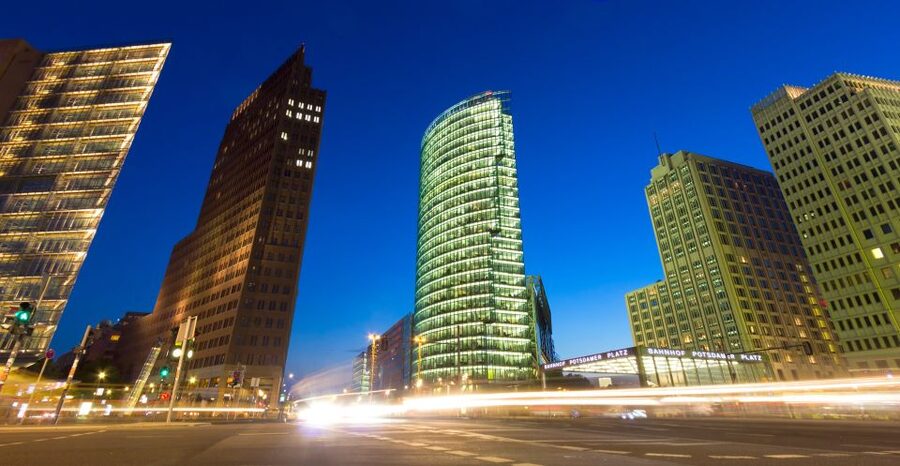
Potsdamer Platz and modern Berlin
Potsdamer Platz adds another layer to the route. Once a major traffic and commercial center, it became closely associated with Berlin’s division and later redevelopment.
On this tour, you see it as part of the broader walk rather than as a full architectural tour. The guide helps place the square between the historic center and the newer city that grew after reunification.
This is a useful stop for anyone trying to understand Berlin’s uneven appearance. You can move from nineteenth-century monuments to postwar spaces and modern construction within a short distance. The city does not hide its breaks, and this route lets you see several of them in one morning or afternoon.
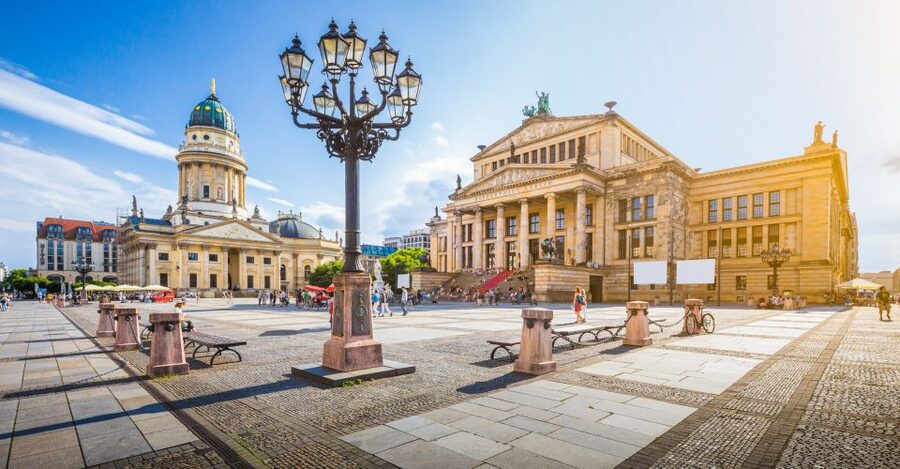
Gendarmenmarkt and Berlin’s grand design
Gendarmenmarkt is one of the prettiest squares on the route. Its main trio of buildings includes the German Cathedral, the French Cathedral, and the Konzerthaus.
The square gives you a strong look at Berlin’s formal side. The architecture is ordered, symmetrical, and grand, a sharp change from the political memorials and modern government buildings earlier in the walk.
The tour includes a guided sightseeing stop, not a promise of entry into each building. That is worth keeping in mind if you are interested in concerts, church interiors, or detailed architectural history.
I like this part of the route because it gives the walk visual variety. You are not hearing about war and political change at every stop. You also get a chance to appreciate the city’s design and the role of Prussian-era planning.
Bebelplatz and the memory of book burning
Bebelplatz brings the Nazi period back into focus. It is remembered for the book burning carried out there in 1933, and the square remains one of central Berlin’s clearest reminders of how public spaces can become stages for propaganda and repression.
The tour includes guided time here, with some free time listed as well. That makes it one of the stops where you can pause briefly, look around, and consider the site without being hurried from one landmark to the next.
The guide’s storytelling matters here. A date and a fact are easy to forget. A good explanation can show how the event fitted into the wider attack on free thought, culture, and opposition.
Unter den Linden and the old royal center
The walk follows Unter den Linden, Berlin’s famous boulevard. This avenue ties together several parts of the tour, from Brandenburg Gate to the historic center around Bebelplatz and Museum Island.
You will hear about emperors, revolutionaries, Prussian power, and the city’s later political changes. The boulevard is valuable as a connecting thread. Instead of seeing separate monuments with no link between them, you get a sense of Berlin as a capital repeatedly reshaped by its rulers and its conflicts.
The route does not promise long stretches of unscheduled strolling. You should stay with the group and listen while walking. Comfortable shoes are essential, and a water bottle is sensible even though the distance is moderate.
Lustgarten, Berlin Cathedral, and Museum Island
Near the end, the tour reaches Lustgarten, Berlin Cathedral, and Museum Island. This is one of the most rewarding sections for first-time visitors because several major sights sit close together.
Lustgarten has strong ties to Prussian history, while Berlin Cathedral brings an impressive architectural focal point to the route. The guide provides a sightseeing stop at the cathedral, but interior admission is not included in the tour description.
Museum Island is another outside viewing stop. You get an introduction to one of Berlin’s main cultural districts, along with the chance to understand its place in the city center. If you plan to visit the museums, use this tour to decide which ones deserve your return time.
The route also includes the New City Palace area, with a view toward the Fernsehturm, Berlin’s famous TV Tower. From here, you are close to Nikolaiviertel, the part of Berlin associated with the city’s beginnings in 1237.
This final stretch helps tie old and new Berlin together. You see royal buildings, a cathedral, museums, the reconstructed palace, and the TV Tower in one broad city view.
Finishing at Friedrichsbrücke
The tour ends at Friedrichsbrücke. That is near Museum Island, so you are well placed to continue sightseeing after the guide says goodbye.
You can use the end point as a springboard for more time around the cathedral, museums, Lustgarten, or Nikolaiviertel. It is also a practical finish if your plan is to continue exploring the historic center on foot.
Because the tour begins in the government district and ends near Museum Island, you are not returned to the starting point. Plan your day around that one-way route rather than expecting a circular walk.
How the pace feels over two hours
Two hours is both the tour’s strength and its main limit. You cover a lot of ground, and the route gives you a strong first orientation without taking an entire day. At about four kilometers, it is manageable for many ages and fitness levels, but you will be walking steadily.
You should expect frequent outdoor stops, short explanations, and movement between sights. There is no indication that the tour includes extended café breaks or long unstructured time.
The guides are meant to keep the past lively with stories, facts, and Berlin humor. That style suits a short walk because a dry lecture would make the schedule feel even faster. Recent praise for Max specifically highlights his answers, photo time, and willingness to let people take in the information. Another recent booking described a private guide who gave a very clear explanation and responded closely to questions.
Those details suggest that guide quality is central to the experience. Since the tour is offered in private or small-group formats, you may have a more personal exchange than on a large group walk, though the exact feel depends on the group you book.
What $82 means in value
At $82 per person, this is not a bargain-priced stroll. The price makes the most sense if you value a certified local guide, a carefully connected route, and a compact introduction to Berlin’s central sights.
You are paying for access to interpretation rather than tickets. The tour covers outdoor landmarks, and the description does not include entry to the Reichstag, Berlin Cathedral, museums, or other interiors. If your main goal is paid admission to a major attraction, this is not the right product.
I see the strongest value for a first day in Berlin. You can learn the basic layout, hear the major political chapters, and mark places to revisit. Families, older visitors, and anyone with limited time may also appreciate the fixed two-hour plan.
Private and small-group options can make the price easier to justify if you want to ask many questions or need the guide to adjust the pace. The basic group experience may be a better fit if you mainly want orientation and a lively walk.
Practical details that affect your day
Tours run in all weather, so bring layers and suitable shoes. Berlin weather can change quickly, and most of the experience takes place outside.
The walk is wheelchair accessible, and the tour is described as suitable for all ages and fitness levels. Still, the four-kilometer distance and steady pace are worth considering if you need frequent rests.
You can cancel up to 24 hours before the start for a full refund, and you can reserve now while paying later. Live guiding is available in English, Spanish, and German.
Bring:
Comfortable walking shoes
Water
A camera or phone for the Brandenburg Gate and other major views
Weather protection suitable for the forecast
For the best use of time, avoid planning another fixed appointment immediately after the walk. The route is scheduled for two hours, but the guide may spend extra time answering questions. One recent booking specifically praised a guide for going beyond the planned length.
Who should book this Berlin walk?
I would recommend it to you if this is your first visit and you want a quick, clear introduction to the central sights. It also suits you if you enjoy history explained through places rather than through a museum lecture.
Families may like the humor and movement. Small groups of friends can use the walk to get oriented before splitting up for museums and meals. Seniors can benefit from the manageable total distance, though the steady schedule still calls for comfortable footwear.
You may want another kind of tour if you have already spent several days around the historic center or if you prefer long interior visits. You will see many important places, but most stops are guided from outside.
Should you book it?
Book this tour if you want Berlin’s main central landmarks placed into one lively, efficient story. The strongest reasons are the sensible one-way route, the mix of modern government buildings and older monuments, the multilingual guides, and the chance to ask questions in a small or private group.
Skip it if $82 feels too high for a walking overview or if you want admission to the Reichstag, cathedral, or museums. For a first look at Berlin, though, this is a practical way to get your bearings fast and decide where to spend the rest of your visit.
FAQ
Where does the tour start?
It starts in front of the main entrance of the Paul-Löbe-Haus at Konrad-Adenauer-Straße 1, 10557 Berlin, opposite the Federal Chancellery.
Where does the tour finish?
The walk finishes at Friedrichsbrücke, near Museum Island.
How long is the walking tour?
The tour lasts two hours and covers approximately four kilometers.
What time does the tour run?
Tours are offered daily at 10:00 AM and 2:00 PM. You should check availability for the time you want.
Which languages are available?
Live guiding is available in English, Spanish, and German.
Is the tour wheelchair accessible?
Yes. The activity is listed as wheelchair accessible.
Can I cancel the booking?
Yes. You can cancel up to 24 hours in advance for a full refund. You can also reserve now and pay later.
Just added around Berlin
- Love and War in Berlin: Self-Guided Story Puzzle Walk★ 5.0 · 7 reviews
- Rickshaw Tours Berlin – Groups of up to 16 people with several rickshaws★ 4.0 · 97 reviews
- Walking on the Wall: 3-Hour Tour in Berlin★ 4.5 · 34 reviews
- eSIM for Germany and 34 European Countries★ 4.5 · 16 reviews
- Warnemuende Shore Excursion: Berlin Private Sightseeing Tour from Rostock★ 5.0 · 4 reviews
- Your ticket to The Wall Museum Berlin★ 3.0 · 60 reviews
- Warnemuende Shore Excursion: Private Berlin Tour★ 4.5 · 27 reviews
- Berlin’s Gay, Lesbian, and Queer Scene Small-Group Walking Tour★ 4.5 · 66 reviews
Walking Tours, compared.





Berlin’s Best: 2 Hour Walking Tour Third Reich and the Cold War
Read our review →

