
Reviewed · WALKING TOURS
Berlin: Jewish Walking Tour including World War II
Berlin’s Jewish story is told here through streets, courtyards, schools, cemeteries, memorials, and the people who passed through them. The route moves from Moses Mendelssohn and the community’s golden era to Nazi persecution, postwar memory, and Jewish life today. It is history you encounter at ground level, not just dates on a wall.
I like two things right away. First, Tal brings academic and professional experience to the subject, including work connected with the Charité hospital’s handling of its Nazi-era past. Second, this is a private tour, so you can shape the discussion around family history, religion, World War II, architecture, or modern Jewish Berlin. The main drawback is the price: $318 per person is a serious expense, especially since the museum in the New Synagogue costs extra.
In This Review
- Key points to know
- Starting at Hackescher Markt
- The Block of Women and the protest of 1943
- The Otto Weidt Museum and one man’s choices
- Old Jewish sites and the first cemetery
- The New Synagogue from the outside
- Schools, charities, and the machinery of community life
- From Nazi persecution to Jewish life today
- Optional extensions beyond the main route
- Is $318 per person a fair price?
- Walking, clothing, and access
- Who should book this Berlin Jewish walking tour?
- FAQ
- How long does the Berlin Jewish walking tour last?
- Where does the tour begin?
- Where does the tour end?
- Is the New Synagogue museum included?
- Are museum and cemetery tickets included?
- What languages does Tal speak?
- Is the tour suitable for wheelchair users?
Key points to know
- Moses Mendelssohn’s grave: The old Jewish cemetery offers a direct link to the philosopher who helped shape Jewish life in Berlin.
- Otto Weidt Museum: This small museum tells the story of a brushmaker who protected blind and deaf Jewish workers during the Holocaust.
- Women’s protest of 1943: The Block of Women memorial recalls a rare public protest against the imprisonment of Jewish relatives.
- Hackescher Markt and the Ostjuden: You’ll hear how Eastern European Jews changed Berlin’s Jewish quarter and how German Jews responded to their arrival.
- Private format: Tal can adjust the route and add sites such as Schönhauser Allee Cemetery or the Grunewald deportation memorial.
- Long walking route: Plan on 3.5 to 4 hours, comfortable shoes, water, and weather protection.
Starting at Hackescher Markt
The tour begins in front of Starbucks at Hackescher Markt, in Berlin’s Mitte district. This is a practical meeting point, easy to identify, and a fitting place to begin because the surrounding area once held many Jewish schools, charities, workshops, synagogues, and community offices.
Tal first sets the scene by explaining how Berlin’s Jewish community was re-established in the second half of the 17th century. The story then reaches the age of Moses Mendelssohn, an important philosopher and writer whose life helps explain the changing place of Jews in German society.
This opening matters because the tour does not treat Jewish Berlin as a story that begins in 1933. You first see the community as a growing part of city life, with its own arguments, institutions, ambitions, and internal divisions. That makes the later destruction more painful and more understandable.
Hackescher Markt also introduces the story of the Ostjuden, or Eastern European Jews. Many came to Berlin after pogroms and other persecution in the east. They brought different customs, clothing, languages, and religious practices. Tal discusses the uneasy response from established German Jews, some of whom felt embarrassed by the newcomers.
That detail gives the tour useful balance. Jewish Berlin was never one uniform group. It included debates over worship, education, social status, and identity. Tal also discusses disputes caused by changes such as the introduction of an organ in worship, showing that religious communities can argue fiercely about modern life long before political disaster arrives.
A few more Berlin trips to weigh up
- Discover Berlin Half-Day Walking Tour
★ 5.0 · 9,624 reviews - Berlin: Third Reich and Cold War 2 Hour Walking Tour
★ 4.9 · 6,830 reviews - Berlin: Discover Berlin Walking Tour
★ 4.9 · 5,998 reviews
The Block of Women and the protest of 1943
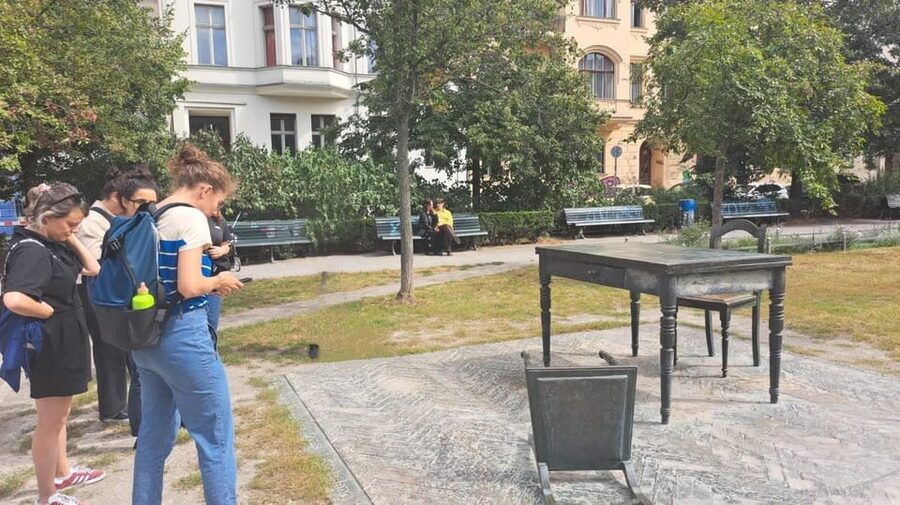
One of the most striking stops is the Block of Women memorial, linked to the women’s protest of 1943. The memorial recalls non-Jewish German women who gathered to demand the release of their Jewish husbands and relatives after those men were arrested.
You will hear about this event as part of the wider machinery of persecution. The protest did not end Nazi rule or halt the Holocaust, but it did lead to the release of many of the men being held there. It is an important reminder that public resistance took different forms, and that personal relationships sometimes crossed the categories imposed by Nazi law.
This stop is especially useful if you want more than a list of deportations and death figures. The focus shifts to individual choices, family ties, and the risks of speaking out. The memorial itself is not a full museum visit, so Tal’s explanation carries much of the weight.
The Otto Weidt Museum and one man’s choices
The Otto Weidt Workshop for the Blind is the tour’s indoor museum stop. Entry is included except on days when the museum is closed. This is one of the strongest parts of the route because it connects the Holocaust to a particular workplace and a particular man.
Otto Weidt operated a brush workshop and employed blind and deaf Jewish workers. Tal explains how Weidt tried to protect them from deportation and death. His efforts included bribery, deception, and attempts to use his contacts to keep workers safe.
The museum gives the story a human scale. Instead of walking past another general memorial, you see how danger entered the daily routine of a workshop. Jobs, identity papers, police inspections, and sudden arrests became matters of life and death.
Allow about 30 minutes here, according to the planned timing. The stop breaks up the walking and provides shelter if the weather turns poor. Flash photography is not allowed, and smoking is not permitted during the tour.
Old Jewish sites and the first cemetery
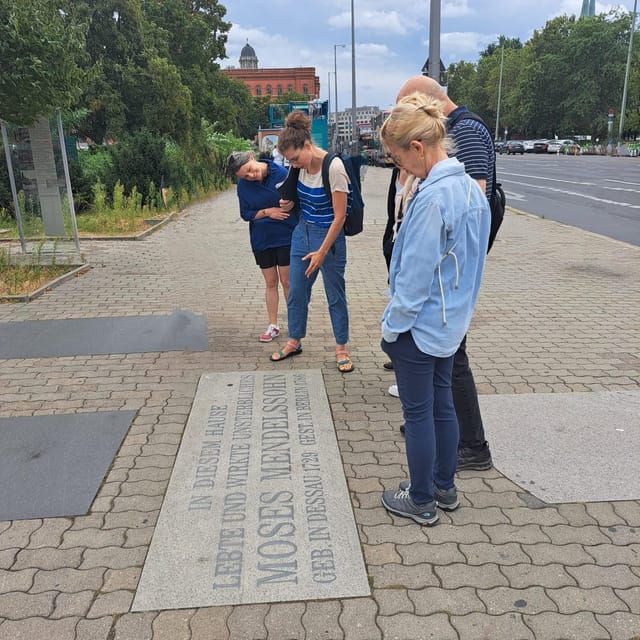
The route continues to the old Jewish cemetery, the community’s first burial ground. Moses Mendelssohn is buried here, making the cemetery an essential stop for anyone interested in the intellectual and cultural development of Berlin’s Jewish community.
A cemetery can be easy to rush through, especially on a packed city itinerary. Here, you should give Tal time to explain who Mendelssohn was and why his grave matters. His presence links the early community to the later period of Jewish education, philosophy, civic life, and debate.
The tour also visits the site of the community’s first synagogue. The exact stop is presented as a historical site rather than a grand surviving interior, so set your expectations accordingly. You are tracing a vanished institution through the city rather than entering a preserved sanctuary.
Entry to the old cemetery is included except on Jewish holidays and Saturdays. The tour description also names the finish as the Memorial Jewish Cemetery, so it is worth checking the precise end point and cemetery access when you book.
Same city, a completely different kind of day:
- Berlin: Reichstag, Dome and Government District Guided Tour
★ 4.7 · 18,288 reviews - Berlin: 1-Hour City Tour by Boat with Guaranteed Seating
★ 4.3 · 16,993 reviews - Berlin: Boat Tour Along the River Spree
★ 4.4 · 11,252 reviews - Berlin: Hop-on Hop-off Bus Tour with Live Commentary
★ 4.3 · 8,579 reviews
The New Synagogue from the outside
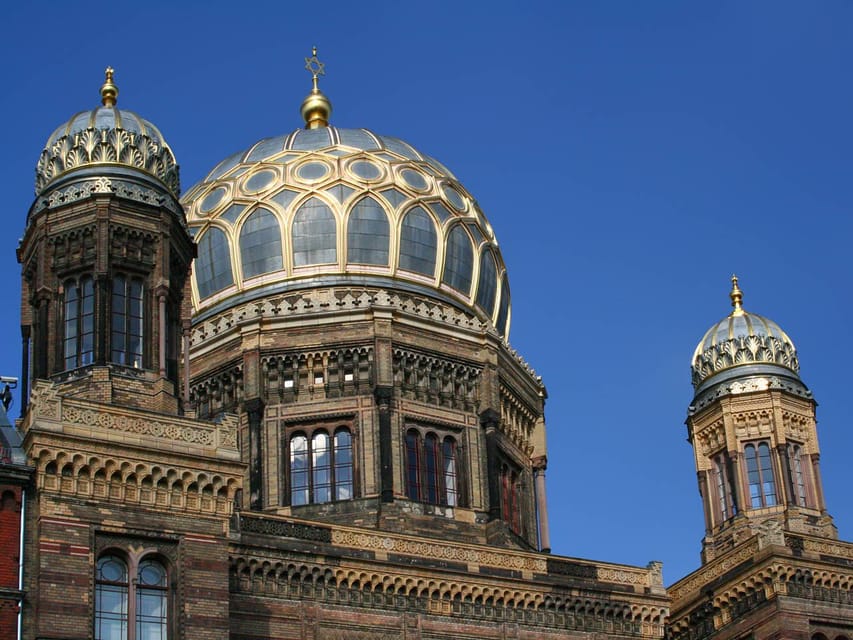
The New Synagogue is one of Berlin’s most recognizable Jewish buildings. On this tour, you see it from outside and learn how it marked the high point of Berlin’s Jewish community before its destruction and damage during the Nazi period and World War II.
The building’s size and appearance make the history visible. It was not a marginal house of worship. It reflected a confident community with money, institutions, education, and a strong presence in the capital.
The tour does not include entry to the Centrum Judaicum, the museum inside the New Synagogue. You must buy that ticket separately. This is an important cost and timing detail. If the interior and exhibition matter to you, ask Tal about adding it or plan a separate visit.
The exterior explanation lasts about 30 minutes in the suggested schedule. That gives you time to discuss the synagogue’s construction, the community’s divisions over modern worship, and the building’s later fate without turning the stop into a quick photograph.
Schools, charities, and the machinery of community life
Several less famous institutions appear along the route, including the Mendelssohn School and a girls’ school. These sites show that Jewish Berlin was built through education as much as through prayer.
I find this part valuable because it widens the focus beyond famous men and monumental buildings. Schools trained the next generation. Charities supported people in need. Community offices handled welfare, religious questions, and social disputes. Together, these places show how a community functions day by day.
The route also includes other institutions in Mitte, though the supplied schedule does not name every stop. Tal can use the private format to spend more time on the subjects that matter most to you. You might ask for more on women’s education, religious reform, migration from Eastern Europe, the Holocaust, or the rebuilding of Jewish life after 1945.
From Nazi persecution to Jewish life today
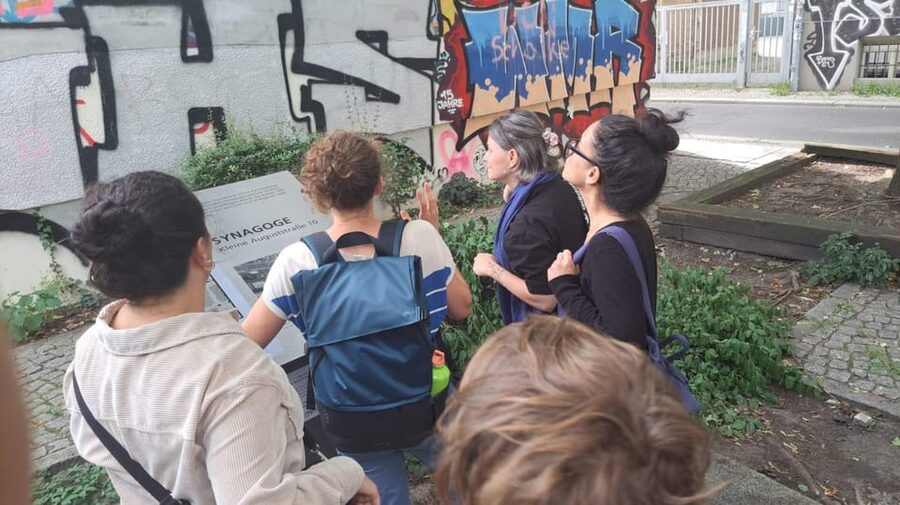
World War II is a major part of this tour, but the route does not stop with destruction. Tal also discusses the community’s move toward the western part of Berlin and the arrival of new Jewish residents over time.
That broader frame is important. Berlin’s Jewish history is not only a memorial story. It includes rebuilding, disagreement, migration, and the question of what it means to maintain Jewish life in a city marked by genocide.
Tal’s professional work adds depth here. His post-doctoral research examined how current professional staff at the Charité deal with the hospital’s history in the 1930s and 1940s. That background can help you connect public memorials with the harder work of institutions examining their own past.
The tour is offered in English or Hebrew. If language choice matters to you, select it when booking and confirm the arrangement with Tal.
Optional extensions beyond the main route
The standard walk lasts about 3.5 hours, with the full experience described as roughly 3.5 to 4 hours including a short break. You can pay for extra time and add further sites.
Schönhauser Allee Cemetery is an option for a longer look at Berlin’s Jewish golden era. It contains the graves of notable members of the community and can suit you if you want more biography, cemetery history, and family research.
The Kindertransport Memorial at Friedrichstraße Station focuses on children sent out of Nazi-controlled Europe. It adds a specific wartime story to the route, centered on rescue, separation, and exile.
The Grunewald Deportation Memorial marks the deportation of Berlin’s Jews. This is a stark addition and may be best for you if you want the tour to spend more time on deportation logistics and the city’s role in the Holocaust.
These extensions cost more and take extra time. Because the main tour already includes several memorial and historical stops, choose one based on your interests rather than trying to collect every site.
Is $318 per person a fair price?
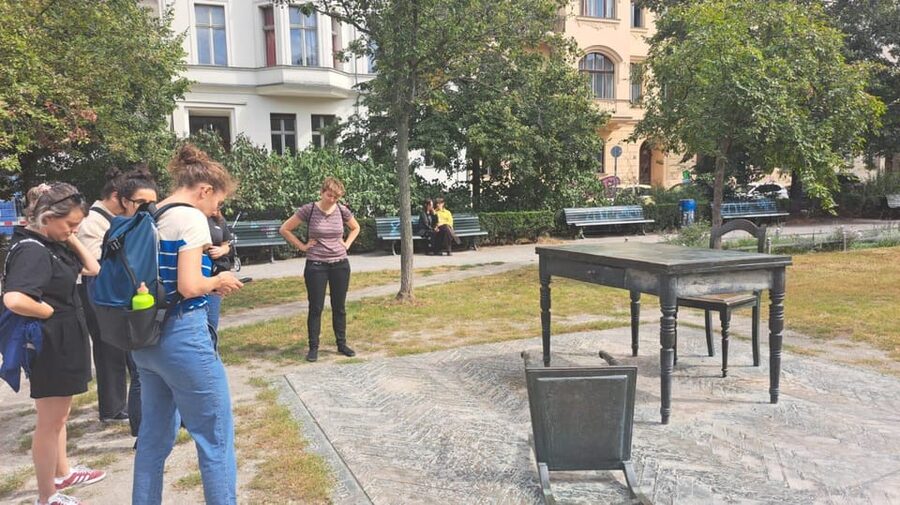
At $318 per person, this is not a budget walking tour. The value depends heavily on your group size and how much you want a tailored discussion.
For a private group with several people, the cost may make sense. You receive 3.5 to 4 hours with Tal, a specialist guide, a flexible route, and entry to the Otto Weidt Museum and old cemetery when open. You are also paying for the chance to ask detailed questions and adjust the emphasis as you go.
For one person or a couple, the cost feels much harder to justify. Meals, drinks, the Centrum Judaicum ticket, and optional extensions are not included. You are paying a premium for subject expertise and privacy, not for a long list of included attractions.
I would compare this with a standard group tour only if price is your main concern. A group option may cost less, but it is unlikely to give you the same control over topics and pace. If Jewish Berlin is a central reason for your visit, this private format may offer better value than adding several unrelated attractions to your schedule.
Walking, clothing, and access
Wear comfortable walking shoes. Bring water, a hat, sunscreen, and clothing suited to the forecast. A head covering or kippah should be carried, as it may be appropriate at Jewish sites.
The route runs through central Berlin but still involves several hours on foot. The activity information describes it as wheelchair accessible in one place, yet it also says it is not suitable for wheelchair users or people with mobility impairments. Treat the more restrictive guidance seriously and confirm conditions with Tal before booking.
The start is at Starbucks near Hackescher Markt, and the activity information says the tour ends back at the meeting point. Because the listed stop sequence finishes at the Memorial Jewish Cemetery, confirm the exact end point and return arrangement in advance.
Cancellation is free up to 24 hours before the start, and you can reserve now and pay later. Those terms are useful if your Berlin schedule is still moving, but they do not change the need to check cemetery and museum opening days.
Who should book this Berlin Jewish walking tour?
I would recommend it to you if you want context, not just photographs. It suits visitors interested in Moses Mendelssohn, Jewish religious life, Eastern European migration, Nazi persecution, resistance, memorial culture, and the rebuilding of Jewish Berlin.
It is also a good choice for families or private groups with a specific research question. You can ask Tal to focus on an ancestor’s period, Jewish schools, the Holocaust, the Charité, women’s history, or the postwar community.
I would hesitate if you want a light sightseeing walk, dislike long discussions, or need a fully accessible route. The subject is painful and serious, and the price is high. You should also allow extra time and money if you want to enter the Centrum Judaicum or visit the optional sites.
FAQ
How long does the Berlin Jewish walking tour last?
The main tour lasts about 3.5 hours. The full experience may run 3.5 to 4 hours and includes a short break.
Where does the tour begin?
The meeting point is in front of Starbucks near Hackescher Markt in Berlin’s Mitte district.
Where does the tour end?
The activity information says it ends back at the meeting point. The listed route also finishes at the Memorial Jewish Cemetery, so confirm the exact end arrangement before the tour.
Is the New Synagogue museum included?
No. The tour visits the New Synagogue from outside. Entry to the Centrum Judaicum, the museum inside, requires a separate ticket.
Are museum and cemetery tickets included?
Entry to the Otto Weidt Museum is included except on days when it is closed. Entry to the old cemetery is included except on Jewish holidays and Saturdays.
What languages does Tal speak?
The tour is available in English and Hebrew.
Is the tour suitable for wheelchair users?
The activity details give conflicting information, listing wheelchair accessibility in one place but also stating that it is not suitable for wheelchair users or people with mobility impairments. Confirm access conditions with Tal before booking.
Just added around Berlin
- Love and War in Berlin: Self-Guided Story Puzzle Walk★ 5.0 · 7 reviews
- Rickshaw Tours Berlin – Groups of up to 16 people with several rickshaws★ 4.0 · 97 reviews
- eSIM for Germany and 34 European Countries★ 4.5 · 16 reviews
- Walking on the Wall: 3-Hour Tour in Berlin★ 4.5 · 34 reviews
- Warnemuende Shore Excursion: Berlin Private Sightseeing Tour from Rostock★ 5.0 · 4 reviews
- Your ticket to The Wall Museum Berlin★ 3.0 · 60 reviews
- Warnemuende Shore Excursion: Private Berlin Tour★ 4.5 · 27 reviews
- Berlin’s Gay, Lesbian, and Queer Scene Small-Group Walking Tour★ 4.5 · 66 reviews
Walking Tours, compared.





Berlin’s Best: 2 Hour Walking Tour Third Reich and the Cold War
Read our review →

