
Reviewed · WALKING TOURS
Berlin Highlights in 2 Hours: Express Walking Tour
Berlin’s most difficult chapters are packed into this two-hour walk from Brandenburg Gate to Checkpoint Charlie. You move from Prussian grandeur to Nazi terror, then on to the Berlin Wall and Cold War tension, with an English-speaking guide tying the sites together.
I like the efficient route and the low $21.77 price. You get a useful first look at central Berlin without giving up half a day, and the group limit of 25 keeps the tour more manageable than a huge street crowd. The tradeoff is clear: ten minutes at each stop is enough for orientation and stories, not enough for a full museum visit or quiet reflection.
I also like the range of guides associated with this walk. Ryan, Gregor, Dylan, and Giles are praised for clear explanations, a pleasant manner, good answers, and a walking pace that worked for a mixed-age group. Still, this is a fast tour, so you should be ready to keep moving and continue exploring the sites on your own.
In This Review
- Key points to know before you book
- Why this two-hour route works in Berlin
- Brandenburg Gate and the Reichstag: Berlin’s grand opening
- Two memorials, two forms of remembrance
- Hitler’s bunker site and the final days of World War II
- The Aviation Ministry and the political use of buildings
- The Berlin Wall on Niederkirchnerstraße
- Topography of Terror: the Nazi system in one location
- Checkpoint Charlie and the Cold War finish
- Pace, group size, and guide style
- Who gets the best value from this walk
- Booking value and cancellation terms
- Should you book Berlin Highlights in 2 Hours?
- FAQ
- How long does the Berlin Highlights walking tour last?
- What is the price per person?
- What language is the tour offered in?
- Where does the tour begin?
- Where does the tour end?
- Which major sites are included?
- How large can the group be?
- Are the sights included with admission?
- Can I cancel for a full refund?
Key points to know before you book
- Nine major stops in about two hours: The route covers Brandenburg Gate, the Reichstag, Holocaust memorials, Nazi government sites, the Berlin Wall, and Checkpoint Charlie.
- A useful Nazi and Cold War history lesson: The walk connects the Holocaust, World War II, divided Berlin, and German reunification in one clear sequence.
- Only $21.77 per person: Since the sights are viewed from public spaces and admission is free, most of the cost pays for the guide and the structure of the route.
- A maximum of 25 people: This is still a group tour, but the cap is far more comfortable than a mass gathering.
- Guide quality matters here: Ryan, Gregor, Dylan, and Giles are praised for strong communication, detailed explanations, and a pace suited to different ages.
- The tour ends at Checkpoint Charlie: You finish near public transportation and can continue sightseeing in central Berlin.
Why this two-hour route works in Berlin
Berlin can feel like a history book spread across a wide city. One square recalls Prussian power, another marks Nazi crimes, and a short walk later you are looking at the remains of a divided capital. Without a guide, it is easy to see the buildings but miss the connections.
This route gives you those connections quickly. It begins at Pariser Platz, beside Brandenburg Gate, and ends at Checkpoint Charlie on Friedrichstraße. Along the way, you cover the period from the late 19th-century German state through the Nazi dictatorship, World War II, the Holocaust, East Germany, and the Cold War.
The tour is listed at about two hours, with roughly ten minutes assigned to each stop. That timing tells you how to use it. You are not signing up for nine long visits. You are getting a guided introduction, a set of locations, and enough background to decide where you want to return later.
The price is strong for this format. At $21.77, the tour costs less than many longer guided activities, and the major outdoor stops do not charge admission. The value depends on how much you want context. If you already know Berlin’s history well, you may find the pace basic. If you are seeing the city for the first time, the route can save you hours of figuring out what belongs together.
A few more Berlin trips to weigh up
- Discover Berlin Half-Day Walking Tour
★ 5.0 · 9,624 reviews - Berlin: Third Reich and Cold War 2 Hour Walking Tour
★ 4.9 · 6,830 reviews - Berlin: Discover Berlin Walking Tour
★ 4.9 · 5,998 reviews
Brandenburg Gate and the Reichstag: Berlin’s grand opening
You meet at Pariser Platz 1, directly by Brandenburg Gate. This neoclassical monument is one of Berlin’s best-known symbols, but its meaning has changed with the city around it. Your guide presents it as a symbol of unity and peace, while the surrounding square provides an immediate sense of Berlin’s formal, political center.
Ten minutes here is enough to take in the gate, the architecture around Pariser Platz, and the opening explanation. It is not enough for an extended architectural talk, so keep your expectations modest. The real value is getting your bearings and understanding why this square has carried so much political weight.
From there, the walk continues to the Reichstag, Germany’s parliamentary building. You hear how the building connects to the Weimar Republic and modern Germany. The exterior alone makes this a worthwhile stop, especially for anyone interested in how German democracy rebuilt itself after dictatorship and war.
The Reichstag visit is an outside stop, with no admission included or needed for this walk. You should not expect entry into the parliamentary building or a visit to its dome. Think of this portion as a concise explanation of the building’s place in German politics.
Two memorials, two forms of remembrance

The next part changes tone. At the Memorial to the Sinti and Roma Victims of National Socialism, the guide explains the persecution of Sinti and Roma people under the Nazi regime. The memorial is a reminder that the Holocaust affected more than one targeted community, and it gives this short tour a broader view of Nazi persecution.
The stop is brief, but its inclusion matters. Many quick Berlin walks focus only on the best-known sites. Here, you get a specific memorial and an explanation of why its victims must be remembered. The tour description refers to thousands of Sinti and Roma people who suffered during the Holocaust, without turning the stop into a long lecture.
You then reach the Memorial to the Murdered Jews of Europe, often called the Holocaust Memorial. Its field of concrete slabs creates a powerful, uneasy setting. You can walk among the blocks and consider how the changing height and narrow paths affect your sense of direction.
The guide gives the memorial historical meaning, but ten minutes is not a long time here. You will not have time to visit every part of the underground information center as part of this walk. If this memorial matters deeply to you, return later and give it more time. The guided stop works best as an introduction rather than a complete visit.
This section requires a respectful attitude. The memorials are not simply photo stops. Your guide helps you understand why Berlin places them in the middle of the capital and how public remembrance has become part of modern German civic life.
Hitler’s bunker site and the final days of World War II
The walk continues to the former Führerbunker site. There is no preserved bunker interior to tour here. Instead, you stand above the location while the guide explains the final days of World War II, including Hitler’s suicide on April 30, 1945.
This is one of the route’s most useful examples of Berlin’s approach to difficult history. The place is visually plain, and that is part of the point. You need the explanation to understand what happened below the ground and why the site looks so ordinary today.
A good guide keeps the focus on historical fact rather than sensational detail. The walk also addresses how present-day Germany confronts and remembers its Nazi past. That wider question makes the stop more useful than a simple account of Hitler’s last days.
Again, ten minutes goes quickly. You get the location and the story, but not a lengthy discussion of the war’s final operations. If you want a fuller World War II study, plan a museum visit separately.
Same city, a completely different kind of day:
- Berlin: Reichstag, Dome and Government District Guided Tour
★ 4.7 · 18,288 reviews - Berlin: 1-Hour City Tour by Boat with Guaranteed Seating
★ 4.3 · 16,993 reviews - Berlin: Boat Tour Along the River Spree
★ 4.4 · 11,252 reviews - Berlin: Hop-on Hop-off Bus Tour with Live Commentary
★ 4.3 · 8,579 reviews
The Aviation Ministry and the political use of buildings
At the former Reich Air Ministry, you see a large example of Nazi-era architecture. The building once served as the Luftwaffe headquarters and later became part of East Germany’s government. It is now home to Germany’s Federal Ministry of Finance.
That change of use gives the building special interest. You are not just looking at an old government façade. You are seeing how one structure passed through several political systems: Nazi Germany, East Germany, and the current Federal Republic.
The stop is especially good for readers who like architecture with a political story attached. Your guide points out the building’s place in Berlin’s changing government center, while you see how much of the structure remains in everyday use.
The drawback is that this is an exterior-focused stop. You should not expect access to the ministry. The explanation is what turns the building from a stern façade into a useful lesson about power and continuity in Berlin.
The Berlin Wall on Niederkirchnerstraße
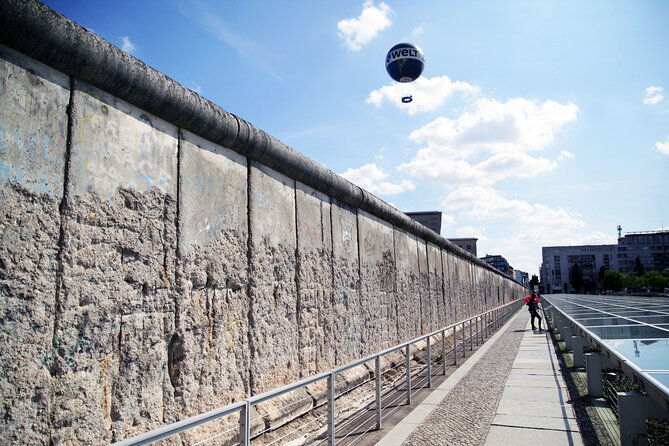
At Niederkirchnerstraße, you see a preserved section of the Berlin Wall. This gives the tour a physical reminder of divided Berlin after the more abstract political stories at the earlier stops.
The guide explains escape attempts, including both successful efforts and tragedies. You also hear about everyday life on the East and West sides of the city. That balance matters. The Wall was not only a barrier used in dramatic escape stories. It shaped work, family life, travel, and the basic geography of Berlin.
The preserved section makes a strong visual stop, but the ten-minute limit means the account stays focused. You get key facts and human stories rather than a full history of the Wall from construction to fall.
For many people, this is where the tour’s timeline becomes easiest to follow. The earlier stops explain the destruction caused by Nazism and the war. The Wall shows how the postwar settlement divided Berlin and kept that division in place for decades.
Topography of Terror: the Nazi system in one location
The Topography of Terror sits on the former site of the headquarters used by the SS, Gestapo, and SD. These organizations played central roles in Nazi persecution and terror. The site now contains an exhibition devoted to those crimes.
The walk treats this as a historical location and exhibition stop, but you should be clear about the format. You are not receiving an extended museum visit during the ten-minute schedule. Your guide introduces the site and explains why it matters.
If you have time after the tour, this is one of the places worth revisiting. The outdoor portion gives you the setting and basic context. A later visit allows you to spend more time with the exhibition material and the documented evidence.
I value this stop because it shifts the focus from individual Nazi leaders to the institutions that carried out the regime’s work. That is an important distinction. It helps you see terror as an organized system, not only as the actions of a few famous figures.
Checkpoint Charlie and the Cold War finish
The final stop is Checkpoint Charlie at Friedrichstraße 43 to 45. This former border crossing became one of the best-known symbols of the Cold War. Here, the guide wraps up the story with accounts of espionage, escape attempts, and the tense division between East and West Berlin.
Ending here gives the route a natural shape. You begin with Brandenburg Gate, a symbol now linked to unity, and finish at a place once associated with separation and confrontation.
Checkpoint Charlie itself can feel more commercial and less atmospheric than the Wall section at Niederkirchnerstraße. The famous name draws crowds and souvenir businesses, so do not expect a quiet memorial space. Its value lies in the political story and its place in Cold War history.
The end point is practical. You are in central Berlin, near public transportation, and can continue to nearby sights after the guide leaves. The route does not return you to Brandenburg Gate, so think ahead if you need to collect luggage or meet someone there.
Pace, group size, and guide style
The group can include up to 25 people. That is not a private walk, but it is a reasonable ceiling for a city tour with frequent stops. A smaller group can make questions easier, and the guide can usually keep the group together without constant crowd management.
The guide is a major part of the value. Ryan is described as pleasant and clear, with strong command of the material. Gregor is praised for bringing meaning to each location, even within the express format. Dylan is noted for answering questions and sharing facts in an interesting way.
Giles is singled out for clear communication, responsiveness, and a walking speed that suited a group ranging from people in their 20s to people in their 70s. That is useful information if your group includes different ages or walking abilities.
You should still expect to walk continuously between outdoor sites. Most people can participate, and service animals are allowed. The tour is offered in English, and confirmation arrives when you book.
The tour is booked, on average, about 12 days ahead. That does not guarantee every departure will fill, but it is a good reason to reserve early if your Berlin dates are fixed.
Who gets the best value from this walk
I would choose this tour for a first visit to Berlin, especially if I had only a short window in the historic center. It also suits history buffs who want a guide to explain the links between sites instead of visiting each one as an isolated monument.
It is a good fit for:
- First-time visitors who want a structured introduction
- People with only a morning or afternoon free
- Families and mixed-age groups that prefer a shorter activity
- Anyone interested in Nazi Germany, Holocaust remembrance, or the Cold War
- Visitors who want to save money with a group walk
- People planning to return to one or two sites later
I would be more cautious if you want museum interiors, long periods of silence at memorials, or detailed military history. This is an express walk. You see many places, but you do not study each one at length.
Wear comfortable shoes and keep your schedule afterward flexible enough to revisit a memorial or exhibition that catches your interest. Since the tour ends at Checkpoint Charlie, you can continue exploring rather than losing time returning to the start.
Booking value and cancellation terms
At $21.77 per person, the walk offers solid value if you want orientation and historical explanation at a low cost. The sights themselves are free to view from outside, so the fee pays mainly for the guide’s time, route planning, and storytelling.
The 98 percent recommendation rate and 4.9 rating from 120 reviews suggest that guide quality has been consistently strong, though no short tour can meet every preference. The strongest praise centers on clear teaching, engaging delivery, useful answers, and a comfortable pace.
Free cancellation is available if you cancel at least 24 hours before the start time. Cancellations made within 24 hours are not refunded, and changes during that period are not accepted. The cut-off follows local Berlin time.
Should you book Berlin Highlights in 2 Hours?
Book it if you want a fast, affordable introduction to Berlin’s central history and prefer a guide to connect the sites for you. The route is especially useful early in your stay, when it can help you decide which memorials and museums deserve a longer return visit.
Skip it if you already know these locations well or want extended time inside museums. For most first-time visitors with limited time, though, the combination of nine major stops, strong guide feedback, a 25-person limit, and a $21.77 price makes this a sensible opening look at Berlin.
FAQ
How long does the Berlin Highlights walking tour last?
The tour lasts approximately two hours.
What is the price per person?
The listed price is $21.77 per person.
What language is the tour offered in?
The tour is offered in English.
Where does the tour begin?
The meeting point is Pariser Platz 1, 10117 Berlin, Germany, beside Brandenburg Gate.
Where does the tour end?
The tour ends at Checkpoint Charlie, Friedrichstraße 43 to 45, 10117 Berlin, Germany.
Which major sites are included?
The route includes Brandenburg Gate, the Reichstag Building, the Memorial to the Sinti and Roma Victims of National Socialism, the Memorial to the Murdered Jews of Europe, the Führerbunker site, the former Aviation Ministry, Niederkirchnerstraße and the Berlin Wall, Topography of Terror, and Checkpoint Charlie.
How large can the group be?
The group can include a maximum of 25 people.
Are the sights included with admission?
Each listed stop has free admission, and the walk views the sites along the route.
Can I cancel for a full refund?
Yes. You can cancel at least 24 hours before the experience starts for a full refund. Cancellations or changes made less than 24 hours before the start time are not refunded or accepted.
Just added around Berlin
- Love and War in Berlin: Self-Guided Story Puzzle Walk★ 5.0 · 7 reviews
- Rickshaw Tours Berlin – Groups of up to 16 people with several rickshaws★ 4.0 · 97 reviews
- Walking on the Wall: 3-Hour Tour in Berlin★ 4.5 · 34 reviews
- eSIM for Germany and 34 European Countries★ 4.5 · 16 reviews
- Warnemuende Shore Excursion: Berlin Private Sightseeing Tour from Rostock★ 5.0 · 4 reviews
- Your ticket to The Wall Museum Berlin★ 3.0 · 60 reviews
- Warnemuende Shore Excursion: Private Berlin Tour★ 4.5 · 27 reviews
- Berlin’s Gay, Lesbian, and Queer Scene Small-Group Walking Tour★ 4.5 · 66 reviews
Walking Tours, compared.





Berlin’s Best: 2 Hour Walking Tour Third Reich and the Cold War
Read our review →


Third Reich Berlin: Hitler and WWII Walking Tour
Read our review →Browse the lists this tour appears in