
Reviewed · WALKING TOURS
An Introduction to Berlin Walking Tour
Berlin’s story comes into focus on this compact three-hour walk. You move from Prussian power and militarism to the divided city of the Cold War, then to the democratic capital and rebuilt urban center of today. The route covers major sights rather than tucked-away corners, but the value lies in having a historian explain how they connect.
I like the small maximum group of eight, which gives you a better chance to ask questions and keep a sensible pace. I also like the mix of grand monuments and sobering places, from the Brandenburg Gate to the Memorial to the Murdered Jews of Europe. The main drawback is that this is not a pure walking tour: you’ll need public transport a few times, and the $156.53 price is high unless you want serious historical context in a very small group.
In This Review
- Key points before you book
- Berlin’s past in one carefully shaped route
- Starting near Unter den Linden
- Reichstag and the modern German state
- Brandenburg Gate and the weight of symbols
- Museum Island and Prussian cultural ambition
- Potsdamer Platz and the city rebuilt
- Tiergarten, the city’s green center
- The Holocaust Memorial requires time and care
- Hackescher Markt and traces of prewar Berlin
- What the $156.53 price really buys
- Public transport is part of the plan
- Who will get the most from this tour
- Booking and cancellation details
- Should you book this Berlin walking tour?
- FAQ
- How long is the Berlin walking tour?
- What language is the tour offered in?
- How many people can join the tour?
- Where does the tour start?
- Does the tour include public transportation?
- Are meals, drinks, or hotel transfers included?
- Can I cancel for a full refund?
Key points before you book
- A 300-year story in three hours: The tour links Prussian Berlin, the Nazi period, the Cold War, reunification, and the modern capital.
- Eight people maximum: A small group keeps the tour more personal than a large city walk.
- A historian leads the way: Guides include professors, doctoral students, journalists, and experienced local storytellers.
- Major Berlin sights included: Expect the Reichstag, Brandenburg Gate, Museum Island, Potsdamer Platz, Unter den Linden, Tiergarten, the Holocaust Memorial, and Hackescher Markt.
- Budget for transit: Several gaps are too long to walk, so a Berlin public transport ticket is part of your planning.
- Good for architecture fans: The buildings and city planning receive real attention, and an architect may occasionally lead the group.
Berlin’s past in one carefully shaped route
This tour is best understood as a guided history lesson that happens outdoors. Berlin can feel like a collection of impressive buildings and empty spaces until someone explains the forces behind them. Here, Prussian kings, military power, dictatorship, war, division, and democratic renewal form the main thread.
You will not spend hours inside museums. That is useful if you have only a short time in Berlin or want an orientation before exploring on your own. It also means the tour depends heavily on the guide. A strong historian can turn a street corner into a useful lesson. A less engaging guide would leave you with a fast march between famous sights.
The small group matters. With no more than eight people, I would expect a quieter experience than a standard coach or large city walk. You can ask why a monument is where it is, how Berlin changed after reunification, or how the old Prussian capital shaped later Germany. Guides may be professors, doctoral students, journalists, or enthusiastic local hosts, so the style can vary, but the advertised focus is clearly academic and story-driven.
One past guide, Dan, is described as an architect who led a group of three architecture fans. That is a useful clue for anyone interested in buildings and city planning. The guide’s background can shape the experience, so if architecture is your main interest, it is worth asking who will lead your departure if that information is available.
A few more Berlin trips to weigh up
- Discover Berlin Half-Day Walking Tour
★ 5.0 · 9,624 reviews - Berlin: Third Reich and Cold War 2 Hour Walking Tour
★ 4.9 · 6,830 reviews - Berlin: Discover Berlin Walking Tour
★ 4.9 · 5,998 reviews
Starting near Unter den Linden
The meeting point is Unter den Linden 42, in central Berlin. This puts you near one of the city’s key ceremonial avenues and close to several important government and cultural buildings.
Unter den Linden means under the linden trees. The boulevard runs from the former City Palace area toward the Brandenburg Gate and was Berlin’s answer to grand avenues such as the Champs-Élysées. On this walk, the avenue helps explain Berlin’s old royal ambitions. It was designed to project order, power, and prestige.
The listed stop receives about 30 minutes, one of the longer pauses on the route. That is sensible. A quick photograph would miss the point. The boulevard is a way to read the city, with royal, military, cultural, and political functions layered along one axis.
You should wear comfortable shoes, but do not assume every minute is spent walking. The distances between several sights are too great for a continuous walk, and public transport is used along the way. That is a practical detail many people miss when they see the word walking in the title.
Reichstag and the modern German state
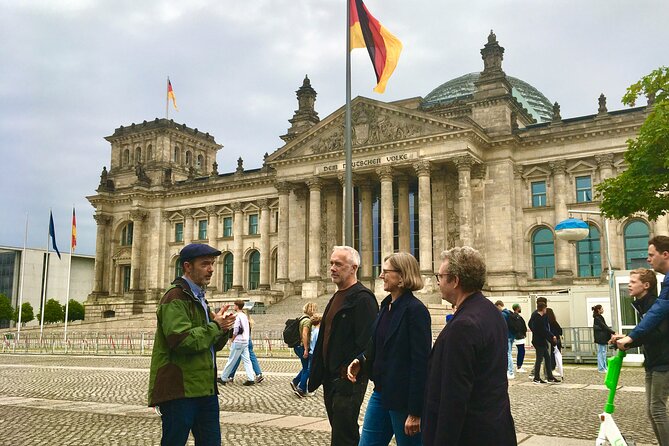
The Reichstag is home to the Bundestag, Germany’s lower house of parliament. The building is one of Berlin’s clearest symbols of political change, especially because the modern glass dome by Norman Foster presents openness and public access as part of democratic government.
The scheduled stop is about 15 minutes, with no admission charge for this visit. That is enough time for an exterior introduction and an explanation of the building’s role, but not for an extended interior visit or a full dome experience. The tour includes the sight, not a separate paid entry or long architectural inspection.
I find this an effective early stop because it gives the rest of the route a political frame. Berlin is not only a city of kings and ruins. It is also the capital of a modern parliamentary democracy, and the Reichstag makes that change visible.
If you want time to study the dome or enter the building, plan a separate visit. The tour’s schedule is tight, and the Reichstag is only one part of a wide-ranging route.
Brandenburg Gate and the weight of symbols
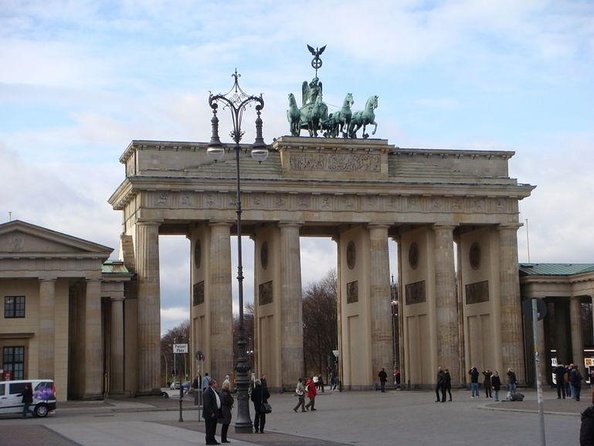
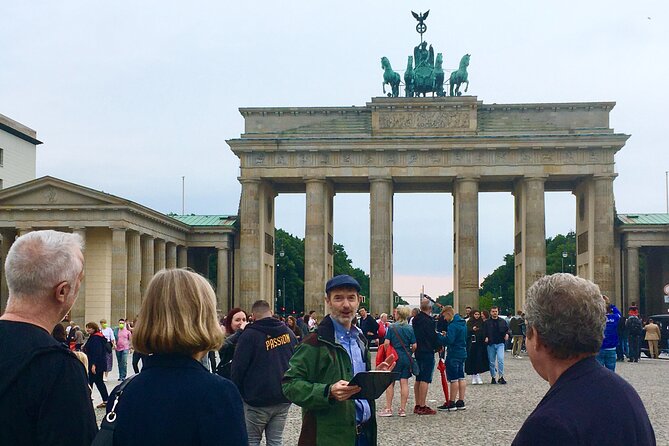
The Brandenburg Gate receives roughly 20 minutes. Built in the 18th century on the orders of Prussian King Frederick William II, it began as a royal monument. Later, it became a stage for major events, including Napoleon’s entry into Berlin and Ronald Reagan’s Cold War speech.
That shift in meaning is exactly what makes the gate worth hearing about rather than simply photographing. A single monument can represent monarchy, conquest, division, and political challenge, depending on the decade.
The gate is also a useful place to understand Berlin’s scale. It is grand without being isolated, and its position near the Reichstag, Unter den Linden, the Tiergarten, and the Holocaust Memorial makes it part of a larger civic center.
The limitation is the time. Twenty minutes will give you orientation and context, but not a full architectural study. If the square is crowded, your guide’s explanation may matter more than your ability to find a clear photo.
Same city, a completely different kind of day:
- Berlin: Reichstag, Dome and Government District Guided Tour
★ 4.7 · 18,288 reviews - Berlin: 1-Hour City Tour by Boat with Guaranteed Seating
★ 4.3 · 16,993 reviews - Berlin: Boat Tour Along the River Spree
★ 4.4 · 11,252 reviews - Berlin: Hop-on Hop-off Bus Tour with Live Commentary
★ 4.3 · 8,579 reviews
Museum Island and Prussian cultural ambition
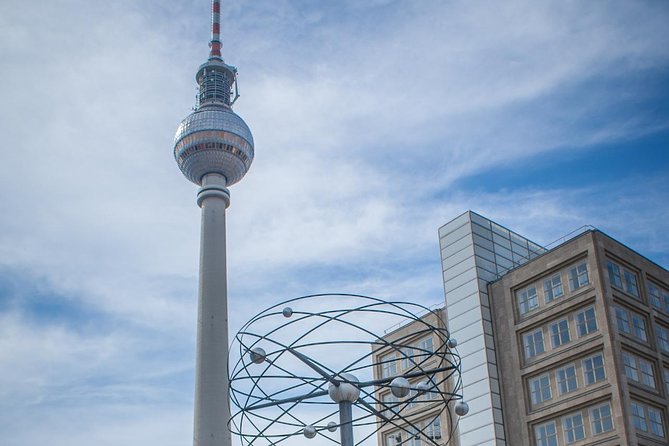
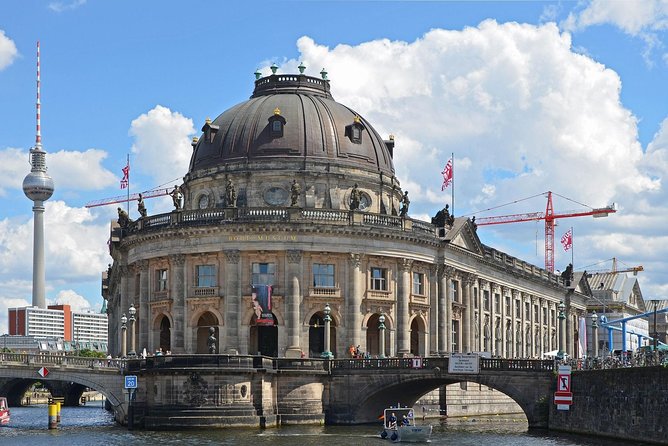
Museum Island sits on the Spree Island in central Berlin. The ensemble includes five major museums built under Prussian rulers, including the Pergamon Museum, the Neues Museum, and the Alte Nationalgalerie.
The tour allows about 25 minutes here. Admission to the museums is not included, and the stop does not promise an interior museum visit. Instead, you should expect an introduction to the island as a planned cultural center and a discussion of how Prussian rulers used art, archaeology, and monumental buildings to shape the capital.
This is one of the places where a historian or architect can add real value. The buildings are not random attractions. Together, they show how a state presented itself as educated, powerful, and connected to the great civilizations of the past.
Do not book this tour expecting a substitute for Museum Island’s collections. If you want to see the exhibits, set aside another half-day or more. The guided stop works better as a preview that helps you choose which museum deserves your time.
Potsdamer Platz and the city rebuilt
Potsdamer Platz offers a very different view of Berlin. Once a major urban square, it was transformed after the fall of the Berlin Wall into a center of restaurants, shops, entertainment, and modern buildings.
The stop is about 15 minutes. That short pause should be enough to explain the area’s post-Wall rebirth, but you will not have much time for shopping, dining, or exploring its architecture in detail. If contemporary city planning interests you, note the buildings and public spaces, then consider returning later.
Potsdamer Platz is useful because it shows that reunification was not only a political event. It changed the physical city. Formerly divided areas had to be connected, rebuilt, and given a new purpose. The contrast with older Berlin is sharp, and the guide can help you understand why the area looks so different from Unter den Linden or Museum Island.
Tiergarten, the city’s green center
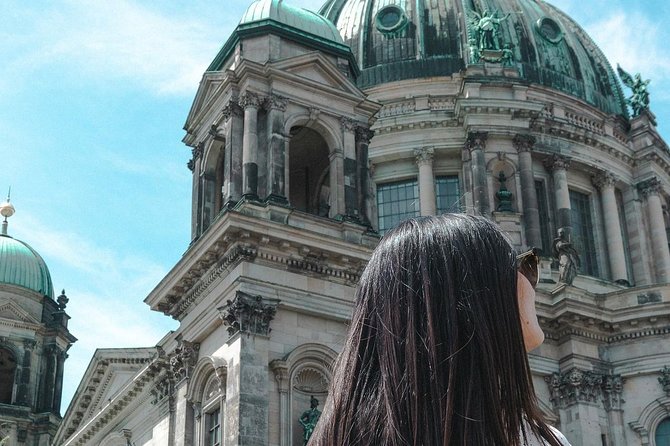
Tiergarten is Berlin’s best-known inner-city park, with gardens and grand statuary. The planned stop is only about 10 minutes, so think of it as a brief look rather than a park outing.
The park gives your eyes a break from stone facades and traffic. It also helps explain Berlin’s broad urban design. The city’s central spaces are not all ceremonial squares and government buildings. Large open areas have long played a role in how Berlin works and how people move through it.
You will not have time for a long stroll through the park during this tour. If you enjoy gardens, statues, or quiet paths, return on your own. The brief stop is still worthwhile because it adds physical variety to a route packed with political and architectural landmarks.
The Holocaust Memorial requires time and care
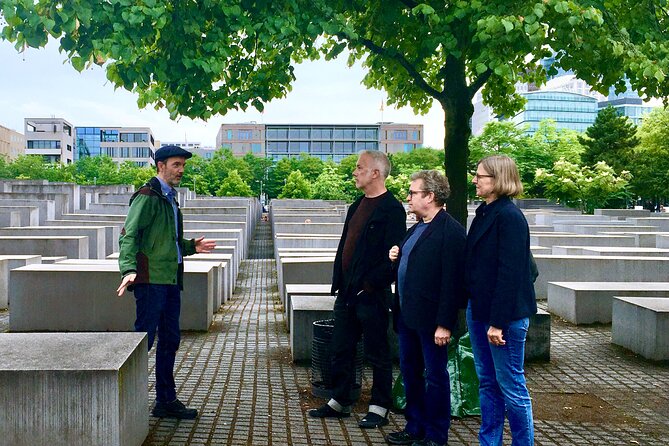
The Memorial to the Murdered Jews of Europe is made up of 2,711 concrete slabs of different heights. Designed by Peter Eisenman and opened in 2005, the memorial creates a stark field that you can enter and walk through.
The tour allows about 10 minutes here. That is enough for your guide to explain the memorial’s purpose and design, but it is a short period for such a serious place. You may want to spend extra time alone after the guided portion, moving quietly through the blocks and considering how the changing ground and narrow passages affect you.
This is not a stop for a quick joke or a rushed photograph. The memorial asks for attention, and its meaning is not reduced to a list of dates. The tour can provide context, but the physical experience also matters.
Because the memorial is outdoors, the visit does not involve an admission fee. Still, treat the space with respect and allow yourself a few quiet minutes if the schedule permits.
Hackescher Markt and traces of prewar Berlin
Hackescher Markt is the liveliest stop near the end of the listed route. Its preserved Art Nouveau courtyards offer a glimpse of prewar Berlin, with a more intimate scale than the huge government monuments seen earlier.
The scheduled visit lasts about 15 minutes. That gives you a quick introduction to the square and its courtyards, but the area deserves a return visit if you want to browse, eat, or study the architecture without a group schedule.
This stop also broadens the tour’s picture of Berlin. You see royal avenues, parliament, museums, memorials, modern redevelopment, and then urban courtyards that feel more local and enclosed. The city’s character changes from stop to stop, and that contrast is one of the route’s strengths.
A guide who pays attention to architecture can make Hackescher Markt especially rewarding. The earlier account of Dan leading architecture fans suggests that some guides may explain the courtyards and buildings in more detail than a standard city guide would.
What the $156.53 price really buys
At $156.53 per person, this is not a bargain sightseeing walk. You are paying for a three-hour private-feeling format with a maximum of eight people, not for entrance tickets or meals.
The included feature is the guided tour with a historian. Food, drinks, hotel pickup, and drop-off are not included. Admission is listed as free at each stop, but the museums on Museum Island are not part of the tour’s included program.
The price makes more sense if you value expert explanation, ask questions, and want a focused introduction to Berlin’s difficult past. It is less convincing if you mainly want photographs or a quick list of landmarks. Berlin has many lower-cost ways to see these sights, and this tour’s advantage is the guide rather than access.
Group discounts may help lower the cost for some bookings. Since the tour averages being booked seven days ahead, I would not leave it until the last minute if your dates are fixed.
Public transport is part of the plan
Several sights are too far apart to reach on foot within three hours. You will need to use Berlin public transport a few times, and that cost is not included in the tour price.
A Berlin Transit AB one-way ticket is listed at €2.80, with a senior fare of €1.70. A one-person day ticket is listed at €7, with a senior fare of €4.70. If you already have a visitor transit pass, you may be set. Otherwise, the day ticket is the simpler option if you will make more than a couple of rides.
If you cannot buy a ticket before the tour, the guide can help you purchase one at the first metro station. That is useful, but I would still arrive with enough time to deal with the ticket machine and find the meeting point at Unter den Linden 42.
This transport requirement is the clearest practical drawback. The tour title may lead you to expect three hours entirely on foot. Instead, think of it as a guided central Berlin route that combines walking with short public transport connections.
Who will get the most from this tour
I would choose this experience if you are visiting Berlin for the first time and want the city’s main historical story explained in one sitting. It also suits people who prefer questions and conversation over a large group following a flag.
Architecture fans are a particularly good match. The route includes royal planning, the Reichstag’s glass dome, Museum Island, the Brandenburg Gate, the Holocaust Memorial, modern Potsdamer Platz, and Art Nouveau courtyards. The right guide can connect those pieces in a way that a simple sightseeing map cannot.
The tour may be less suitable if you want long visits inside museums, extensive free time, or a gentle, slow-paced stroll. Eight stops in about three hours is a lot of ground. The pace is described positively by the architecture-focused party led by Dan, but your own guide and group may shape the rhythm.
Most people can participate, and the tour is near public transportation. Still, the combination of walking, station access, and changing sites means you should plan for an active outing rather than a seated lecture.
Booking and cancellation details
The tour is offered in English and uses a mobile ticket. Confirmation is provided when you book. There is no hotel pickup or drop-off, so you are responsible for reaching the starting point.
Free cancellation is available if you cancel at least 24 hours before the local start time. Cancellations or changes made less than 24 hours before the start are not accepted for a refund.
Should you book this Berlin walking tour?
Book it if you want historical connections, a very small group, and a guide with an academic or professional background. The route gives you a strong first look at Berlin’s major civic, cultural, and memorial sites, while explaining how Prussian rule and 20th-century conflict shaped the modern city.
Skip it if your priority is saving money, visiting museum interiors, or walking every step without using public transport. At $156.53, the tour needs to deliver through its guide, so it is best for curious people who will listen, ask questions, and value context over a checklist of photos.
FAQ
How long is the Berlin walking tour?
The tour lasts approximately three hours.
What language is the tour offered in?
The tour is offered in English.
How many people can join the tour?
The maximum group size is eight travelers.
Where does the tour start?
The meeting point is Unter den Linden 42, 10117 Berlin, Germany.
Does the tour include public transportation?
No. You will need to use public transport several times, and transportation costs are not included. A Berlin Transit AB one-way ticket is listed at €2.80, while a one-person day ticket is listed at €7.
Are meals, drinks, or hotel transfers included?
No. Food, drinks, hotel pickup, and hotel drop-off are not included.
Can I cancel for a full refund?
Yes. You can receive a full refund if you cancel at least 24 hours before the experience start time. Changes or cancellations made less than 24 hours before the start are not accepted.
Just added around Berlin
- Love and War in Berlin: Self-Guided Story Puzzle Walk★ 5.0 · 7 reviews
- Rickshaw Tours Berlin – Groups of up to 16 people with several rickshaws★ 4.0 · 97 reviews
- Walking on the Wall: 3-Hour Tour in Berlin★ 4.5 · 34 reviews
- eSIM for Germany and 34 European Countries★ 4.5 · 16 reviews
- Warnemuende Shore Excursion: Berlin Private Sightseeing Tour from Rostock★ 5.0 · 4 reviews
- Your ticket to The Wall Museum Berlin★ 3.0 · 60 reviews
- Warnemuende Shore Excursion: Private Berlin Tour★ 4.5 · 27 reviews
- Karl-Marx-Allee Tour: Life and Architecture in East Berlin★ 5.0 · 19 reviews
Walking Tours, compared.





Berlin’s Best: 2 Hour Walking Tour Third Reich and the Cold War
Read our review →

