
Reviewed · WALKING TOURS
Rostock: Private Guided Walking Tour
Rostock’s story comes into focus on foot: Hanseatic wealth, Gothic churches, wartime destruction, and careful rebuilding all appear within a compact old center. The highlight is St. Mary’s astronomical clock, a 15th-century survivor that gives the tour a real sense of time and place.
I like the private format, especially for families or groups that want to ask questions without slowing anyone down. I also like the mix of architecture and harder history, from the Town Hall’s seven towers to the WWII damage that reshaped the city. The main consideration is the two-hour limit: entrance fees are not included, and the schedule is tight if you want to linger inside churches or add many questions.
In This Review
- Key points to know before you book
- Rostock in two hours: a useful first look
- Meeting the guide at New Market Square
- The Town Hall and Rostock’s Hanseatic power
- St. Mary’s Church and its remarkable clock
- St. Petri Church and the rebuilt skyline
- Walking the surviving fortifications
- Stone Gate and its message of civic pride
- The university and Fountain of Happiness
- WWII, destruction, and rebuilding
- What the $280 private price really means
- Who will get the most from this walk
- Practical advice for making the walk count
- Should you book Rostock’s private walking tour?
- FAQ
- Where does the Rostock walking tour begin?
- How long does the tour last?
- Is this a private tour?
- How many people can join one booking?
- What languages are available?
- Is the guide included in the price?
- Are entrance fees included?
- Can the tour be customized?
- What are the main sights on the route?
- Can I cancel for a full refund?
- Can I reserve now and pay later?
Key points to know before you book
- Start at New Market Square: Meet your private guide by Seagulls’ Fountain in Neuer Markt.
- See Rostock’s Hanseatic center: The Town Hall, city gates, churches, university, and old fortifications form the main route.
- Look closely at St. Mary’s clock: This 15th-century astronomical clock is one of the tour’s most distinctive sights.
- Expect wartime context: St. Mary’s survived the air raids, while St. Petri Church was damaged and later rebuilt.
- Use the private format well: Your guide can adjust the experience on the spot for your group.
- Best value for larger parties: The $280 rate covers up to 15 people, making the per-person cost far better for a full group than for one or two guests.
Rostock in two hours: a useful first look
Rostock is a Baltic port city with an unusually broad story for a walking tour. It is home to a university founded in 1419, one of the oldest universities in the world, and it has long connected Germany with Scandinavia, cruises, and wider maritime trade.
This tour keeps you in the historic center, where the city’s past is easy to read in the buildings. You will move through squares, churches, gates, walls, and civic landmarks rather than spending time on buses or between far-flung sights.
That makes the two-hour length sensible for a first introduction. You can get your bearings, understand why Rostock mattered, and note which places deserve a return visit. You should not expect a museum-heavy outing or a long stop at every monument. This is a guided overview with a strong focus on outdoor sights.
The private setup changes the feel. Your group has the guide to itself, and the experience allows possible changes on the spot. If your party is interested in church architecture, the university, wartime reconstruction, or maritime trade, say so early. A private tour is most useful when you make use of that freedom.
A few more Rostock trips to weigh up
- Rostock: City Walking Tour
★ 4.9 · 198 reviews - Discover Berlin Half-Day Walking Tour
★ 5.0 · 9,624 reviews - Berlin: Third Reich and Cold War 2 Hour Walking Tour
★ 4.9 · 6,830 reviews
Meeting the guide at New Market Square
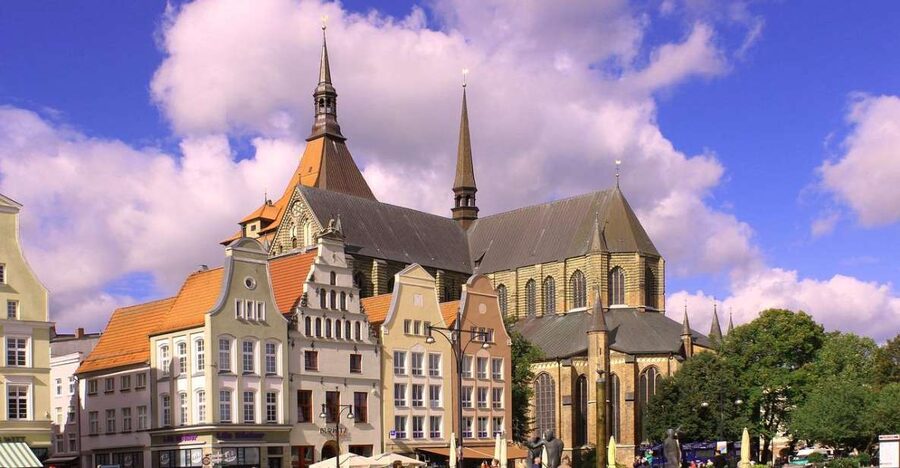
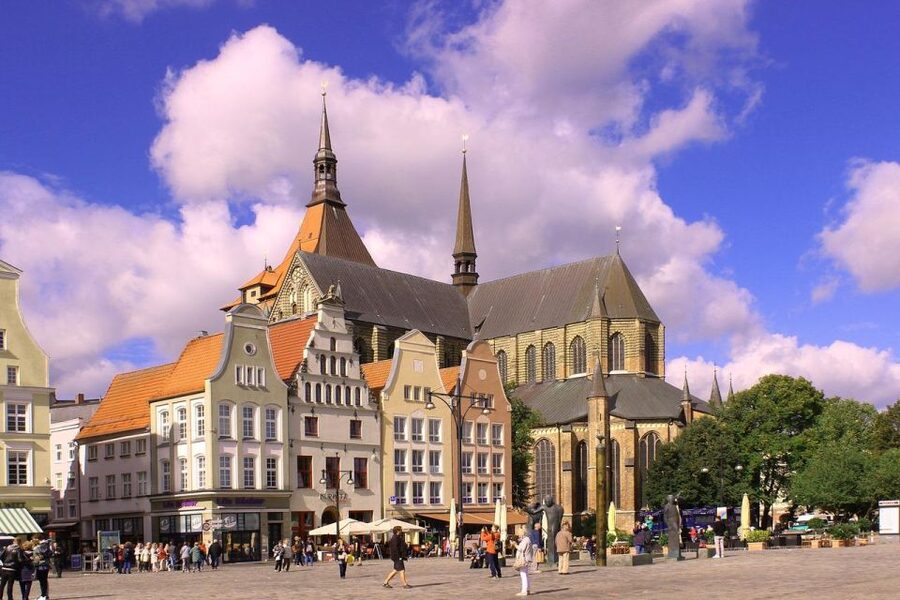
The tour begins at Seagulls’ Fountain in New Market Square, or Neuer Markt. This is a practical meeting point because it introduces several themes at once: public life, maritime identity, local legends, and Rostock’s historic center.
The fountain depicts Neptune, god of the sea, with his sons. Its subject fits Rostock well. The city grew through trade and shipping, and the fountain gives your guide an easy way to explain why the Baltic mattered to the city’s fortunes.
Look around the square before the walking begins. The Town Hall occupies the main visual role, and its mixture of Baroque and Gothic design tells you that Rostock was not built in one neat period. The building has seven towers, an unusual detail that helps you recognize it later in photographs.
A square like this is more than a pretty starting point. It lets you see the relationship between civic power, religion, and commerce. Rostock’s central buildings were designed to make the city’s importance visible, and the tour begins right in that public setting.
The Town Hall and Rostock’s Hanseatic power
The Town Hall is one of the tour’s clearest architectural highlights. Its Baroque and Gothic elements reflect changes over time, while the seven towers give it an unmistakable profile.
Your guide also explains Rostock’s role in the Hanseatic League. This network of trading cities shaped business across northern Europe, and Rostock’s position on the Baltic made it an important participant. The point is not only that merchants traded here. The Hanseatic connection helps explain why the city developed strong civic buildings, churches, walls, and gateways.
You will also hear about the origins of Rostock’s name and the city’s wider historical importance. That background gives the stonework a purpose. A gate is no longer just an old gate. A square becomes a place where trade, government, and public ceremony met.
The Town Hall is primarily an exterior stop in the supplied program. Entrance fees are not included, so ask your guide what can be visited inside during your time. If you want a detailed look at interior rooms, make that clear when the tour begins. With only two hours, time spent indoors can reduce the number of outdoor landmarks you see.
St. Mary’s Church and its remarkable clock
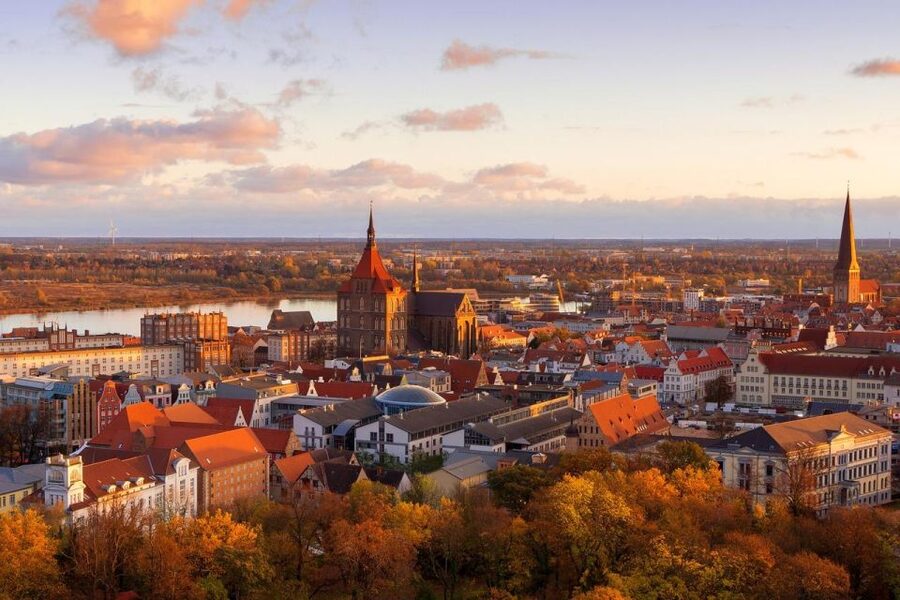
St. Mary’s Church is likely the most memorable stop for many people. It was the only main Rostock church to survive the WWII air raids, and it contains a famous astronomical clock built in the 15th century.
The clock is valuable not simply because it is old. An astronomical clock reflects how people once tracked time, calendars, and the movement of the heavens in a public religious setting. It connects scientific skill, faith, and civic pride in one object.
This is also where Rostock’s wartime story becomes especially clear. St. Mary’s survived, while much of the city had to face destruction and rebuilding. You can see how one surviving structure carries a physical link to the earlier city.
If the church is open and you want to go inside, remember that admission is not part of the tour price. The walking tour gives you the setting and explanation, but any entrance costs are separate. Ask about the clock early if it is your priority, since the guide may be able to shape the route around it.
Same city, a completely different kind of day:
- Rostock: Guided tour of the historic city center
★ 4.5 · 311 reviews - Best Berlin Shore Excursion from Warnemunde or Rostock Port
★ 4.8 · 200 reviews - Rostock: Full-Day, Half-Day, or Sunset Sailing Experience
★ 4.7 · 174 reviews - Rostock: Electric Boat Rental on the Warnow River
★ 4.8 · 106 reviews
St. Petri Church and the rebuilt skyline
St. Petri Church offers a useful contrast with St. Mary’s. Its Gothic tower was a landmark for fishermen in the area, but the church was destroyed during WWII and rebuilt later.
That story gives you two versions of Rostock’s past. St. Mary’s shows survival. St. Petri shows loss, reconstruction, and the decision to restore a familiar landmark. Together, the churches help you understand that the present city is not simply an untouched medieval setting.
The tower’s connection with local fishermen also points back to Rostock’s maritime character. The city’s churches were not isolated religious buildings. Their towers helped people identify the city from the water and served as practical markers for those working along the coast.
The tour does not promise tower entry, and entrance fees are excluded. Treat the church as an architectural and historical stop unless your guide confirms that an interior visit fits the schedule.
Walking the surviving fortifications
Parts of Rostock’s old defenses still remain. You will see sections of the fortifications, ramparts with built-in guard houses, and part of the wooden wall walk.
These fragments are especially useful because they show how the city was protected and organized. A wall once marked the boundary between the urban center and the world outside. Guard houses and walkways reveal the practical side of medieval city life, far removed from the grand civic image presented by the Town Hall.
The surviving sections also carry the WWII story in a quieter way. Rostock’s center suffered major damage, yet portions of the older defensive line remain. The city’s past appears in pieces rather than as a single preserved block.
Do not expect a complete circuit of the fortifications. The description points to sections that remain, not a full wall walk. Still, these pieces can be more revealing than a perfectly restored structure because they show what endured and what had to be rebuilt.
Stone Gate and its message of civic pride
The Dutch Renaissance Stone Gate is another strong photo stop. Its motto is written on the walls: May harmony and prosperity reign within your walls.
The wording captures the ambition of a trading city. Prosperity was not an abstract idea in Rostock. It was tied to ships, markets, merchants, and the security of the town. The gate represented entry into a place that wanted visitors to see order, wealth, and shared purpose.
The Stone Gate also adds architectural variety to the route. After the mixed Gothic and Baroque Town Hall and the Gothic churches, its Dutch Renaissance design shows how outside influences reached Rostock through trade and cultural contact.
This is a spot where a guide adds real value. Without explanation, you might photograph the gate and move on. With the motto and the Hanseatic context, the building becomes a statement about the city’s goals.
The university and Fountain of Happiness
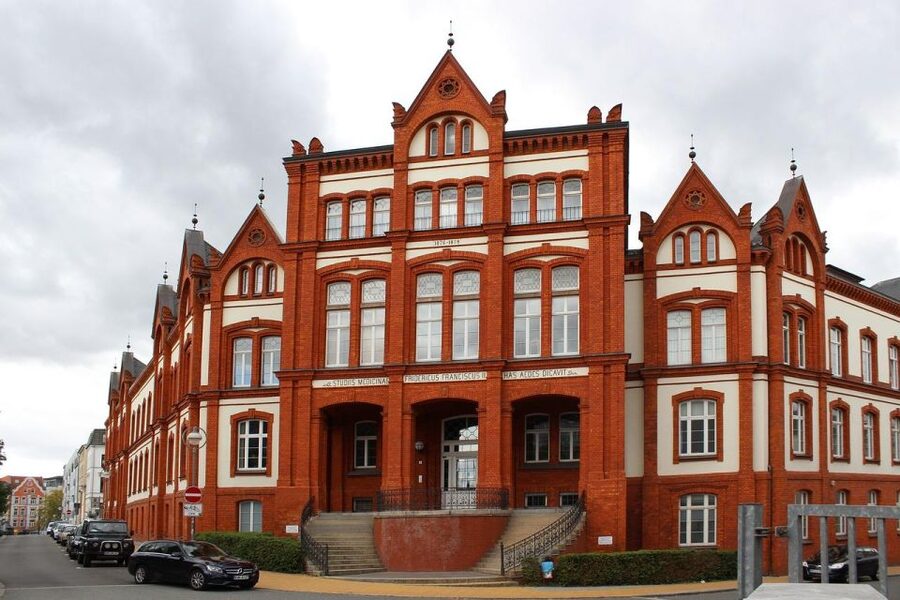
Rostock’s university dates from 1419 and is described as the oldest in the Baltic region. Its presence adds an intellectual side to a city often introduced through ships, merchants, and churches.
The university also helps explain why Rostock remains more than a port and historic center. Academic life has been part of the city for centuries, giving the place a connection to education and public thought.
The Fountain of Happiness provides a lighter stop on the route. After the serious subjects of war, destruction, and rebuilding, a fountain linked with happiness changes the mood. It also shows how public art can shape the way a city presents itself.
Ask your guide how the university fits into Rostock’s wider identity. Since the group is private, this is a good place to steer the conversation toward student life, architecture, or the city’s modern role if those subjects interest you.
WWII, destruction, and rebuilding
The tour does not treat Rostock as a frozen medieval town. WWII air raids are part of the central story, and the city’s recovery is presented as a major reason it looks the way it does today.
St. Mary’s survival and St. Petri’s destruction provide two clear examples, but the wider lesson concerns resilience. You will see a city where old landmarks, reconstructed buildings, and surviving fragments share the same streets.
This section may appeal most to visitors who want more than dates and decorative façades. Wartime history explains why some buildings are missing, why others were rebuilt, and why preservation in Rostock can mean both protecting original fabric and restoring a familiar outline.
The subject can also make the tour feel more balanced. You are not being shown only attractive squares and Gothic towers. You are being asked to understand the cost of the city’s past and the work required to bring its center back to life.
What the $280 private price really means
The price is $280 per group of up to 15 people. That is not a low price for a two-hour walk if you are booking for one or two people. For a larger family, reunion, cruise group, or organized party, the calculation changes quickly.
At the full 15-person limit, the cost works out to about $18.67 per person. With 10 people, it is $28 each. With four people, it is $70 each. The value depends heavily on group size and on how much you care about having a guide dedicated only to your party.
A private guide can answer questions, adjust the emphasis, and keep the pace suited to your group. That matters if you have mixed interests or do not want to follow a large public tour. It matters less if you mainly want a short orientation and are happy to explore on your own afterward.
The two-hour format also helps keep the cost in perspective. You are paying for a focused introduction, not a full-day historical program. Entrance fees are separate, so budget for those only if you plan to go inside sites during the walk.
Who will get the most from this walk
I would recommend this tour to first-time visitors who want Rostock explained rather than simply photographed. It suits people interested in Gothic architecture, maritime trade, Hanseatic history, university cities, and WWII reconstruction.
It is also a good fit for groups that value flexibility. Families can ask for a manageable pace. History-minded visitors can spend more time on wartime damage. Architecture fans can focus on the Town Hall, churches, Stone Gate, and fortifications.
The tour is less suitable if you want extensive interior visits or a slow study of every monument. Two hours passes quickly, and the main program covers many sights. You will gain breadth, but not a complete museum-style examination of each location.
Language choice is straightforward. The tour is offered in English or German, and the guide is local and professional. If your group has a strong preference, choose the language that lets you ask the most questions comfortably.
Practical advice for making the walk count
Arrive at Seagulls’ Fountain in New Market Square with your group ready to begin. The meeting point is specific: Neuer Markt, 18055 Rostock. Starting on time matters because the route includes several major stops in a short period.
Tell the guide your priorities at the outset. Ask to give extra attention to the astronomical clock, the WWII story, the university, or the city walls if one subject matters most. The tour allows possible customization on the spot, which is one of the best reasons to choose the private option.
Keep the price structure in mind before booking. A full group receives strong value. A small group may still appreciate the private attention, but the per-person cost is much higher than the headline figure suggests.
The cancellation policy is flexible: you can cancel up to 24 hours in advance for a full refund. You can also reserve now and pay later, which helps if your Rostock plans may shift.
Should you book Rostock’s private walking tour?
Book it if you want a concise, personal introduction to Rostock’s main historic sights, especially if you are traveling with a group. The combination of the Town Hall, St. Mary’s clock, St. Petri Church, Stone Gate, fortifications, and university gives you a clear picture of how trade, religion, war, and rebuilding shaped the city.
The strongest reasons are the private format and the range of subjects. You get more than a parade of attractive buildings, and you can guide the conversation toward your interests. Guide Jana was praised for sharing appealing insider details, so if she is assigned to your group, you may benefit from that same personal approach.
Skip it if you are a solo visitor focused on keeping costs low, or if you want long interior visits rather than a broad outdoor route. For everyone else, especially a group arriving by cruise or using Rostock as a Baltic base, this is a practical way to understand the city before exploring on your own.
FAQ
Where does the Rostock walking tour begin?
The meeting point is by Seagulls’ Fountain in New Market Square, Neuer Markt, 18055 Rostock.
How long does the tour last?
The walking tour lasts two hours.
Is this a private tour?
Yes. The tour is for a private group, with a local guide assigned only to your group.
How many people can join one booking?
The price covers a group of up to 15 people.
What languages are available?
The live tour guide can provide the experience in English or German.
Is the guide included in the price?
Yes. A local professional guide is included.
Are entrance fees included?
No. Entrance fees are not included in the tour price.
Can the tour be customized?
Possible customization with your local guide is available on the spot. You can discuss your interests and priorities during the tour.
What are the main sights on the route?
The tour includes New Market Square, the Town Hall, Seagulls’ Fountain, St. Mary’s Church and its astronomical clock, St. Petri Church, sections of the old fortifications, Stone Gate, the university, and the Fountain of Happiness.
Can I cancel for a full refund?
Yes. You can cancel up to 24 hours in advance for a full refund.
Can I reserve now and pay later?
Yes. The reserve-now, pay-later option lets you hold your plans without paying today.
Just added around Rostock
- Rostock: Tour with the Rostocker Executioner★ 4.7 · 28 reviews
- Rostock: Electric Boat Rental on the Warnow River★ 4.8 · 106 reviews
- Rostock: Hot Rod Harbor City Tour★ 4.9 · 16 reviews
- Rostock: Hot Rod Sightseeing Tour to Warnemünde★ 5.0 · 19 reviews
- Berlin and Sachsenhausen: Shore Trip from Warnemünde Port★ 4.8 · 40 reviews
- Distillery tour with guide!★ 4.7 · 14 reviews
- Discover Rostock: A Guided City Tour for Cruise Guests★ 3.7 · 7 reviews
- Brewery tour with guide!★ 4.8 · 13 reviews
Walking Tours, compared.





Berlin’s Best: 2 Hour Walking Tour Third Reich and the Cold War
Read our review →


Third Reich Berlin: Hitler and WWII Walking Tour
Read our review →Browse the lists this tour appears in