
Reviewed · WALKING TOURS
Frankfurt: Private or Shared Walking Tour
Frankfurt’s story makes the most sense when you see its old and new faces side by side. This 1.5-hour walk links the Römerberg, the rebuilt Neue Altstadt, and the modern towers, while explaining how war damage and later rebuilding changed the city.
I like the clear route from Eiserner Steg to the Römer and Paulskirche, and I like that you can choose a shared tour or a private outing. The main drawback is that the tour is conducted in German, so you’ll need a good command of the language to get the full value from the guide.
- Eiserner Steg dates to 1868, giving the walk an early look at Frankfurt’s riverfront history.
- The Neue Altstadt shows how Frankfurt recreated a historic-looking quarter in a very modern city.
- Paulskirche marks the site of the first German national assembly, an important stop in the country’s political story.
- Sanel has earned praise for detailed explanations, and one private group appreciated his flexibility with timing.
- The tour costs $17 per person, a modest price for a focused introduction to central Frankfurt.
- You return to the Justitia-Brunnen, so there is no complicated end point to find.
In This Review
- Frankfurt in 90 Minutes: Old Stones and New Towers
- Meeting Justice at the Justitia-Brunnen
- Crossing the Eiserner Steg, Built in 1868
- The Römer and Frankfurt’s Civic Center
- Paulskirche and the First German National Assembly
- The Neue Altstadt: A New Quarter With an Old Look
- Reading Frankfurt’s World War II Story
- What the Guide Adds to the Walk
- Is $17 a Fair Price?
- Who Will Get the Most From This Tour?
- Booking Flexibility for Changing Plans
- Should You Book the Frankfurt Walking Tour?
- FAQ
- How long does the Frankfurt walking tour last?
- Where does the tour start?
- Where does the tour end?
- Is the tour shared or private?
- What language is the tour conducted in?
- What sights are included on the walking route?
- How much does the tour cost?
- Can I cancel the booking?
- Can I reserve now and pay later?
Frankfurt in 90 Minutes: Old Stones and New Towers
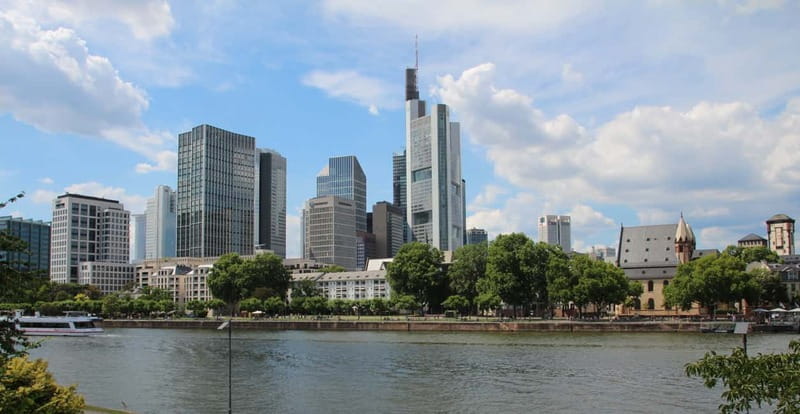
Frankfurt can look like two different cities. One side is made up of financial towers, glass facades, and busy streets. The other centers on old-looking squares, churches, bridges, and reconstructed buildings.
This walking tour makes that contrast the main theme. Rather than showing you only a postcard version of Frankfurt, it explains why so much of the old center is reconstructed and how the city’s modern identity grew around it.
You begin at the Justitia-Brunnen on Römerberg. From there, the route moves through some of the city center’s most important sights before returning to the same meeting point. That simple arrangement works well if you have limited time or need to stay near the historic core.
At $17 per person, the tour offers good value as an orientation walk. You are paying for a guide who can connect the buildings and dates, not for entrance tickets or a long museum visit. If you want a broad introduction before exploring on your own, 90 minutes is a useful amount of time.
Meeting Justice at the Justitia-Brunnen
The Justitia-Brunnen is your starting point on Römerberg. Meeting at a recognizable statue makes the first few minutes easier, especially in a city center where several streets and squares come together.
Römerberg is an appropriate place to begin because it puts Frankfurt’s civic history right under your feet. The square leads naturally toward the Römer, Paulskirche, and Neue Altstadt, so the tour does not waste time getting to its main subject.
I would arrive a little early. The meeting point is clear, but central squares can be busy, and finding the guide is easier when you are not rushing in at the scheduled start time.
The tour ends back at the Justitia-Brunnen. That is useful for planning a meal, another museum visit, or a walk along the Main River afterward. You do not need to learn a new address or arrange transport back from an unfamiliar neighborhood.
A few more Frankfurt trips to weigh up
- Frankfurt Highlights English Walking Tour
★ 5.0 · 1,203 reviews - Frankfurt on Foot Daily Walking Tour in English
★ 4.9 · 323 reviews - Frankfurt Self-Guided Historical Walking Tour
★ 4.0 · 58 reviews
Crossing the Eiserner Steg, Built in 1868
One of the early highlights is the Eiserner Steg, Frankfurt’s iron footbridge. Built in 1868, it offers a practical way to think about the city’s connection to the Main and its growth during the industrial age.
The bridge is more than a crossing. It gives the tour a change of view and helps place the historic center within the wider city. From here, you can better appreciate the contrast between older buildings and Frankfurt’s taller modern structures.
The tour uses the bridge as part of a story about change. Frankfurt’s old buildings were not simply preserved untouched. Many grand structures were destroyed during World War II, and the city later had to decide what to rebuild, what to alter, and what to leave modern.
That context matters. Without it, a reconstructed old quarter can look like a collection of pretty facades. With an explanation of the war damage and later projects, you can read the city with more care.
The bridge itself may be less comfortable in poor weather than a sheltered attraction. The walk is outdoors, and a rainy day can make the footing and the views less pleasant. Still, one private tour continued on a rainy evening, and the guide adjusted the timing to suit the group.
The Römer and Frankfurt’s Civic Center
The Römer is one of Frankfurt’s key historic sights and one of the clearest symbols of the city’s civic life. On this tour, you see it as part of the larger story of the old town rather than as an isolated photo stop.
Your guide provides information about the attractions along the route, so you can expect explanation rather than a silent walk between landmarks. The value here is the connection between the square, the historic buildings, and the city’s repeated rebuilding.
The Römer area also shows why Frankfurt can feel visually confusing at first. Traditional-looking buildings sit close to modern streets and towers. That mixture is not accidental. It reflects a city that has repeatedly adapted to destruction, reconstruction, commerce, and modern urban needs.
Do not expect a long indoor visit to the Römer. The experience is a guided outdoor tour, and the emphasis is on seeing the important places and understanding their role. If you want detailed access inside every building, you will need separate time after the walk.
Paulskirche and the First German National Assembly
Paulskirche is one of the most important stops for understanding Frankfurt’s place in German political history. The church hosted the first German national assembly, making it more than another attractive building in the old center.
A visit here helps broaden the tour beyond architecture. Frankfurt was not only a trading and financial city. It also played a role in the country’s political development, and Paulskirche is the clearest reminder of that role on this route.
Your guide explains the significance of the building as part of the walk. That is particularly helpful if German political history is unfamiliar to you. The stop gives the tour a stronger sense of purpose, since you are learning about civic ideas as well as seeing old buildings.
As with the Römer, the information provided is part of a walking route. The supplied details do not promise an extended interior visit or a separate museum presentation, so plan on viewing Paulskirche from the tour route unless your guide explains otherwise.
Same city, a completely different kind of day:
- Frankfurt: River Main Sightseeing Cruise with Commentary
★ 4.3 · 5,127 reviews - Frankfurt: Hop-On, Hop-Off Grand or Express Bus Ticket
★ 3.9 · 2,088 reviews - Frankfurt: 1-Hour Panorama Boat Cruise on the river Main
★ 4.4 · 1,822 reviews - From Frankfurt: Rhine Valley Day Trip
★ 4.4 · 1,317 reviews
The Neue Altstadt: A New Quarter With an Old Look
The Neue Altstadt is the city’s latest major old-town project and one of the tour’s most interesting subjects. The name means New Old Town, which sounds like a contradiction until you learn that this is a modern reconstruction project designed to restore the feel of part of Frankfurt’s historic center.
The guide discusses the renovation of 2008 and 2009 as part of the city’s rebuilding story. That gives you a useful way to judge the quarter for yourself. You can look at its traditional forms while keeping in mind that the district is not simply an untouched survival from the past.
I like this part of the tour because it raises a question many historic European cities face: how do you bring back a lost urban center without pretending that nothing changed? Frankfurt’s answer combines historic references with the needs of a modern city.
You may find the Neue Altstadt especially useful if you are interested in architecture, city planning, or postwar Europe. It is also a good stop for anyone who wants attractive old-town views without assuming that every old-looking building is original.
The short format means you will not study every building in detail. Instead, you get the main idea, the timing of the project, and a framework for looking more closely after the guide leaves.
Reading Frankfurt’s World War II Story
The tour’s discussion of World War II destruction is one of its most useful elements. Frankfurt’s historic center suffered major damage, and the buildings you see today reflect choices made after the war as well as older traditions.
That distinction is important for your expectations. A rebuilt building can still be meaningful, but its meaning is different from that of a structure that survived centuries without major interruption.
The guide helps you separate those layers. You learn how grand buildings were destroyed, how the old center changed, and how later renovation shaped the city you see now. This turns a simple sightseeing walk into a lesson in how cities remember and rebuild.
I would pay close attention during this part, even if architecture is not your main interest. It explains why Frankfurt’s old town does not have the same uninterrupted feel as some other German historic centers.
The story also makes the modern skyline easier to understand. Frankfurt’s towers are not merely a backdrop. They are part of the city’s continuing push toward a modern identity, set against a center that has been repaired and reimagined.
What the Guide Adds to the Walk
A short city tour rises or falls on the guide. The route itself is straightforward, but the value comes from the links between the stops.
The available guide language is German. That is the most important practical point before booking. If you understand German well, you can expect a more detailed and personal introduction to Frankfurt. If you do not, the commentary will be difficult to follow, even though the sights are easy to recognize.
Sanel is specifically praised for giving an in-depth look at Frankfurt’s history. One private group also appreciated his flexibility with the timing and his ability to make a shortened tour work on a rainy evening. Those details suggest that a private booking can be useful if your schedule is unusual or your group wants a more tailored pace.
The tour has a strong local feel because it is not limited to famous names and quick photographs. It explains the city’s rebuilding, political history, and changing appearance. That is the kind of information that helps you make sense of Frankfurt after the walk.
If you choose the shared option, the experience is likely to be less tailored than a private tour. The provided details do not give a maximum group size, so you should not book expecting a guaranteed small group. Choose private if personal timing and direct conversation matter more to you than the lower shared-tour cost.
Is $17 a Fair Price?
At $17 per person, this is a reasonably priced way to get your bearings in central Frankfurt. The walk lasts 1.5 hours and includes a live guide, so the cost is not simply for access to a route.
You receive no stated entrance tickets, meals, or transport. That is not a weakness for this type of activity. The main sights are experienced from the streets and squares, and the point is to understand the city rather than spend the afternoon inside one attraction.
The shared option is the better value for solo visitors and couples who want a short introduction. A private group can make more sense for families, friends, or anyone who wants to ask many questions about Frankfurt’s past and rebuilding.
The tour is also useful early in a city visit. After the walk, you will have a clearer idea of where the Römerberg, Paulskirche, Neue Altstadt, and Eiserner Steg fit together. You can then decide which places deserve a longer return visit.
Who Will Get the Most From This Tour?
I would recommend this walk to first-time visitors who want a compact introduction to Frankfurt. It is also a good match for people with only a short stay, since the route covers major central sights in 90 minutes.
History-minded visitors should appreciate the focus on World War II destruction, reconstruction, and Paulskirche’s political importance. Architecture fans will find the contrast between the Neue Altstadt and modern towers particularly useful.
The tour also suits anyone who prefers to learn through a local explanation rather than read guidebook panels alone. The guide supplies the connections, while you see the buildings in their city setting.
I would hesitate to book it if you need an English-language tour. The stated tour language is German, and that is a firm practical consideration. I would also choose another activity if you want extended indoor sightseeing, since this is a focused outdoor walk.
Wear comfortable shoes and prepare for the weather. The route includes the Eiserner Steg and open city streets, and a rainy evening can affect the experience even when the guide is flexible.
Booking Flexibility for Changing Plans
You can cancel up to 24 hours before the activity for a full refund. You can also reserve now and pay later, which helps if your Frankfurt plans are still shifting.
The duration is fixed at 1.5 hours, but you need to check availability for the actual starting times. That makes it wise to confirm the schedule before arranging a meal, train, or museum visit around the tour.
The meeting and return point are both at the Justitia-Brunnen on Römerberg. This keeps the logistics simple and makes the activity easy to fit into a day of central Frankfurt sightseeing.
Should You Book the Frankfurt Walking Tour?
Book this tour if you want a short, affordable explanation of Frankfurt’s old town, reconstruction, and political past, and if you can follow German. The route covers the Eiserner Steg, Römer, Paulskirche, Neue Altstadt, and the city’s modern contrast without taking up half your day.
Choose the private option if you value flexible timing or want a more direct conversation with the guide. Sanel’s detailed approach and willingness to adjust timing are useful examples of what a private format can offer.
Skip it if you need English commentary or hope to spend substantial time inside the sights. For everyone else, the $17 price makes this a sensible first look at a city that is easiest to understand when you see its rebuilt old center and modern skyline together.
FAQ
How long does the Frankfurt walking tour last?
The tour lasts 1.5 hours.
Where does the tour start?
The tour starts at the Justitia-Brunnen on Römerberg.
Where does the tour end?
The activity ends back at the Justitia-Brunnen, the same place where it starts.
Is the tour shared or private?
You can choose a shared walking tour or a private group, depending on the option selected.
What language is the tour conducted in?
The live tour guide speaks German.
What sights are included on the walking route?
The route includes the Eiserner Steg, the Römer, Paulskirche, and the Neue Altstadt. It also explains Frankfurt’s modern buildings, World War II destruction, and later rebuilding.
How much does the tour cost?
The listed price is $17 per person.
Can I cancel the booking?
Yes. You can cancel up to 24 hours in advance for a full refund.
Can I reserve now and pay later?
Yes. You can reserve your spot and pay nothing at the time of booking.
Just added around Frankfurt
- Day Trip to Rothenburg from Frankfurt★ 4.6 · 25 reviews
- Rhine Valley: Half Day Tour from Frankfurt★ 3.7 · 66 reviews
- Private Tour with Native English speaking Local★ 4.9 · 60 reviews
- Hohenzollern Castle: Full-Day Tour from Frankfurt★ 4.3 · 11 reviews
- From Frankfurt: Day Tour to Heidelberg with Local Guide★ 4.8 · 250 reviews
- Heidelberg and Rhine Combination Tour from Frankfurt★ 4.1 · 33 reviews
- Frankfurt: Guided walk between palm trees and skyline★ 4.8 · 9 reviews
- From Frankfurt: Heidelberg and Rothenburg Guided Day Trip★ 5.0 · 14 reviews
Walking Tours, compared.





Berlin’s Best: 2 Hour Walking Tour Third Reich and the Cold War
Read our review →


Third Reich Berlin: Hitler and WWII Walking Tour
Read our review →Browse the lists this tour appears in