
Reviewed · HISTORICAL TOURS
Lübeck: Private Historical and Architectural Walking Tour
Lübeck’s story comes alive through its Gothic brick buildings, old merchants’ streets, and the sweet surprise of freshly baked marzipan. I like the way this private walk links grand sights such as Holsten Gate and St. Mary’s Church with smaller details, including the little devil outside the church and the city’s trading ties across the Baltic Sea.
I also like the private format and compact 90-minute length. You get a guide focused on your group, and the tour fits neatly into a port call or a short stay. The main drawback is pace: with so much packed into an hour and a half, you will see the major landmarks but may not have much time to linger or enter them. The walk also is not suitable for wheelchair users or people with mobility impairments.
In This Review
- Key points at a glance
- Starting at Holsten Gate in Lübeck
- Lübeck’s brick skyline and merchant wealth
- Buddenbrook House and the Mann family
- St. Mary’s Church and the little devil
- The marzipan stop adds a taste of Lübeck
- Lübeck Town Hall closes the route
- What the private format is worth
- Walking conditions and who should book
- Practical booking details
- Should you book this Lübeck walk?
- FAQ
- How long does the Lübeck walking tour last?
- How much does the private tour cost?
- Where do I meet the guide?
- What languages are available?
- Are entry tickets included?
- Is marzipan included in the experience?
- Is the tour suitable for wheelchair users?
Key points at a glance
- Holsten Gate from 1464: Begin beside Lübeck’s most famous medieval fortification, a brick gateway linked with freedom and the city’s old defenses.
- Five church towers in one view: Look across the skyline toward Lübeck’s celebrated spires, salt storehouses, and merchant-built brick homes.
- Buddenbrook House and the Mann brothers: Follow the Lübeck setting associated with writers Thomas Mann and Heinrich Mann.
- St. Mary’s Church and its small devil: Hear the local tale tied to the church before considering its place among Germany’s largest brick Gothic churches.
- Fresh marzipan tasting: Sample different varieties at a traditional bakery while learning why this almond-and-sugar sweet matters to Lübeck.
- Private value for groups: At $265 for up to 15 people, the cost works best when several people share the booking.
Starting at Holsten Gate in Lübeck
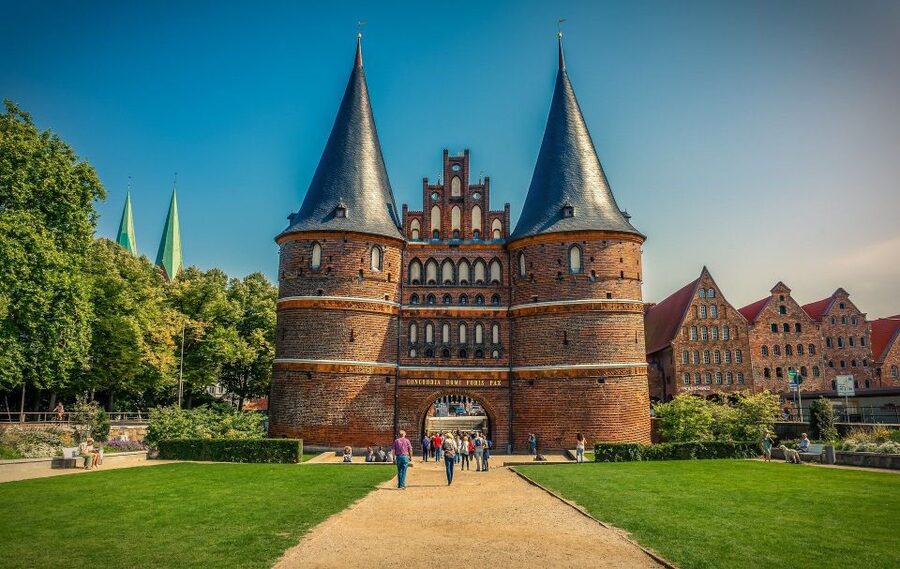
Your meeting point is in front of Holsten Gate, near Museum Holstentor. This is a useful place to begin because the gate gives you an instant sense of Lübeck’s past before the walking even starts.
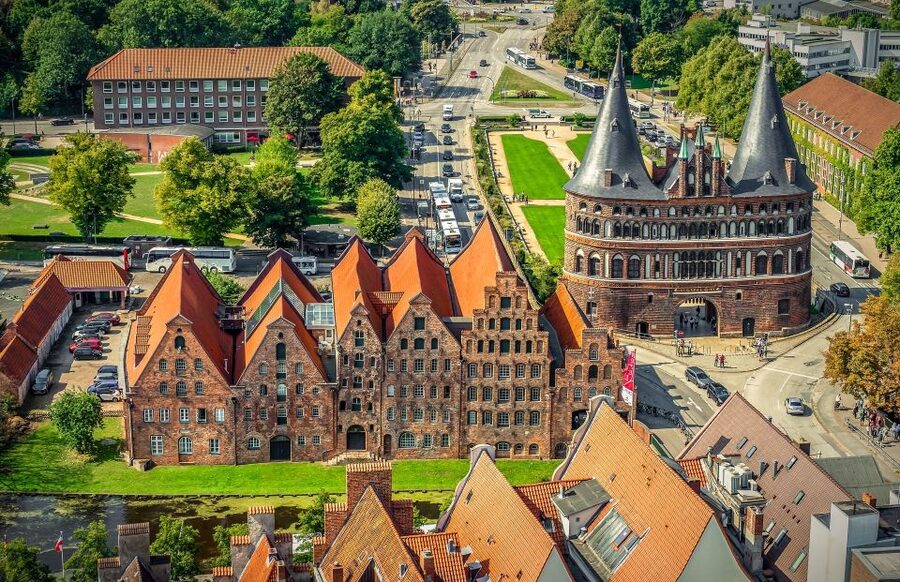
Built in 1464, Holsten Gate is one of the last remaining Gothic pieces of the city’s medieval fortifications. It is also one of only two surviving city gates. Its heavy brick form makes a strong first impression, and your guide uses it to explain how Lübeck protected and presented itself during its powerful trading years.
The gate was built to symbolize freedom, a fitting idea for a city whose fortunes grew through movement and commerce. You are not just looking at a photogenic entrance. You are seeing a surviving part of a defensive system that once marked the edge of the city.
I recommend arriving a few minutes early. The meeting point is clear, but one practical criticism from the tour feedback is worth noting: the guide may not always be easy to identify at once. Look for the person leading a private walking group, and if needed, confirm the tour at the gate.
A few more Lubeck trips to weigh up
- Lübeck: Hanseatic League History Walking Tour
★ 4.9 · 57 reviews - Leipzig: City History Canal Sightseeing Tour on a Motorboat
★ 4.7 · 6,232 reviews - Berlin: Natural History Museum Entrance Ticket
★ 4.6 · 3,382 reviews
Lübeck’s brick skyline and merchant wealth
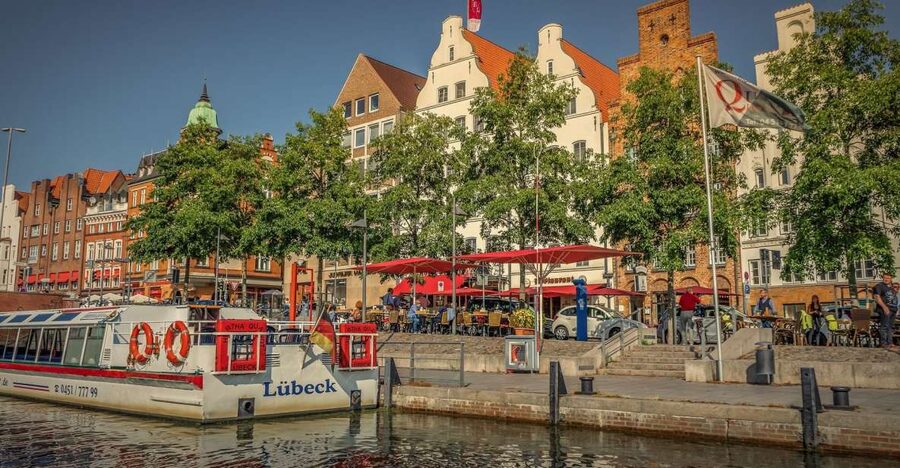
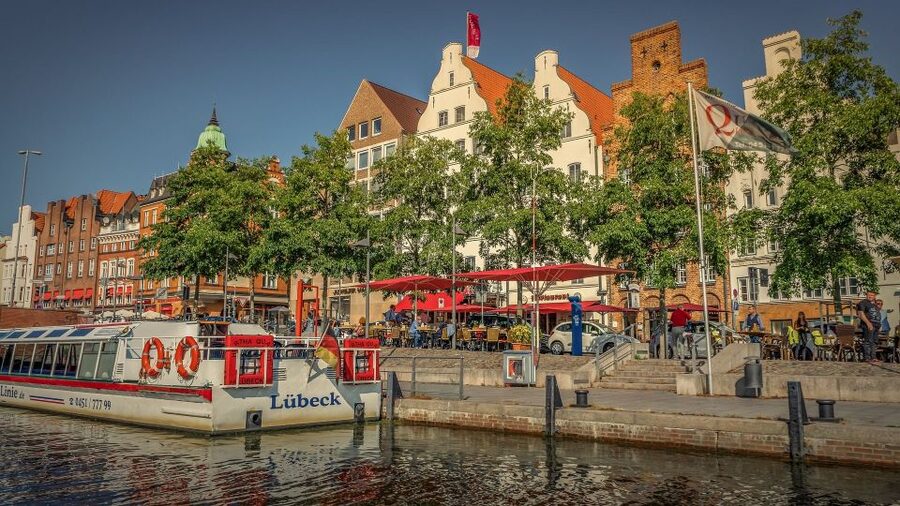
From Holsten Gate, the walk continues into the historic center. Lübeck is often called the City of Seven Spires, and the skyline helps explain why. From suitable viewpoints along the route, you can see five churches, salt storehouses, and tall brick homes once built for prosperous merchants.
This is one of the tour’s most useful sections because it connects architecture with economics. Lübeck’s position beside the Baltic Sea placed it on important trading routes. Goods moved through the region, and successful merchants put their money into homes, warehouses, public buildings, and churches.
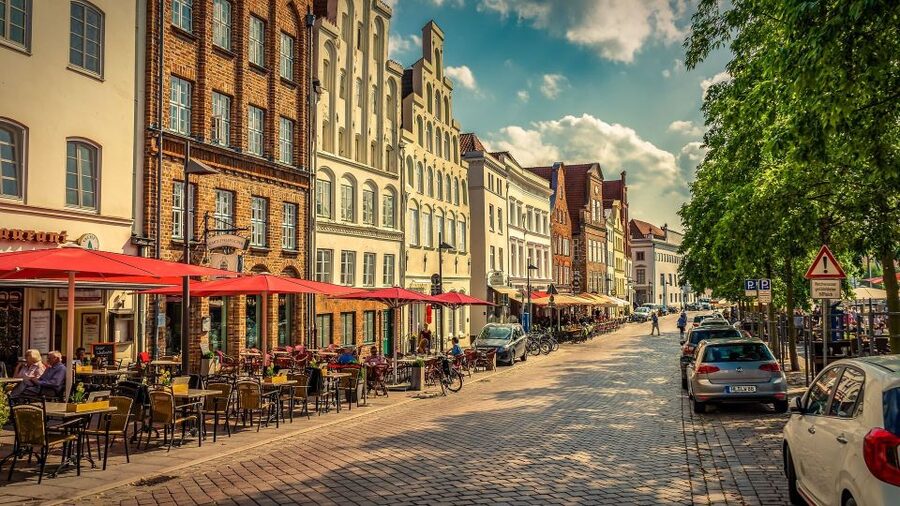
The city’s brick style is especially important. Stone was not always readily available in northern Europe, but fired brick could be produced and used on a grand scale. The result is a city center with a strong, unified look: red and dark brick walls, narrow streets, church towers, and large merchant houses.
You will also hear about the Merchants’ Quarter near St. Mary’s Church. The point is not simply to admire old façades. Your guide helps you read them as signs of wealth, trade, status, and civic ambition.
Some of the luxurious brick homes mentioned on the walk date from the late 1700s. They add another layer to Lübeck’s story, showing that the city continued to change after its medieval peak. I like this contrast. The tour does not treat Lübeck as a frozen medieval display. It shows how the city’s buildings reflect different periods of prosperity.
Buddenbrook House and the Mann family
The stop at Buddenbrook House brings literature into the walk. Here you learn about German writers Thomas Mann and Heinrich Mann, whose family is closely tied to Lübeck and whose names are central to the building’s identity.
The house is especially meaningful if you know Thomas Mann’s novel Buddenbrooks, which follows the decline of a merchant family. Even if you have not read it, the stop gives you a human angle on Lübeck’s merchant world. The grand houses, business families, and social expectations seen in the old town become more than background scenery.
The tour focuses on the Mann brothers and the connection between literature and place. That makes this stop different from a standard architecture walk. You are encouraged to picture Lübeck not only as a trading city, but also as a setting that shaped writers and their work.
Entry tickets are not included, so check the arrangement before you go if you want to see the interior. The supplied tour details promise information about Buddenbrook House, but they do not state that admission is included. In a 90-minute route, the stop may work mainly as an exterior and neighborhood visit unless your guide says otherwise.
St. Mary’s Church and the little devil
St. Mary’s Church is one of the route’s major landmarks. It is described as the third-largest brick Gothic church in Germany, which gives you a clear sense of its scale and importance.
The church also helps explain how Lübeck’s merchants displayed civic pride. Large churches required money, labor, and long-term support. Their size reflects the wealth and ambition of the city’s leading families and institutions.
Your guide also tells the story of a little devil located outside the church. This small figure offers a welcome change of pace after the larger facts about trade, architecture, and religion. It is the sort of detail you could easily walk past without help, and it gives the stop a bit of local character.
Because the tour lasts only 90 minutes, do not assume you will have a long interior visit. The supplied details promise an explanation of the church and its nearby setting, but they do not list church admission as included. If entering St. Mary’s is important to you, ask your guide how much time is available and whether an entry ticket is needed.
Same city, a completely different kind of day:
- Lübeck: 1-Hour Splash Bus City Tour
★ 4.0 · 2,626 reviews - Lübeck: entertaining guided tour to old town highlights
★ 4.7 · 594 reviews - Lübeck: Entertaining Tour Through Hidden Courtyards
★ 4.8 · 483 reviews - Lübeck: Electric Boat Rental – without driving licence
★ 4.8 · 174 reviews
The marzipan stop adds a taste of Lübeck
The marzipan tasting is the most playful part of the route. At a traditional bakery, you sample freshly baked marzipan and different varieties while learning about the sweet’s importance to Lübeck.
This stop works well because it gives you something concrete to remember. Architecture can blur together during a city walk, but a taste tied to local culture tends to stay with you. Marzipan also connects daily life with the city’s trading past, since the sweet’s ingredients and popularity are part of a wider story of commerce and food.
Do not treat the tasting as a full meal. It is a sample stop within a walking tour, not a food tour. If you have a strong almond allergy or dietary restriction, check with the provider before booking, since the tour specifically includes marzipan tasting.
I like the balance here. You spend time looking at churches, gates, and public buildings, then pause for a local specialty. The bakery stop also gives the guide a chance to explain why marzipan has such a strong place in Lübeck’s identity rather than simply handing you a piece of candy.
Lübeck Town Hall closes the route
The final major stop is Lübeck’s Town Hall, regarded as one of Germany’s most beautiful town halls. It sits within the city’s UNESCO World Heritage setting, where public buildings, churches, merchant houses, and streets work together as one historic urban center.
A town hall is a fitting place to end because it brings the earlier themes together. Lübeck’s wealth came through trade, but trade needed rules, officials, civic structures, and public authority. The Town Hall reflects the city’s political and commercial importance.
The UNESCO designation is not just a label for individual buildings. It recognizes Lübeck’s historic center and its unusual collection of medieval and later brick architecture. During the walk, you get a practical explanation of why the city earned that status rather than simply hearing that it has it.
The route ends after about 90 minutes. You should have a solid orientation to the old town, along with several places to revisit on your own. You will not get a full museum program or a detailed interior tour of every landmark, but that is not the aim. This is an introduction that helps you decide what deserves more of your time.
What the private format is worth
The price is $265 per group of up to 15 people. That is not a low-cost individual tour, but the calculation changes if you are traveling with family or friends. At the full group limit, the price works out to about $18 per person. For two people, it is much closer to $132.50 each.
That makes the tour best suited to a group that values a guide’s attention and wants to set its own pace within a fixed route. A private guide can explain the buildings in relation to your interests, answer questions, and avoid the more impersonal feel of a large public group.
The 90-minute length also has value. You can fit it into a half-day plan, and it is short enough for people who prefer not to spend several hours walking. On the other hand, the short schedule means you should not expect long stops, extensive interiors, or a relaxed café break.
The strongest praise for this experience focuses on the guide’s command of Lübeck. One German-language assessment describes a female guide as someone who had lived and breathed the city and seemed to know every brick. That is exactly the quality you want on a walk through a place where the details matter more than the big sights alone.
Another assessment calls the guide kind and competent, but points out that she could have made herself easier to recognize at the meeting point. That is a small issue, but it is useful advice. Confirm the meeting details and arrive at the front of Holsten Gate rather than wandering around the museum area.
The overall rating is 4.5 from six reviews, including perfect scores from recent bookings. That is a positive signal, though the sample is small. I would place more weight on the repeated praise for the guide’s ability to make Lübeck understandable than on the rating alone.
Walking conditions and who should book
Wear comfortable shoes and comfortable clothing. The route follows cobbled streets in the historic center, so supportive footwear matters more here than fashion. You will be on foot for the full 90 minutes, with no transport included.
The experience is not suitable for wheelchair users or people with mobility impairments. The city’s historic streets and the walking format are important factors, so consider another way to see Lübeck if uneven surfaces or sustained walking are difficult for you.
I would recommend this tour to:
- First-time visitors who want a clear introduction to Lübeck
- Small groups who want a private guide rather than a large shared tour
- Readers interested in architecture, Baltic Sea trade, or German literature
- People who enjoy local food details as part of a sightseeing walk
- Cruise or short-stay visitors with only a limited amount of time
I would be more cautious if you want extensive museum interiors, a slow photography walk, or a food-focused experience. You may also find the route too brisk if you prefer to spend a long time at each church or house.
The live tour is offered in English or German. When booking, choose the language that lets you ask questions easily. The value of this walk comes from the explanations, and you should not settle for a language in which you can only follow the broad outline.
Practical booking details
The tour is provided by Travmonde OÜ and operates as a private group experience. The meeting point is in front of Holsten Gate near Museum Holstentor.
Entry tickets are not included. The experience includes the private guide and the tour itself, while admission to sights is separate if you choose to enter them. Ask about interiors before the walk begins, especially at Buddenbrook House and St. Mary’s Church.
You can cancel up to 24 hours before the tour for a full refund, and the reserve-now, pay-later option lets you keep your plans flexible. Starting times vary, so check availability for the date you want.
Should you book this Lübeck walk?
Book it if you want Lübeck explained through its buildings, people, trade, and food in one compact route. The private format is particularly good for a family or group of friends, since the $265 fee can be reasonable when divided among several people.
The best reason to choose it is the guide’s reported ability to make the city feel personal, down to individual bricks and small stories. The marzipan tasting, little devil outside St. Mary’s, and Mann family connection keep the route from becoming a string of church façades.
Skip it if you need step-free access, want a long museum visit, or prefer to explore without a fixed pace. For most able-bodied visitors with 90 minutes to spare, this is a practical first look at Lübeck, with enough substance to guide the rest of your time in the old town.
FAQ
How long does the Lübeck walking tour last?
The tour lasts 90 minutes.
How much does the private tour cost?
The price is $265 per group of up to 15 people.
Where do I meet the guide?
Meet in front of Holsten Gate near Museum Holstentor.
What languages are available?
The live guide is available in English or German.
Are entry tickets included?
No. Entry tickets are not included in the tour price.
Is marzipan included in the experience?
Yes. The route includes a stop at a traditional marzipan bakery where you can taste different varieties and learn about the sweet’s significance.
Is the tour suitable for wheelchair users?
No. The experience is not suitable for wheelchair users or people with mobility impairments. Comfortable shoes and clothing are recommended.
Just added around Lubeck
- Lübeck zwischen Grusel und Geschichte Truecrime zu Halloween★ 4.9 · 35 reviews
- Lübeck: Old Town Highlights Private Walking Tour★ 4.8 · 8 reviews
- Lübeck Day Pass – Day ticket for Lübeck museums★ 4.0 · 15 reviews
- Lübeck: Express Walk with a Local★ 4.9 · 10 reviews
- Lübeck: Hanseatic League History Walking Tour★ 4.9 · 57 reviews
- Lübeck: Classic Tour of the Hanseatic City★ 4.8 · 64 reviews
- Lübeck: Backyards and Town Houses Private Guided Tour★ 4.9 · 23 reviews
- Lübeck: Architecture and Local Craft Private Guided Tour★ 4.0 · 6 reviews
Historical Tours, compared.

City History Canal Sightseeing Tour on a Motorboat
Read our review →






Browse the lists this tour appears in