
Reviewed · OLD TOWN WALKING TOURS
Lübeck: entertaining guided tour to old town highlights
Lübeck’s story begins at the Holstentor, the proud brick gate beside the city’s famous seven-towered skyline. From there, this 1.5-hour walk leads you through the old town’s key sights, medieval passageways, and abbey courtyards while a German-speaking guide explains how this Hanseatic city took shape. I like the clear route and the mix of solid history with amusing local details. I also like that the walk includes small corners many visitors might miss, not just the big monuments.
The main drawback is group size. Recent departures have reached roughly 29 or 30 people, and that can make it hard to hear the guide or see what is being discussed. At $16 per person, the tour offers good value for a first look at Lübeck, but you should be comfortable with a busy walking group.
In This Review
- Key points at a glance
- Starting at the Holstentor and Lübeck’s seven towers
- Walking through the brick-built old town
- St. Peter’s Church and the city from above
- Lübeck’s town hall and civic power
- St. Mary’s Church and Lübeck’s church skyline
- Medieval corridors and abbey courtyards
- A German-speaking guide with a lively style
- The group-size problem at about 30 people
- What to expect during the 90 minutes
- Who gets the best value from this Lübeck tour?
- Should you book the Lübeck old town tour?
- FAQ
- Where does the Lübeck walking tour meet?
- How long does the tour last?
- What language is the tour conducted in?
- Which sights are included?
- How much does the tour cost?
- Can I cancel the tour and receive a refund?
Key points at a glance
- Start beside the Holstentor: Meet on the park side of Lübeck’s famous gate, an easy landmark in the center of the city.
- See the old town essentials: The route covers the Holstentor, St. Peter’s Church, the town hall, and St. Mary’s Church.
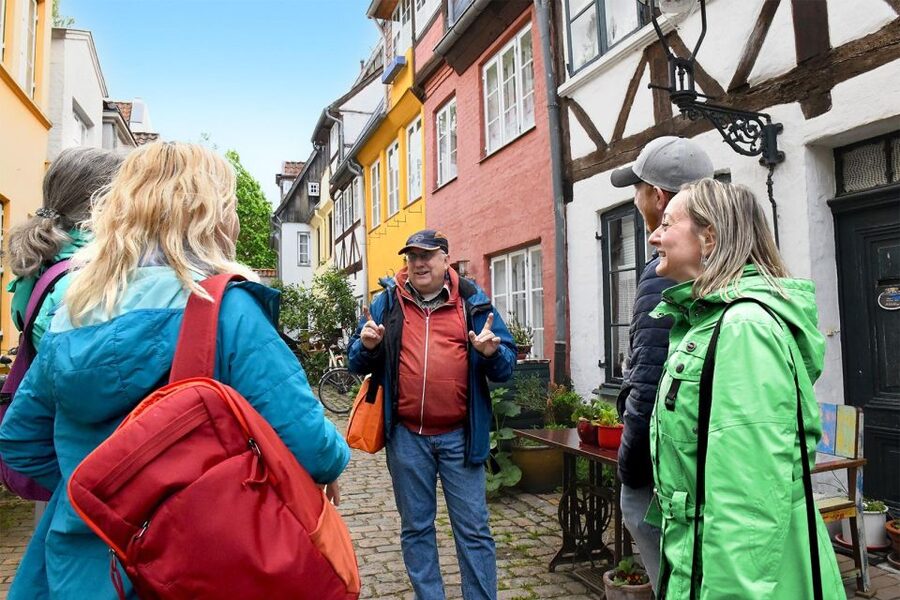
- Look beyond the main squares: Medieval corridors and abbey courtyards add quieter, more intimate views of Lübeck.
- Expect history with humor: The guide balances dates and city background with witty anecdotes and small details.
- German only: The live tour is conducted in German, so a working understanding of the language is important.
- Allow for a large group: Groups may approach 30 people, which can affect hearing, pace, and personal interaction.
Starting at the Holstentor and Lübeck’s seven towers
The meeting point is in front of the Holstentor on the park side. This is a practical choice because the gate is Lübeck’s best-known landmark and easy to locate without searching through a side street.
The Holstentor is more than a photo stop. It sets up the whole story of Lübeck: a powerful medieval trading city protected by walls and gates, with red-brick buildings that reflect the northern European style associated with the Hanseatic world. Your guide begins here, then uses the view toward the old town and its seven towers to explain why Lübeck became such an important city.
I like starting with a landmark you can understand at a glance. You see the gate, the towers, and the dense old town ahead of you, then learn how those pieces fit together. It gives the rest of the walk a clear purpose instead of making the tour feel like a string of unrelated stops.
The open area near the gate can be exposed to the weather. On one recent February departure, the group spent the opening moments standing around puddles because of wet conditions. Wear shoes that can handle damp streets, and bring a coat if the forecast looks uncertain. The walk is short, but the first explanation takes place outdoors.
More old town walking tours in Lubeck:
- Lübeck: Old Town Highlights Private Walking Tour
★ 4.8 · 8 reviews - Dresden: Semperoper and Old Town Tour
★ 4.8 · 5,735 reviews - Nuremberg: Old Town Guided Walking Tour
★ 4.6 · 2,416 reviews
Walking through the brick-built old town
Lübeck’s old town is a listed UNESCO World Heritage site, and the tour focuses on its brick architecture. Brick is the visual thread running through much of northern Germany, but Lübeck gives it a particularly strong setting, with tall church towers, narrow streets, and carefully preserved historic buildings.
As you move away from the Holstentor, the guide explains Lübeck’s past as a Hanseatic city. The emphasis is not only on dates and famous names. You also hear how the city’s wealth, trade, faith, and civic power shaped its buildings and streets.
That balance matters. A city walk can become a lecture if every stop is a list of facts. Here, the guide aims to alternate historical explanations with lighter anecdotes. The best feedback describes the experience as informative, amusing, and interesting until the end. That style suits you if you want context without spending the whole walk memorizing names.
The route also gives you a useful first orientation. After 90 minutes, you should have a basic map in your head: where the Holstentor sits, how the main old town sights relate to one another, and which areas you may want to revisit on your own.
St. Peter’s Church and the city from above
St. Peter’s Church, or Petrikirche, is one of the principal sights included on the walk. The tour presents it as part of Lübeck’s wider group of brick churches and towers, rather than as an isolated monument.
The church is also valuable as a reminder of Lübeck’s vertical character. The skyline is one of the city’s defining features, and the tall towers help you understand the scale and importance of the medieval town. Your guide uses the buildings around you to explain how religious and civic power appeared in the city’s architecture.
The supplied details do not promise entry into the church or access to a tower viewpoint, so you should treat St. Peter’s as an exterior sightseeing stop unless your guide says otherwise. That is worth knowing if you are booking mainly for an indoor visit or a high panorama.
For me, this part of the route works best as visual context. You are not simply checking off another church. You are seeing how Lübeck’s towers work together as a city image, the same seven-towered skyline introduced at the Holstentor.
Lübeck’s town hall and civic power
The town hall is another major stop. Its presence gives the guide a natural way to talk about Lübeck as a self-confident trading city, where civic government and commerce were central to urban life.
Town halls are often the place where a city’s public identity becomes easiest to read. Churches tell you about faith and devotion. Gates tell you about defense and control. The town hall tells you about law, trade, public decisions, and the power of the city itself.
The tour does not just point at the facade and move on. The aim is to explain why the building matters within Lübeck’s story and how it fits the surrounding old town. You get the most from this stop if you pay attention to the contrast between the large public buildings and the smaller lanes that follow.
As with St. Peter’s, the information provided does not confirm an interior visit. Plan on seeing the town hall as part of an exterior walking route. The value is the guide’s explanation and the way the building connects to Lübeck’s wider civic story.
A few more Lubeck trips to weigh up
- Lübeck: Backyards and Town Houses Private Guided Tour
★ 4.9 · 23 reviews - Lübeck: Architecture and Local Craft Private Guided Tour
★ 4.0 · 6 reviews - Berlin: Reichstag, Dome and Government District Guided Tour
★ 4.7 · 18,288 reviews - Dresden: Semperoper Tickets and Guided Tour
★ 4.7 · 12,102 reviews
St. Mary’s Church and Lübeck’s church skyline
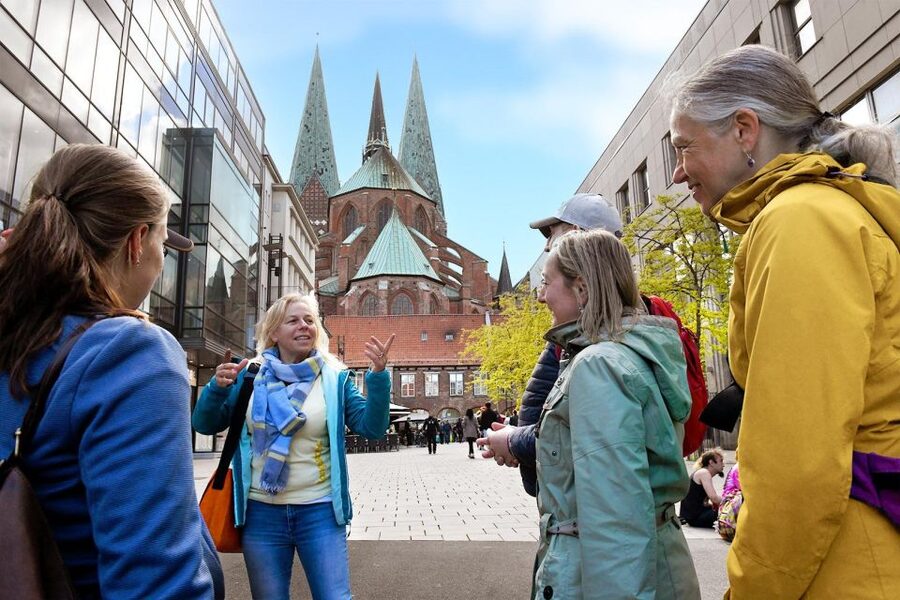
St. Mary’s Church, or St. Marien, is one of the old town’s key brick buildings and an important stop on the route. Together with St. Peter’s and the other church towers, it helps explain the famous skyline seen from outside the Holstentor.
The church gives the tour another chance to connect architecture with city history. Lübeck’s churches were not built as small neighborhood chapels. Their scale reflects the city’s former wealth and importance, and their brick construction ties them to the regional style that makes northern German towns so distinctive.
I like having both the town hall and St. Mary’s on a short tour. They show two sides of Lübeck: the city as a place of government and trade, and the city as a center of religious life and grand construction.
The guide’s presentation is especially important here. A strong explanation turns a large church facade into part of a story. Without that context, you might admire the brickwork, take a picture, and keep walking. With the story, the building becomes evidence of how Lübeck once saw itself.
Medieval corridors and abbey courtyards
The most appealing part of the route may be the detour into Lübeck’s medieval corridors and abbey courtyards. These spaces offer a change of scale after the broad views of gates, churches, and public buildings.
Lübeck’s main monuments show the city’s public face. The corridors and courtyards suggest the more private side of old town life, where homes and religious buildings occupied tight spaces behind the main streets. You get a better feel for how people lived within the historic center, not just how the city presented itself to merchants and officials.
This is also where the walk can feel less like a standard landmark circuit. The major sights are essential, but small passages often give you the strongest sense of an old city’s texture. I would pay close attention here and avoid treating the detour as filler.
The exact corridors and courtyards can vary with the guide and the day’s route, so do not expect a fixed list of named interiors. The important point is that the tour makes room for these smaller historic spaces. They add variety and help break up the sequence of large buildings.
A German-speaking guide with a lively style
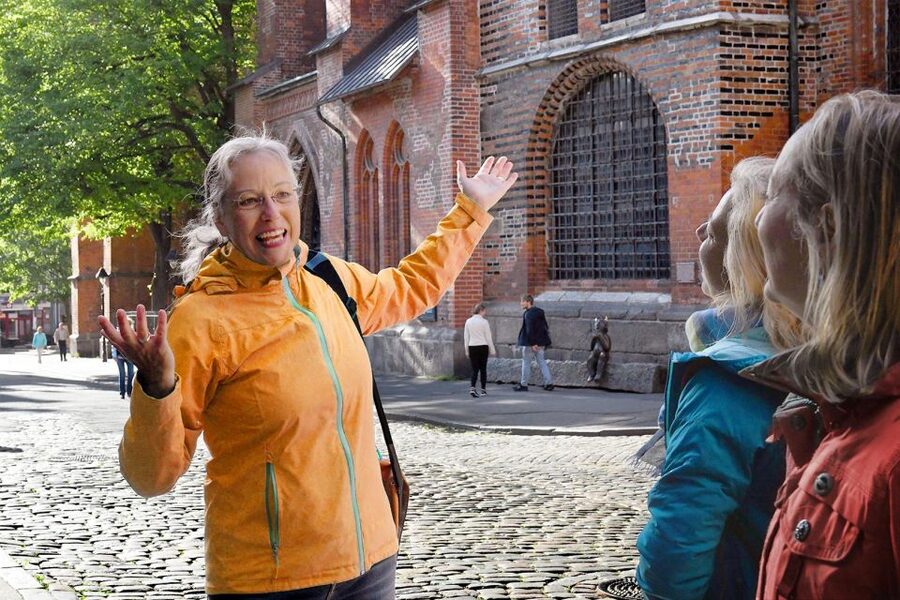
The tour is conducted in German, with a live guide. The guide’s role is central because the route itself is compact and the sights are close together. You are paying less for transportation or entry tickets and more for the explanation, local framing, and practical orientation.
The strongest descriptions of the experience point to guides who are friendly, amusing, and clear. One departure mixed enough historical information with jokes and anecdotes to keep the group interested through the final stop. That balance is useful in Lübeck, where many buildings can look impressive before their purpose and background become clear.
No guide names are supplied for this experience, so you should not book expecting a specific individual. The quality can depend on who leads your departure, but the stated format is consistent: a competent German-speaking city guide, a brisk route, and advice on leisure activities, nightlife, and shopping.
Those final tips can be useful if Lübeck is your base for more than a few hours. A guide who knows the city can point you toward ways to spend the rest of the day. Still, the information provided does not name particular shops, restaurants, or activities, so think of these as general local suggestions rather than a promised list of businesses.
The group-size problem at about 30 people
Group size is the one concern you should take seriously. Several departures have had around 29 or 30 participants. That is not automatically a deal breaker, but it changes how the tour feels.
A large group can spread out on narrow streets. The guide may begin speaking before the last people have reached the stop, and anyone at the back may miss part of the explanation. At busy sights, it may also be difficult for everyone to get a clear view of the detail being discussed.
The problem is not simply comfort. It affects the main service you are buying: the guide’s voice and interpretation. A 90-minute tour with a small group allows more questions and easier conversation. A group of 30 usually feels more like a moving class.
I would stand near the guide when possible, especially at the beginning of each stop. Arrive a little early, identify the guide quickly, and avoid drifting to the rear when the group starts moving. If you have hearing difficulty or care about asking many questions, the group size may be a reason to choose a different format.
The price helps soften this drawback. At $16, the tour is inexpensive for a guided introduction to several major sights. You are not paying a premium for a private experience, and the cost reflects the public group format. If you see it as a city orientation rather than an intimate architectural seminar, the value is stronger.
What to expect during the 90 minutes
The walk lasts 1.5 hours, long enough to cover the essential old town sights without taking up your whole day. It is a useful first activity if you have only limited time in Lübeck or want background before exploring on your own.
The route begins at the Holstentor, moves through the old town, includes St. Peter’s Church and the town hall, reaches St. Mary’s Church, and makes room for medieval corridors and abbey courtyards. The exact order may depend on the guide and local conditions.
This is a walking tour through historic streets, so practical footwear matters. The wet-weather feedback shows that conditions underfoot can be messy, especially near the starting point. The information provided does not state a minimum fitness level, but you should be ready to walk for the full 90 minutes and remain outside for much of it.
The tour is best taken early in your visit. Afterward, you can return to the sights that caught your attention, spend more time around the town hall or churches, or use the guide’s suggestions for shopping and going out.
Who gets the best value from this Lübeck tour?
I would choose this tour if you want a compact introduction to Lübeck’s old town and understand German well enough to follow a live explanation. It suits first-time visitors, people on a short stop, and anyone who prefers a guide to provide the basic city story before independent wandering.
It is also a good fit if you enjoy architecture but do not want a highly academic tour. The mix of Hanseatic history, brick buildings, anecdotes, and smaller historic passages keeps the route varied.
You may want to think twice if you need an English-language tour, a small group, or a highly personal exchange with the guide. German is the only stated language, and the group can reach about 30 people. The tour also does not promise interior visits, special access, or a tower ascent.
With a 4.7 rating from 594 reviews, the overall response is strong, and the praise centers on the guide’s friendly delivery, useful information, and humor. The repeated complaint is equally clear: large groups make it harder to hear and see. That gives you a fair picture of the tradeoff.
Should you book the Lübeck old town tour?
Book it if you want an affordable, well-focused first look at Lübeck, speak German, and can accept a public group that may approach 30 people. For $16, you get the city’s major landmarks, a look at medieval passages and courtyards, and enough history to make the old town easier to understand.
Skip it if you want English, a quiet private walk, or guaranteed access inside the churches and town hall. If you do book, meet at the park side of the Holstentor, wear weather-ready shoes, and stay close to the guide. Those simple choices will help you get the most from a short but useful introduction to Lübeck.
FAQ
Where does the Lübeck walking tour meet?
The meeting point is in front of the Holstentor on the park side.
How long does the tour last?
The tour lasts 1.5 hours.
What language is the tour conducted in?
The live tour is conducted in German. German is the only language listed for this activity.
Which sights are included?
The route includes the Holstentor, St. Peter’s Church, Lübeck’s town hall, and St. Mary’s Church. It also includes medieval corridors and abbey courtyards in the old town.
How much does the tour cost?
The listed price is $16 per person.
Can I cancel the tour and receive a refund?
Yes. You can cancel up to 24 hours in advance for a full refund. You can also reserve now and pay later.
Just added around Lubeck
- Lübeck zwischen Grusel und Geschichte Truecrime zu Halloween★ 4.9 · 35 reviews
- Lübeck: Private Historical and Architectural Walking Tour★ 4.5 · 6 reviews
- Lübeck: Old Town Highlights Private Walking Tour★ 4.8 · 8 reviews
- Lübeck Day Pass – Day ticket for Lübeck museums★ 4.0 · 15 reviews
- Lübeck: Hanseatic League History Walking Tour★ 4.9 · 57 reviews
- Lübeck: Express Walk with a Local★ 4.9 · 10 reviews
- Lübeck: Classic Tour of the Hanseatic City★ 4.8 · 64 reviews
- Lübeck: Backyards and Town Houses Private Guided Tour★ 4.9 · 23 reviews
Old Town Walking Tours, compared.
Old Town & Viktualienmarkt City Walk in German
Read our review →

The Night Watchman Old Town Walking Tour in German
Read our review →
Browse the lists this tour appears in