
Reviewed · WALKING TOURS
Dresden: Walking Tour with Virtual Reality elements
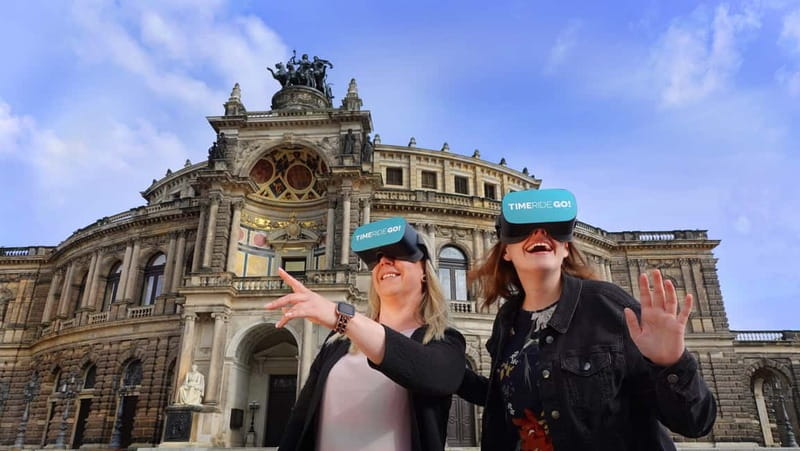
Dresden’s past comes alive through a mobile VR headset that lets you compare the streets in front of you with earlier versions of the city. At nine Old Town locations, you see Baroque Dresden, the prewar city, wartime destruction, socialist rebuilding, and reunification while your guide fills in the human stories. I like the clear time span and the fact that you keep moving through the real city rather than sitting in a museum. I also like the route’s mix of major sights and less obvious urban changes.
The main point to consider is language. The live tour is offered in German, and the headset must be handled with care. The walk also depends on decent weather, and its 1.5-hour length gives you a useful introduction rather than a full study of Dresden.
In This Review
- Key points to know before booking
- Dresden’s past through a headset
- Starting at Taschenberg 3
- The Zwinger: Baroque Dresden in three dimensions
- Postplatz and the city’s changing edges
- Old Market Square and the wartime break
- Pirnaischer Platz and socialist Dresden
- Neumarkt and the return of the historic center
- Fürstenzug: a visual pause in the timeline
- Ending near the Semperoper
- What the $34 price really covers
- Who will enjoy this format most
- Practical tips for making the most of it
- Should you book the Dresden VR walking tour?
- FAQ
- How long does the Dresden VR walking tour last?
- Where does the tour begin?
- Where does the tour end?
- What language is the tour offered in?
- Is museum admission included?
- Can children join the tour?
Key points to know before booking
- Nine locations, five major eras: See Dresden shift from Baroque glory through the 1920s, World War II, socialism, and reunification.
- VR adds vanished views: The headset supplies 360-degree scenes that help you picture buildings and streets no longer visible today.
- A walking tour, not a museum visit: Entrance fees are not included, so you mainly pay for the guide, route, and virtual scenes.
- The route covers the Old Town’s big names: Expect the Zwinger, Postplatz, Old Market Square, Pirnaischer Platz, Neumarkt, Fürstenzug, and the Semperoper area.
- German is the tour language: You need enough German to follow the guide’s stories and instructions.
- Good shoes matter: You walk between stops for about 1.5 hours, and bad weather can lead to cancellation.
Dresden’s past through a headset
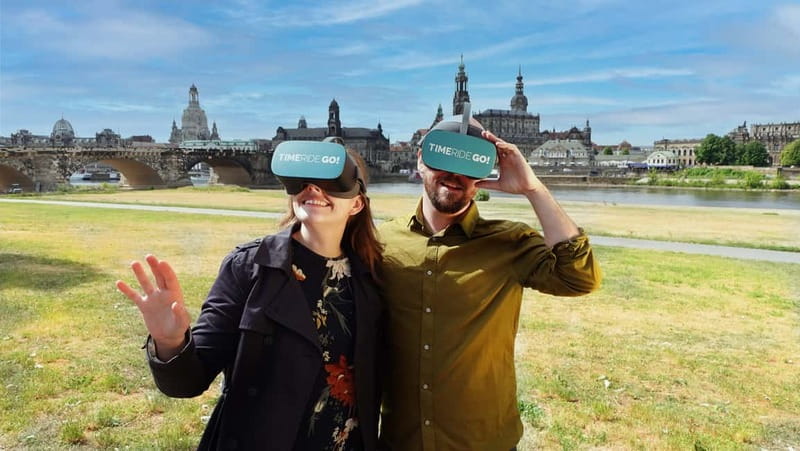
This tour uses a simple idea well: show you a place as it looks now, then let you look through the headset and picture another era in the same spot. Dresden is especially suited to this approach because its center has seen dramatic change. Baroque court culture, twentieth-century rebuilding, wartime loss, socialist planning, and post-1990 restoration all overlap within a compact area.
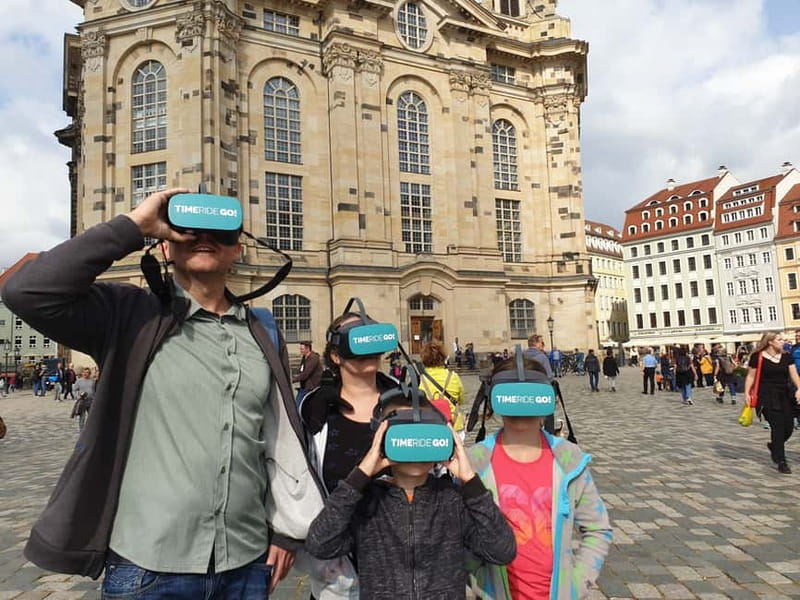
You are not just looking at old photographs on a phone. The advertised experience uses a mobile virtual reality headset with a 360-degree view. That matters because it gives you a sense of the surrounding streets, not only one framed building. At each stop, the guide connects the virtual view with whatever remains in front of you.
The tour covers roughly 400 years. You move from the glamorous Baroque period to changes up to the 1920s, then to the destruction of World War II, the new ideas of socialism, and reunification. That broad sweep helps you understand Dresden as a city that has been repeatedly remade, not as a postcard frozen in one golden age.
The guide is an important part of the experience. The German-speaking leader explains the scenes, keeps the group moving, and moderates the VR portions. One published comment describes the guide as sympathetic, well informed, and especially good at handling the TimeRide presentation. No guide name is provided, so you should not book expecting a particular person.
A few more Dresden trips to weigh up
- Dresden: City & Semperoper Guided Walking Tour
★ 4.8 · 2,293 reviews - Dresden: Guided City Walk with a Cup of Coffee
★ 4.7 · 1,568 reviews - Dresden: Complete Walking Tour with Frauenkirche Visit
★ 4.8 · 700 reviews
Starting at Taschenberg 3
The meeting point is at Taschenberg 3, in front of the shop marked by the TIME RIDE GO! flag. Look for that flag rather than simply waiting somewhere in the wider square. The start places you close to the historic center, so the tour gets to its main sights quickly.
Before setting off, expect an introduction to the headset and instructions for careful handling. The equipment is included, but it is not treated as a casual prop. You need to use it responsibly and follow the guide’s directions as the group moves from place to place.
Wear comfortable shoes and dress for the forecast. This is an outdoor walking experience with repeated stops, not a seated indoor presentation. If the weather becomes seriously bad, the tour may be canceled. That is worth keeping in mind if you are planning this as the fixed centerpiece of a short visit.
The Zwinger: Baroque Dresden in three dimensions
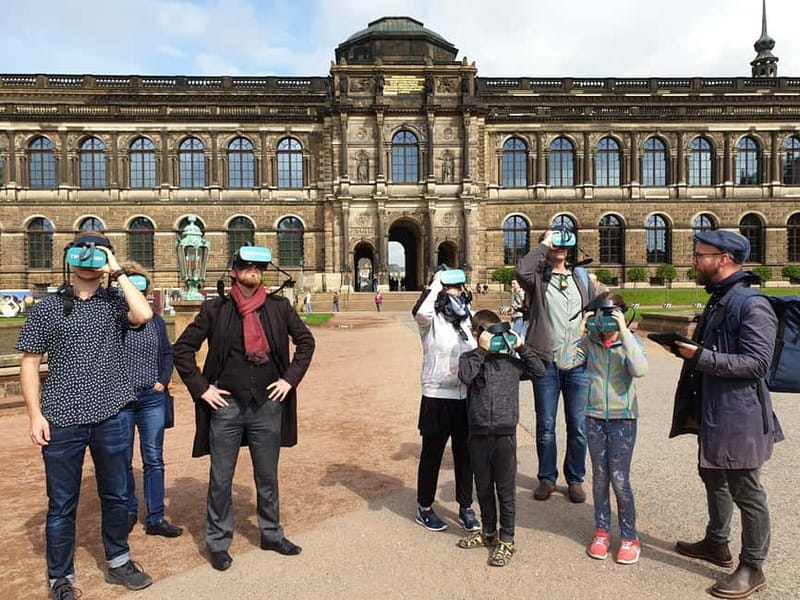
The first listed sightseeing area is the Zwinger, Dresden’s famous Baroque complex. The itinerary lists two Zwinger stops, each with about ten minutes of guided touring, walking, and sightseeing. Treat these as two separate VR moments or viewpoints within the same broad area.
The Zwinger is the natural place to begin a story about Dresden’s courtly past. Here, the virtual scenes can help you picture the setting in its grander Baroque context, while the guide explains how the city changed over time. You get the benefit of looking at a surviving landmark and then using the headset to see beyond the present-day walls.
The two stops should give the guide room to make a comparison instead of rushing through a single photograph. Still, ten minutes is not long. You will hear selected stories rather than receive a full architectural lecture, and the tour does not include entry to museums. If you want to explore the Zwinger’s collections or courtyards at length, plan a separate visit.
Postplatz and the city’s changing edges
The route continues to Postplatz, a busy part of central Dresden where different periods of the city meet. The stop includes a guided visit and about ten minutes of walking and sightseeing.
Postplatz is useful in a historical tour because it helps you think about urban change beyond palace facades. The VR view can show how the area looked in an earlier period, while the guide explains what happened during war, reconstruction, and later planning. You may find this less instantly pretty than the Zwinger, but it can be more revealing.
This is one reason I like the route’s structure. It does not keep you only among restored monuments. You also get places where the shape and use of the city changed sharply. The headset makes those changes easier to picture than a verbal explanation alone.
Same city, a completely different kind of day:
- Dresden: Semperoper Tickets and Guided Tour
★ 4.7 · 12,102 reviews - Dresden: The Original Night Watchman Tour in Lantern Light
★ 4.6 · 6,653 reviews - Dresden: Semperoper and Old Town Tour
★ 4.8 · 5,735 reviews - Dresden: River Sightseeing Boat Cruise
★ 4.3 · 5,323 reviews
Old Market Square and the wartime break
Old Market Square, or Altmarkt, brings the story closer to Dresden’s central civic life. The stop lasts about ten minutes and includes guided sightseeing. This is a key point for understanding the break between the historic city and the postwar city.
The tour’s timeline includes Dresden’s destruction during World War II. At a place such as the Old Market Square, a virtual reconstruction can show you what the area looked like before the destruction and how much was lost. The value is not only visual. It gives the guide a clear point from which to explain why later rebuilding choices mattered.
You should expect the subject to be serious. The VR scenes are designed to compare different periods, but the guide’s account supplies the context. If you prefer a quiet, unhurried visit to a memorial site, the group format may feel brisk. You have about ten minutes here, and the broader route still has several stops ahead.
Pirnaischer Platz and socialist Dresden
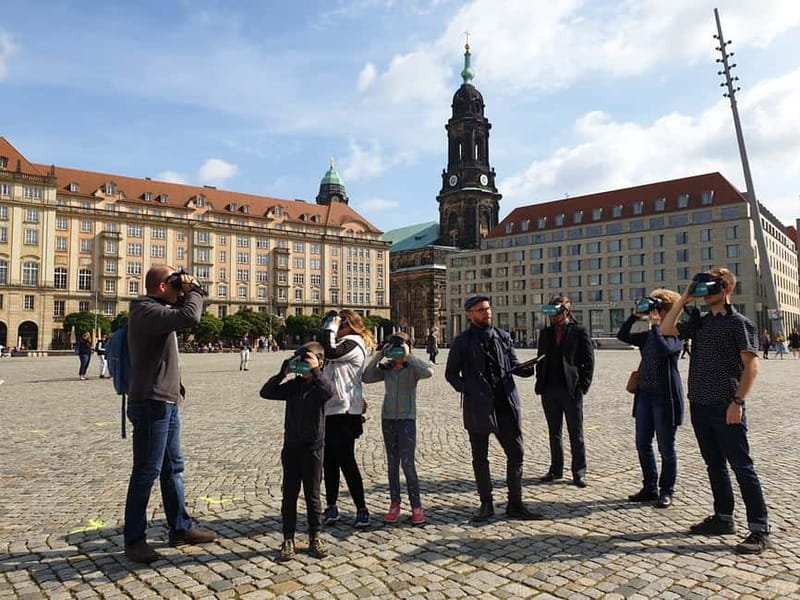
At Pirnaischer Platz, the focus shifts toward the city’s later urban form. The stop includes a guided visit, sightseeing, and walking for about ten minutes. It is a good place to consider how postwar Dresden developed under socialism.
The tour specifically includes new socialist ideas, so you are not shown only the famous royal and Baroque side of the city. The guide uses the changing surroundings to explain a period when planners had different priorities and the city was rebuilt according to a new political system.
This stop may appeal most if you want to understand modern Dresden rather than simply admire old buildings. The VR device can make the comparison sharper by showing the same location at another point in time. As with Postplatz, the site itself may feel more like an ordinary city junction than a classic sightseeing highlight. That is part of its value, but it also means the experience depends heavily on the guide’s explanation.
Neumarkt and the return of the historic center
Neumarkt offers one of the clearest examples of Dresden’s effort to reconnect with its historic identity. The ten-minute stop includes guided sightseeing and a VR comparison. The area is closely associated with the Frauenkirche and the re-creation of the historic center, although the supplied route details do not promise entry into the church or any other building.
Here, you can compare the square’s earlier appearance, its destruction, and the modern effort to restore a familiar urban setting. The subject raises a useful question: how much of a rebuilt city can feel historic, and how much is a modern interpretation? A short tour cannot settle that debate, but the headset gives you something concrete to examine.
I would pay close attention to the transition between the virtual view and the real square. That is where the experience works best. You see the current buildings, then look again with another period placed over the same ground. It makes the city’s reconstruction easier to grasp than a standard walking tour that simply lists dates.
Fürstenzug: a visual pause in the timeline
The Fürstenzug, or Procession of Princes, is listed as a photo stop as well as a guided sightseeing stop. You have about ten minutes here. The long porcelain-tile mural is one of Dresden’s most memorable outdoor artworks, and its scale gives the group a natural pause before the final part of the route.
This stop adds a different kind of history. Instead of asking you to picture a vanished street plan, it gives you a surviving artwork that presents Saxony’s rulers across time. The guide can use it to link Dresden’s court culture with the city’s wider political story.
The photo-stop label is useful practical information. You will have a chance to take pictures, but you should not expect a long, quiet photography session. The group has a schedule, and the guide needs to keep everyone together. If the Fürstenzug is high on your personal list, return later for a slower look.
Ending near the Semperoper
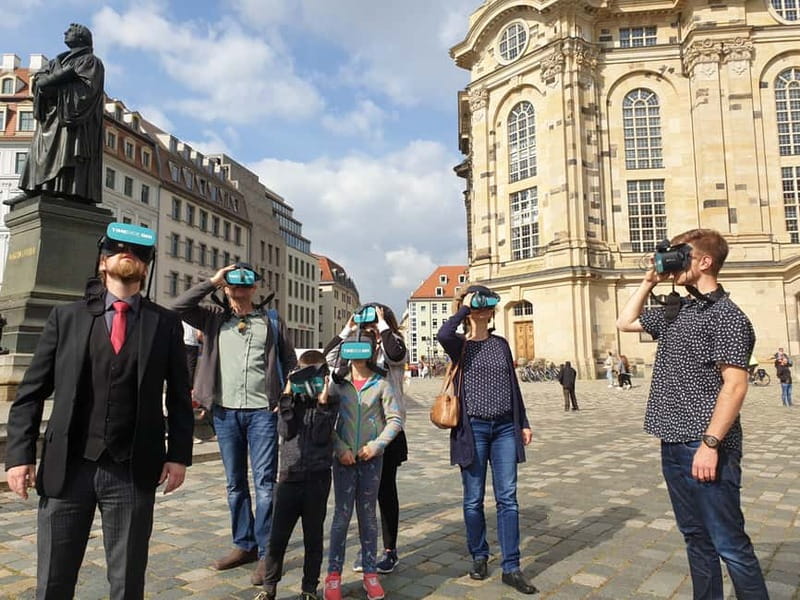
The listed finish is the Semperoper Dresden, one of the Old Town’s most recognizable cultural buildings. The route details describe the tour ending there, while the meeting-point information also says the activity ends back at the meeting point. Because those details do not match perfectly, confirm the exact end location when you reserve.
Either way, the final area keeps the tour centered on Dresden’s grand architectural story. After seeing several periods through the headset, the Semperoper gives you a strong closing image of the city’s cultural identity and its restored historic core.
The end point is also useful for planning the rest of your day. You will be near major Old Town sights, though this experience does not include museum admission. If you want to enter the Semperoper, the Zwinger museums, or another attraction, budget separate time and admission.
What the $34 price really covers
At $34 per person, the cost is reasonable if you want a guided overview with a special visual tool. Your fee covers the live guide and VR headset, plus the route through nine locations. You are paying for interpretation and the prepared virtual scenes, not for entry to Dresden’s museums.
For comparison, a free self-guided walk would let you see many of the same squares, but it would not give you the headset comparisons or a guide connecting the periods. A conventional walking tour might offer more time for questions or more detailed architecture, but it would not supply the same 360-degree historical views.
The value depends on how you like to learn. If you enjoy seeing a place change before your eyes, the VR element makes the price easier to justify. If you mainly want long explanations, museum interiors, or time to take photographs, you may get better value by combining a regular city walk with a separate museum visit.
The 1.5-hour length is a practical strength. It fits neatly into a morning or afternoon and gives you a framework for exploring on your own afterward. The tradeoff is that each stop is short, usually about ten minutes. You get breadth across Dresden, not a slow examination of every monument.
Who will enjoy this format most
I would recommend this tour to first-time visitors who want a quick orientation and to anyone curious about how Dresden changed across the twentieth century. The historical comparisons are likely to be most useful if you do not yet know the city’s story.
Families with children aged six and older may also find the headset more engaging than a standard lecture, though the tour is still guided in German. Children under six are not permitted. Adults should also remember that the equipment needs careful handling and that the group must keep moving.
This is a good fit if you want:
- A compact introduction to Dresden’s Old Town
- A clear timeline from the Baroque era to reunification
- Visual comparisons at real city locations
- A guide who adds stories beyond the standard postcard sights
- A short activity that leaves time for museums or independent walks
You may want something else if you need an English tour, dislike wearing VR equipment, or want to enter the city’s major buildings. The tour is also not ideal for a day when the forecast calls for severe weather.
Practical tips for making the most of it
Book a start time that leaves room afterward for the Zwinger, Frauenkirche area, or a museum, since admission is not included. The tour gives you useful context, then you can return to the places that caught your attention.
Arrive at the TIME RIDE GO! flag in front of the shop at Taschenberg 3. Comfortable shoes are more important than dressy footwear. You will be outside and walking between several central locations, with stops that combine standing, listening, and viewing.
Bring weather-appropriate clothing and be ready for the possibility of cancellation in truly bad weather. The activity allows free cancellation up to 24 hours before the start and offers a reserve-now, pay-later option, which can help when your itinerary is still shifting.
Keep your questions focused and listen closely during the VR scenes. The virtual section is the special feature, but it lasts only as long as the guide’s explanation at each stop. A distracted group can miss the connection between the image and the street in front of you.
Should you book the Dresden VR walking tour?
Book it if you want Dresden’s complicated past explained in a brisk, visual way. The strongest parts are the nine-location route, the comparison between vanished and present-day city views, and the guide’s role in connecting Baroque Dresden with war, socialism, and reunification.
Skip it if you need English, want museum entry included, or prefer a slow architectural walk. At $34, the tour earns its price through the VR equipment and historical framing, not through admissions or an unusually long itinerary. For a first look at Dresden, it is a useful 1.5-hour introduction. Pair it with a museum visit or a slower independent walk, and you will get a much fuller picture of the city.
FAQ
How long does the Dresden VR walking tour last?
The tour lasts 1.5 hours. Check availability for the available starting times.
Where does the tour begin?
Meet at Taschenberg 3, at the TIME RIDE GO! flag in front of the shop.
Where does the tour end?
The route lists the Semperoper Dresden as the finish. The meeting information also says the activity ends back at the meeting point, so confirm the exact end location when booking.
What language is the tour offered in?
The live tour guide speaks German.
Is museum admission included?
No. Entrance to museums is not included in the tour price.
Can children join the tour?
Children under six cannot join this activity. The equipment must also be handled with care.
Just added around Dresden
- Test Drive Electric Vehicles from the VW brand (ID. model)★ 4.8 · 190 reviews
- SRF CoBi | City Tour by ConferenceBike★ 4.7 · 38 reviews
- Dresden: Scavenger Hunt to Elbe River & Castles★ 4.7 · 15 reviews
- Dresden: Bike Rental – City Bike with Option Children Seat★ 4.5 · 13 reviews
- Moritzburg: Scavenger Hunt Self-Guided Walking Tour★ 4.8 · 12 reviews
- Historical tour of the old town including a Saxon dinner★ 4.7 · 23 reviews
- Climb the mountains together with goats★ 4.8 · 8 reviews
- From Prague: Day trip to Dresden★ 4.3 · 4 reviews
Walking Tours, compared.





Berlin’s Best: 2 Hour Walking Tour Third Reich and the Cold War
Read our review →


Third Reich Berlin: Hitler and WWII Walking Tour
Read our review →Browse the lists this tour appears in