
Reviewed · CITY TOURS
Dresden: Guided City Walk with a Cup of Coffee
Dresden’s old town is a compact lesson in power, art, war, and rebuilding. This 90-minute walk links the city’s grandest sights, from the Frauenkirche and Semperoper to the Zwinger and the long Fürstenzug mural, while your licensed guide explains how medieval Dresden became an extravagant Baroque capital and later a divided German city.
I like the strong concentration of major sights. You see a lot without changing transport or paying separate admission, and the live commentary adds the stories that façades alone cannot provide. I also like the practical touch of local tips on restaurants and things to do afterward. The main catch is simple: the tour is German only, and one person reported that the promised coffee coupon was not handed out.
In This Review
- Key points to know before you book
- Why Dresden works so well on foot
- Neumarkt and the first look at the Frauenkirche
- Stallhof and the Fürstenzug
- Brühl’s Terrace and the river-side view
- Semperoper and the culture of the court
- The Zwinger’s Baroque spectacle
- Dresden Castle and the royal center
- Taschenbergpalais, Augustus Bridge, and the modern city
- What the guide adds to the buildings
- The coffee coupon and practical value
- Who should choose this Dresden walk
- Should you book it?
- FAQ
- How long does the Dresden guided city walk last?
- What language is the tour conducted in?
- Where does the tour begin?
- Where does the tour end?
- Which major sights are included?
- Is coffee included?
- Is the tour wheelchair accessible?
- Can I cancel the booking?
Key points to know before you book
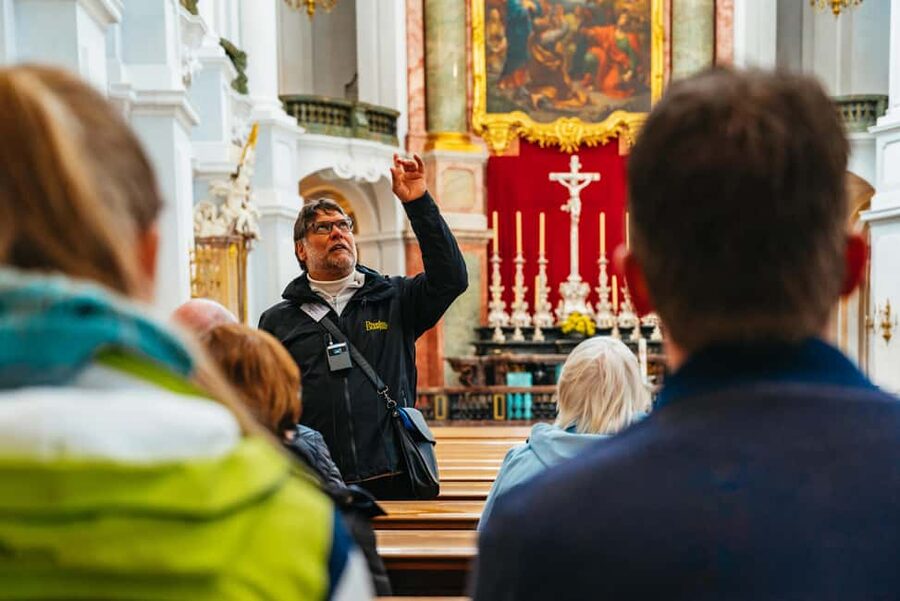
- A compact route through Dresden’s grandest center: See the Frauenkirche, Semperoper, Zwinger, Dresden Castle, Fürstenzug, Brühl’s Terrace, and Stallhof in about 90 minutes.
- German-language guiding only: The live guide and digital audio system are designed for German-speaking participants.
- History runs from the Middle Ages to 1989: Expect stories about medieval Dresden, the Renaissance, Baroque court life, and the Peaceful Revolution.
- The route is mostly about exteriors: You pass the city’s major monuments, but the supplied details do not promise entry into each building.
- Coffee is included in principle: A free coffee coupon comes with the booking, though it is worth checking for it before you leave the meeting point.
- Easy to budget: At $15 per person, the tour is a low-cost way to get your bearings in the historic center.
Why Dresden works so well on foot
Dresden’s old town rewards a walking introduction because its main sights sit close together. You move from a church square to a royal palace, an opera house, a ceremonial courtyard, and a river terrace without losing time to buses or taxis.
The route also gives you several versions of Dresden in a short span. The Middle Ages appear in the city’s early development and darker stories. The Renaissance and Baroque periods explain the grand court buildings. Modern Dresden enters through the Peaceful Revolution of 1989 and the difficult choices that followed reunification.
That range matters. If you only photograph the Baroque façades, Dresden can look like a polished museum. Your guide’s job is to explain the forces behind them, including royal ambition, political change, destruction, rebuilding, and new buildings that have sparked debate.
The walk begins at Dresden Information, in the basement of the QF Passage. This is a practical meeting point near Neumarkt and the Frauenkirche. Arrive with comfortable shoes and enough time to find the information office, since the meeting location is indoors rather than simply at a famous monument.
The tour is wheelchair accessible, which makes this central route useful for many visitors. Still, a walking tour means you should expect a steady pace over city streets and public spaces. Ask the operator about your particular needs if you require more detailed route information.
A few more Dresden trips to weigh up
- Hamburg: Speicherstadt Walking Tour with Coffee Tasting
★ 4.6 · 360 reviews - Rüdesheim: city tour with music and wine and Rüdesheim coffee
★ 4.8 · 6 reviews
Neumarkt and the first look at the Frauenkirche
Neumarkt gives you an immediate sense of Dresden’s central drama. The Frauenkirche dominates the square, and the surrounding buildings frame the church with the sort of Baroque setting that makes Dresden famous.
This is a good place for your guide to set the scene. You hear how Dresden developed, how its rulers shaped the center, and how the city’s story stretches from medieval beginnings through modern reconstruction. The tour description also promises discussion of the darker side of the Middle Ages, so the opening is not limited to royal glamour.
The Frauenkirche is one of the essential sights on the walk. Its presence anchors the route, even though the stated program is a guided walk past the major attractions rather than a confirmed interior visit. If entering the church is important to you, plan to check its separate opening arrangements.
The first stretch is especially useful if you have just arrived in Dresden. You begin with the city’s most recognizable square and then move toward the royal quarter, building a mental map as you go.
Stallhof and the Fürstenzug
From the starting area, the walk heads toward Stallhof, the former royal stable courtyard. This stop helps connect Dresden’s grand palaces with the daily machinery of court life. It is not just another ornate façade. A stable yard tells you about processions, horses, servants, and the practical business behind royal display.
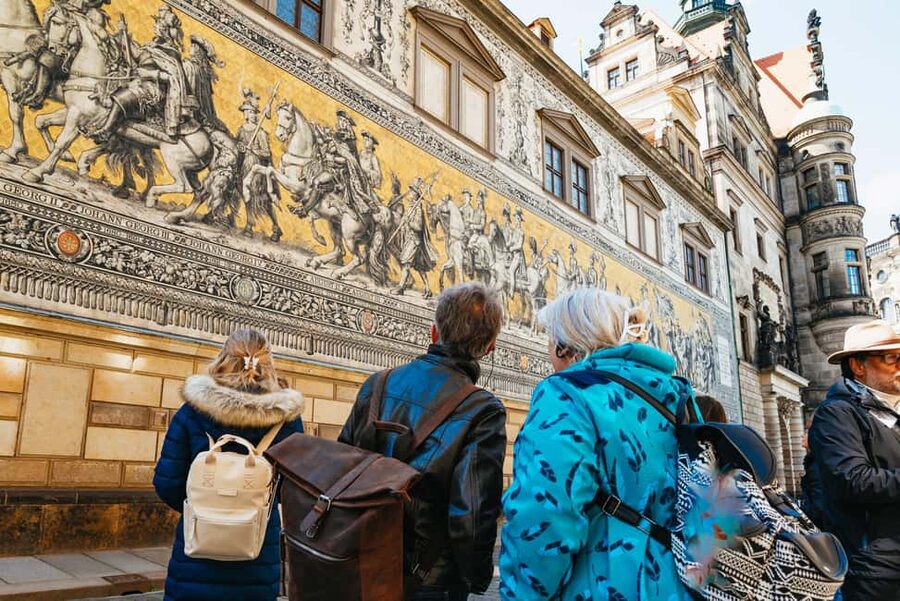
Next comes the Fürstenzug, or Procession of Princes. This long mural is one of Dresden’s most memorable public artworks. It presents a procession of rulers and gives your guide an easy way to explain the dynasty, succession, and the importance of ceremony in Saxony.
Look at it as a history lesson in picture form. Instead of hearing a list of names in a lecture room, you see rulers arranged across a long wall. The guide can point out how the artwork turns political memory into a public monument.
The Fürstenzug is also a good example of why a guide helps. On your own, you can admire the scale and detail. With commentary, you get the reason it is there and how it fits Dresden’s royal identity.
Brühl’s Terrace and the river-side view
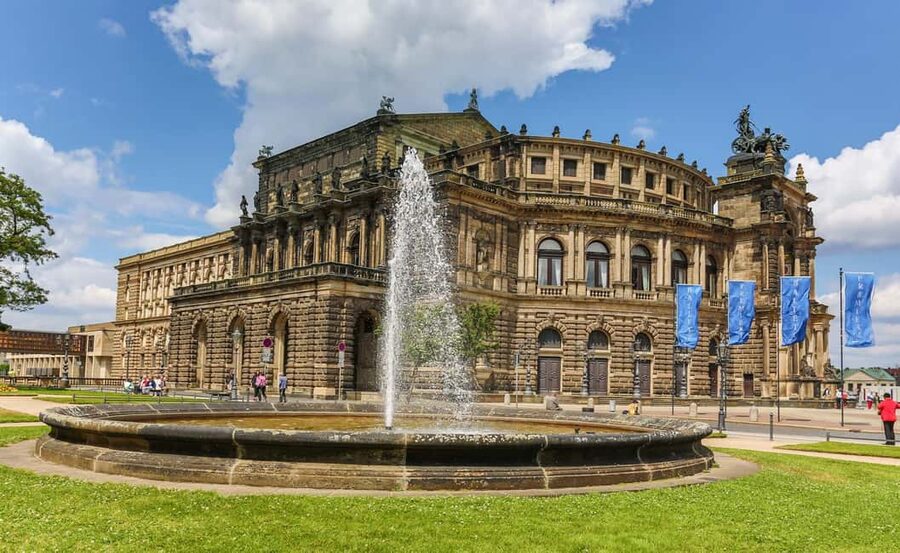
Brühl’s Terrace gives the route a change of mood. Known as the Balcony of Europe, it runs along the Elbe and offers a broader view than the enclosed courtyards and narrow old-town streets.
Your guide discusses Dresden’s development from this elevated riverside position. The terrace helps you understand the city as a planned capital, not merely a collection of isolated monuments. It also provides a welcome pause after the denser palace area.
Do not expect a long photo stop built into the schedule. Ninety minutes is short for this many landmarks, so the guide must keep the group moving. You will have time to see the terrace and hear its story, but you may want to return later if you prefer slow photography.
This section is also a useful reminder that Dresden is not only about buildings. The Elbe setting shaped the city’s identity and gives the old town room to breathe.
Same city, a completely different kind of day:
- Dresden: Semperoper Tickets and Guided Tour
★ 4.7 · 12,102 reviews - Dresden: The Original Night Watchman Tour in Lantern Light
★ 4.6 · 6,653 reviews - Dresden: Semperoper and Old Town Tour
★ 4.8 · 5,735 reviews - Dresden: River Sightseeing Boat Cruise
★ 4.3 · 5,323 reviews
Semperoper and the culture of the court
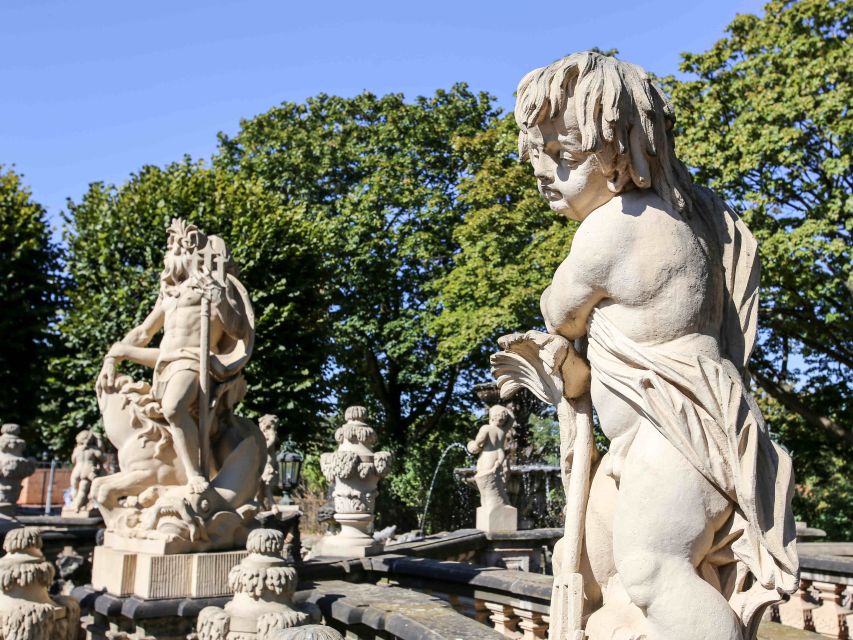
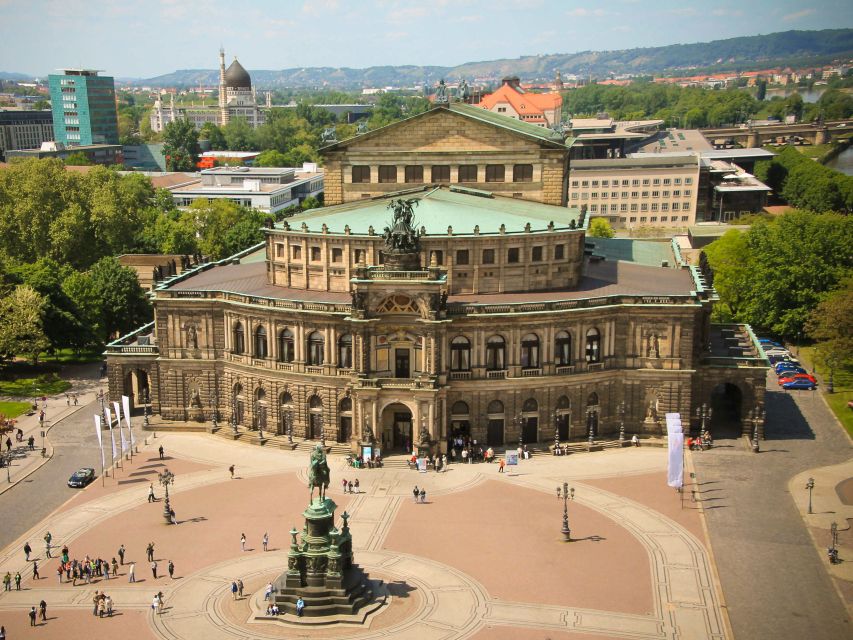
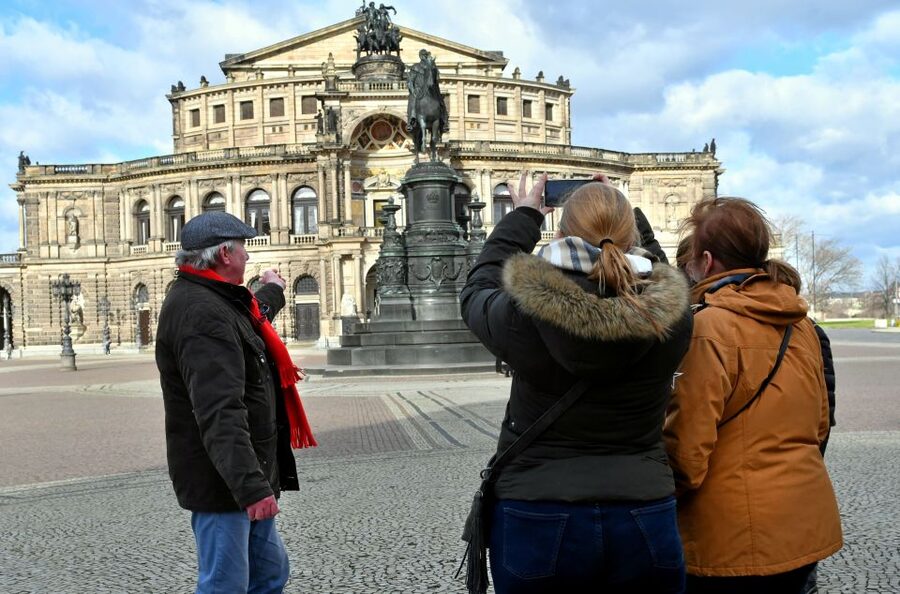
The Semperoper brings music and performance into the story. Its grand exterior reflects Dresden’s ambition as a cultural capital, while its place near the royal buildings shows how closely art, politics, and court life were linked.
The guide explains the building as part of the city’s development rather than treating it as an isolated opera house. That context makes the stop more useful for first-time visitors who want to understand why so much effort went into monumental architecture.
The tour is designed as a pass-by visit, and the supplied details do not include an interior tour or performance ticket. You should treat the Semperoper stop as an exterior introduction. If you plan to attend a concert or see the inside, arrange that separately.
For many people, this is one of the most photogenic stops. For others, the main value is the connection between Dresden’s royal past and its continuing cultural life.
The Zwinger’s Baroque spectacle
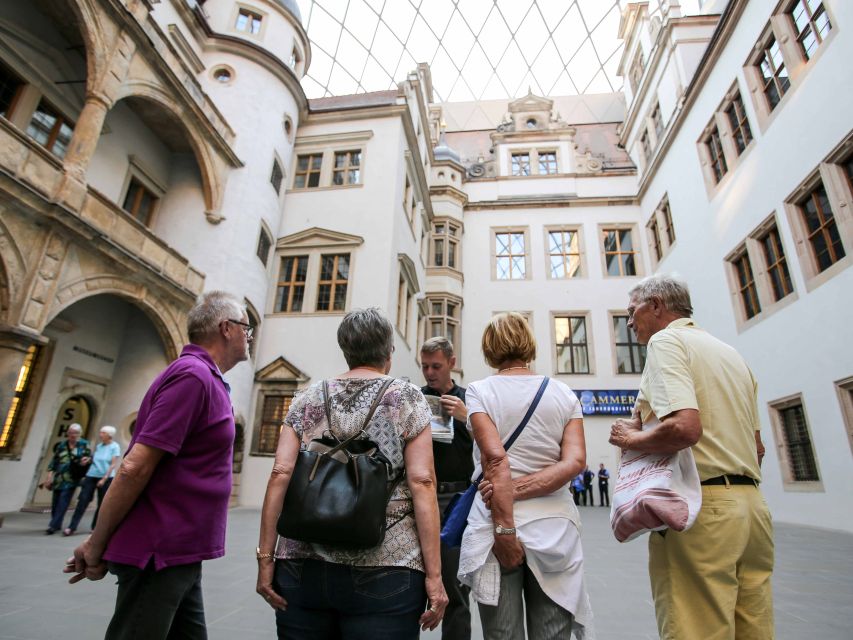
The Zwinger is likely to be the visual high point of the walk. Its courtyards, sculptural details, and dramatic Baroque forms show the period at full volume. Dresden’s rulers were not aiming for modesty here.
Your guide uses the Zwinger to explain the growth of Baroque Dresden and the development of the city as a center of power and display. The building makes that lesson easy to grasp. Grand entrances, open courts, and decorative details all communicate status before a single historical date is mentioned.
The route includes a guided look at the Zwinger, but it does not promise admission to its museums. That distinction matters. If you want the Old Masters Picture Gallery, the Porcelain Collection, or the Mathematical and Physical Salon, you will need extra time and separate admission arrangements.
I would use this tour to learn the basic story, then return to the Zwinger if you want to explore its collections. The walk gives you orientation and context. It is not a substitute for a museum visit.
Dresden Castle and the royal center
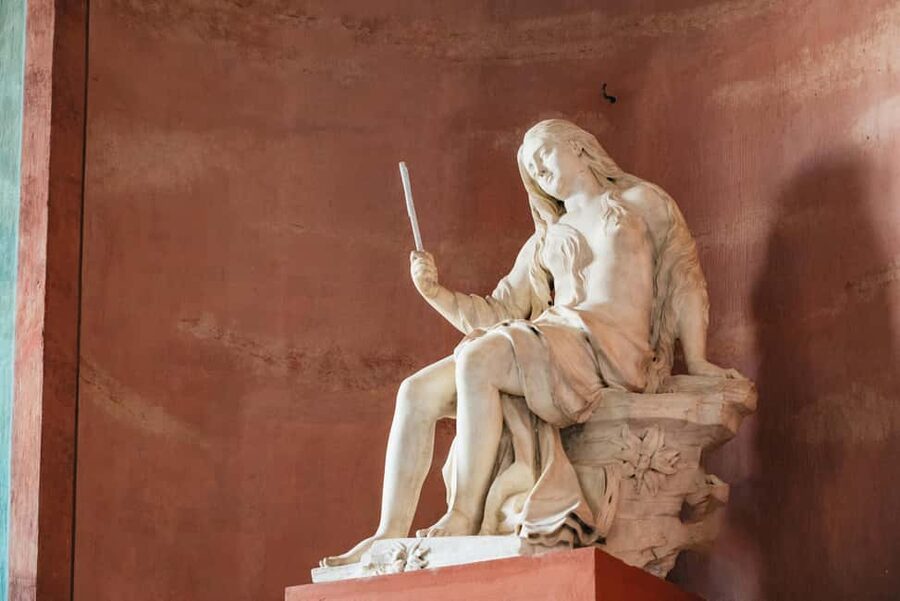
Dresden Castle, or Residenzschloss, brings the route back to the heart of Saxon power. From here, the nearby Fürstenzug and Stallhof make more sense as parts of a connected royal district.
The castle stop is valuable because it ties together several themes from the walk: dynastic rule, court ceremony, art, and the city’s physical growth. Your guide can show how the buildings were arranged around royal needs rather than modern traffic or commercial life.
Again, expect a guided exterior visit unless your booking details say otherwise. The castle contains important museums, but this activity is a walking tour, not a museum ticket. If you want the Historic Green Vault or other castle collections, set aside a separate block of time.
The castle also gives you a chance to hear about Dresden’s later chapters. The tour covers the Peaceful Revolution of 1989 and asks you to consider what life felt like for people in former East and West Germany. That modern history adds needed weight to a route otherwise filled with royal spectacle.
Taschenbergpalais, Augustus Bridge, and the modern city
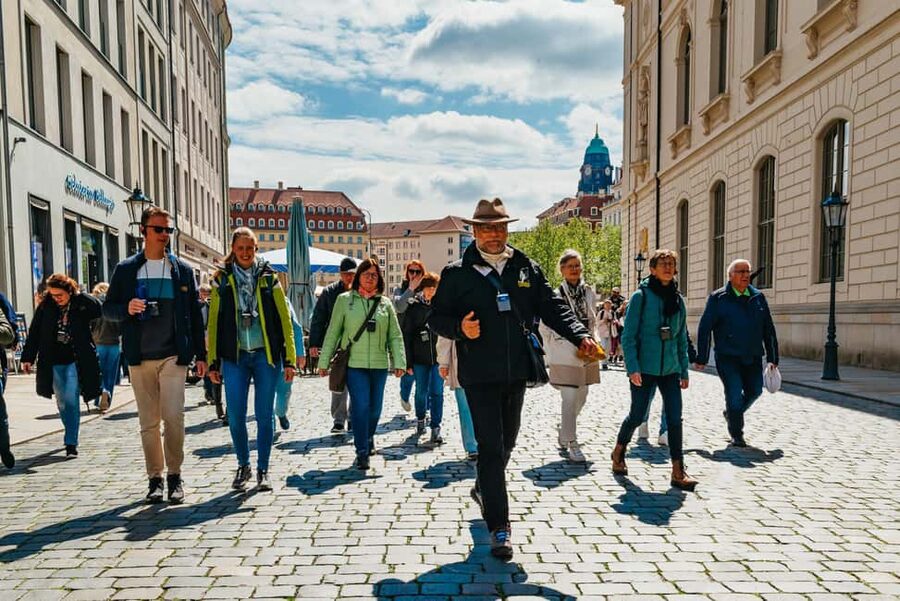
After the castle area, the route continues past Taschenbergpalais and toward Augustus Bridge. These stops broaden the picture beyond the best-known postcard sights.
Taschenbergpalais fits into Dresden’s royal and aristocratic quarter, while Augustus Bridge connects the old town with the wider city. The bridge is a useful point for thinking about movement, trade, power, and the relationship between Dresden’s central districts.
The tour also acknowledges modern and controversial buildings. That is an important promise because Dresden’s rebuilding has not been a simple return to the past. Some parts of the center were reconstructed in historic forms, while newer additions have prompted disagreement about what a city should preserve and what it should change.
You will not get a full architectural seminar in 90 minutes. You will get enough background to notice that Dresden is a living city, not a perfect stage set. That is one of the better reasons to choose this walk over a route that only lists monuments.
What the guide adds to the buildings
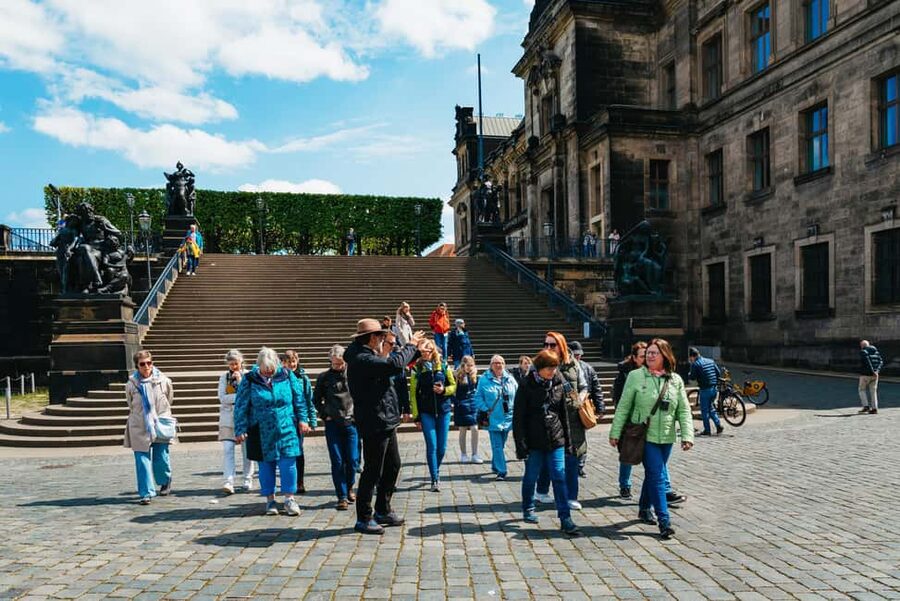
The experience depends heavily on the live German-speaking guide. The tour promises small anecdotes alongside larger stories, which is the right approach for a short city walk. Dates and names give structure, but small human details are what help a place stick in your mind.
The guide also uses a digital audio guide system. This can help you hear commentary in a city center where groups may spread out or street noise gets in the way. It is a useful feature, though you should still expect the tour to feel like a group walk rather than a private conversation.
The highly rated feedback points to a good mix of history, description, and anecdotes. That balance is worth emphasizing. A tour that only recites facts can feel flat, while one that only tells colorful stories may leave you lost. This experience aims for both.
No guide names are provided, so you cannot select a particular guide in advance. The important point is that the guide is licensed, live, and German-speaking. If you do not understand German well, the audio system will not solve the language problem.
The coffee coupon and practical value
At $15 per person, this is inexpensive for a guided introduction to Dresden’s old town. You are paying mainly for the guide’s time and the organized route, not for museum admission. Since the tour reaches several of the city’s signature sights, the cost makes sense if you want a quick orientation on your first day.
The free coffee coupon is a pleasant extra, but I would not make it the reason to book. One review specifically noted that the coupon was not handed out, so check for it before the walk ends. Consider it a small bonus rather than a guaranteed highlight.
The activity lasts 1.5 hours. That is long enough to cover the core sights but short enough to fit before lunch, after arrival, or ahead of a museum visit. The tradeoff is pace. You will see the landmarks, hear the main stories, and get restaurant and leisure tips, but you will not linger at every stop.
The tour is listed with free cancellation up to 24 hours before the start and a reserve-now, pay-later option. Those terms are useful if your Dresden schedule is still shifting. Check the available starting times for your date, since the exact departure time is not fixed here.
The meeting point is in front of Dresden Information in the basement of the QF Passage. The supplied details also list the end near An der Frauenkirche and say the activity ends back at the meeting point. Because those descriptions differ slightly, confirm the precise finish point when you book.
Who should choose this Dresden walk
I would recommend this tour to a first-time Dresden visitor who wants a clear introduction before deciding which museums and interiors deserve more time. It suits anyone who enjoys history, architecture, and short walking routes with plenty of major sights packed into the schedule.
It also works well for a budget-conscious visit. At $15, you can get a guided overview without committing to a full-day excursion or a costly private guide.
This is a good fit for German speakers, families within the stated booking limit, and visitors who want practical suggestions for restaurants and leisure activities. Per adult, a maximum of four children’s tickets can be booked.
I would choose something else if you need English commentary, want to enter several buildings, or prefer a slow photographic walk. The German-only format is the biggest limitation, and the tight schedule means this is an overview rather than an exhaustive tour.
Should you book it?
Book this Dresden city walk if you want the city’s essential old-town sights explained in a short, affordable format. The route gives you the Frauenkirche, Fürstenzug, Stallhof, Brühl’s Terrace, Semperoper, Zwinger, Dresden Castle, Taschenbergpalais, and Augustus Bridge, while placing them in a story that reaches from medieval Dresden to 1989.
Skip it if you do not understand German or if your main goal is interior access to the Zwinger, castle, opera house, or Frauenkirche. For the right audience, though, this is a smart first look at Dresden, with a useful dose of royal drama, modern debate, and practical local advice.
FAQ
How long does the Dresden guided city walk last?
The walking tour lasts 1.5 hours. Check availability for the starting times offered on your chosen date.
What language is the tour conducted in?
The live tour guide speaks German, and the activity is available in German only.
Where does the tour begin?
Meet the guide in front of Dresden Information in the basement of the QF Passage.
Where does the tour end?
The stated finish point is near An der Frauenkirche in Dresden. The activity details also say it ends back at the meeting point, so confirm the exact finish location when booking.
Which major sights are included?
The walk passes the Frauenkirche, Semperoper, Zwinger, Residenzschloss or Dresden Castle, Fürstenzug, Brühl’s Terrace, Stallhof, Taschenbergpalais, Dresden Cathedral, and Augustus Bridge.
Is coffee included?
A free coffee coupon is included. Check that you receive it, since one booking comment reported that the coupon was not handed out.
Is the tour wheelchair accessible?
Yes, the activity is listed as wheelchair accessible.
Can I cancel the booking?
You can cancel up to 24 hours in advance for a full refund. A reserve-now, pay-later option is also available.
Just added around Dresden
- Test Drive Electric Vehicles from the VW brand (ID. model)★ 4.8 · 190 reviews
- SRF CoBi | City Tour by ConferenceBike★ 4.7 · 38 reviews
- Dresden: Scavenger Hunt to Elbe River & Castles★ 4.7 · 15 reviews
- Dresden: Bike Rental – City Bike with Option Children Seat★ 4.5 · 13 reviews
- Moritzburg: Scavenger Hunt Self-Guided Walking Tour★ 4.8 · 12 reviews
- Historical tour of the old town including a Saxon dinner★ 4.7 · 23 reviews
- Climb the mountains together with goats★ 4.8 · 8 reviews
- From Prague: Day trip to Dresden★ 4.3 · 4 reviews
City Tours, compared.

1-Hour City Tour by Boat with Guaranteed Seating
Read our review →
City History Canal Sightseeing Tour on a Motorboat
Read our review →


Browse the lists this tour appears in