
Reviewed · WALKING TOURS
Dresden: Sightseeing Walking Tour in English
Dresden’s old town gives you a lot in a small space: grand Baroque buildings, a rebuilt church, a royal palace, an opera house, and reminders of the city’s destruction in World War II. This 90-minute English walking tour ties those sights together with stories reaching from the Middle Ages to the peaceful revolution of 1989.
I like the small groups, since you can ask questions without shouting across a crowd. I also like the local angle. Guides such as Franziska, also spelled Franceska in some tour details, have shared personal memories of growing up in Dresden after World War II, something you will not get from a plaque or photo stop.
The main limitation is time. Ninety minutes is enough for an excellent introduction, but not enough to visit every major building inside. The tour is best for seeing the old town from the outside, getting your bearings, and deciding where to return later.
In This Review
- Key points to know before you book
- Why Dresden works so well on foot
- Neumarkt and the Frauenkirche
- From the Palace Stables to the Procession of Princes
- The Catholic Cathedral and Royal Castle
- Zwinger Palace and the Nyphembad
- Semper Opera, Taschenbergpalais, and Augustus Bridge
- The history beyond the pretty facades
- Local tips are part of the value
- Is $15 a fair price?
- Who will enjoy this walk most
- Booking details worth keeping in mind
- Should you book the Dresden walking tour?
- FAQ
- How long does the Dresden walking tour last?
- What language is the tour offered in?
- Where does the tour meet?
- How much does the tour cost?
- Which Dresden sights are included?
- Does the tour include the Nyphembad?
- Is the walking tour wheelchair accessible?
- Can I cancel the tour for a refund?
Key points to know before you book
- Dresden’s main old-town sights fit into one compact walk: Frauenkirche, Semper Opera, Zwinger Palace, Royal Castle, Brühl Terrace, and more.
- The historical range is unusually broad: Your guide covers the Middle Ages, the Reformation, the Baroque court, World War II destruction, and the events of 1989.
- Small groups make questions easier: Recent departures have been praised for polite, patient guides and a relaxed chance to talk.
- The Zwinger includes an unusual stop: You will hear about the mysterious Nyphembad, a feature many independent visitors miss.
- The price is modest at $15 per person: You are paying mainly for context, storytelling, and local advice rather than museum admission.
- The meeting point is indoors: Find the seating area at the Tourist Information in the basement of QF Passage.
Why Dresden works so well on foot
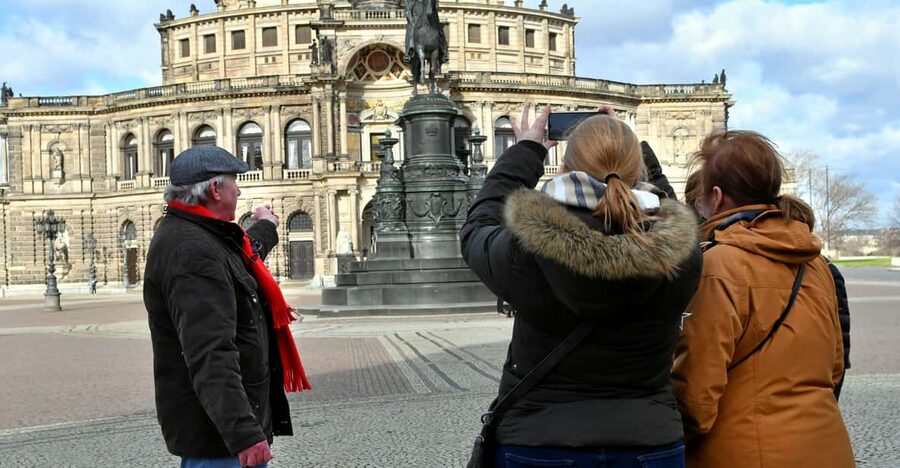
Dresden’s historic center is compact enough to cover comfortably in an hour and a half. That matters because the tour does not waste time on buses or long transfers. You move from square to square, with the city’s major sights appearing in a logical sequence.
The walk begins at the Tourist Information seating area in the basement of QF Passage. From there, your guide leads you into the old town and toward Neumarkt, the square anchored by the Frauenkirche. Starting here makes sense: the church is one of Dresden’s clearest symbols, and its story gives you an early lesson in both destruction and rebuilding.
The tour is conducted in English and uses a licensed local guide. That combination is important in Dresden, where dates and architectural names can pile up quickly. A good guide turns the city from a row of handsome facades into a place shaped by rulers, religious conflict, war, and civic protest.
A few more Dresden trips to weigh up
- Dresden: City & Semperoper Guided Walking Tour
★ 4.8 · 2,293 reviews - Dresden: Guided City Walk with a Cup of Coffee
★ 4.7 · 1,568 reviews - Dresden: Complete Walking Tour with Frauenkirche Visit
★ 4.8 · 700 reviews
Neumarkt and the Frauenkirche
Neumarkt, or Newmarket Square, is one of the most atmospheric parts of the walk. The square presents Dresden as a Baroque city, with the Frauenkirche at its center and carefully restored buildings around it.
The Church of Our Lady was destroyed during the bombing of Dresden in 1945 and later rebuilt. Your guide explains the destruction of Dresden and the long process of bringing the church back into the city. You should not expect an interior visit as part of this walking tour, but the exterior and surrounding square provide plenty to discuss.
I find this stop especially useful if you are trying to understand Dresden’s identity. The city is neither simply an old European capital nor simply a rebuilt one. Much of what you see carries both an earlier Baroque form and a modern history of loss, division, and repair.
Your guide also places the church in the wider story of the Reformation and the religious changes that shook central Europe. The tour does not treat Dresden as a collection of pretty buildings. It connects faith, power, and architecture in a way that helps the rest of the walk make more sense.
From the Palace Stables to the Procession of Princes
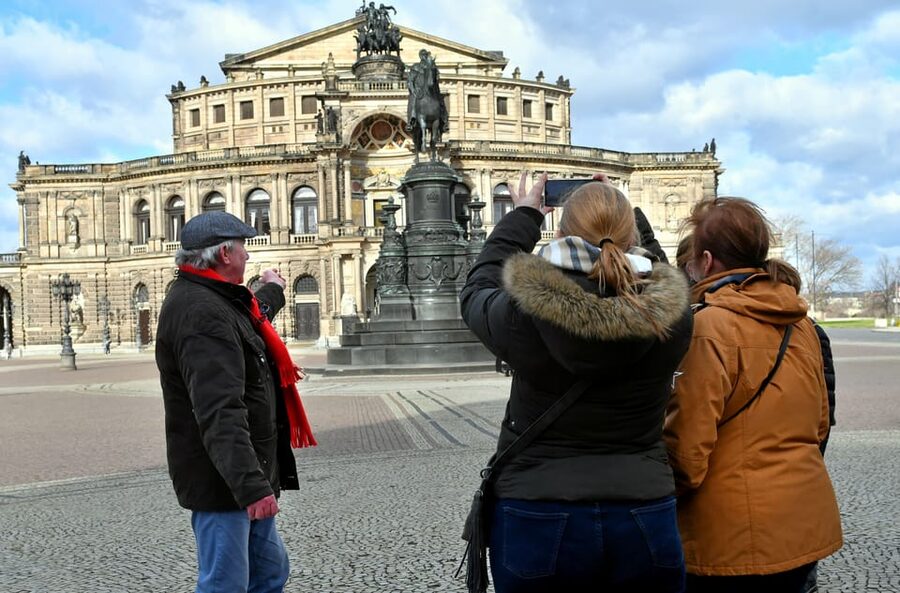
From Neumarkt, the walk continues through a group of royal and courtly sights. The Palace Stables reflect Dresden’s former role as the seat of Saxon rulers. You will also see the Procession of Princes, a long ceramic mural showing rulers from the House of Wettin.
The mural is one of those places where a guide adds real value. You can look at the figures on your own, but the succession of rulers, costumes, and symbols is easier to follow when someone explains what you are seeing. The work also shows how Dresden used art and public buildings to project royal power.
The story here is not only about decoration. It is about how the Saxon court shaped the city and how the Baroque style became a public display of wealth and authority. If you enjoy architecture, this section gives you a helpful link between individual buildings and the people who paid for them.
Do not expect long stops at each sight. The tour keeps moving, so take quick photos as you go and return later if a mural or courtyard catches your eye.
The Catholic Cathedral and Royal Castle
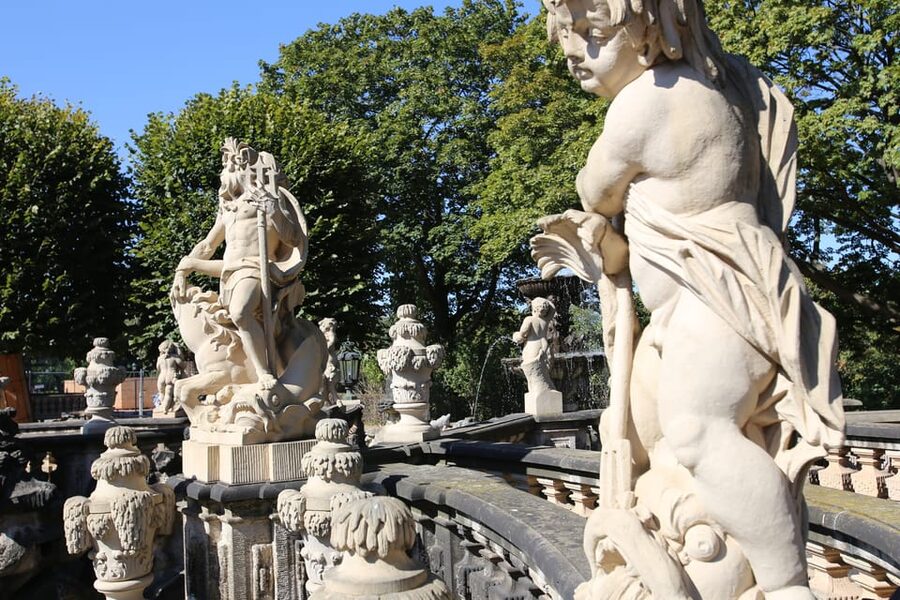
The Catholic Cathedral, formally known as the Cathedral of the Holy Trinity, gives the route another striking architectural contrast. Its presence in the old town reflects the religious and political complexity of Dresden’s ruling family and court.
The walk then brings you toward the Royal Palace, one of the city’s major historic buildings. The palace tells a different story from the Frauenkirche. Here the focus is on rulers, collections, court life, and the long changes that affected Dresden’s center.
The Royal Palace is also a reminder that a building can have several lives. Dresden’s old town was heavily damaged, and many structures required major reconstruction. A guide can point out where the historic appearance survives, where rebuilding took place, and how the city chose to present its past.
For you, the practical benefit is simple: this tour helps you decide if a later palace visit is worth your time. Since the 90-minute walk does not function as a full indoor museum tour, you will need a separate visit if you want to explore the collections inside.
Same city, a completely different kind of day:
- Dresden: Semperoper Tickets and Guided Tour
★ 4.7 · 12,102 reviews - Dresden: The Original Night Watchman Tour in Lantern Light
★ 4.6 · 6,653 reviews - Dresden: Semperoper and Old Town Tour
★ 4.8 · 5,735 reviews - Dresden: River Sightseeing Boat Cruise
★ 4.3 · 5,323 reviews
Zwinger Palace and the Nyphembad
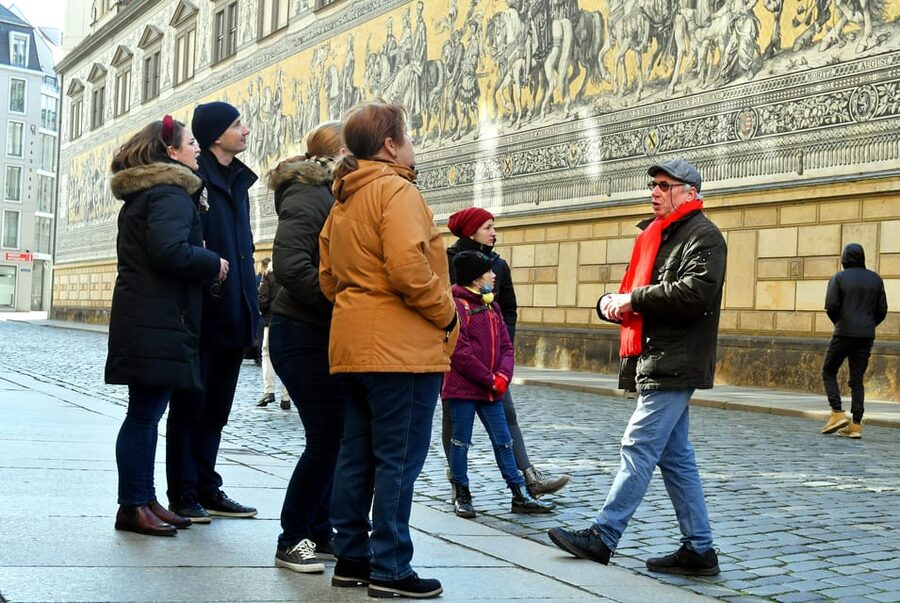
The Zwinger Palace is one of Dresden’s great Baroque showpieces. Its courtyards, pavilions, sculpted decoration, and broad open spaces make it one of the easiest places in the city to appreciate the confidence of the Saxon court.
The tour includes a visit to the mysterious Nyphembad in the Zwinger. This unusual feature adds character to the stop. It is the sort of detail that can slip past you if you are only taking photographs of the main gates and courtyards.
A guide is useful here because the Zwinger can feel like a grand stage without a clear script. You learn why it was built, how it fit the court’s plans, and what its decoration was meant to convey. The word Baroque can become vague when used only as an architectural label. At the Zwinger, you can see its theatrical quality in stone, sculpture, and layout.
The tour does not promise a full exploration of the palace complex or its museums. Treat this as a well-explained introduction, then return on your own if you want more time with the architecture or collections.
Semper Opera, Taschenbergpalais, and Augustus Bridge
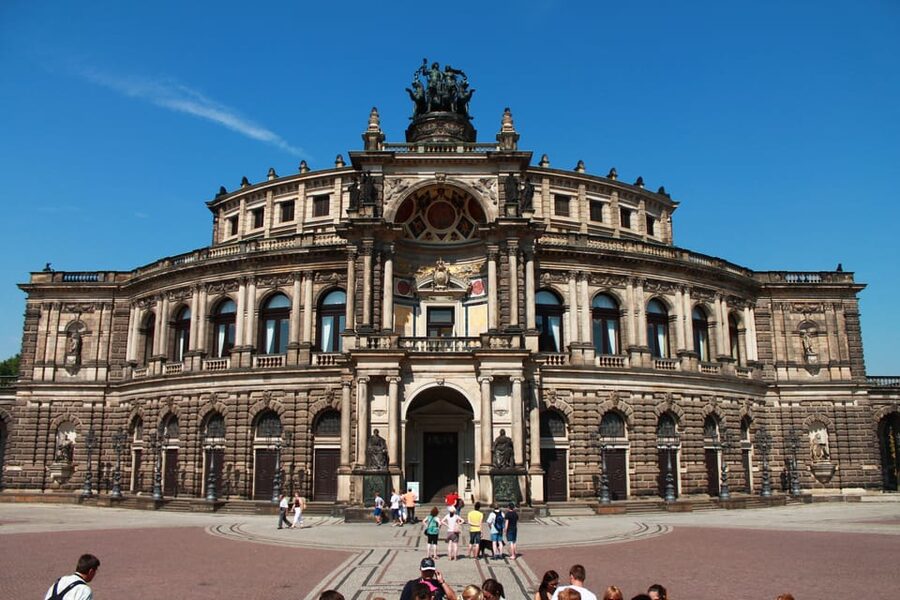
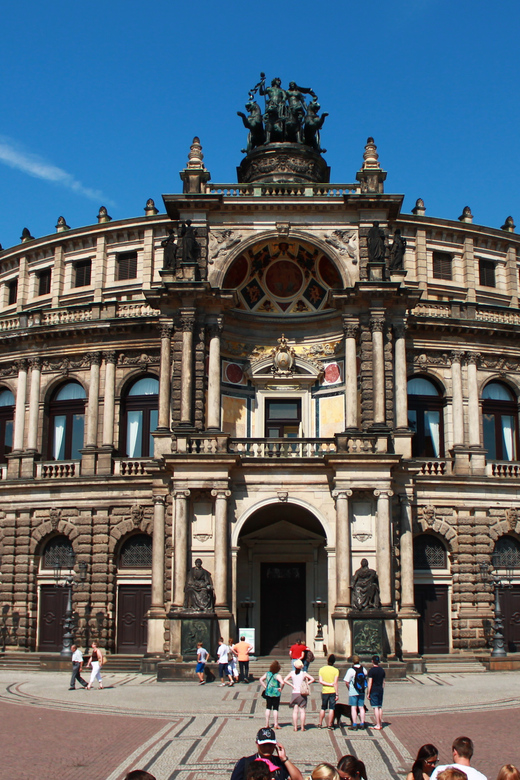
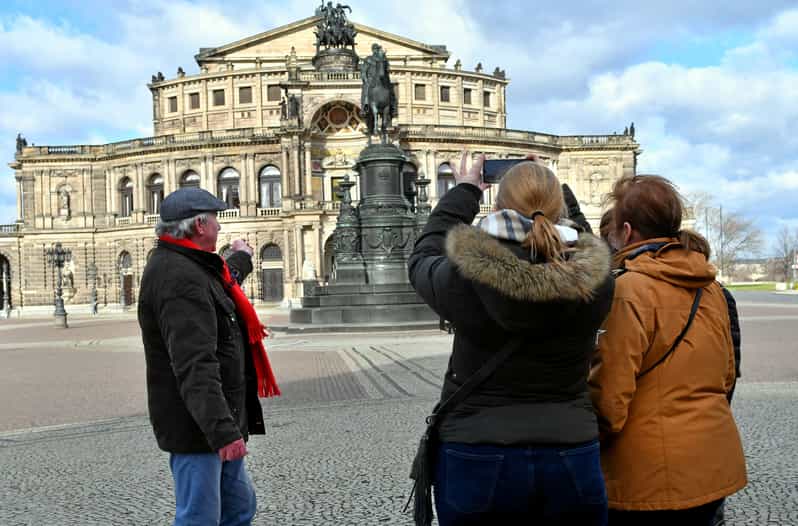
The Semper Opera House is another major highlight. Its ornate exterior reflects Dresden’s taste for grand public architecture, while its name links the building to architect Gottfried Semper and the city’s musical life.
The route also includes the Taschenbergpalais, another important piece of the old court district. Taken together, these buildings show how Dresden’s center was shaped not just by churches and palaces but also by performance, ceremony, and courtly hospitality.
The final stretch includes Brühl Terrace and the majestic Augustus Bridge. Brühl Terrace offers one of the most appealing elevated views along the old town route, while the bridge opens the city toward the river and the wider setting beyond the historic center.
I like this change of scale. Earlier stops focus on facades, squares, and details close at hand. From Brühl Terrace and the bridge, you get a better sense of how the old town fits together.
Weather will affect this part of the experience more than the indoor-looking palace stops. Bring sensible shoes and a light layer, since the tour is outside and Dresden’s conditions can change. The activity is listed as wheelchair accessible, but the route still involves public streets and historic areas, so you may want to confirm current route conditions when booking.
The history beyond the pretty facades
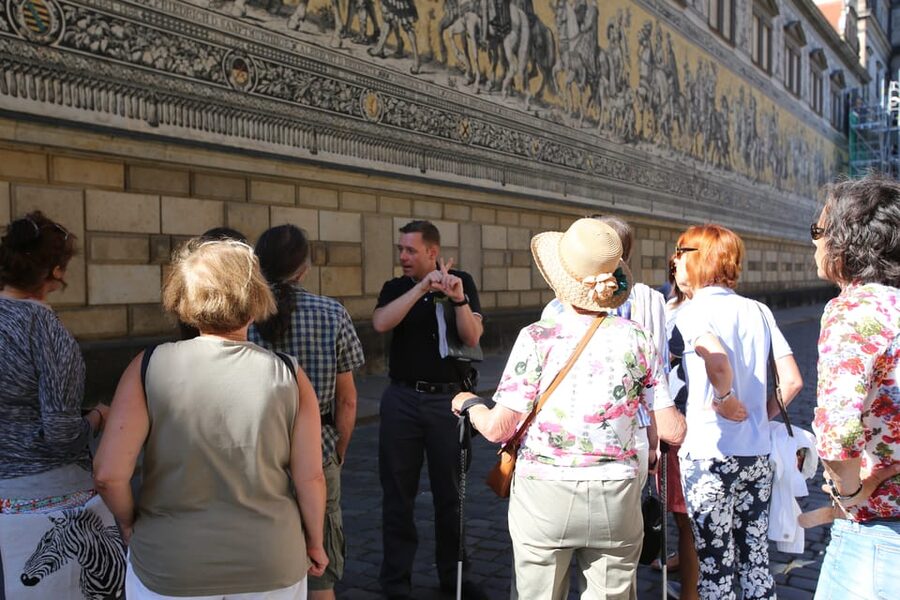
The strongest part of this experience is its historical range. You are not getting only a Baroque architecture lesson. The guide moves through more than 1,000 years of Dresden’s past, including the Middle Ages, the Reformation, the court’s Baroque era, the destruction of the city, and the peaceful revolution of 1989.
That last subject gives the tour a modern edge. Dresden was part of the East German story, and 1989 changed the political direction of the country. Hearing what inspired people who took part in the peaceful revolution helps connect the old town to living memory.
The personal element can be especially valuable. One recent guide shared what it was like to grow up in Dresden after World War II. That sort of local perspective does not replace historical evidence, but it can show you how major events affected ordinary life over several generations.
The tour also covers the destruction of Dresden without treating it as a simple tragedy with no context. You get the city’s wartime story alongside its royal past and later political changes. For an introductory walk, that is a useful balance.
Local tips are part of the value

The guide offers advice on restaurants, shopping, nightlife, and events. This can be more useful than a standard list of attractions, particularly if Dresden is one stop on a longer Germany trip and you have limited free time.
Ask specific questions. You might ask where to eat near the old town, which shopping areas suit your interests, or what local events are worth checking during your stay. The stated promise is insider guidance, but the usefulness will depend on how actively you engage with your guide.
The tour also emphasizes support for local businesses. That makes the tips practical rather than purely decorative. Still, you should think of them as personal suggestions, not guarantees. Restaurants and events change, and your guide may have a different taste from yours.
Is $15 a fair price?
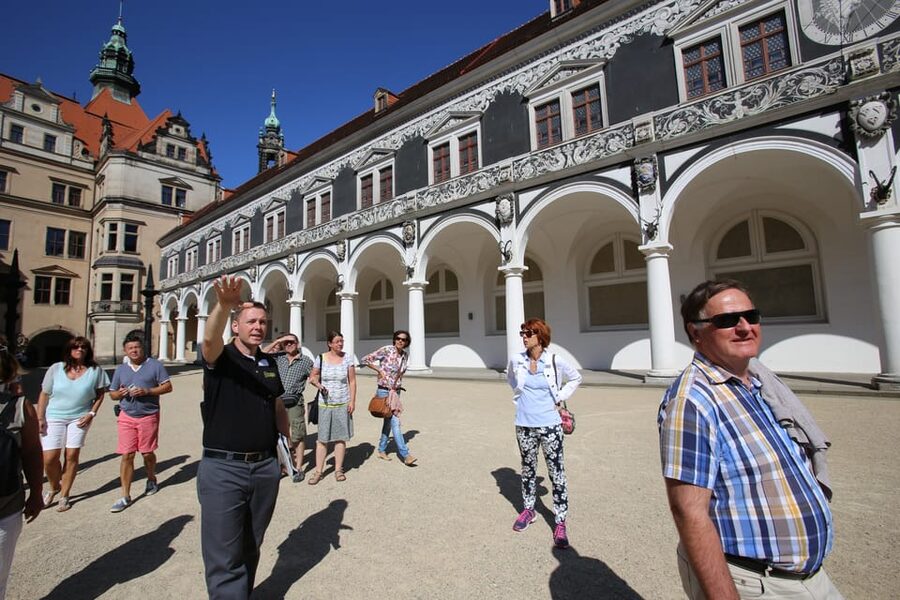
At $15 per person, this is a strong-value introduction to Dresden. You are getting 90 minutes with a live English-speaking guide, a small-group format, historical explanation, and local advice for less than the cost of many formal attractions.
The value comes from what is included: interpretation. You can walk past the Frauenkirche, Zwinger, Royal Castle, and Semper Opera for free, but you will not automatically understand how they connect. The guide gives you a framework that can improve the rest of your time in Dresden.
The price does not appear to include museum admission or extended interior visits. If you want to explore the Royal Palace collections or spend an afternoon inside the Zwinger museums, budget separately.
For a first morning or afternoon in Dresden, I think the price works particularly well. You can use the tour to identify the places worth returning to, then spend your independent sightseeing time more carefully.
Who will enjoy this walk most
This tour suits first-time visitors who want a clear introduction without committing to a half-day program. It also works well for anyone who prefers local stories and historical context over a simple checklist of photo stops.
You will probably enjoy it most if you:
- Want a short orientation in English
- Like architecture but also want political and social history
- Prefer a small group where questions are easy
- Need ideas for restaurants, shopping, nightlife, or events
- Are comfortable seeing many sights from the outside
- Want a wheelchair-accessible activity
Families can book, but there is a limit of four children’s tickets per adult. The 90-minute length is manageable for many families, though the experience remains a history-focused walking tour rather than a children’s activity.
Booking details worth keeping in mind
The meeting point is the seating area of the Tourist Information in the basement of QF Passage. Arrive with enough time to find the basement location rather than waiting outside the main attractions.
The activity costs $15 per person, is offered in English, and has starting times that vary by availability. You can reserve now and pay later, which is useful if you are still arranging a Germany itinerary.
Free cancellation is available up to 24 hours before the start time for a full refund. The activity is listed as wheelchair accessible, and the tour has a small-group format.
Recent guides have included Franziska, whose patient explanations and local background were especially appreciated. Another departure described a guide as polite, patient, and well-informed. Since guide assignments can vary, book this for the route and format first, while treating the individual guide as an added benefit.
Should you book the Dresden walking tour?
Yes, if you want a short, affordable introduction to Dresden’s old town and its layered past. The route covers the city’s most important central sights, while the guide adds the wartime and 1989 stories that architecture alone cannot show you.
I would book it early in your stay, then return to the Frauenkirche, Zwinger, Royal Palace, or museums that interest you most. Skip it if you want long indoor visits or a slow architectural study of each building. At $15, though, it is an easy choice for most first-time visitors who want to get their bearings and hear Dresden explained by someone local.
FAQ
How long does the Dresden walking tour last?
The tour lasts 1.5 hours, or 90 minutes.
What language is the tour offered in?
The tour is conducted in English with a live English-speaking guide.
Where does the tour meet?
Meet at the seating area of the Tourist Information in the basement of QF Passage.
How much does the tour cost?
The listed price is $15 per person.
Which Dresden sights are included?
The route includes the Frauenkirche, Neumarkt, Palace Stables, Procession of Princes, Brühl Terrace, Catholic Cathedral, Royal Palace, Semper Opera House, Taschenbergpalais, Augustus Bridge, and parts of the Zwinger Palace.
Does the tour include the Nyphembad?
Yes. A visit to the mysterious Nyphembad in the Zwinger Palace is included.
Is the walking tour wheelchair accessible?
Yes, the activity is listed as wheelchair accessible.
Can I cancel the tour for a refund?
Yes. You can cancel up to 24 hours in advance for a full refund. You can also reserve now and pay later.
Just added around Dresden
- Test Drive Electric Vehicles from the VW brand (ID. model)★ 4.8 · 190 reviews
- SRF CoBi | City Tour by ConferenceBike★ 4.7 · 38 reviews
- Dresden: Scavenger Hunt to Elbe River & Castles★ 4.7 · 15 reviews
- Dresden: Bike Rental – City Bike with Option Children Seat★ 4.5 · 13 reviews
- Moritzburg: Scavenger Hunt Self-Guided Walking Tour★ 4.8 · 12 reviews
- Historical tour of the old town including a Saxon dinner★ 4.7 · 23 reviews
- Climb the mountains together with goats★ 4.8 · 8 reviews
- From Prague: Day trip to Dresden★ 4.3 · 4 reviews
Walking Tours, compared.





Berlin’s Best: 2 Hour Walking Tour Third Reich and the Cold War
Read our review →


Third Reich Berlin: Hitler and WWII Walking Tour
Read our review →Browse the lists this tour appears in