
Reviewed · WALKING TOURS
Dresden: Private Guided Walking Tour
Dresden’s old town is a compact lesson in power, art, war, and rebirth. This private walk takes you from the church-filled Neumarkt to the grand Zwinger, Dresden Castle, and the Elbe-facing Brühl’s Terrace, while your guide connects more than 1,000 years of local history.
I like the private format, which lets your group ask questions and set the pace, and I like the wide historical range, from medieval Dresden to the events of 1989. The main caution is practical: one recent booking reported that no guide appeared and that a refund had not yet arrived, so confirm your meeting details carefully before setting out.
In This Review
- Key points
- Why Dresden’s old town works so well on foot
- Neumarkt and the rebuilt Frauenkirche
- Semperoper and Dresden’s artistic reputation
- The Zwinger, where Baroque Dresden goes big
- Dresden Castle and the royal center
- Procession of Princes and Stallhof
- Dresden Cathedral and Taschenbergpalais
- Brühl’s Terrace and Augustus Bridge
- From medieval Dresden to the Peaceful Revolution
- Group size, pacing, and accessibility
- Is $212 good value for your group?
- Booking advice and one important caution
- Who should book this Dresden walk?
- Should you book it?
- FAQ
- How long does the Dresden private walking tour last?
- What is the price of the tour?
- Where does the tour meet?
- Where does the walking tour finish?
- Which Dresden sights are included?
- What languages are available?
- Is the tour private?
- Is the walking tour wheelchair accessible?
- Can I cancel the booking for a refund?
Key points
- A focused two-hour route: See Dresden’s main old-town sights without spending a full day on foot.
- Baroque Dresden at its grandest: The Zwinger, Semperoper, Dresden Castle, and Procession of Princes form the visual core.
- History beyond pretty buildings: The tour covers the Middle Ages, Renaissance, Baroque rule, wartime destruction, East Germany, and the Peaceful Revolution.
- Private group of up to 25: Useful for families, colleagues, and groups that want a guide devoted to them.
- English or German guiding: Other languages require a special request.
- Good local orientation: Ask your guide about restaurants, events, and what to see after the walk.
Why Dresden’s old town works so well on foot
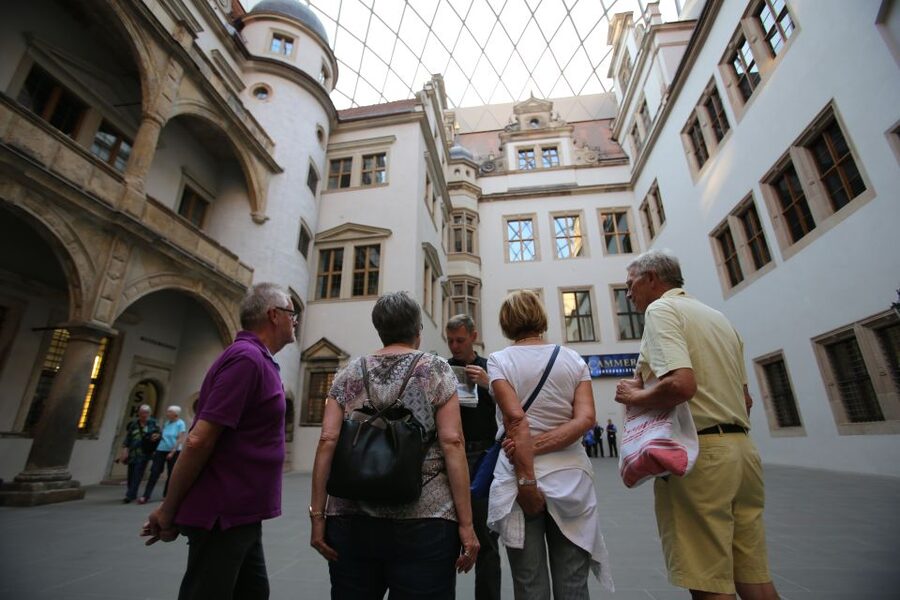
Dresden is one of those cities where the past is easiest to understand from a pavement, not through a coach window. The principal sights sit close together around Neumarkt, the castle district, and the riverfront. In two hours, you can get a clear first look at the city’s grand center and learn how its different eras fit together.
The route begins at Dresden Information in the QF Passage, on the basement floor at Neumarkt 2. That location is convenient for the old town, but give yourself enough time to find the correct level. The guide meets you there before leading the group into the historic center.
This is a walking tour, not an interior tour of every monument. That distinction matters. You will see the buildings, hear their stories, and get an introduction to Dresden’s city plan, but entrance fees and long visits inside museums are not part of the two-hour schedule.
The private setup is especially useful if your group includes children, older relatives, or people with very different interests. You can ask why a building was rebuilt, how Dresden changed under East German rule, or where to eat that evening. A public tour may offer a lower per-person price, but a private group gives you more room to guide the conversation.
A few more Dresden trips to weigh up
- Dresden: City & Semperoper Guided Walking Tour
★ 4.8 · 2,293 reviews - Dresden: Guided City Walk with a Cup of Coffee
★ 4.7 · 1,568 reviews - Dresden: Complete Walking Tour with Frauenkirche Visit
★ 4.8 · 700 reviews
Neumarkt and the rebuilt Frauenkirche
Neumarkt is the natural starting point because it puts you in the middle of Dresden’s best-known historic quarter. The square is dominated by the Frauenkirche, whose rounded stone form and huge dome shape the city’s visual identity.
Your guide can use the church and square to explain Dresden’s Baroque ambitions. This was not modest architecture. The court wanted a city that projected wealth, artistic taste, and political influence, and the buildings around the center were designed to make that message plain.
Frauenkirche also opens the door to Dresden’s 20th-century story. The city suffered severe destruction during the Second World War, and the church remained a ruin for decades before being rebuilt. Its return is closely tied to Dresden’s wider effort to restore its historic center while remembering what happened to it.
I find this opening valuable because it prevents the Baroque buildings from becoming mere decoration. You begin to see the old town as a place shaped by ambition, destruction, division, and repair.
The tour finishes near Frauenkirche, so you can return to the church, explore Neumarkt, or use the area as a base for lunch after the walk. Ask the guide for restaurant and event suggestions while you still have the city’s layout fresh in your mind.
Semperoper and Dresden’s artistic reputation
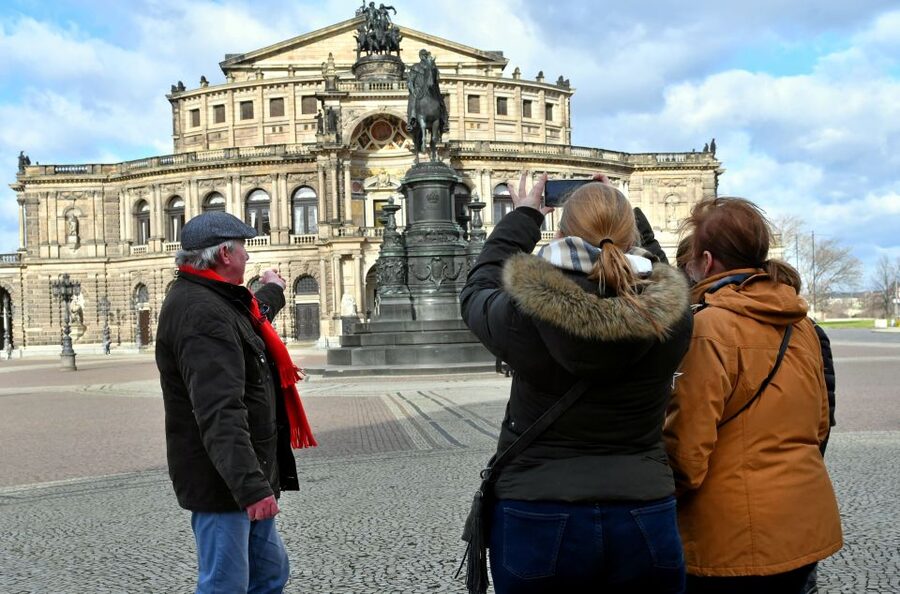
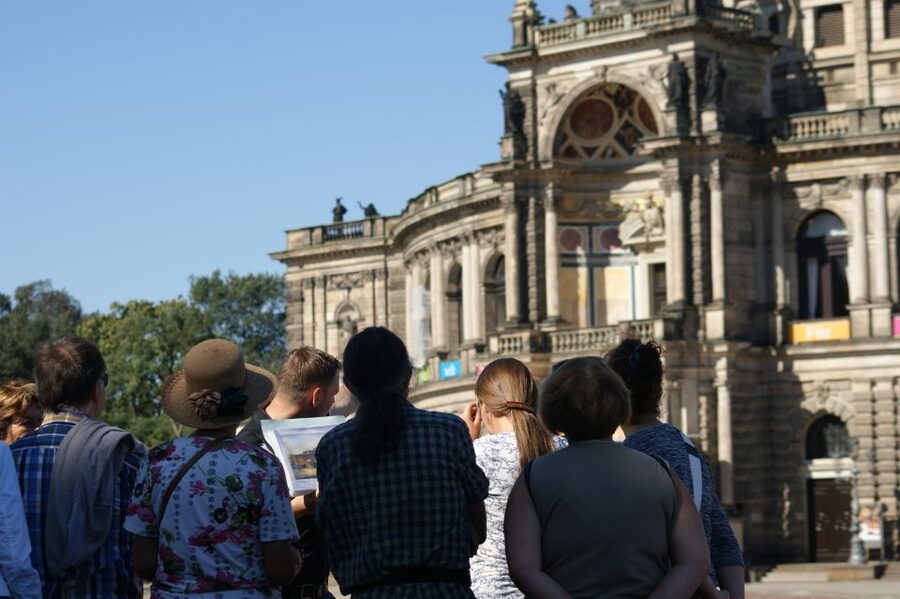
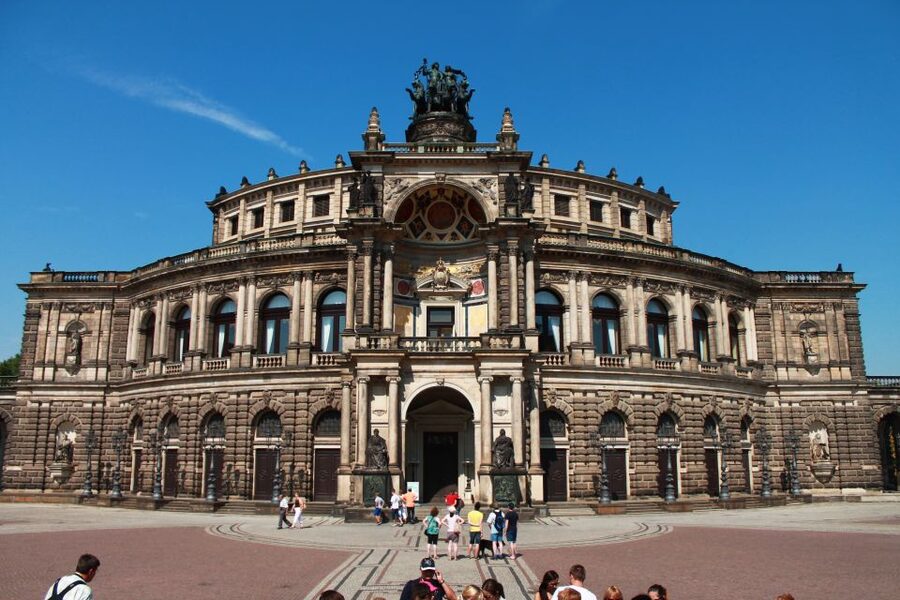
The route includes Semperoper, Dresden’s famous opera house and one of the city’s most recognizable buildings. Even from outside, its scale and formal design help explain why Dresden became known for court culture and the arts.
The opera house is part of a larger story about Dresden’s rulers and their desire to draw artists, architects, musicians, and craftsmen to the city. A good guide can turn the facade into a short lesson in how culture served both entertainment and political image.
You should expect exterior commentary rather than a full performance-house visit. That is a benefit if your main goal is orientation, but it may feel brief if you are hoping for detailed information about the interior or opera program.
The guide’s anecdotes are meant to keep the history moving. Recent guide names associated with this experience include Frau Schulz and Idiko, though the guide assigned to your booking may be different. The strongest feedback has singled out friendly, experienced guides who adjusted well to the group and mixed serious history with humor.
That flexibility matters. Dresden’s story includes difficult subjects, and a guide who can explain them clearly without turning the walk into a lecture makes the two-hour format much easier to enjoy.
The Zwinger, where Baroque Dresden goes big
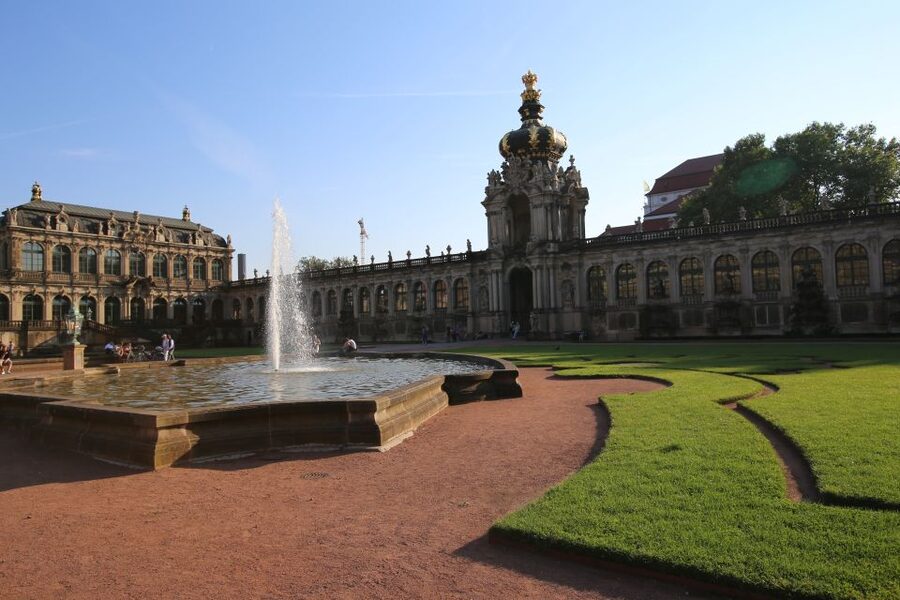
The Baroque Zwinger is one of the walk’s major visual rewards. Its courtyards, pavilions, sculptures, and sweeping architectural lines show Dresden at its most theatrical.
The word Baroque can sound like a textbook label, but here it is easy to understand. The Zwinger was built to impress. Its design served court festivals and public display, and its ornament tells you that Dresden’s rulers wanted visitors to see their wealth and reach.
A guide can point out how the complex fits into the old town and explain its relationship to the royal court. You will not have time to cover every museum or collection inside the Zwinger, so consider this stop a strong introduction rather than a substitute for a museum visit.
The route works well for first-time visitors because the Zwinger is close to other major sights. After the tour, you can return on your own if you want more time with the courtyards or exhibitions. The walking tour helps you decide where to spend that extra time.
For photographers, the Zwinger offers several changes of scale. You see large court architecture, detailed sculpture, and enclosed spaces within a short walk. The guide’s historical context adds meaning to what could otherwise be a quick stop for photographs.
Same city, a completely different kind of day:
- Dresden: Semperoper Tickets and Guided Tour
★ 4.7 · 12,102 reviews - Dresden: The Original Night Watchman Tour in Lantern Light
★ 4.6 · 6,653 reviews - Dresden: Semperoper and Old Town Tour
★ 4.8 · 5,735 reviews - Dresden: River Sightseeing Boat Cruise
★ 4.3 · 5,323 reviews
Dresden Castle and the royal center

From the Zwinger, the walk continues toward Dresden Castle. This was the center of court power for centuries, and its location helps you understand how tightly packed the old royal district is.
The castle connects the artistic side of Dresden with the political one. The same court that sponsored grand buildings and cultural events also shaped the city’s government, ceremonies, and public image. Your guide can place the castle beside the opera house, cathedral, and other nearby buildings so the old town feels like one planned royal stage.
The tour does not promise a museum visit inside the castle. That is worth noting if you have your heart set on the Historic Green Vault or other collections. Those require more time than this walk allows, and you should plan them separately.
Still, the exterior setting is useful. You get a clear sense of how Dresden’s rulers organized their world, and you can ask the guide which castle interiors are most worthwhile for a later visit.
Procession of Princes and Stallhof
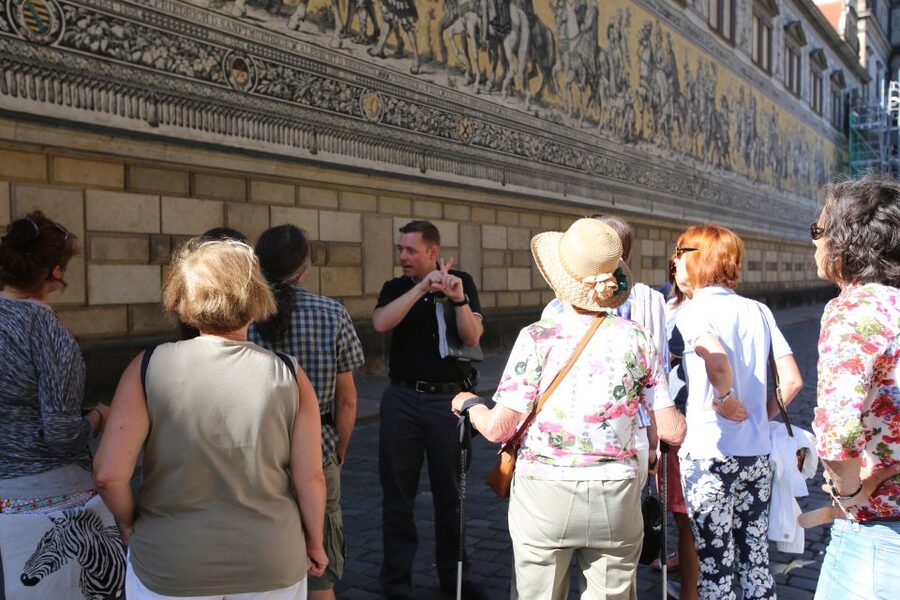
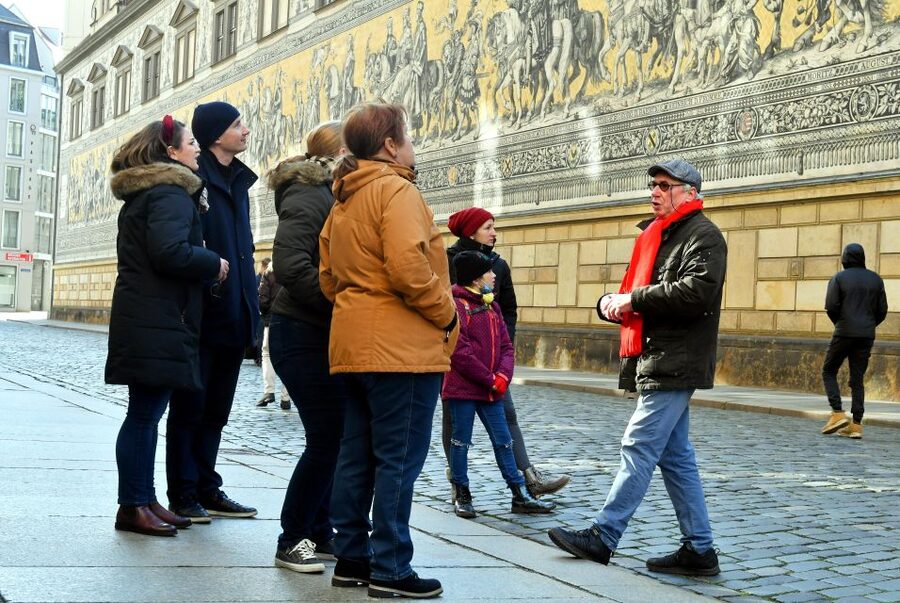
The Procession of Princes is one of Dresden’s most distinctive public artworks. This long ceramic mural presents a procession of rulers and gives the walking route a visual way to discuss dynasties, memory, and civic identity.
It is the kind of sight that benefits from a guide. On your own, you can admire the scale and detail, but you may not know what the figures represent or why the work matters to Dresden. A short explanation turns a wall into a timeline.
Nearby Stallhof adds another piece of the former court complex. Its name and design recall the activities of the royal stable yard and ceremonial center. Together, the mural and courtyard help you picture how court life once moved through these spaces.
The stop is also a reminder that Dresden’s old town is not just a collection of isolated monuments. Walk a few minutes and the function of the buildings changes, from worship to opera, royal residence, ceremony, and public display.
Dresden Cathedral and Taschenbergpalais
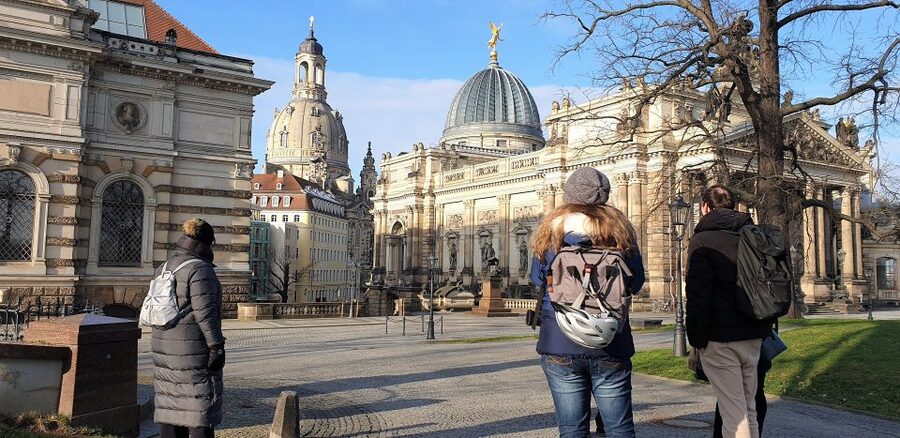
Dresden Cathedral appears later in the route, bringing a religious building into the royal district. Its position near the castle helps explain the close links between faith and court power in the historic center.
The cathedral is another place where exterior viewing may leave you wanting more. If the doors are open and time permits, your guide may help you understand what to look for, but the scheduled experience is a walking overview, not a dedicated church visit.
The route then passes Taschenbergpalais, a palace associated with Dresden’s courtly center. This stop helps fill in the spaces between the famous landmarks. You are not simply moving from one postcard view to another; you are following the network of palaces, ceremonial areas, churches, and public routes that made the old center function.
I like this middle section because it gives the tour more substance. The best city walk does not only point at the most famous facade. It shows you how the pieces relate.
Brühl’s Terrace and Augustus Bridge
Brühl’s Terrace offers a change of mood and viewpoint. Known as the Balcony of Europe, it runs along the Elbe and gives you a sense of Dresden beyond its tight central squares.
The terrace is a good place to pause and look outward. After several stops focused on palaces and churches, the riverfront opens the scene and helps you understand Dresden’s position on the Elbe. It also gives the guide a natural point for discussing how the city changed over time.
The route includes Augustus Bridge before returning toward Frauenkirche. The bridge links the old town with the wider city and provides another useful orientation point. You can see how close the central sights are and how the river shapes Dresden’s layout.
Because the walk lasts only two hours, this section may feel more like a viewpoint and transition than a long riverfront stroll. That is fine for a first visit. You get the view without giving up too much time at the main historic sites.
From medieval Dresden to the Peaceful Revolution
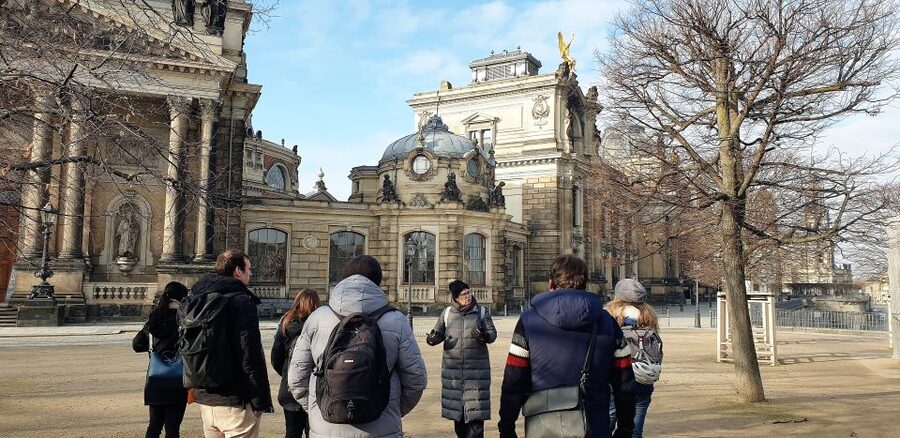
The most valuable part of the tour may be its time range. Dresden’s story is not limited to Baroque splendor. The guide is expected to cover the Middle Ages, the Renaissance, the royal era, the difficult years of the 20th century, and the Peaceful Revolution of 1989.
That final period is especially important for understanding modern Dresden. The city was part of East Germany, and the walk addresses what life and change meant for people on both sides of the former East and West German divide.
You should listen for the human scale of these stories. Dates and rulers matter, but so do questions about daily life, political control, protest, and the sudden changes that followed 1989. The supplied tour information promises both large events and small anecdotes, which is the right balance for a short city walk.
This historical range also helps explain why Dresden can feel visually unified yet historically layered. Rebuilt Baroque facades, royal monuments, and modern German memory all occupy the same compact center.
Group size, pacing, and accessibility
The tour is private for your group, with a maximum of 25 people. That is a fairly large private group, so do not picture an intimate walk with only two or three participants unless your own booking is small.
For a family or office group, the format offers clear value. You are not sharing the guide with strangers, and you can ask for explanations suited to your group. A party of 20 or 25 should expect less personal conversation than a couple or small family, simply because more people need to hear and move together.
The duration is two hours. That is enough for the listed old-town circuit, but it is not enough for long interior visits, extended coffee stops, or a relaxed museum tour. Wear comfortable shoes and keep your expectations focused on outdoor sights and historical orientation.
The experience is listed as wheelchair accessible. Since this is a walking route through the historic center, it is sensible to state any specific mobility needs when booking, especially if your group needs a particular pace or meeting arrangement.
Guiding is available in English and German. If you need another language, you must send a request rather than assume it will be available.
Is $212 good value for your group?
The price is $212 for a group of up to 25 people. At the maximum size, that works out to about $8.48 per person, which is strong value for a private, licensed guide covering Dresden’s main old-town sights.
The calculation changes for a small party. Two people would effectively pay $106 each, and four people would pay $53 each. For a couple, a public group walk may be cheaper. For a family reunion, school group, wedding party, or company outing, the fixed group rate becomes much more attractive.
The value also comes from time saved. In two hours, you get a planned route linking Neumarkt, Frauenkirche, Semperoper, Zwinger, Dresden Castle, Brühl’s Terrace, the Procession of Princes, Stallhof, Dresden Cathedral, Taschenbergpalais, and Augustus Bridge. You can then return to the places that interest you most.
The guide also provides local suggestions for restaurants and events. That is a small inclusion, but it can be useful on a short stay when you do not want to spend your first evening guessing where to go.
Booking advice and one important caution
Free cancellation is available up to 24 hours before the tour for a full refund, and you can reserve now and pay later. Those terms make the booking easier to fit around a changing itinerary.
Check the meeting point closely: Dresden Information, Neumarkt 2, in the QF Passage basement floor. The exact location matters because Neumarkt is a busy historic area with several entrances and nearby attractions.
One booking reported that no guide arrived and that a refund had not been received. That is a serious concern, even though the overall score is 4.5 from 81 ratings and the supplied feedback contains strong praise for guides such as Frau Schulz and Idiko. I would save the confirmation, verify the date and meeting place, and contact the provider promptly if anything changes.
Who should book this Dresden walk?
I would choose this tour for a group that wants a clear introduction before exploring Dresden on its own. It suits first-time visitors, families, colleagues, and anyone who prefers a private guide to a large public group.
It is also a good match for people who want history with their architecture. You will hear about the Middle Ages, Renaissance, Baroque court, East Germany, and 1989, not just receive a list of building names.
I would hesitate if you want extensive time inside museums, a highly specialized architecture tour, or a full-day examination of Dresden’s wartime history. The two-hour route is a broad overview. Its strength is coverage and context, not deep attention to a single monument.
Should you book it?
Book this private Dresden walking tour if your group values a personal guide, wants to see the old town’s major sights in a short time, and appreciates a history lesson that reaches from medieval Dresden to modern Germany.
The fixed price is especially fair for larger groups. Small parties should compare it with public walks, but the private format may still be worthwhile if you want to ask questions and get restaurant or event advice.
Go in knowing that the tour is mainly an outdoor overview and that guide availability should be confirmed carefully. With that practical point handled, this is a sensible way to get your bearings in Dresden and understand why its rebuilt Baroque center matters.
FAQ
How long does the Dresden private walking tour last?
The tour lasts two hours.
What is the price of the tour?
The price is $212 for a private group of up to 25 people.
Where does the tour meet?
Meet the guide at Dresden Information, Neumarkt 2, 01067 Dresden, in the QF Passage basement floor.
Where does the walking tour finish?
The walk concludes near Frauenkirche.
Which Dresden sights are included?
The route includes Frauenkirche, Semperoper, the Baroque Zwinger, Dresden Castle, Brühl’s Terrace, the Procession of Princes, Stallhof, Dresden Cathedral, Taschenbergpalais, and Augustus Bridge.
What languages are available?
The tour is offered in English or German. A different language requires a special request.
Is the tour private?
Yes. It is a private group tour, with a maximum group size of 25 people.
Is the walking tour wheelchair accessible?
Yes, the activity is listed as wheelchair accessible.
Can I cancel the booking for a refund?
You can cancel up to 24 hours in advance for a full refund. You can also reserve now and pay later.
Just added around Dresden
- Test Drive Electric Vehicles from the VW brand (ID. model)★ 4.8 · 190 reviews
- SRF CoBi | City Tour by ConferenceBike★ 4.7 · 38 reviews
- Dresden: Scavenger Hunt to Elbe River & Castles★ 4.7 · 15 reviews
- Dresden: Bike Rental – City Bike with Option Children Seat★ 4.5 · 13 reviews
- Moritzburg: Scavenger Hunt Self-Guided Walking Tour★ 4.8 · 12 reviews
- Historical tour of the old town including a Saxon dinner★ 4.7 · 23 reviews
- Climb the mountains together with goats★ 4.8 · 8 reviews
- From Prague: Day trip to Dresden★ 4.3 · 4 reviews
Walking Tours, compared.





Berlin’s Best: 2 Hour Walking Tour Third Reich and the Cold War
Read our review →


Third Reich Berlin: Hitler and WWII Walking Tour
Read our review →Browse the lists this tour appears in