
Reviewed · CONCENTRATION CAMP MEMORIAL TOURS
Berlin: Sachsenhausen Concentration Camp Bus Tour in English
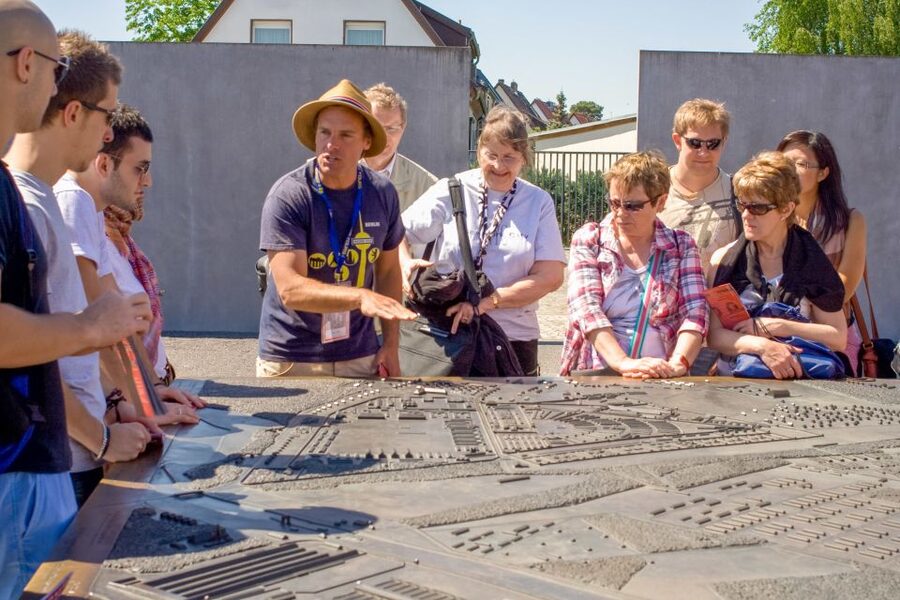
Sachsenhausen is not a casual day trip. It is a place of murder, forced labor, disease, and calculated cruelty. This four-hour tour takes you from central Berlin to the memorial by bus, then gives you two hours to walk through the former camp with a guide who explains how the system worked and what happened to the people trapped inside it. Ariel, Paul, Jamie, Nickolai, and Lewis are among the guides praised for clear, respectful storytelling.
I like the air-conditioned bus because Sachsenhausen is outside Berlin and the memorial is not right beside the station. I also like the commentary during the ride, which gives you useful context before you arrive instead of leaving you to face the site with only a map. The main drawback is time: two hours at the memorial is enough for a strong introduction, but not enough to see every building at a slow pace.
In This Review
- Key points at a glance
- Why Sachsenhausen matters
- Meeting at Friedrichstraße station
- The ride to Oranienburg
- Entering through Tower A
- Barracks and daily prisoner life
- Infirmaries and medical crimes
- Punishment, execution, and cremation areas
- The commandant and the machinery behind the camp
- What the guides add
- Is $49 good value?
- Practical advice for the four-hour visit
- Who should book this Sachsenhausen tour?
- FAQ
- Where does the Sachsenhausen tour start?
- How do I find the guide?
- How long is the bus ride to Sachsenhausen?
- How much time do I spend at the memorial?
- What does the $49 price include?
- What should I bring?
Key points at a glance
- 50-minute bus ride each way: Travel directly from Friedrichstraße instead of arranging the train connection and long walk to the memorial entrance.
- Two hours inside Sachsenhausen: See Tower A, prisoner barracks, infirmaries, isolation cells, crematoria, the gas chamber area, and the execution trench.
- English and Spanish guiding: The guide speaks during the ride and at the camp, with past guides including Ariel, Paul, Jamie, Lewis, and Nickolai.
- A serious historical focus: Learn how Sachsenhausen was planned for control, expansion, forced labor, punishment, and mass death.
- $49 includes the basics: Transport, a licensed guide, entry, a €3 memorial donation, and a camp map are covered.
- Central Berlin meeting point: Meet outside Friedrichstraße station, beside the Tränenpalast, and look for a yellow umbrella.
Why Sachsenhausen matters
Sachsenhausen was built in 1936 as a model concentration camp for the Nazi system. Its layout was designed from the start to make control easier and expansion possible. That detail matters because the site was not an improvised prison that grew by accident. Its buildings, sight lines, gates, work areas, and punishment spaces were part of an organized system.
During your visit, the guide connects the physical remains to that system. You hear about the daily routines forced on prisoners, the work they performed, the punishments used against them, and the administrative chain that made the camp operate. The camp was also linked to a much wider network of Nazi camps, so the visit helps you understand Sachsenhausen as part of a national machine rather than an isolated place.
The memorial records that about 35,000 people were murdered or died from disease at Sachsenhausen. The number is difficult to grasp in the abstract. Walking through the gate, the barracks, and the treatment areas gives that figure a human and physical setting. This is the value of visiting with a guide: you are not simply looking at old walls. You are learning what each space was intended to do.
The tour also addresses what people outside the wire knew. You hear about the camp’s place in the surrounding town and the way forced labor affected local life. The exact amount that ordinary residents understood is a difficult historical question, and a good guide treats it with care rather than offering a simple answer.
More Concentration Camp Memorial Tours in Berlin
- Berlin: Sachsenhausen Concentration Camp Tour in English
★ 5.0 · 5,711 reviews - Berlin: Sachsenhausen Concentration Camp Memorial Tour
★ 4.7 · 3,716 reviews - Sachsenhausen Concentration Camp Bus Tour in English from Berlin
★ 5.0 · 1,962 reviews
Meeting at Friedrichstraße station
The standard meeting point is outside Friedrichstraße train station, on the square between the station and the Tränenpalast, also called the Palace of Tears. The address is Reichstagufer 17, 10117 Berlin.
Look for a guide wearing a blue lanyard and yellow name tag, holding a yellow umbrella. That bright umbrella is useful in a busy city square, but do not cut your arrival too close. Friedrichstraße is a major transport point, and finding the correct side of the station can take a few minutes.
Hotel pickup is not included for the regular group tour. Private options may include pickup, with the guide arriving five minutes before the start time. Check the option you choose carefully, since the meeting arrangement can vary.
The tour ends back at the meeting point, with Reichstagufer 17 listed as the Berlin drop-off location. That makes it easy to continue sightseeing or take the train elsewhere, though you may want a quiet break after the visit rather than scheduling a packed activity immediately afterward.
The ride to Oranienburg
The bus ride to Sachsenhausen takes about 50 minutes. This is more than a transfer. The guide uses the journey to explain Berlin’s wartime setting, the Nazi camp system, and the role of Oranienburg before you reach the memorial.
That early explanation improves the visit. Without it, the first moments at the camp can feel confusing because the grounds are large and the surviving structures are spread out. You arrive with a basic map in your head: entrance, prisoner area, work zones, infirmaries, punishment spaces, and killing facilities.
The route also passes through Oranienburg, where prisoners were forced to work. Seeing the town beyond the camp boundary helps you consider the relationship between the camp and the wider population. Sachsenhausen was not completely detached from normal life. Prisoners worked in and around the area, while the camp’s administration and labor system affected the town.
The vehicle is air-conditioned and transportation is included in the $49 price. That is a practical advantage on a cold, wet, or hot day. It also saves you from organizing the regional train journey and the walk from Oranienburg station to the memorial site. The bus is one of the strongest reasons to choose this tour over visiting independently.
Entering through Tower A
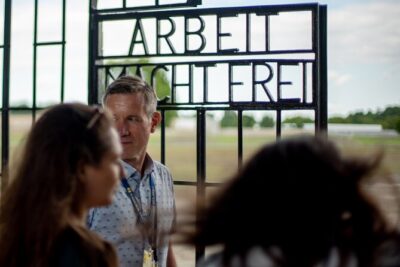
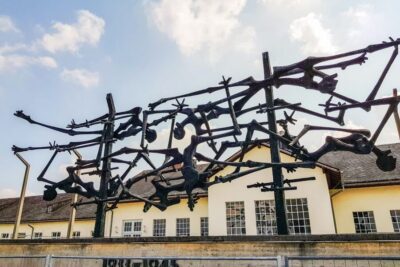
At the memorial, the tour begins with the camp entrance and Tower A. The gate carries the Nazi slogan Arbeit Macht Frei, or work sets you free. Here, the words are not a slogan to admire. They were part of a system of deception and terror, placed where prisoners would see them as they entered.
The entrance is one of the most recognizable points at Sachsenhausen, but the guide gives it needed context. You learn how the gate controlled movement and how the camp’s planned design supported surveillance. The visit becomes more meaningful when you understand that the geometry of the site was tied to power.
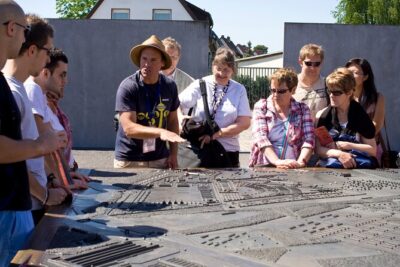
The central area can feel stark and open. Much of the original camp is gone, while other structures remain as memorial spaces. A map is included, and you should keep it with you. It helps you follow the tour and understand the difference between surviving buildings, reconstructed elements, and marked locations.
Your guide leads the group through the camp rather than leaving you to work out the route alone. Guides such as Jamie, Paul, Ariel, and Nickolai have been praised for explaining difficult material clearly and answering questions without losing sight of the subject’s seriousness.
Same city, a completely different kind of day:
- Berlin: Reichstag, Dome and Government District Guided Tour
★ 4.7 · 18,288 reviews - Berlin: 1-Hour City Tour by Boat with Guaranteed Seating
★ 4.3 · 16,993 reviews - Berlin: Boat Tour Along the River Spree
★ 4.4 · 11,252 reviews - Discover Berlin Half-Day Walking Tour
★ 5.0 · 9,624 reviews
Barracks and daily prisoner life
The barracks show the cramped, controlled conditions prisoners faced. The tour explains daily routines, forced labor, discipline, and the brutal treatment used to break people physically and mentally.
The word barracks can sound ordinary until you consider their purpose. These were not simple dormitories. They were part of a system that reduced people to numbers, labor capacity, and obedience. The guide helps you connect the building to the routines that filled it: sleeping, roll calls, work, hunger, illness, and punishment.
The experience is largely about listening and observing rather than rushing from one dramatic object to another. You walk, stop, hear an explanation, and take in the space. Comfortable shoes are essential because the memorial visit involves substantial walking across a large former camp site.
Some people may find the pace too quick. Two hours sounds long, but the memorial contains more information than a short tour can cover. You get a well-planned overview, not a complete study of every surviving building or exhibit. If you already have a strong academic interest in Sachsenhausen, plan to return independently with more time.
Infirmaries and medical crimes
The infirmary barracks are among the most difficult areas on the route. Here, you learn about illness, medical care under camp conditions, and experimentation carried out during the war.
The camp’s medical facilities reveal the contradiction at the heart of the Nazi system. A place called an infirmary could offer little real protection to prisoners who were starved, exhausted, abused, or sick. It could also become a site of experimentation and further harm.
A careful guide handles this part without turning suffering into spectacle. The most praised guides, including Lewis, Ariel, and Nickolai, are described as respectful and sensitive while still explaining the facts plainly. That balance matters. You need enough detail to understand what occurred, but you should never feel that the visit is being treated like entertainment.
Punishment, execution, and cremation areas
The tour includes isolation cells, punishment cells, the execution trench, crematoria, and the gas chamber area. These spaces explain the camp’s methods of punishment and killing, as well as the attempt to hide or manage the evidence of mass death.
The crematoria and gas chamber area are especially sobering. Your guide places them within the wider camp system and explains how killing facilities operated alongside forced labor, starvation, disease, and punishment. Sachsenhausen was not only a prison. It was a place where different forms of violence worked together.
The execution trench makes the camp’s violence feel immediate and physical. It is a quiet place, but the purpose of the space is clear. The memorial does not need theatrical effects. The ground, buildings, and careful explanation do the work.
Bring a camera if you wish, since photography is listed among the recommended items, but use judgment. A camera can help you remember the layout and details, yet this is a memorial site rather than a standard sightseeing stop. Keep your attention on the place and on the people whose lives are being discussed.
The commandant and the machinery behind the camp
The commandant’s house offers a different view of Sachsenhausen. The prisoner barracks show the experience of those held inside. The commandant’s house points toward the people who planned, managed, and benefited from the camp’s operation.
That contrast is important. The camp did not run by itself. Orders had to be issued, records kept, guards assigned, labor organized, punishments approved, and supplies managed. The guide connects the offices and residences to the larger structure of Nazi rule, including Heinrich Himmler’s effort to create a modern, controlled concentration camp system.
This part of the visit helps you avoid seeing the camp only as a collection of tragic rooms. You learn about administration and responsibility. The violence was organized by people making decisions, not caused by an impersonal force.
What the guides add
The guide is the most important variable in a historical tour. The names change, but the experience has included English-speaking guides such as Ariel, Paul, Jamie, Nickolai, Lewis, Joseph, Martin, Rebecca, Scott, and Dr. Thomas.
Their roles go beyond reciting dates. Joseph, for example, has been praised for discussing Berlin landmarks during the ride and offering ideas for food and further sightseeing afterward. Jamie has been noted for continuing the historical explanation during the bus transfers. Paul has connected Sachsenhausen with wider German history, including war and government.
The strongest guiding style here is direct and calm. You need a guide who can explain the Nazi camp system, answer questions, and remain sensitive when the subject becomes especially painful. The experience has received a 4.9 rating from 709 reviews, and the repeated praise centers on clear explanations, respectful delivery, strong organization, and helpful bus transport.
No tour can guarantee a particular guide unless your booking option says so. Still, the range of names and consistent praise suggests that the company has a broad team able to handle the material well. English and Spanish tours are available.
Is $49 good value?
At $49 per person, the price is fair for a four-hour outing. You receive the return bus ride, driver, professional licensed guide, entry to the memorial, a €3 donation, and a camp map.
The bus is the key value. You avoid planning the train connection and the long walk from the station to the memorial entrance. You also receive commentary on the way there and back, which gives the transport real purpose.
Visiting independently may allow more time on site and a slower pace. It can also suit you if you want to read every panel, revisit certain areas, or spend much of the day at the memorial. The guided tour suits you better if you have limited time in Berlin, want the route organized, or prefer historical explanation as you walk.
The return journey is also useful. It gives you a chance to ask final questions and place the visit within Berlin’s wider history. It may be an intense ride back, so allow yourself some quiet time afterward.
Practical advice for the four-hour visit
Wear comfortable walking shoes and dress for the weather. The memorial visit takes place outdoors across a broad area, and rain or wind can make the grounds tiring. Bring a light snack and a drink, as these are specifically recommended.
Alcohol and drugs are not allowed. Keep your clothing practical rather than formal, and bring only what you need for the bus and walking portion.
Free cancellation is available up to 24 hours before the tour for a full refund. You can also reserve now and pay later, which helps if your Berlin schedule is still shifting. Starting times vary, so check availability for the date you want.
This is not a tour for children who are unprepared for the subject, though the supplied information does not set a specific age rule. I would explain the nature of the visit in advance to anyone in your group who may find accounts of murder, disease, experimentation, and camp punishment overwhelming.
Who should book this Sachsenhausen tour?
Book it if you have four hours, want a guide, and prefer a direct bus from central Berlin. It is especially useful for a first visit, a short stay, or anyone who wants the camp’s layout and Nazi administration explained in plain English.
Choose an independent visit if you want more than two hours inside the memorial or prefer to set your own pace. The guided tour covers a great deal, but it cannot give every building and exhibit the time they deserve.
For most visitors, I would book the tour. The bus removes the awkward part of getting there, the included entry and donation simplify the cost, and the guide gives the memorial a clear historical frame. Go prepared for a serious, quiet experience, and leave space afterward to think about what you have seen.
FAQ
Where does the Sachsenhausen tour start?
Meet outside Friedrichstraße train station, on the square between the station and the Tränenpalast, also called the Palace of Tears. The listed address is Reichstagufer 17, 10117 Berlin.
How do I find the guide?
Look for a guide wearing a blue lanyard and yellow name tag and holding a yellow umbrella.
How long is the bus ride to Sachsenhausen?
The bus or coach journey takes about 50 minutes each way.
How much time do I spend at the memorial?
The guided visit at Sachsenhausen lasts about two hours.
What does the $49 price include?
The price includes a professional licensed guide, transport in a private air-conditioned vehicle, a driver, Sachsenhausen Memorial entry, a €3 donation per person, and a map of the former camp.
What should I bring?
Bring comfortable walking shoes, weather-appropriate clothing, a light snack, and a drink. A camera is also listed as something you can bring.
Just added around Berlin
- Love and War in Berlin: Self-Guided Story Puzzle Walk★ 5.0 · 7 reviews
- Rickshaw Tours Berlin – Groups of up to 16 people with several rickshaws★ 4.0 · 97 reviews
- Walking on the Wall: 3-Hour Tour in Berlin★ 4.5 · 34 reviews
- eSIM for Germany and 34 European Countries★ 4.5 · 16 reviews
- Your ticket to The Wall Museum Berlin★ 3.0 · 60 reviews
- Warnemuende Shore Excursion: Private Berlin Tour★ 4.5 · 27 reviews
- Warnemuende Shore Excursion: Berlin Private Sightseeing Tour from Rostock★ 5.0 · 4 reviews
- Berlin’s Gay, Lesbian, and Queer Scene Small-Group Walking Tour★ 4.5 · 66 reviews
Concentration Camp Memorial Tours, compared.
Sachsenhausen Concentration Camp Tour in English
Read our review →
Dachau Concentration Camp Memorial Site Tour from Munich by Train
Read our review →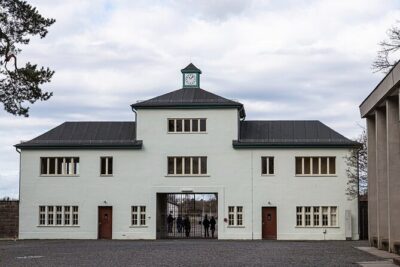
Sachsenhausen Concentration Camp Memorial Tour
Read our review →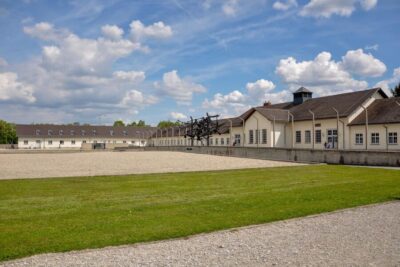
Sachsenhausen Concentration Camp Bus Tour in English from Berlin
Read our review →Sachsenhausen Concentration Camp Tour in English
Read our review →
Sachsenhausen Concentration Camp Memorial Tour (Max. 15 Guests)
Read our review →Browse the lists this tour appears in