
Reviewed · WALKING TOURS
Schwerin: Private Guided Walking Tour
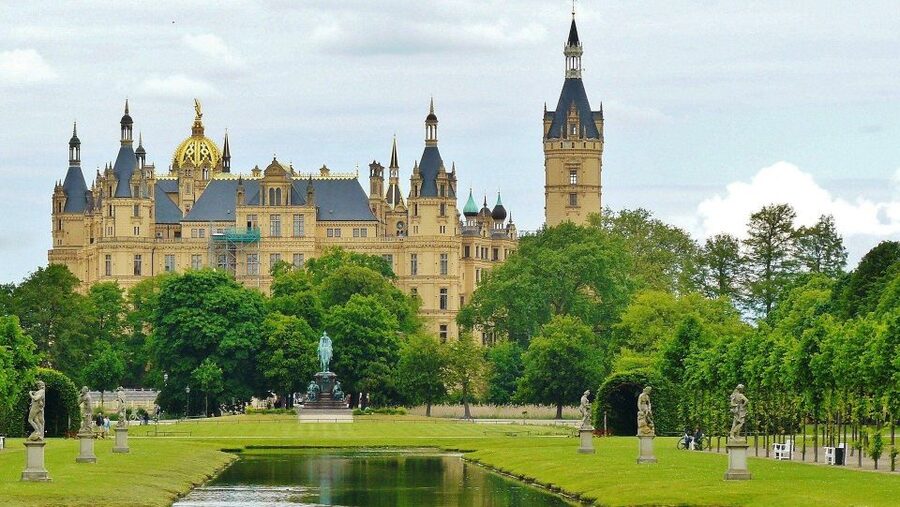
Schwerin Palace is the star here: a romantic castle on an island in Lake Schwerin, often called the Neuschwanstein of the North. This private walk uses the palace as a starting point, then opens up the city’s medieval streets, cathedral, and later political history. I like the small private format and the chance to ask for a route that fits your interests.
I also like that the tour reaches beyond pretty buildings. You’ll hear why Schwerin Cathedral once drew pilgrims from across Europe, and how the Reformation, the Thirty Years’ War, Napoleon, and German unification changed the city. Guides Jürgen and Theresa have both received especially warm praise for clear, engaging explanations. The main drawback is price: $280 per group is fair for a larger party, but steep for one or two people, and entrance fees are extra.
In This Review
- Key points to know before booking
- Starting at Schwerin Palace on Lake Schwerin
- Schwerin Palace, the city’s romantic centerpiece
- Medieval Schwerin and the cathedral’s unusual claim
- The old town and the survival of historic streets
- From the Reformation to the Thirty Years’ War
- Napoleon, German unification, and a changing city
- What the guide adds to the experience
- Is $280 good value for your group?
- Who should book this Schwerin walk?
- Practical advice for a smooth visit
- Should you book it?
- FAQ
- Where does the Schwerin walking tour meet?
- How long does the tour last?
- What languages are available?
- Is this a private tour?
- How many people can join for the listed price?
- Are entrance fees included?
- Does the tour visit Schwerin Palace?
- Can the route be adjusted?
- Can I cancel for a full refund?
- Do I have to pay when I reserve?
Key points to know before booking
- Schwerin Palace begins the story: Meet in front of the castle on Lennéstraße and use its island setting to get your bearings.
- A private guide changes the pace: Your group can ask questions and request more attention to selected periods or sights.
- Medieval pilgrimage is part of the tour: Schwerin Cathedral is linked to a reputed drop of Christ’s blood.
- The old town remains a major draw: Schwerin suffered only minor damage in World War II, so many historic streets survived.
- The 90-minute length is focused: You get a useful introduction, not an exhaustive museum visit.
- Budget for admission separately: Entrance fees are not included in the $280 group price.
Starting at Schwerin Palace on Lake Schwerin
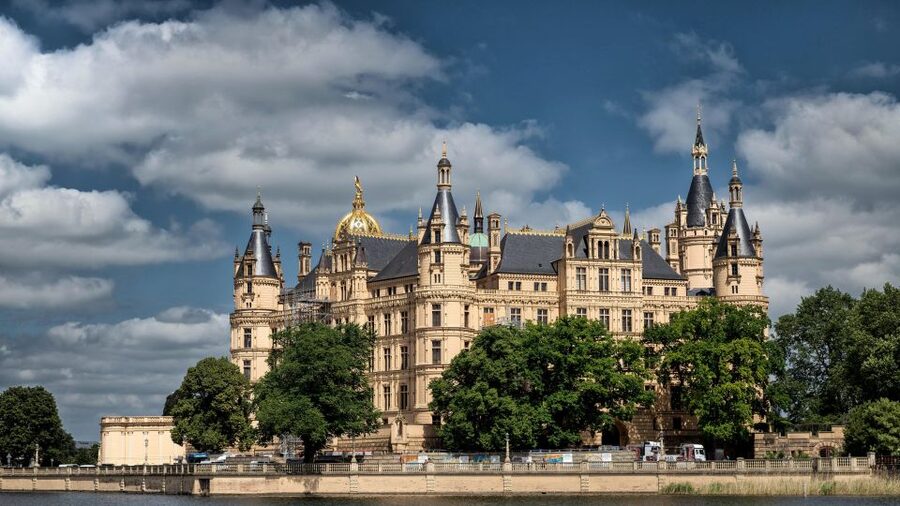
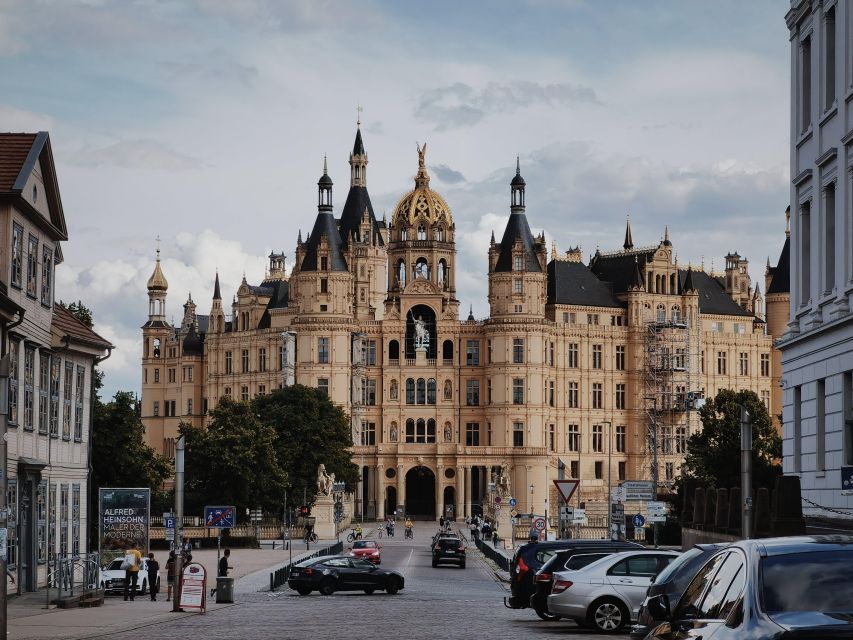
The tour begins in front of Schwerin Castle at Lennéstraße 1, 19053 Schwerin. That is a sensible meeting point because the palace gives you the city’s most memorable first view: towers, ornate façades, water, and the island setting all arrive at once.
Schwerin is surrounded by seven lakes and is Germany’s smallest state capital by land area. That makes the opening scene feel surprisingly grand for a relatively compact city. The palace is not just a photogenic stop. It gives your guide a clear way into Schwerin’s political story, from princely power to the city’s place in later German history.
You should pay close attention to the meeting instructions. One person found the wording unclear and waited at the entrance connected with the museum, while the intended point was the entrance to the palace courtyard. The confusion was eventually sorted out, but it cost time. The safest practical move is to confirm exactly which castle entrance your guide means, especially if the courtyard entrance is closed on a weekday.
The tour is on foot and lasts 90 minutes. Wear comfortable shoes, but you do not need to prepare for a long hike. The format is best understood as a guided introduction to Schwerin, with the castle and old town as the main settings.
A few more Germany trips to weigh up
- Discover Berlin Half-Day Walking Tour
★ 5.0 · 9,624 reviews - Berlin: Third Reich and Cold War 2 Hour Walking Tour
★ 4.9 · 6,830 reviews - Munich: Third Reich & WWII Walking Tour
★ 4.6 · 6,181 reviews
Schwerin Palace, the city’s romantic centerpiece
The palace deserves its nickname, Neuschwanstein of the North, though the comparison is more about romance and appearance than size or setting. Here, the castle rises from an island in Lake Schwerin, surrounded by water rather than mountain peaks. That setting gives you a strong sense of why Schwerin became such an appealing royal residence.
Your guide can use the palace to explain the city’s power structure and changing fortunes. The tour description promises a look at Schwerin’s role during the Napoleonic era and the unification of Germany, so the castle is more than a stop for photographs. It is the visual anchor for a wider political story.
Entrance fees are not included. That matters because a walking tour beginning at the palace does not automatically mean you receive a full interior visit. Ask your guide how the route handles the castle and decide if you want to pay separately for admission. The 90-minute schedule may allow only a selected look at the palace area rather than a full museum visit.
I would treat the castle as the grand opening and the old town as the part that gives the tour texture. The palace catches your eye quickly. The smaller streets and historic details help explain how daily life developed around it.
Medieval Schwerin and the cathedral’s unusual claim
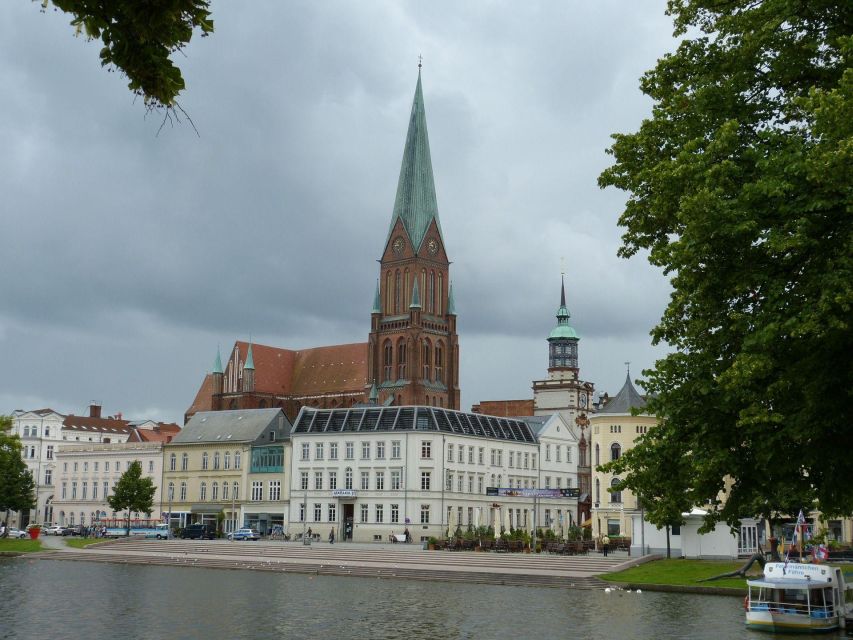
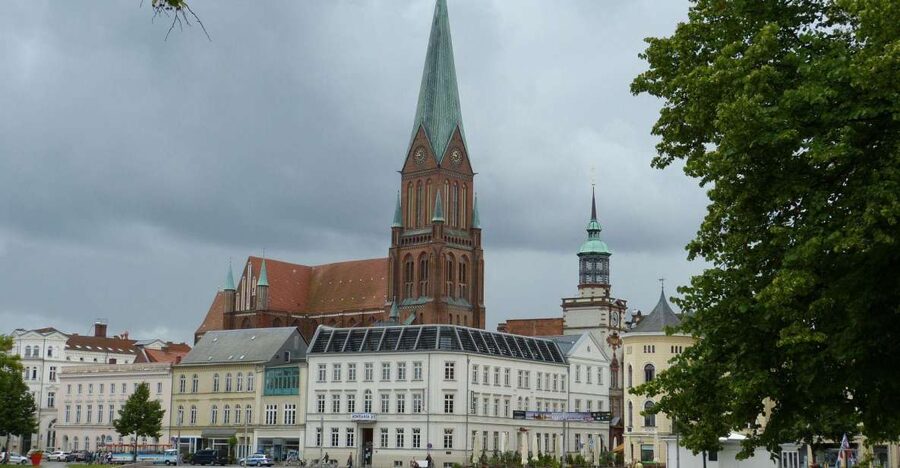
Schwerin’s roots reach back to at least 1018, and it was recognized as a city in 1160. Those dates give the walk a useful timeline, but the real value comes from seeing how the early settlement grew into the town you walk through today.
In the Middle Ages, Schwerin Cathedral was the center of town life. It was also known across Europe for reputedly holding a drop of Christ’s blood. That relic made the cathedral an important pilgrimage destination and helps explain why this building mattered well beyond the city itself.
A guide can make this point more useful than a plaque does. You are not only looking at a church. You are learning why people traveled to Schwerin, what drew them there, and how religious objects could shape a city’s importance. The cathedral also gives the tour a human scale after the large, formal palace.
This is one of the strongest reasons to choose a private guide rather than simply walk around with a map. You can ask how the cathedral fit into medieval life, or request more attention to religious history if that interests you. If your group prefers architecture, you can instead keep the focus on the building and the surrounding streets.
The old town and the survival of historic streets
Schwerin has a largely intact old town, with only minor damage during World War II. For you, that means the walking portion should feel coherent. Instead of seeing isolated historic buildings surrounded by modern replacements, you can follow a connected urban story through the center.
The tour promises beautiful streets as well as major landmarks. That balance matters. A city is easier to understand when you see the spaces between the headline sights: the routes people used, the relationship between civic buildings and churches, and the way the old center connects back to the palace.
One especially useful detail from the tour experience is the chance to step into places that might not appear on a standard checklist. A guide named Jürgen adjusted one group’s route because they already had a night watchman tour planned for later. The walk then focused on different details, including a visit to the oldest house and a stop inside a wild game butcher’s shop.
That example shows what possible customizing on the spot can mean in practice. It does not promise access to every private business or historic building, but it shows why you should tell your guide what else you plan to do in Schwerin. If you have a night tour, museum visit, or limited time, say so at the start.
Same city, a completely different kind of day:
- Berlin: Reichstag, Dome and Government District Guided Tour
★ 4.7 · 18,288 reviews - Berlin: 1-Hour City Tour by Boat with Guaranteed Seating
★ 4.3 · 16,993 reviews - Hamburg: Sex and Crime in St. Pauli Tour for Ages 18+
★ 4.7 · 15,447 reviews - Hamburg: 1.5-Hour Harbor and Speicherstadt Day Cruise
★ 4.6 · 14,200 reviews
From the Reformation to the Thirty Years’ War
The tour also places Schwerin within two major upheavals: the Protestant Reformation and the Thirty Years’ War. These subjects can become a blur of dates, so the advantage of a guide is connecting them to the streets and institutions around you.
The Reformation changed religious life, church authority, and politics across German lands. In a city where the cathedral had long drawn pilgrims, that shift was especially important. The Thirty Years’ War then brought further political and religious conflict across central Europe. You may not get every military detail in a 90-minute walk, but you should come away with a clearer sense of how these events affected Schwerin.
This part of the tour is likely most valuable for visitors who want context rather than a quick photo stop. The palace and cathedral look attractive on their own. The historical explanation tells you why their roles changed and why Schwerin’s identity is not limited to its romantic appearance.
The private format helps here because you can stop the guide when a period needs more explanation. Guides Jürgen and Theresa are specifically associated with an easy, understandable approach. That suits a short tour, where clarity matters more than an overloaded list of facts.
Napoleon, German unification, and a changing city
The final historical stretch reaches into the Napoleonic era and German unification. These subjects show how Schwerin moved from medieval religious importance to the political changes of the modern German state.
Napoleon’s influence reshaped territories and power relationships across Germany. Later, unification altered the meaning of local governments and princely states. Schwerin’s palace and civic center provide a useful setting for discussing those changes because the buildings make political history visible.
Do not expect a full lecture on nineteenth-century Germany. Ninety minutes requires choices. Instead, think of this section as a framework that helps you place Schwerin within a wider story. If you are especially interested in Napoleon or unification, ask your guide to give those years more time.
That ability to steer the conversation is one of the tour’s clearest strengths. The guide is with your group only, so you do not have to follow the interests of a large mixed audience. One group found that the guide shaped the tour around what they wanted to see and avoided repeating subjects covered on another planned walk.
What the guide adds to the experience
The guide matters more here than any formal activity. This is a short walking tour through a city that can be explored independently, so the experience earns its price through explanation, local judgment, and flexibility.
Jürgen is named several times in the available feedback. His approach is described as clear, relaxed, interesting, and easy to follow. Theresa is also singled out for a very strong performance. Another guide was praised for local knowledge and for adapting the route to the group’s wishes.
That pattern points to the main benefit: you get a person who can decide what deserves your attention. The strongest moments may not be the most famous sights. They may be the oldest house, a local shop, a detail in a side street, or an explanation of why a cathedral once drew pilgrims.
The tour is available in English or German. If your group has mixed language needs, confirm which language you want when booking. Since the tour is private, the language choice should be simpler than on a large shared walk.
Is $280 good value for your group?
The listed price is $280 for up to 15 people. For a full group, that works out to about $18.67 per person, which is quite reasonable for a private guide. For four people, it is $70 each. For two people, it becomes $140 each, before any admission fees.
That makes group size the key value question. Families, friends, and organized groups can spread the cost and gain the benefits of a private route. A couple may still prefer it for the personal attention, but the price is much harder to justify if you mainly want a quick orientation.
The 90-minute length also helps keep the commitment manageable. You can use it at the start of your Schwerin visit, then return to the palace, cathedral, or old town sights that caught your attention. It is less suitable if you want a full-day historical program or an extended interior tour.
The price includes a local professional guide who stays with your group. It does not include entrance fees. You are paying for the guide’s time and the private format, not a bundled ticket package.
The flexible booking terms add practical value. You can reserve now and pay later, and cancellation is free up to 24 hours before the start for a full refund. Check available starting times before booking, since the 90-minute duration does not by itself tell you which departure times are offered.
Who should book this Schwerin walk?
I would choose this tour if you want a clear first look at Schwerin and prefer conversation to a recorded audio guide. It is especially well suited to people who enjoy history but do not want to spend hours reading signs.
It also fits families and small groups with different interests. One person can ask about the palace, another about medieval religion, and another about the Napoleonic period. The guide can adjust the emphasis instead of delivering the same fixed speech to everyone.
The tour is a good match for repeat visitors, too. If you already know the main square or have another evening walk planned, tell the guide. You may be able to focus on less obvious details, such as the oldest house or local businesses along the route.
I would think twice if you want a guaranteed, detailed interior tour of Schwerin Palace. Admission is separate, and the 90-minute walk has several historical themes to cover. Ask in advance how much time will be spent inside or around the castle.
Practical advice for a smooth visit
Meet at the castle, but confirm the exact entrance. The clearest lesson from the meeting-point mix-up is that the phrase in front of Schwerin Castle can cover more than one obvious place. Arrive early enough to sort this out without losing tour time.
Tell the guide your priorities right away. You might want the medieval cathedral story, the palace, the old town, or the later German political eras. You can also mention any other tour you have booked so the guide can avoid unnecessary overlap.
Keep the admission issue in mind. If you want to enter the palace or another paid site, fees are not part of the tour price. Ask what can fit into the schedule before paying for tickets.
Finally, bring questions. This is where a private walk earns its keep. A short question about the cathedral relic, the palace’s political role, or Schwerin’s survival during World War II can turn a basic city stroll into a much more useful introduction.
Should you book it?
Book it if you are visiting Schwerin for the first time, have at least four people in your group, and want the palace, cathedral, old town, and major turning points explained in one compact walk. The private format and flexible route are the strongest reasons to choose it.
For one or two people, compare the cost carefully. The $280 price can still make sense if personal attention matters more than saving money, but it is not a bargain at that size. Also confirm the castle meeting point and ask about any entrance you hope to make.
Overall, this is a focused way to get beyond Schwerin’s pretty façade. The palace draws you in, the cathedral adds medieval purpose, and the old streets connect the city to the Reformation, wartime upheaval, Napoleon, and German unification. For a private group that values a local guide and a tailored conversation, it is a strong choice.
FAQ
Where does the Schwerin walking tour meet?
The meeting point is in front of Schwerin Castle at Lennéstraße 1, 19053 Schwerin.
How long does the tour last?
The walking tour lasts 90 minutes.
What languages are available?
The tour is available in English and German.
Is this a private tour?
Yes. It is arranged for a private group, with a local professional guide accompanying only your group.
How many people can join for the listed price?
The $280 price covers a group of up to 15 people.
Are entrance fees included?
No. Entrance fees are not included in the tour price.
Does the tour visit Schwerin Palace?
The tour begins at Schwerin Castle and includes discovering the palace and its importance. Since entrance fees are separate, confirm with the guide how much of the visit will be inside the palace.
Can the route be adjusted?
Possible customization with the local guide is offered on the spot. Tell the guide what interests you most and mention other tours you have planned.
Can I cancel for a full refund?
Yes. You can cancel up to 24 hours in advance for a full refund.
Do I have to pay when I reserve?
No. The reserve now and pay later option allows you to book without paying anything today.
Just added around Germany
- Aachen old town tour – GERMAN (public)★ 5.0 · 24 reviews
- Aachen Private Walking Tour With A Professional Guide★ 5.0 · 11 reviews
- Cologne Highlights: Exclusive Private Tour★ 5.0 · 5 reviews
- Bremen Private Walking Tour With A Professional Guide★ 5.0 · 7 reviews
- Private Walking Tour through the Fascinating Bremen’s City Center★ 5.0 · 5 reviews
- Explore Cologne’s best Street Art Quarter★ 4.5 · 4 reviews
- Bremen Exploration Private Game and City Tour on your Phone★ 4.5 · 7 reviews
- e-Scavenger hunt Bremen: Explore the city at your own pace★ 4.0 · 24 reviews
Walking Tours, compared.





Berlin’s Best: 2 Hour Walking Tour Third Reich and the Cold War
Read our review →

