Reviewed · PRIVATE
Private Taxi Tour of Berlin East and West and Neighbourhood approx. 4-6h
Berlin is too spread out to understand well from a single square. This private taxi tour connects the old East and West, the Wall, government quarter, grand boulevards, rebuilt districts, and lively neighborhoods in four to six hours. Guide Gunter Bauer supplies the running story, while the car saves your feet for the stops that matter.
I like the personal pickup and private vehicle, especially for families or anyone who cannot walk far. I also like the mix of famous places and less obvious details, from the bullet scars of wartime buildings to the former border crossings and Berlin’s changing neighborhoods. The drawback is that this is mainly a driving survey, not a series of long museum visits, and the small vehicle may feel tight for four people.
In This Review
- Key points to know before booking
- Why a taxi makes sense in sprawling Berlin
- The Reichstag and Brandenburg Gate set the tone
- Potsdamer Platz shows Berlin’s awkward rebirth
- Unter den Linden and the old royal center
- Museum Island, Hackesche Höfe, and Humboldt Forum
- The Wall, Checkpoint Charlie, and the Topography of Terror
- Tiergarten, the Victory Column, and West Berlin
- Ku’damm, KaDeWe, and modern Berlin culture
- East Side Gallery, Oberbaum Bridge, and Kreuzberg
- Price, comfort, and who should book
- Should you book this Berlin taxi tour?
- FAQ
- How long does the private Berlin taxi tour last?
- Where is pickup included?
- Is the tour private?
- Is the tour offered in English?
- Can children use a car seat?
- Are admission tickets included?
- Can the route be changed?
Key points to know before booking
- A citywide orientation by taxi: Cover central Berlin, former East Berlin, Kreuzberg, Tiergarten, Charlottenburg, and the Wall corridor without changing trains.
- Gunter’s strongest asset: He brings years of local experience, explains architecture and politics in plain language, and can tailor some stops to your interests.
- Several useful walks: Expect short visits at the Brandenburg Gate, Hackesche Höfe, Humboldt Forum, East Side Gallery, Checkpoint Charlie, and other major sites.
- A smart choice for limited mobility: The car can usually get close to sights, and the tour includes an air-conditioned vehicle, parking, and WiFi.
- A fast look at both halves of Berlin: You see how the city was split, rebuilt, and reshaped after reunification.
- Plan around traffic: Some stops may be shortened or skipped, including Friedrichstrasse, Alexanderplatz, East Side Gallery, Oberbaum Bridge, and parts of Kreuzberg.
Why a taxi makes sense in sprawling Berlin
Berlin’s main sights are scattered across a large area. The Brandenburg Gate and Reichstag sit near the Spree, Museum Island lies farther east, the Wall’s best-known surviving art is by the river in Friedrichshain, and the grand shopping streets run west toward Charlottenburg.
On foot, you would spend much of a day simply moving between these districts. Public transportation is excellent, but changing lines takes time and can make it harder to follow the city’s story. In a private taxi, Gunter can point out buildings as you pass, pull over near key sights, and adjust the route to traffic.
This is not a hop-on, hop-off bus. Your group has the vehicle and guide to itself. That makes conversation easier, and Gunter contacts you before the tour to ask what interests you. Still, it helps to send a clear priority list. Some people found that the planned route received more attention than their requested stops, so speak up early if you want to trade a general sight for a particular museum, neighborhood, or memorial.
A few more Berlin trips to weigh up
- Berlin: Private Reichstag and Glass Dome Tour
★ 4.8 · 2,226 reviews - Berlin Private Complete History All Day Walking Tour
★ 5.0 · 474 reviews - Private Walking Tour Berlin Third Reich Hitler and World War II
★ 5.0 · 360 reviews
The Reichstag and Brandenburg Gate set the tone
The tour usually begins around the government quarter, where Berlin’s past and present meet in a tight area. The Reichstag is a magnificent Wilhelminian building with a complicated political life. The Red Army flag photograph associated with its capture was recreated rather than taken exactly as the famous image suggests, but the building itself became a major symbol of Nazi defeat and German reunification.
For decades, the Reichstag sat just five meters from the Wall on the West Berlin side. It was not permitted to host regular Bundestag sessions during the division of Germany. After reunification, the building was gutted and redesigned for a parliament of more than 700 members. The glass dome, added after architect Norman Foster’s redesign, now expresses a more open style of government.
You may also hear about Christo’s well-known wrapping project, which temporarily covered the building and turned it into an international art event. The tour does not treat the Reichstag as a single postcard view. It uses the building to explain how Berlin moved from empire to dictatorship, division, and democracy.
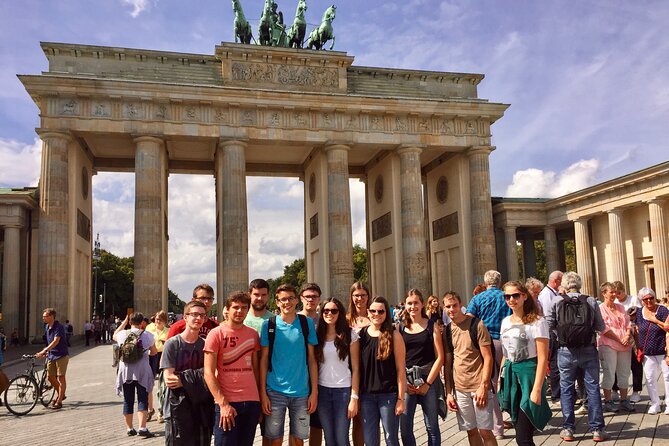
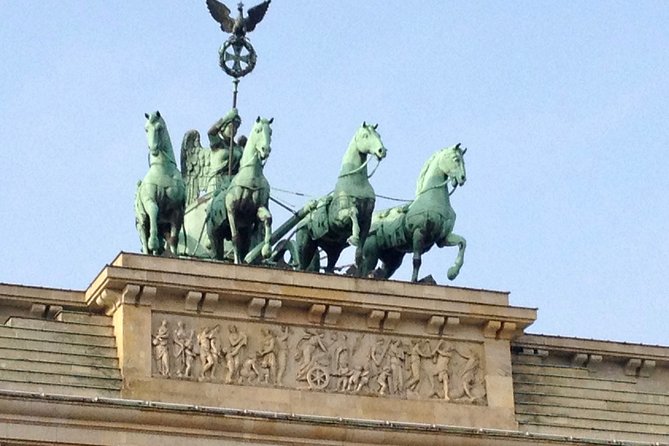
At the Brandenburg Gate, you get one of the tour’s most important short walks. Pariser Platz is Berlin’s formal front room, framed today by the Academy of the Arts, the Liebermannhaus, and the French and American embassies.
The open square can feel timeless, but it was once a lonely relic. War destroyed the surrounding buildings, and later the Wall blocked access from both sides. The surviving gate once resembled Paris’s isolated Arc de Triomphe, with barriers and fences replacing the normal flow of city life. After 1989, the surrounding buildings were rebuilt in modern form, using the earlier street pattern and scale.
Take time here for photographs and a close look at the gate. This is one of the places where a short walk adds real value to the drive.
Potsdamer Platz shows Berlin’s awkward rebirth
Potsdamer Platz was a major traffic and nightlife center before World War II. As many as 100,000 vehicles passed through daily in the 1920s, while restaurants and entertainment venues filled the surrounding streets.
The Wall later cut through the area, leaving a dead zone at the center of Berlin. After reunification, major corporations rebuilt it with glass towers, offices, hotels, shops, and entertainment venues. The Sony Center and Mercedes complex are the most recognizable results.
I find this stop useful because it explains both the ambition and the limits of new Berlin. The district was designed to bring back a lively urban center, but parts of it can feel planned from a boardroom rather than grown from local life. Gunter also points out the former Hotel Esplanade, whose surviving historic rooms were moved 75 meters to make space for the new development.
The nearby Abgeordnetenhaus, or Berlin House of Representatives, adds another layer. The building once served as the Prussian Landtag, later became an officers’ mess and a socialist planning office, and now houses Berlin’s state parliament. Around it are traces of the Wall, the Gropius Bau, and the Topography of Terror.
Unter den Linden and the old royal center
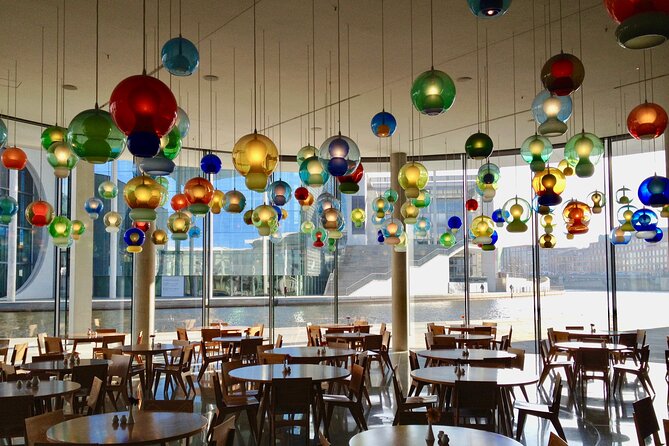
The drive along Unter den Linden introduces Berlin’s grandest historic axis. What began as a royal bridle path from the Berlin Palace toward the hunting grounds became a formal boulevard lined with palaces, universities, libraries, and the State Opera.
The name means under the linden trees, and the central planting gives the avenue its familiar look. The route passes the State Library, Humboldt University, and other major buildings linked to Prussian power and German scholarship.
The Bebelplatz area, once called Opernplatz, is a worthwhile pause. The Royal Court Library, St. Hedwig Cathedral, State Opera, and Humboldt University form the Forum Fridericianum. A glass panel in the pavement recalls the Nazi book burning of May 10, 1933. Beneath it is an empty library, a quiet memorial to censorship and destruction.
The square also shows how royal buildings were reused. Humboldt University began as a palace for Prince Heinrich, younger brother of Frederick the Great, before becoming the nucleus of the university.
At the Neue Wache, you see a former guardhouse that now honors victims of war and tyranny. The interior contains Käthe Kollwitz’s enlarged Pietà, inspired by her son, who died in World War I. The memorial’s meaning is broader than its imperial setting, and official wreath-laying ceremonies still take place here.
Nearby, the former Soviet embassy makes a blunt statement about postwar power. Its huge scale was intended to show who controlled central Berlin after 1945. Today it serves the successor states of the Soviet Union.
Same city, a completely different kind of day:
- Berlin: Reichstag, Dome and Government District Guided Tour
★ 4.7 · 18,288 reviews - Berlin: 1-Hour City Tour by Boat with Guaranteed Seating
★ 4.3 · 16,993 reviews - Berlin: Boat Tour Along the River Spree
★ 4.4 · 11,252 reviews - Discover Berlin Half-Day Walking Tour
★ 5.0 · 9,624 reviews
Museum Island, Hackesche Höfe, and Humboldt Forum
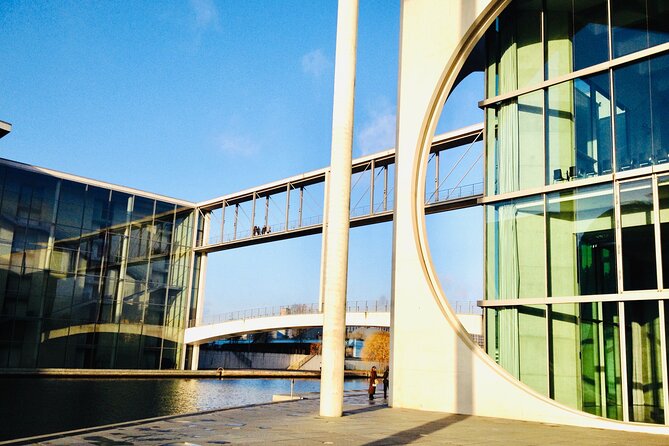
East Berlin’s older center comes into focus at Hackesche Höfe. Built in 1908, this connected group of courtyards was designed to combine housing, workspaces, small factories, workshops, and shops. It deteriorated during the GDR period and was later restored in its Art Nouveau style.
The courtyards now contain shops and displays, including Königliche Porzellan-Manufaktur pieces and Berlin’s cheerful Ampelmännchen traffic-light figure. The area is touristy, but the design still lets you see how dense Berlin living once worked. Ask for a short walk here rather than viewing it only through the taxi window.
The Humboldt Forum occupies the site of the former Berlin Palace. The palace was damaged in the war and demolished by the East German government, despite protests. The reconstructed exterior follows the historic design, while the interior is modern and houses non-European collections and material connected with Humboldt University.
The roof terrace is a major attraction. One family specifically arranged a visit to the top and found the city view memorable. If you want to go inside, ask Gunter in advance. A driving tour cannot guarantee time for every interior, and some observation facilities have limited opening days.
The Nikolaiviertel offers another reconstructed version of old Berlin. Most of what you see here was rebuilt in the 1980s, when the GDR tried to recreate a compact historic quarter. The Nikolaikirche is the oldest church in Berlin and now serves as a city museum. The nearby Knoblauchhaus, furnished in Biedermeier style, provides a glimpse of family life in a cloth-making household.
The area is scenic and pleasant for a short walk, though it is best understood as a carefully staged reconstruction rather than an untouched medieval neighborhood.
The Wall, Checkpoint Charlie, and the Topography of Terror
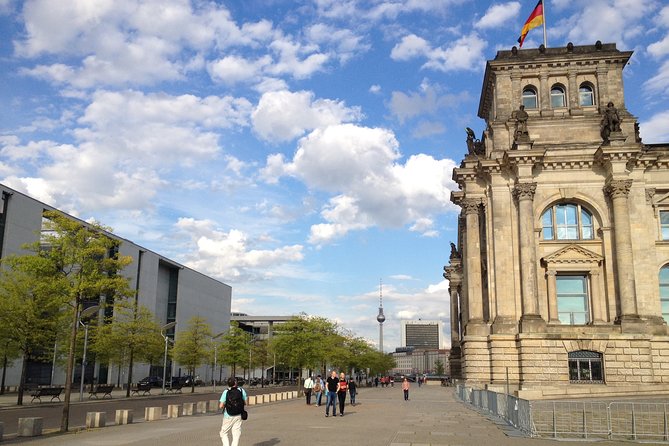
Berlin’s divided past receives the most attention in the central section of the route. At Invalidenfriedhof, Gunter explains the death of Günter Litfin, who was shot while trying to swim through a harbor after the Wall went up. One of the last surviving watchtowers is connected with this story.
Berlin Central Station then shows the modern answer to the city’s old railway problem. The enormous station has underground and elevated tracks spread over five levels. It replaced Berlin’s collection of terminal stations with a central interchange, though the decision reduced long-distance service at Bahnhof Zoo, once the key station of West Berlin.
At Friedrichstrasse Station, you learn how closely travel and surveillance were linked. During the Wall years, it was the only station where trains could continue between East and West Berlin. East Berliners leaving through it often had no return ticket. The adjacent Palace of Tears recreates the barriers and checkpoints where families said goodbye.
Checkpoint Charlie is more famous than it is visually impressive today. The original Allied checkpoint buildings are gone, replaced by a replica guardhouse and a crowded commercial setting. Its importance lies in the 1961 tank confrontation, when American and Soviet forces faced each other at close range. That standoff could have triggered a much larger conflict.
The Topography of Terror is one of the most useful stops. The documentation center and excavated remains occupy the site of former SS, Gestapo, and police offices. This was where Nazi security agencies planned persecution and interrogated prisoners. The exhibitions connect the physical location with the machinery of dictatorship.
A surviving section of Wall runs along Niederkirchnerstrasse, beside the documentation center and today’s Finance Ministry. It is short, battered, and full of holes, but that makes it more direct than a polished monument. If time is tight, Gunter may combine or omit parts of this section, so tell him which Wall site matters most to you.
Tiergarten, the Victory Column, and West Berlin
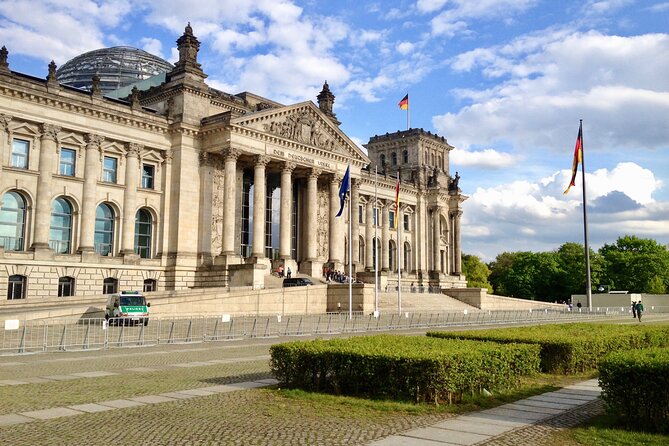
The drive through Tiergarten explains why Berlin has so much open space. It began as a royal hunting ground, later became a public park, and was redesigned as an English-style garden by Peter Lenné. World War II left it badly damaged, but Allied assistance helped replant it.
The Victory Column originally stood in front of the Reichstag and had three drums honoring Prussian victories over Denmark, Austria, and France. Hitler moved it to its present location and added a fourth drum. The monument’s position today reflects Nazi-era city planning as much as nineteenth-century military pride.
The Nordic embassies offer a lighter architectural pause. Five countries share a connected group of wooden buildings, including Iceland, which is easy to forget when counting the Nordic states.
Bellevue Palace, now the Federal President’s official Berlin residence, was built for Frederick the Great’s youngest brother. It later served as a West German presidential residence in Berlin, a role that caused political protests from East Berlin during the Cold War. The palace is small and formal compared with many national residences.
The route then reaches the Zoological Garden and the Kaiser Wilhelm Memorial Church. The church’s damaged tower remains beside Egon Eiermann’s modern blue-glass structure. Inside, the thick double-wall design creates surprising quiet despite the traffic outside. It is a strong example of how postwar Berlin chose to preserve damage rather than erase it.
Ku’damm, KaDeWe, and modern Berlin culture
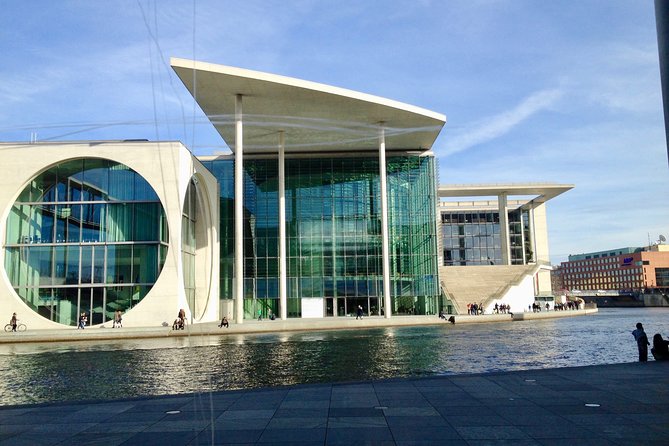
Kurfürstendamm, usually shortened to Ku’damm, was West Berlin’s grand shopping and entertainment boulevard. Today its boutiques, department stores, Apple and Tesla shops, and international brands give it a polished commercial character.
Tauentzienstrasse leads toward KaDeWe, the vast department store known for its food hall and luxury goods. The upper floor is worth visiting if you like food markets, fine chocolates, bread, cheese, oysters, or a glass of champagne. It is one of the easiest places to add a personal stop after the tour.
The route can also pass Nollendorfplatz and the Bülowstrasse area, where the elevated U-Bahn and underground lines meet. The neighborhood has long been associated with Berlin’s gay culture, including early twentieth-century dance halls and clubs. Today the area around Nollendorfplatz, Motzstrasse, Wittenbergplatz, and Fuggerstrasse remains an important LGBTQ district.
The Kulturforum offers a final look at West Berlin’s cultural ambitions. The Philharmonie, New National Gallery, New State Library, Picture Gallery, and Museum of Musical Instruments were planned as a counterpart to Museum Island. The Picture Gallery holds old masters including Titian, Caravaggio, and Rembrandt.
Mies van der Rohe’s New National Gallery is the architectural prize. Its glass hall has a self-supporting metal roof with the columns placed outside, leaving the interior open. Temporary exhibitions use the upper level, while much of the collection is shown below.
East Side Gallery, Oberbaum Bridge, and Kreuzberg
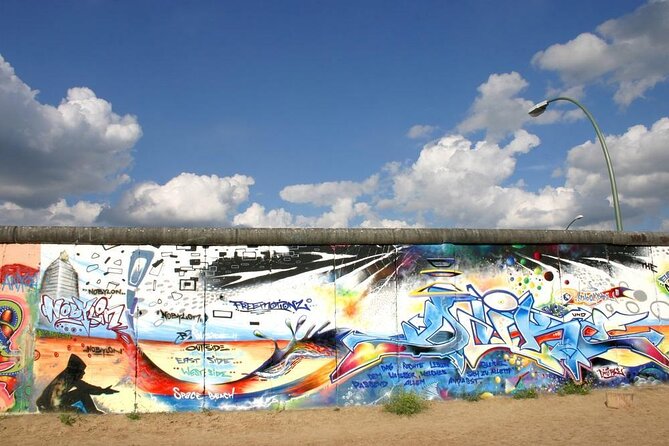
The East Side Gallery preserves about 1,600 meters of Wall, painted after reunification by artists from around the world. The Trabant breaking through the Wall and the Brezhnev-Honecker kiss are its best-known images.
Technically, this is not the original front wall that West Berliners faced. It is the former hinterland wall, later painted as a public artwork. Repeated restoration has kept the images visible, but weather and urban development continue to affect the site.
Nearby Oberbaum Bridge links Friedrichshain and Kreuzberg. Its medieval-looking towers recall the old customs boundary, while the subway runs through the upper structure. Today it connects a busy nightlife corridor around Warschauer Strasse and Schlesisches Tor.
Kreuzberg adds the neighborhood perspective missing from formal Berlin. Plans in the 1960s called for a motorway route that would have erased old buildings, restaurants, and alternative spaces. The plan was abandoned, leaving a district known for immigrant life, creative culture, and rapid rent increases.
The drive may finish with the former Stalin Allee, now Karl-Marx-Allee. Its monumental workers’ apartment blocks were built to display socialist power. The 1953 uprising began after wage cuts and production demands, and Soviet tanks crushed it. The restored buildings now form one of Germany’s longest protected monument areas.
Price, comfort, and who should book
At about $179.82 per person, the price is easiest to justify with three or four people sharing a private vehicle. You are paying for the car, driver-guide, pickup within the S-Bahn ring, parking fees, WiFi, and a great deal of concentrated explanation. Taxi transport is included under the local fare, while the tour service is also built into the price.
The value is strongest if you have only one day in Berlin, dislike long walks, or want a citywide orientation before choosing which museums and neighborhoods to revisit. Several people found the tour especially helpful for mobility limits, and child seats are available for toddlers and older children.
The small vehicle is the main practical concern. Four adults may feel cramped, so ask about vehicle size before booking if comfort matters. Pickup from BER airport or outside the S-Bahn ring costs extra.
Cancellation is free up to 24 hours before the start time. The tour is offered in English, and service animals are allowed.
Should you book this Berlin taxi tour?
Book it if you want a fast, personal introduction to Berlin’s divided past, especially on a first visit or a short stay. Gunter’s strongest qualities are his local knowledge, smooth driving, detailed explanations, warm manner, and willingness to take photos at stops. His enthusiasm can be intense, so be ready for a steady stream of information.
Do not book it expecting long museum visits or slow neighborhood walks. Send your must-see list before pickup, ask which interiors require advance tickets, and agree on the stops you would rather explore on foot. Used that way, this private taxi tour gives you a useful city map in a single afternoon and leaves you with a clear plan for the rest of your stay.
FAQ
How long does the private Berlin taxi tour last?
The tour lasts approximately four to six hours. Traffic, weather, time spent walking, and the number of requested stops can affect the final duration.
Where is pickup included?
Pickup within Berlin’s S-Bahn ring is included, covering roughly five kilometers around the Brandenburg Gate. Pickup from BER airport or locations outside the S-Bahn ring costs extra.
Is the tour private?
Yes. Only your group participates in the activity, with private transportation and an air-conditioned vehicle.
Is the tour offered in English?
Yes. The tour is offered in English, and Gunter Bauer is the guide named for the experience.
Can children use a car seat?
A child seat is available for toddlers from six months to three years, and a booster seat is available for older children. A Maxi-Cosi baby seat can be brought on request.
Are admission tickets included?
The listed experience includes the taxi ride, city tour, pickup within the included area, parking fees, private transportation, and WiFi. The supplied details do not state that museum or interior admission tickets are included.
Can the route be changed?
The guide asks about your interests before the tour and can adapt some stops. Traffic and timing may require certain locations to be shortened or omitted, so send your priorities in advance and discuss them before setting off.
Just added around Berlin
- Love and War in Berlin: Self-Guided Story Puzzle Walk★ 5.0 · 7 reviews
- Rickshaw Tours Berlin – Groups of up to 16 people with several rickshaws★ 4.0 · 97 reviews
- eSIM for Germany and 34 European Countries★ 4.5 · 16 reviews
- Walking on the Wall: 3-Hour Tour in Berlin★ 4.5 · 34 reviews
- Warnemuende Shore Excursion: Berlin Private Sightseeing Tour from Rostock★ 5.0 · 4 reviews
- Your ticket to The Wall Museum Berlin★ 3.0 · 60 reviews
- Warnemuende Shore Excursion: Private Berlin Tour★ 4.5 · 27 reviews
- Berlin’s Gay, Lesbian, and Queer Scene Small-Group Walking Tour★ 4.5 · 66 reviews
Private, compared.
Berlin Private Complete History All Day Walking Tour
Read our review →
Munich Private Tour with a Local – Highlights & Hidden Gems
Read our review →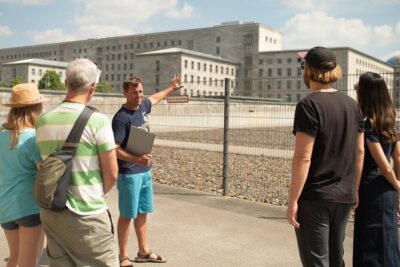
Private Walking Tour Berlin Third Reich Hitler and World War II
Read our review →
Your private 3-hour Hamburg driving tour with a former policeman
Read our review →
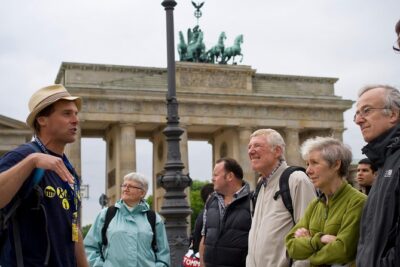
Private Berlin: Iconic Sights and Hidden Gems Walking Tour
Read our review →