

Reviewed · HISTORICAL TOURS
Private Taxi Tour City East & West History and Architecture 3-4h
Berlin makes more sense when you see its two former halves together. In three to four hours, Gunter Bauer drives you from the western shopping boulevards and Kaiser Wilhelm Memorial Church to Checkpoint Charlie, the Brandenburg Gate, Museum Island, and the rebuilt Humboldt Forum. You get a fast, useful introduction to a city shaped by monarchy, war, dictatorship, division, and reunification.
I like the private format, which lets you ask questions and adjust the emphasis toward architecture, Berlin Wall history, or the city’s older royal center. I also like the warm taxi, especially in winter or poor weather, plus the included pickup within the S-Bahn ring and the chance to stop for photos.
The main consideration is pace. The route covers a huge amount of Berlin, so many sights are viewed from the vehicle or receive only a short stop. If you want long museum visits, this is not the right tour. If you want to get your bearings quickly, it is a strong choice.
In This Review
- Key points at a glance
- A fast way to understand Berlin’s divided past
- Charlottenburg’s western boulevard and memorial church
- Ku’damm, KaDeWe, and the former West Berlin center
- Tiergarten, Bellevue, and the road to government
- The Reichstag and the modern government quarter
- Hackesche Höfe and Berlin’s Jewish history
- From the Wall’s Palace of Tears to the Brandenburg Gate
- Gendarmenmarkt, Humboldt Forum, and Alexanderplatz
- Checkpoint Charlie and the final urban contrasts
- Who will get the most from this tour?
- Should you book it?
- FAQ
- How long does the private taxi tour last?
- What is the price?
- Is hotel pickup included?
- Is airport pickup included?
- Is the tour private?
- Is the tour offered in English?
- What is included in the price?
- Are children’s seats available?
- Is lunch included?
- Can I cancel for a full refund?
Key points at a glance
- A private taxi and guide: Only your group rides with Gunter Bauer, so questions and timing can be handled more easily than on a large coach tour.
- East and West in one outing: The route links Charlottenburg, Kurfürstendamm, the Tiergarten, the former border, Mitte, and the old royal heart of Berlin.
- Strong historical range: Expect Prussian kings, Nazi Germany, the Berlin Wall, the Cold War, reunification, and modern government buildings.
- Useful in bad weather: You spend much of the tour inside an air-conditioned vehicle, with stops for landmarks and photos.
- Several brief walks: The Brandenburg Gate, Gendarmenmarkt, Humboldt Forum, Hackesche Höfe, and Topography of Terror offer chances to get out and look around.
- Flexible pickup: Hotel or apartment pickup inside the S-Bahn ring is included, while airport and outer-city pickup costs extra.
A fast way to understand Berlin’s divided past
This is not simply a taxi ride past famous buildings. The route uses Berlin’s streets to explain how the city grew, broke apart, and changed again.
You begin in the western part of town, where the story often feels imperial, commercial, and postwar. The route then moves through the former West Berlin center, the Tiergarten, the government district, Mitte, old Jewish Berlin, the Wall era, and the restored royal center around Unter den Linden.
That range is the tour’s real strength. Berlin’s landmarks are spread across a large area, and walking between all of them would take far longer than half a day. A private vehicle lets you connect places that otherwise seem unrelated.
At $150.18 per person, the price needs context. It is not a budget sightseeing ride, particularly for one person or a couple. But it includes private transportation, the guide, vehicle WiFi, air conditioning, parking fees, and pickup within central Berlin. For a small group, the cost may make more sense because you are paying for a private experience rather than buying several separate rides.
The tour is offered in English. Gunter’s fluent English, personal stories, careful driving, and willingness to take photographs are recurring strengths of the experience. He also contacts you ahead of time, which gives you a chance to explain what matters most to your group.
A few more Berlin trips to weigh up
- Berlin: Natural History Museum Entrance Ticket
★ 4.6 · 3,382 reviews - Berlin: World Heritage Cruise to Potsdam
★ 4.5 · 1,435 reviews - Berlin Historical Highlights Walking Tour
★ 4.9 · 657 reviews
Charlottenburg’s western boulevard and memorial church
The western section begins around Breitscheidplatz and the Kaiser Wilhelm Memorial Church. The church is one of Berlin’s clearest reminders that the past has not been neatly erased.
The surviving tower and west portal belong to the original church, built as a memorial to Kaiser Wilhelm I. The preserved entrance includes mosaics showing the Holy Family and disciples, with faces that resemble Prussian rulers from the Hohenzollern family. That detail gives the monument a strong imperial connection, even though many people first read it only as a war memorial.
The modern church hall and tower were designed by Egon Eiermann. Berliners gave the pair nicknames based on their unusual shape, often comparing the old and new buildings to lipstick and a powder compact. Inside the new church, thousands of blue glass blocks create a quiet, almost otherworldly light. The double-wall construction also keeps out much of the traffic noise from the busy square.
You then pass the Zoological Garden, one of Germany’s oldest zoos. Its collection includes about 16,000 animals from around 1,600 species, and the building fronts are designed in styles associated with the animals’ places of origin. From the taxi, look for the Elephant Gate and the Lion Gate near Zoo station.
Nearby, the Theater des Westens shows the confidence of Berlin’s early 20th century expansion westward. The building has a theatrical, confection-like exterior and an imperial box inside. It was created when fashionable Berlin began moving away from the crowded center toward larger homes and greener streets.
Ku’damm, KaDeWe, and the former West Berlin center
Kantstrasse leads toward Kurfürstendamm, usually shortened to Ku’damm. This is Berlin’s best-known western boulevard, once modeled partly on the Champs Élysées.
At its height, Ku’damm was lined with villas, cafes, cinemas, entertainment venues, and grand urban life. Today, the eastern section is more strongly associated with shopping. Farther west, you find luxury names such as Versace, Bulgari, and Dolce & Gabbana, while modern flagship stores fill other blocks.
The route also reaches Tauentzienstrasse, often treated as part of Ku’damm even though the street numbering has an odd historical gap. Here the shopping becomes more accessible, except for the huge Kaufhaus des Westens, better known as KaDeWe.
You get about 15 minutes at KaDeWe, with admission included. The department store covers roughly 60,000 square meters and is one of the major shopping landmarks in continental Europe. The gourmet floor is the main attraction, with bread, cheese, chocolate, oysters, champagne, and other high-end food.
I would treat this stop as a quick taste, not a full shopping visit. Fifteen minutes lets you look around and perhaps grab something small, but it is not enough for a relaxed meal or a serious look at the store.
The route continues past Wittenbergplatz and Nollendorfplatz, where Berlin’s old rail and subway story comes into view. The city’s transport system reflects its age and divided development. Different lines and districts were built at different times, and wealthy Charlottenburg once resisted having a noisy, dirty railway pushed through its elegant villa areas.
At Urania, you see a science association created to make research understandable to a broad public. A nearby sky-reaching arch, given by France for Berlin’s 750th anniversary, adds a curious modern detail. The wide green strip around Lützowplatz also reveals an abandoned urban idea: Berlin was once planned as a car-friendly city with elevated roads for through traffic.
Tiergarten, Bellevue, and the road to government
The Tiergarten began as a royal hunting ground. Frederick the Great opened parts of it to the public and later garden designer Peter Joseph Lenné reshaped it into an English-style park.
Lenné widened the Schafgraben into the Landwehr Canal, draining wet ground and creating paths, lakes, views, and planted areas. World War II left the park badly damaged, with many trees destroyed and food crops grown near the Reichstag. Allied help later supported reforestation.
The taxi route gives you an efficient look at this large central park, though you should not expect a long walk through it. One stop is the House of World Cultures, originally a gift from the United States to West Berlin. Its curved roof earned it the nickname Pregnant Oyster.
The roof collapsed in 1980, killing a journalist, but the building was reconstructed. It now hosts non-European art, performances, and concerts. Its position beside the Spree makes it especially appealing in warm weather.
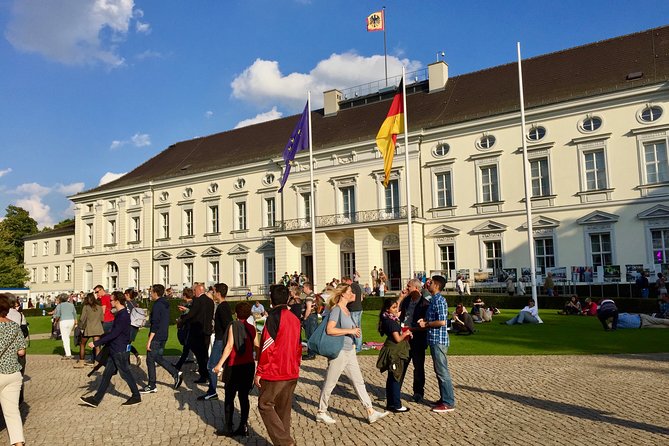
Bellevue Palace follows. The small palace was built for August Ferdinand, younger brother of Frederick the Great, and is now the official Berlin residence of Germany’s Federal President. The original view toward Charlottenburg Palace has disappeared, and the building has been repaired and rebuilt several times.
The Victory Column, or Siegessäule, is another important stop. It originally stood in front of the Reichstag and had three decorated sections honoring victories over Denmark, Austria, and France. Hitler later moved it to its present location and added another section after the next supposed victory failed to materialize.
Same city, a completely different kind of day:
- Berlin: Reichstag, Dome and Government District Guided Tour
★ 4.7 · 18,288 reviews - Berlin: 1-Hour City Tour by Boat with Guaranteed Seating
★ 4.3 · 16,993 reviews - Berlin: Boat Tour Along the River Spree
★ 4.4 · 11,252 reviews - Discover Berlin Half-Day Walking Tour
★ 5.0 · 9,624 reviews
The Reichstag and the modern government quarter
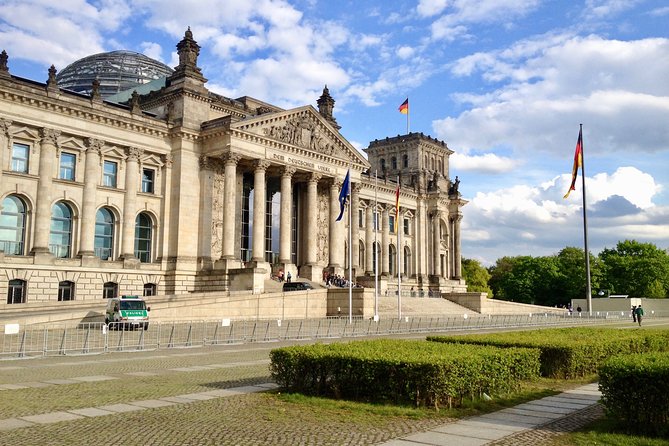
The Reichstag’s exterior recalls the German Empire, but its current role belongs to the reunited republic. The building was badly damaged, ignored for decades because it sat close to the Wall, then gutted and redesigned for the Bundestag.
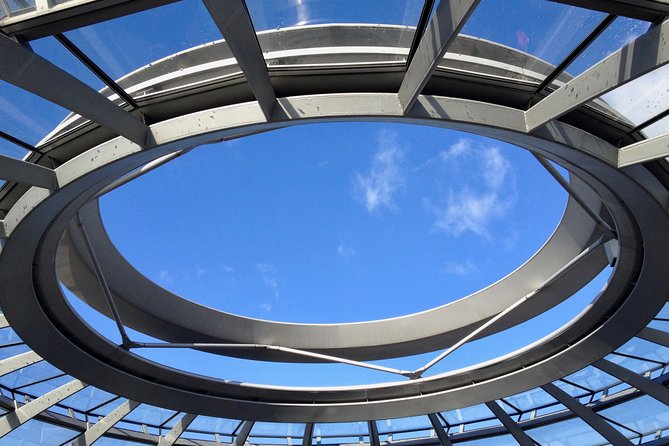
Its glass dome has become one of Berlin’s defining modern symbols. The route may not provide enough time for a full dome visit, but Gunter explains the building’s political and architectural history as you pass.
Across the Spree, the long Paul-Löbe Building contains the committees where much of parliamentary work takes place. Its glass design lets you see activity inside, at least in principle. The Marie-Elisabeth-Lüders Building provides more offices and committee rooms, while the large Federal Chancellery dominates the government quarter.
The Chancellery is a massive building with ten floors, about 500 offices, and space for more than 300 employees. Its scale was intended to match the importance of the federal government, though its empty official apartment for the chancellor has often been described as impractical.
This section is useful because it shows the contrast between old imperial buildings and the open, glass-heavy architecture of the reunited capital.
Hackesche Höfe and Berlin’s Jewish history
Hackesche Höfe offers one of the route’s best short walking stops. Built in 1908, the linked courtyards were designed to mix workshops, small factories, printing businesses, housing, and shared open space.
During the East German period, the courtyards deteriorated and were partly used for storage. After reunification, they were among the early restoration projects in the area. Today, small shops and design businesses occupy spaces that once held workshops. You can see restored Art Nouveau details and browse goods from local makers.
The stop lasts about 10 minutes, so think of it as a look at the courtyards rather than a shopping expedition.
The nearby New Synagogue is easy to recognize by its golden dome and Moorish-style decoration. The original building could hold about 3,000 worshippers and was inaugurated in 1866, when Prussia had granted Jews equal civil rights. The synagogue was badly damaged in World War II, but its front section was partly restored and now includes an exhibition on Jewish life in Berlin.
Security is strict. You should expect airport-style checks before entering the exhibition area. The tour’s brief pass by the building gives useful context, but anyone especially interested in Jewish Berlin should return later with more time.
From the Wall’s Palace of Tears to the Brandenburg Gate
Berlin Central Station demonstrates how much the city’s transport system changed after reunification. It has underground and above-ground tracks, five levels, large halls, and extensive shops. The former Zoo station lost its long-distance role when the new central station opened, which frustrated residents of Charlottenburg who suddenly had farther to go for certain trains.
The route then crosses the former East-West border near the harbor. This area recalls Günter Litfin, one of the first people killed while trying to escape East Berlin after the Wall went up.
At Friedrichstrasse station, you see a place where East and West were connected under strict control. It was the only station through which certain international trains passed between the two sides. East Berlin residents who left through here often could not simply return.
Next door, the Palace of Tears preserves the setting where families said goodbye under the watch of border officials. A longer visit is worthwhile if the Wall period is your main interest.
Unter den Linden then brings you into the old royal center. The broad avenue began as a route from the Berlin Palace through the Brandenburg Gate to the royal hunting grounds. Aristocratic palaces, the State Opera, Humboldt University, and the State Library line the route.
The Brandenburg Gate receives about 15 minutes. It sits on Pariser Platz, the ceremonial front room of Berlin. War, demolition, the Wall, and decades of separation left the gate isolated, but the surrounding buildings have since been rebuilt in a modern form that follows their former size and shape.
Gendarmenmarkt, Humboldt Forum, and Alexanderplatz
Gendarmenmarkt is one of Berlin’s most graceful squares. The German Cathedral, French Cathedral, and Concert Hall form a balanced composition, though the two buildings called cathedrals are not bishop’s seats.
The French Cathedral still serves a French-speaking Reformed congregation. The German Cathedral now contains a museum about German parliamentary history. The square is usually a short photo stop, with about five minutes noted for the visit.
The Neue Wache memorial is another brief but meaningful stop. Its central sculpture by Käthe Kollwitz mourns a dead son and now commemorates victims of war and tyranny.
At Bebelplatz, the glass panel in the pavement marks the Nazi book burning of May 10, 1933. Below it is an empty library, a quiet image of censorship and loss. Around the square are the former royal library, St. Hedwig’s Cathedral, the State Opera, and Humboldt University.
The German Historical Museum occupies the old armory. Its exterior and courtyard decorations include replicas of death masks of dying warriors, a reminder that the building began as a military storehouse.
The Humboldt Forum is the tour’s longest listed stop, at about 30 minutes. The modern interior and rebuilt exterior occupy the site of the former Berlin Palace, home of Prussian electors, kings, and emperors. The East German government demolished the war-damaged palace, replacing it with a large open area.
The reconstructed exterior follows the old palace, including the Schlüter courtyard. Inside are non-European collections and material linked to Humboldt University. This is one place where the tour gives you enough time to step out and explore rather than simply look from the taxi.
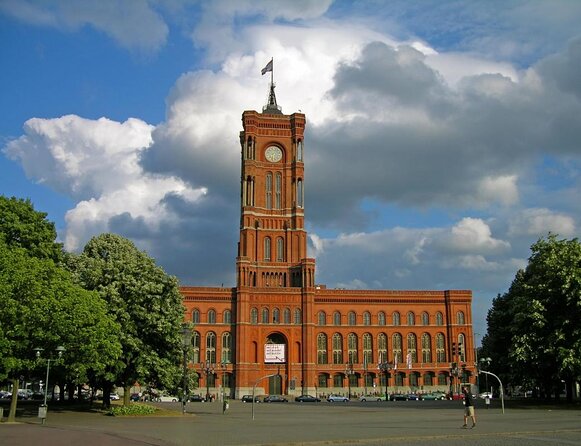
Alexanderplatz and the Red City Hall complete the old-center section. Alexanderplatz began outside the oldest city walls and was reshaped during the GDR period into a broad socialist plaza. The television tower remains its most famous feature and is Germany’s tallest.
The Red City Hall gets its name from its brick, not from any political party. It has served as Berlin’s municipal center, while West Berlin’s government operated from Schöneberg Town Hall during the city’s division.
Nearby Nikolaiviertel recreates an older Berlin. Much of what you see was rebuilt in the 1980s, when only a few original buildings survived. The Nikolaikirche, Berlin’s oldest church, now belongs to the city museum, while the Knoblauchhaus presents a Biedermeier interior and family life. Ten minutes gives you a useful glimpse, though more time would help.
Checkpoint Charlie and the final urban contrasts
Checkpoint Charlie is a photo stop of about 10 minutes. The guard hut and sign are replicas, not original Cold War equipment. The famous crossing was already reduced to a container before the Wall fell.
The place still matters because of the tank confrontation in October 1961, when American and Soviet forces faced each other at the height of the Cold War. Gunter can frame the photo stop with that context, helping you see beyond the replica checkpoint.
The final section may include the Berlin Aquarium at the DomAquarée. Its displays include reptiles on sandstone-colored panels, aquatic life, and a large tropical aquarium. A hotel elevator passes directly through the aquarium, creating one of Berlin’s more unusual indoor sights.
Who will get the most from this tour?
I would choose this tour for a first visit, a short stay, or a family group that needs to cover a lot of ground without wearing out its feet. It also suits older travelers, people with limited walking stamina, and anyone visiting Berlin in cold or wet weather.
It works especially well for adults interested in political history, architecture, World War II, the Cold War, and the city’s royal past. Children may enjoy the vehicle, photos, and changing scenery, but younger attention spans can make a full four-hour history route demanding.
Bring water. One traveler specifically found this useful, and the amount of talking and sightseeing can make a bottle worthwhile. Tell Gunter your priorities before starting. The tour can be shaped around highlights, architecture, or Berlin’s 20th-century story.
Pickup inside the S-Bahn ring is included. Pickup from BER Airport or outside the central area costs extra, and you should allow more time if you begin far from the center. A toddler seat, booster seat, and baby seat on request make the private setup practical for families.
Should you book it?
Book it if you want a citywide orientation with real historical explanation, comfortable transport, and the freedom to ask questions. Gunter Bauer is particularly well suited to visitors who want personal attention, clear English, and photographs taken along the way.
Skip it if your plan is to spend hours inside museums or examine every monument at length. The route is broad by design, and some stops are short. For most first-time visitors, though, the combination of East and West Berlin, private transport, and flexible storytelling offers solid value, especially when several people share the vehicle.
FAQ
How long does the private taxi tour last?
The tour lasts approximately three to four hours.
What is the price?
The listed price is $150.18 per person.
Is hotel pickup included?
Pickup from a hotel or apartment within Berlin’s S-Bahn ring is included.
Is airport pickup included?
Pickup from BER Airport is not included in the standard service and costs extra according to the Berlin taxi tariff.
Is the tour private?
Yes. Only your group participates in the tour.
Is the tour offered in English?
Yes. The experience is offered in English, and Gunter Bauer is described as fluent in English.
What is included in the price?
Private transportation, WiFi onboard, an air-conditioned vehicle, parking fees, and the included city tour taxes are provided.
Are children’s seats available?
A toddler seat for children from six months to three years and a booster seat for older children are available. A Maxi-Cosi baby seat can be brought on request.
Is lunch included?
No. Lunch is not included.
Can I cancel for a full refund?
You can cancel for a full refund up to 24 hours before the experience begins. Changes or cancellations made less than 24 hours before the start time are not accepted for a refund.
Just added around Berlin
- Love and War in Berlin: Self-Guided Story Puzzle Walk★ 5.0 · 7 reviews
- Rickshaw Tours Berlin – Groups of up to 16 people with several rickshaws★ 4.0 · 97 reviews
- Walking on the Wall: 3-Hour Tour in Berlin★ 4.5 · 34 reviews
- eSIM for Germany and 34 European Countries★ 4.5 · 16 reviews
- Warnemuende Shore Excursion: Berlin Private Sightseeing Tour from Rostock★ 5.0 · 4 reviews
- Your ticket to The Wall Museum Berlin★ 3.0 · 60 reviews
- Warnemuende Shore Excursion: Private Berlin Tour★ 4.5 · 27 reviews
- Berlin’s Gay, Lesbian, and Queer Scene Small-Group Walking Tour★ 4.5 · 66 reviews
Historical Tours, compared.

City History Canal Sightseeing Tour on a Motorboat
Read our review →






Browse the lists this tour appears in