
Reviewed · BERLIN TOURS
Path of Resistance: Berlin’s Hidden Holocaust Stories
Berlin’s most powerful Holocaust stories are often found in ordinary streets and courtyards, not behind grand museum doors. This walking tour follows the people who resisted Nazi rule, protected Jewish neighbors, protested deportations, or tried to save children from the killing machine.
I like the small group of no more than 15 because it gives the guide room to answer questions and adjust the pace. I also like the route’s range: Jewish schools, a destroyed cemetery, a secret workshop, protest sites, military resistance, book burning, and the Kindertransport all fit into one carefully linked walk.
The main drawback is simple: you will be on your feet for much of the 2 hours 30 minutes, with roughly ten minutes at most stops. There is little time to sit, eat, or explore the interiors in depth, so wear comfortable shoes and treat this as a focused outdoor history lesson.
In This Review
- Key points to know before you book
- Why this walking route matters
- Starting at the New Synagogue on Oranienburger Straße
- The Moses Mendelssohn school and the machinery of deportation
- A destroyed cemetery and the cost of ideological hatred
- Otto Weidt’s workshop in a hidden courtyard
- Rosenstraße and the protest that forced releases
- Lustgarten and the loss of public space
- The Zeughaus and a failed assassination plan
- Neue Wache and the meaning of a national memorial
- Bebelplatz and the book burning
- Trains to Life, Trains to Death
- What the guides add to the experience
- Price, pace, and practical value
- Who should choose this Berlin tour?
- Should you book Path of Resistance?
- FAQ
- How long does the tour last?
- Where does the tour begin?
- Where does the tour end?
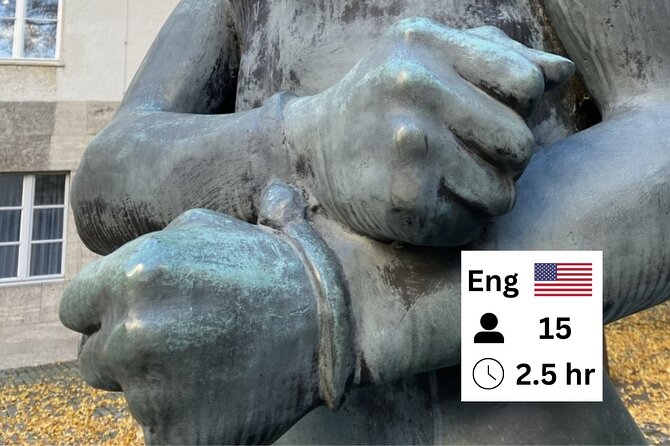
- How large is the group?
- Is the tour offered in English?
- What is included in the price?
- Can I cancel for a full refund?
Key points to know before you book
- A resistance story rather than a standard Nazi-era overview: The route focuses on people and groups who opposed persecution, from Otto Weidt to the women of Rosenstraße.
- Ten meaningful stops in central Berlin: You move from Oranienburger Straße through Museum Island and Unter den Linden to Friedrichstraße.
- Personal stories give the history a human scale: Blind and deaf Jewish workers, detained husbands, rescued children, and a would-be assassin all feature in the route.
- Small groups make discussion possible: The maximum group size is 15, and guides use maps and then-and-now photographs.
- A strong choice for repeat Berlin visitors: Much of the value comes from seeing familiar city landmarks in a very different context.
- Plan for steady standing and walking: Food, drinks, and hotel transfers are not included.
Why this walking route matters
This is not a tour built around one famous memorial. It is a chain of places that shows how persecution worked, how the Nazi state restricted public life, and how individuals pushed back.
You begin with Berlin’s prewar Jewish community, move through the machinery of deportation, and then see several forms of resistance. Some were bold and organized. Some involved forged papers or bribes. Some meant gathering in a street and refusing to go home.
That structure is useful because it avoids reducing the period to dates and military decisions. You see how policy reached schools, families, workplaces, cemeteries, bookshops, and city squares. The guide’s maps and then-and-now photographs help bridge the gap between the Berlin in front of you and the Berlin that was damaged, rebuilt, or deliberately altered.
The route is also compact. It stays in central Berlin and finishes at S+U Friedrichstraße, a major transport hub. You can continue sightseeing afterward without arranging a separate transfer.
Other Berlin days worth putting on the list:
- Berlin: Reichstag, Dome and Government District Guided Tour
★ 4.7 · 18,288 reviews - Berlin: 1-Hour City Tour by Boat with Guaranteed Seating
★ 4.3 · 16,993 reviews - Berlin: Boat Tour Along the River Spree
★ 4.4 · 11,252 reviews
Starting at the New Synagogue on Oranienburger Straße
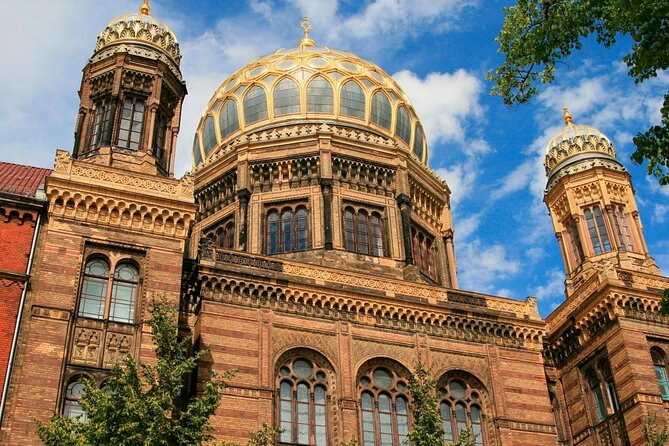
The meeting point is outside the Stiftung Neue Synagoge Berlin, also called the Centrum Judaicum, at Oranienburger Strasse 36. The building’s ornate dome and broad historic presence make it an immediate reminder of the size and confidence of Berlin’s Jewish community before the Nazi period.
Built in 1866, the New Synagogue was the largest and most magnificent synagogue in Berlin. That detail matters. It was not a small house of worship serving a marginal group. It reflected a Jewish population of about 160,000 people and a community deeply woven into the city’s cultural and civic life.
The building survived the Kristallnacht pogrom because a police officer intervened and stopped vandals from destroying it. Its story afterward was far less fortunate. The synagogue was confiscated in 1940 and used to store military uniforms. Allied bombing severely damaged it in November 1943, and the main hall was later torn down in 1958.
Part of the building was reconstructed in 1988, and the site officially reopened in 1995. Today, the Centrum Judaicum works to preserve Jewish memory and tradition. You receive about ten minutes here, enough for the guide to establish the setting without turning the first stop into a full museum visit.
The Moses Mendelssohn school and the machinery of deportation
A short walk brings you to the Jüdisches Gymnasium Moses Mendelssohn. Founded in 1779, it was the first Jewish school in Germany without tuition fees. Although Jewish in character, it welcomed students of all faiths and promoted a liberal form of Jewish education. Female students were admitted in 1931.
That earlier openness makes the later use of the building especially grim. In the autumn of 1941, Jewish schools were banned as deportations began. In 1942, the Reich Main Security Office under the SS converted this building into a transit camp.
Windows were barred, and Jewish people were crowded inside while awaiting deportation to the east. You spend only about five minutes here, but the stop shows how an institution created for education became part of the deportation system. The change was not abstract. It happened in a recognizable school building in the middle of Berlin.
A destroyed cemetery and the cost of ideological hatred
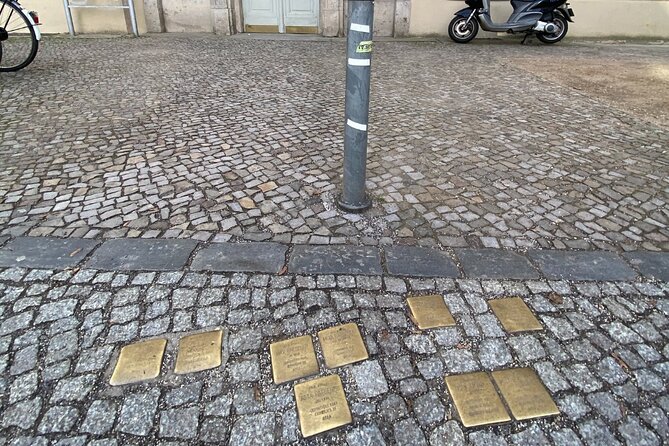
The Jewish Cemetery and Holocaust Memorial offer one of the route’s hardest stops. Between 1672 and 1827, about 12,000 members of Berlin’s Jewish community were buried here.
In 1943, the Gestapo ordered the SS to destroy the cemetery. Thousands of gravestones were smashed, human remains were thrown away, and SS men desecrated the site in a particularly cruel way, even playing football with skulls. This is a place where the physical destruction of Jewish life is impossible to separate from the wider crime.
The site also holds a second, complicated layer. In April 1945, burials began again. Mass graves contain almost 2,500 German soldiers and Berlin civilians killed during the final fighting, including civilians shot by the SS for hanging white flags from their windows.
Allow about 15 minutes here. The stop requires quiet attention, and the guide’s role is important in explaining why the cemetery is both a Jewish burial ground and a burial place connected to Berlin’s final weeks of war.
Same city, a completely different kind of day:
- Discover Berlin Half-Day Walking Tour
★ 5.0 · 9,624 reviews - Berlin: Hop-on Hop-off Bus Tour with Live Commentary
★ 4.3 · 8,579 reviews - Berlin: Government District around the Reichstag Guided Tour
★ 4.7 · 8,447 reviews - Berlin: Reichstag, Plenary Chamber, Cupola & Government Tour
★ 4.6 · 8,422 reviews
Otto Weidt’s workshop in a hidden courtyard
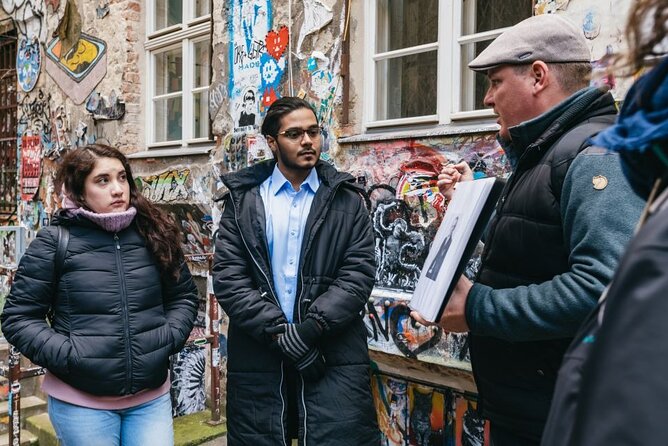
One of the most personal stops is the Museum Blindenwerkstatt Otto Weidt. It sits in a courtyard that is easy to miss if you are simply walking through the area.
Otto Weidt, supported by his wife Else, employed more than 30 blind and deaf Jewish workers between 1940 and 1945. His workshop produced items used by the German military, but the real story here is the effort to protect his employees from persecution and deportation.
Weidt bribed Gestapo officers and falsified documents. He also traveled to Auschwitz in an attempt to bring back one of his workers. That act gives the story unusual force. Resistance was not always a public speech or an armed plot. Sometimes it was a person using a workplace, personal courage, money, and deception to keep vulnerable people alive.
You have about ten minutes at the workshop. The visit is brief, but the stop gives the tour a human face. It also helps you see that resistance could take place in a small Berlin business, not only in government offices or military circles.
Rosenstraße and the protest that forced releases
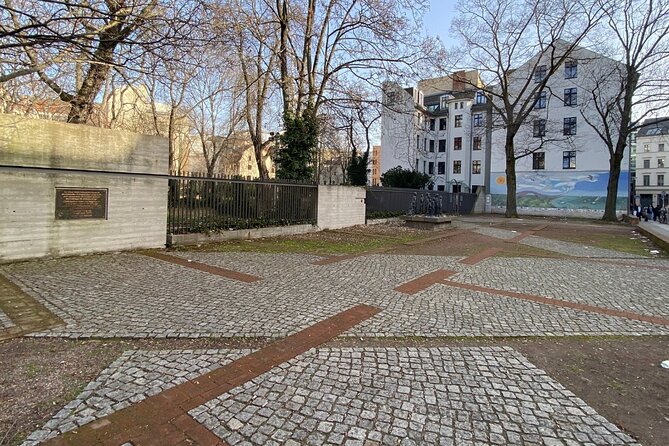
At the Rosenstraße Memorial, the tour turns to one of Berlin’s clearest examples of public protest during the Nazi era.
On February 27, 1943, the Gestapo, Waffen SS, and Berlin Police arrested about 2,000 Jewish men married to non-Jewish German women. The men were held together while the authorities decided what would happen to them.
Hundreds of their wives gathered outside the detention site. They were threatened with being shot if they did not disperse. The women moved away briefly when ordered to do so, then returned in larger numbers. Their repeated protest created pressure that the authorities could not easily ignore.
Eventually, Goebbels authorized the prisoners’ release. The Rosenstraße story does not suggest that protest was safe or that it could have stopped the entire Nazi system. It does show that public action could sometimes make a difference, even under dictatorship.
The ten-minute stop works well because it connects a broad political system to a group of people standing in one street, demanding the return of their husbands.
Lustgarten and the loss of public space
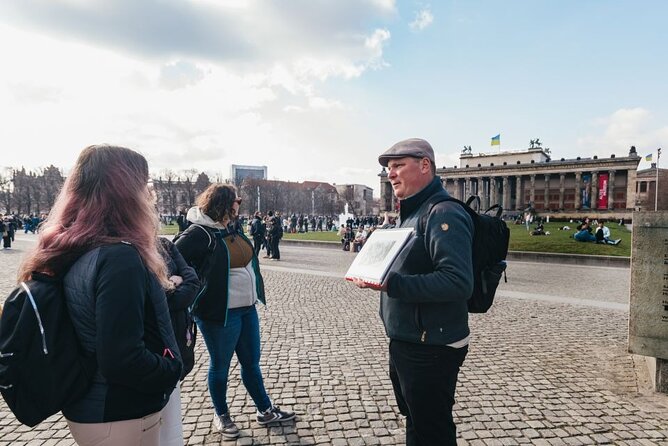
Lustgarten is framed by Berlin Cathedral, the Altes Museum, and the Zeughaus. Before the Nazi period, it was a favored place for protests and public speeches.
One week after Hitler became Chancellor, about 200,000 Berliners gathered here to protest the new government. Soon afterward, Nazi restrictions made opposition much more dangerous. Fines and arrests narrowed the right to protest, and public space was brought under tighter control.
In 1934, the Nazis paved over Lustgarten for propaganda rallies, military parades, and swearing-in ceremonies. The change in the square’s design was political. A place for citizens to gather and challenge authority became a stage for state power.
I find this stop particularly useful if you are already sightseeing around Museum Island. The cathedral and museums can seem purely monumental. The guide helps you read the open space between them as a place whose purpose was changed by dictatorship.
The Zeughaus and a failed assassination plan
The Zeughaus is the oldest building along Unter den Linden. Built in 1730 as an artillery arsenal, it later became the setting for a planned act of military resistance.
On March 21, 1943, the building hosted an exhibition of captured Soviet weapons. Major General Rudolf Christoph Freiherr von Gersdorff, a member of the Wehrmacht resistance, was chosen to lead the display.
The plan was extreme. Gersdorff intended to approach Hitler with two concealed British clam mines and kill both men in a death embrace. The broader coup plan was ready, and the assassination was meant to trigger action against the Nazi leadership.
The attempt failed because Hitler left the exhibition far sooner than expected. Gersdorff had only minutes to remove the explosives and escape without being detected.
You spend about ten minutes at the Zeughaus, where the guide explains the plan and what happened next. This stop adds military resistance to a route otherwise centered largely on Jewish experience and civilian action. It also gives you a sharper sense of how difficult resistance became when even a carefully prepared attack depended on Hitler’s movements.
Neue Wache and the meaning of a national memorial
Neue Wache is a small but powerful memorial on Unter den Linden. It is Germany’s central memorial for victims of war and tyranny.
The site is surrounded by one of Berlin’s busiest ceremonial streets, which creates a striking contrast. You pause in a city center full of traffic and movement, then enter a space intended for silence and remembrance.
The tour allows about ten minutes here. The guide can place the memorial within the route’s wider theme: remembering those who suffered, while also asking how Germany has chosen to represent war, dictatorship, and political violence in the years since 1945.
Bebelplatz and the book burning
At Bebelplatz, the focus shifts from physical persecution to the attack on ideas. On May 10, 1933, members of the Nazi German Student Union and their professors gathered beside Humboldt University for a nationwide action against what they called the un-German spirit.
They burned more than 25,000 books considered politically or culturally unacceptable. The location is important because the event involved students and professors, not only party officials. The destruction of books showed how quickly cultural institutions and educated citizens could be drawn into Nazi propaganda.
A memorial beneath the square recalls the event. You may not see much at ground level, but the point is to look down and recognize the empty library below. This is one of the route’s shortest visual lessons: censorship and violence begin by deciding which people, ideas, and voices are allowed to exist.
Trains to Life, Trains to Death
The final stop is the sculpture Trains to Life, Trains to Death near Friedrichstraße. It shows two groups of Jewish children looking in opposite directions.
One group represents children rescued by the Kindertransport to England. The other represents children deported to concentration camps. Their contrasting directions express two radically different outcomes created by the same Nazi persecution.
The sculpture was designed by Frank Meisler, who was himself rescued by a Kindertransport and traveled from here to England in 1939. That personal connection gives the work added weight without needing a long explanation.
The tour ends nearby at Friedrichstraße and Georgenstraße, at S+U Friedrichstraße. This is a practical finish. You can connect to trains and the rest of Berlin easily, or ask the guide for help reaching your next destination.
What the guides add to the experience
A route like this depends heavily on the guide. The sites are often modest, and several are easy to pass without understanding what happened there.
Guides associated with this experience include Johan, Jochen, Scott, Jorg, and Benjamin. Their approach has been described as informed, friendly, and able to answer detailed questions. One guide has led tours for seven years, while another has handled questions from someone with formal Holocaust studies training.
That range suggests the tour can work for both first-time learners and people who already know the broad outline. It is still worth setting expectations: 2.5 hours cannot provide a full academic treatment of Berlin under National Socialism. Its strength is the route, the personal stories, and the links between places.
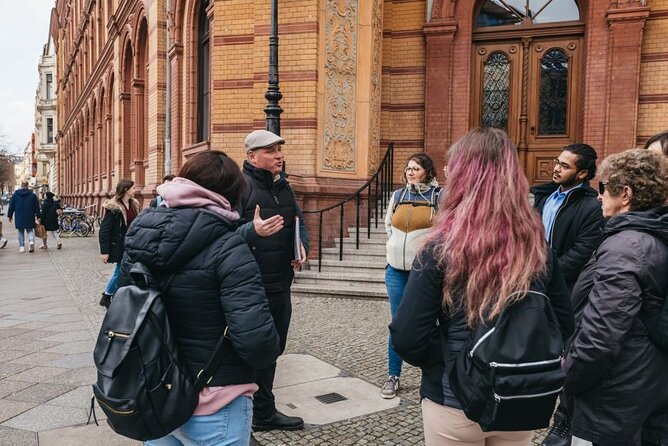
The small group also matters. With a maximum of 15 people, you have a better chance of hearing the guide clearly and asking about a detail that catches your attention. The guide can also adapt the pace to the group, though you should not expect a private tour.
Price, pace, and practical value
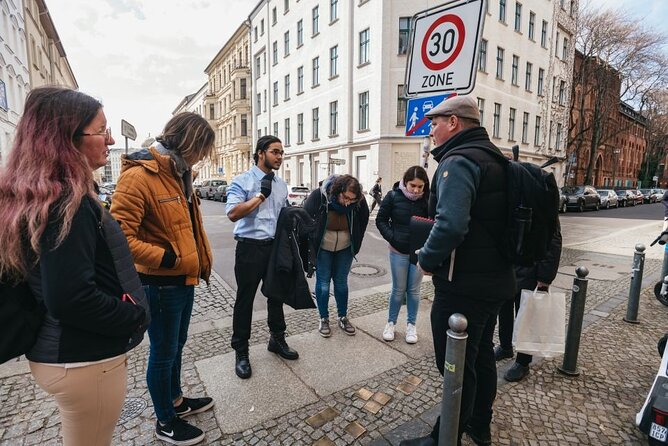
At $48.01 per person, this is not the cheapest way to see central Berlin. You can walk past many of these sites for free. The value comes from the explanation, the route planning, the maps, and the then-and-now photographs that connect present-day Berlin with wartime events.
Ten stops in 2.5 hours makes the pace purposeful. Most stops last about ten minutes, with five minutes at the Moses Mendelssohn school and 15 minutes at the cemetery. You will not have long to linger at every memorial, and the tour does not include food, drinks, or hotel pickup.
The tour is accessible, and service animals are allowed. It operates near public transportation, but good weather is required. If poor weather cancels the experience, you are offered another date or a full refund. A minimum number of participants is also required.
Because standing is a major part of the tour, comfortable shoes are more useful than a packed schedule. Families can take part, and the route has enough personal stories to hold the attention of older children, but younger children may find the subject and the steady pace difficult.
Who should choose this Berlin tour?
I would choose this experience if you want to understand Berlin through specific acts of courage rather than only through major monuments and battlefield dates.
It suits you especially well if you:
- Want a focused introduction to Jewish life and German resistance in central Berlin
- Prefer walking tours to long indoor museum visits
- Value personal stories about rescuers, families, students, and resistance figures
- Have already seen the main Berlin sights and want to understand what happened around them
- Are comfortable standing and walking for most of the afternoon or morning
- Want a small group where questions are possible
You may prefer a museum visit if you need extensive time with original documents, artifacts, or exhibitions. You may also find the tour emotionally demanding. The cemetery, deportation sites, book burning, and children’s memorial are not light sightseeing stops.
Should you book Path of Resistance?
Yes, if you want a serious, tightly organized walking tour that links Jewish history with civilian and military resistance. The best parts are Otto Weidt’s workshop, the Rosenstraße protest, and the way Lustgarten and Bebelplatz reveal how ordinary public places were reshaped by Nazi power.
Book it early if your schedule is firm, since it is often reserved well ahead of time, around 37 days in advance on average. Leave room afterward for a quiet break rather than planning another demanding museum immediately.
At $48.01, you are paying for interpretation more than admission. Since nearly every stop is free to enter or viewed from outside, the guide is the core of the purchase. If you want facts, context, and a route that makes central Berlin easier to read, this is a worthwhile choice. If you want plenty of free time or an indoor experience, choose something else.
FAQ
How long does the tour last?
The tour lasts approximately 2 hours and 30 minutes.
Where does the tour begin?
It begins at Oranienburger Strasse 36 in Berlin, outside the Stiftung Neue Synagoge Berlin, also called the Centrum Judaicum.
Where does the tour end?
The tour ends at S+U Friedrichstraße, near Friedrichstraße and Georgenstraße 14/17. This is a major Berlin train hub.
How large is the group?
The tour has a maximum of 15 participants.
Is the tour offered in English?
Yes. The experience is offered in English and includes a mobile ticket.
What is included in the price?
The price includes an expert tour guide, a small group, then-and-now photographs, maps, and an accessible tour. Food, drinks, and hotel pickup and drop-off are not included.
Can I cancel for a full refund?
Yes. You can cancel at least 24 hours before the experience begins for a full refund. Changes or cancellations made less than 24 hours before the start time are not accepted, and the amount paid is not refunded.
Just added around Berlin
- Love and War in Berlin: Self-Guided Story Puzzle Walk★ 5.0 · 7 reviews
- Rickshaw Tours Berlin – Groups of up to 16 people with several rickshaws★ 4.0 · 97 reviews
- Walking on the Wall: 3-Hour Tour in Berlin★ 4.5 · 34 reviews
- eSIM for Germany and 34 European Countries★ 4.5 · 16 reviews
- Your ticket to The Wall Museum Berlin★ 3.0 · 60 reviews
- Warnemuende Shore Excursion: Private Berlin Tour★ 4.5 · 27 reviews
- Warnemuende Shore Excursion: Berlin Private Sightseeing Tour from Rostock★ 5.0 · 4 reviews
- Berlin’s Gay, Lesbian, and Queer Scene Small-Group Walking Tour★ 4.5 · 66 reviews
Berlin Tours, compared.

Reichstag, Dome and Government District Guided Tour
Read our review →
1-Hour City Tour by Boat with Guaranteed Seating
Read our review →


Reichstag, Plenary Chamber, Cupola & Government Tour
Read our review →

