
Reviewed · BERLIN TOURS
One Up to 3 Rickshaws(6 GUESTS)-Taylor Made Rickshaw Berlin Tour
Berlin is spread out, and this private rickshaw tour gives you a quick, unusually close look at its major sights. In roughly three hours, you can move from Alexanderplatz to Brandenburg Gate, then across the former Wall border to Checkpoint Charlie, Potsdamer Platz, and the Holocaust Memorial without spending the day figuring out public transport.
I like the flexible route and the personal guiding. You can ride alone or in pairs, stop for photos whenever you wish, and finish at a hotel, restaurant, cafe, market, monument, or boat-tour starting point. The main drawback is the price: $420.08 is listed for a group of up to two, so this makes the most sense when you value private service and time savings.
In This Review
- Key points
- Why a Rickshaw Works Well in Berlin
- Alexanderplatz to Museum Island
- Bebelplatz and the Book Burning Memorial
- Gendarmenmarkt and Checkpoint Charlie
- The Wall, the Topography of Terror, and Potsdamer Platz
- The Holocaust Memorial and Brandenburg Gate
- The Reichstag, Sinti and Roma Memorial, and Führerbunker Site
- Returning to the Berliner Dom
- Price, Group Size, and Comfort
- Who Should Book This Berlin Tour
- Should You Book It?
- FAQ
- How long does the Berlin rickshaw tour last?
- How much does the tour cost?
- Can larger groups take the tour?
- Is hotel pickup available?
- Where can the tour finish?
- Is the tour private?
- Which languages are offered?
- Are admission tickets included?
- Is the tour suitable for people with limited mobility?
- Can I cancel for a full refund?
Key points
- A fast route through central Berlin: Cover Alexanderplatz, Museum Island, Bebelplatz, Gendarmenmarkt, Checkpoint Charlie, Potsdamer Platz, and the government district in about three hours.
- A genuinely private outing: Only your party takes part, with room to change the pace and choose which sights deserve more time.
- A close-up view from the street: The rickshaw can pull near monuments, and the guide can stop for photographs along the way.
- Strong guide personalities: Levent Aydin and Tille are named guides associated with the experience, with particular praise for friendly explanations and practical routing.
- Useful for mixed mobility: You can use a rickshaw, bike, or walking sections, and the service is described as suitable for less mobile people.
- A high cost for small parties: The listed price covers up to two people, while the wider setup allows up to three rickshaws and six people. Confirm the exact rate for your group.
Why a Rickshaw Works Well in Berlin
Berlin rewards anyone who can cover ground. Its famous sights are not gathered around one compact old town. Alexanderplatz, Museum Island, the former Wall crossings, Potsdamer Platz, the government quarter, and the Brandenburg Gate are connected, but walking between all of them can eat up much of a day.
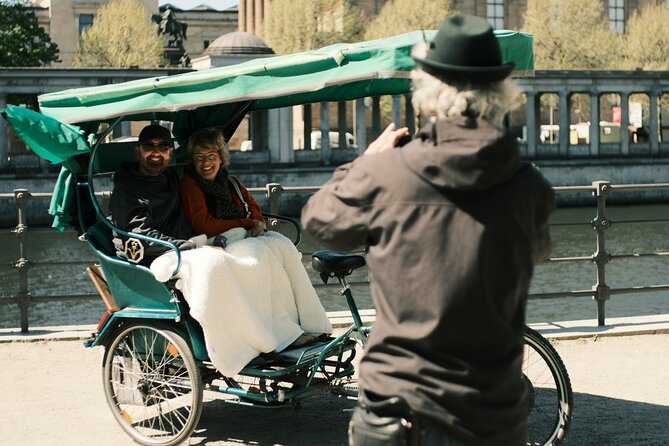
A rickshaw solves that problem without putting you behind a tour-bus window. You sit close to the street, hear the guide as you move, and can pull over for a photograph. The vehicle is also small enough to reach places where a larger vehicle would be awkward.
The route is not a simple ride with a fixed script. The guide can adjust the plan to match what you have already seen and what interests you most. If you have little time in Berlin, you can focus on headline sights. If you are drawn to 20th-century history, the guide can give more attention to the Wall, Checkpoint Charlie, the former Gestapo headquarters, and the Holocaust Memorial.
The guiding is an important part of the experience. Levent Aydin is praised for making the day personal and fun, while Tille is noted for finding practical routes and reaching places that might be easy to miss. The guide is also described as a capable photographer, which is useful when you want a picture of the whole group rather than another hurried selfie.
Other Berlin days worth putting on the list:
- Berlin: Reichstag, Dome and Government District Guided Tour
★ 4.7 · 18,288 reviews - Berlin: 1-Hour City Tour by Boat with Guaranteed Seating
★ 4.3 · 16,993 reviews - Berlin: Boat Tour Along the River Spree
★ 4.4 · 11,252 reviews
Alexanderplatz to Museum Island
The tour begins near the Berliner Fernsehturm, Germany’s tallest structure, at Alexanderplatz. The tower is one of Berlin’s clearest orientation points, with its round observation sphere visible from many parts of the city.
You only have about five minutes here, and the admission ticket is not included. That means this stop is mainly for seeing the tower from the square and getting your bearings, not for going up to the viewing platform. If you want to visit the tower, plan that separately and allow extra time.
From Alexanderplatz, the rickshaw passes the Rotes Rathaus, or Red Town Hall, along with Marien Church and Neptune Fountain. These sights help show how old Berlin and reconstructed Berlin sit side by side. The ride then moves toward Museum Island.
Museum Island deserves a closer look. This UNESCO World Heritage Site contains a remarkable group of museums and buildings along the River Spree. From the rickshaw, you can see the Berlin Cathedral, the reconstructed City Palace, the Old Museum, the Old National Gallery, the Pergamon Museum, and the Bode Museum.
The listed stop is about ten minutes, with no admission fee for the outdoor visit. You will not have time to tour the museums during this outing, and some museum interiors may require advance planning or separate tickets. Still, the street-level view gives you a useful first look at one of Berlin’s most important cultural areas.
The route also follows Unter den Linden, the grand boulevard running toward the Brandenburg Gate. This is one of the best stretches for seeing how Berlin’s imperial, Prussian, wartime, and modern identities overlap.
Bebelplatz and the Book Burning Memorial
At Bebelplatz, the tour enters the Forum Fridericianum, a group of major buildings that includes the State Opera, Humboldt University, the State Library, the Law Faculty, and St. Hedwig’s Cathedral, Berlin’s first Catholic church.
The square is also tied to the Nazi book burning of 1933. A memorial below ground level recalls the event, when thousands of books were burned. You may need to look carefully to spot it, since the memorial is deliberately restrained rather than grand.
This is a short five-minute stop, but it carries more historical weight than its length suggests. Ask your guide to explain what happened here and how the memorial works. The stop is free, and you do not need an admission ticket for the outdoor site.
Gendarmenmarkt and Checkpoint Charlie
Gendarmenmarkt is one of Berlin’s most graceful squares. The former Royal Concert Hall sits between the German Cathedral and the French Cathedral, creating a formal ensemble that feels very different from the broad open spaces around Alexanderplatz.
The stop lasts about ten minutes. It is a good place for photographs, though restoration work or city events may affect what you see on the day. The square’s beauty also offers a useful pause before the tour turns toward Berlin’s harder 20th-century story.
Checkpoint Charlie comes next. This former border crossing became one of the best-known flashpoints of the Cold War. In October 1961, American and Soviet tanks faced one another here, during a confrontation that raised fears of a much wider conflict.
The five-minute stop is short, so think of it as an introduction rather than a full museum visit. The checkpoint area is free to see, but the surrounding displays and private attractions are separate. Your guide can help you understand why this otherwise ordinary intersection became such a loaded name.
Same city, a completely different kind of day:
- Discover Berlin Half-Day Walking Tour
★ 5.0 · 9,624 reviews - Berlin: Hop-on Hop-off Bus Tour with Live Commentary
★ 4.3 · 8,579 reviews - Berlin: Government District around the Reichstag Guided Tour
★ 4.7 · 8,447 reviews - Berlin: Reichstag, Plenary Chamber, Cupola & Government Tour
★ 4.6 · 8,422 reviews
The Wall, the Topography of Terror, and Potsdamer Platz
Along the former border strip, you will see original sections of the Berlin Wall and reach the Topography of Terror. The documentation center occupies the former headquarters area of the SS and Gestapo, making its location part of the lesson.
The tour allows about five minutes here. That is enough for an exterior look and a brief explanation, not enough for a serious visit to the documentation center. If Nazi-era history is a priority, return later with more time. The center is one of Berlin’s major places for confronting how state terror was organized.
Nearby are Martin-Gropius-Bau, known for major temporary exhibitions, and the former Prussian Parliament. The guide can point out how buildings and empty spaces along this route reflect the city’s political changes.
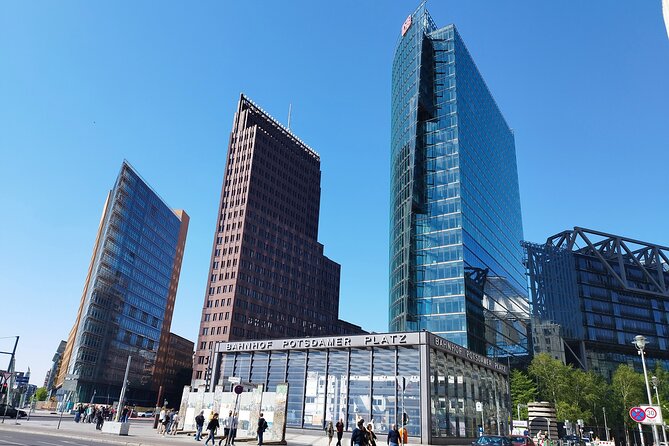
Potsdamer Platz provides a sharp visual change. Once divided by the Wall and later treated as one of Europe’s largest construction sites, it is now filled with tall modern buildings and the Sony Center. The ten-minute stop lets you compare present-day Berlin with the empty border zone that once cut through this area.
This part of the tour is especially useful because the rickshaw links separate sights into one story. You move from the physical Wall to the institutions behind Nazi repression, then to a rebuilt commercial center shaped by reunification.
The Holocaust Memorial and Brandenburg Gate
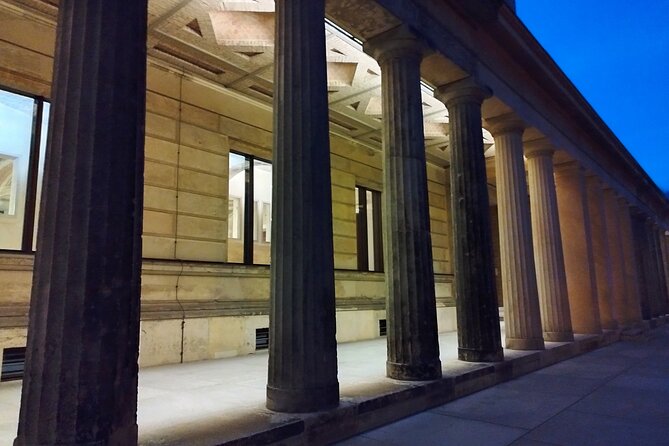
The Memorial to the Murdered Jews of Europe consists of a field of concrete blocks near Brandenburg Gate. It commemorates the murder of six million Jews during the Nazi period.
The tour gives you about ten minutes here. Walk among the blocks carefully and quietly, since the changing ground levels create a different feeling as you move inward. The outdoor memorial is free, while the underground information center is a separate visit.
Your guide can provide the basic context, but this is another place where extra time helps. Ten minutes gives you a first encounter, not a full study of the memorial or the people it represents.
Brandenburg Gate follows, with about ten minutes to see Berlin’s best-known landmark. Once a royal city gate, it later became a powerful Cold War symbol because it sat near the Wall. Since reunification, it has come to represent a shared Berlin rather than a divided one.
The rickshaw is helpful here because the guide can position you near the monument and suggest photo angles. Crowds and events can make the area busy, so having a guide who knows where to stop is useful.
The Reichstag, Sinti and Roma Memorial, and Führerbunker Site
The route continues into the government district, where you see the Reichstag, home of the German Bundestag, and the Federal Chancellery. You also pass the Memorial to the Sinti and Roma Murdered under National Socialism.
This section adds an important layer to the tour. Berlin’s central government quarter is not only about modern politics and impressive buildings. It also contains memorials to groups persecuted and murdered during the Nazi period.
The Reichstag visit from outside does not include entry to the building or its glass dome. If you want to go inside, that requires separate arrangements. The rickshaw stop is about five minutes, so use it to hear the guide’s explanation and take photographs.
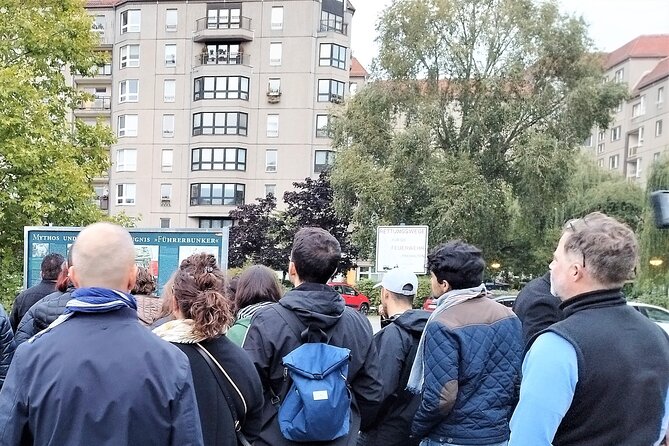
The tour also points out the site of the Führerbunker, now marked by an ordinary parking area. There is no grand ruin to see. That plain setting is part of the point: the place connected with Hitler’s final days is not preserved as a shrine or spectacle.
You have about ten minutes at this stop. Expect context rather than a visible underground complex. A good guide will keep the focus on the historical facts and the postwar decision not to turn the site into a monument.
Returning to the Berliner Dom
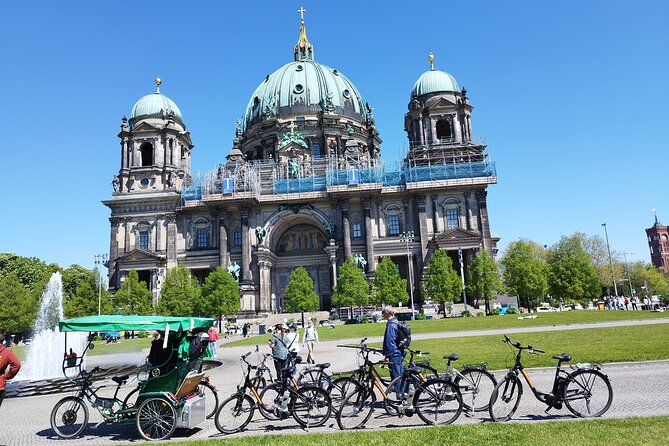
The final listed stop is the Berliner Dom, or Berlin Cathedral, with about ten minutes to see it. Its large dome and riverside position make it one of Museum Island’s most recognizable buildings.
Ending here creates a visual link to the earlier Museum Island stop. You may finish near the cathedral, or arrange another drop-off. The operator says you can return to your hotel or end at a monument, restaurant, cafe, market, or boat-tour meeting point.
That flexibility matters. You are not locked into a standard coach-tour ending far from where you want to go next. Discuss the finish at the start, especially if you have a dinner booking or a boat trip planned.
Price, Group Size, and Comfort
The listed price is $420.08 per group of up to two people. For two people, that works out to $210.04 each, which is a substantial spend for three hours. The price becomes easier to justify if you have limited time, prefer private guiding, or want a route designed around your interests.
The title refers to one to three rickshaws for up to six people, but the published price is specifically shown for up to two. If your party is larger, confirm the total before paying. Three rickshaws could make this a practical choice for a family or small private group, but the cost structure needs to be clear.
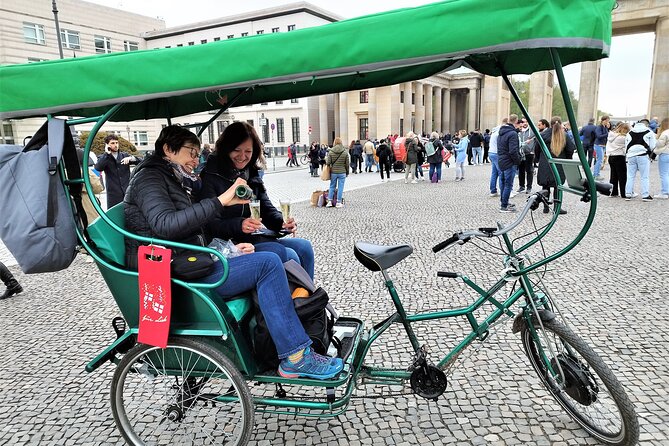
The experience includes a licensed guide, WiFi on board, and a cosy blanket if you choose rickshaw transport. Tips are not included. The service can also use bikes or walking sections when distance and timing make that sensible.
The rickshaw is described as suitable for less mobile people. You enter it in a few steps, and the vehicle can stop close to monuments. Still, the information does not give exact seat dimensions, transfer assistance, or wheelchair specifications, so ask the operator directly if you need those details.
Pickup is offered, and the start and finish can be arranged around your plans. Confirmation comes at booking. Service animals are allowed, public transport is nearby, and most people can take part.
Free cancellation is available until 24 hours before the local start time. Cancellations or changes made inside that window are not accepted for a refund.
Who Should Book This Berlin Tour
I would choose this for a first visit when I wanted to see the city’s main central sights quickly, especially with only one free afternoon. It also suits you if you like asking questions and changing the plan rather than following a fixed group schedule.
It is a good fit for families, couples, older people, and anyone who finds long city walks tiring. The blanket, close vehicle access, pickup option, and flexible finish all add comfort.
History-minded visitors should see the route as an overview. The tour touches many serious sites, but most stops last five or ten minutes. You will get a strong sense of place and chronology, then need separate visits if you want to read exhibits or study memorials in depth.
I would hesitate if you are watching your budget or already know Berlin well. Public transport and walking cost far less, and a three-hour route cannot give every stop the time it deserves. The value comes from having a private guide, saving time, getting close to the sights, and shaping the route around your interests.
The experience has a 4.9 rating from 20 ratings, with every rating recommending it. The strongest praise centers on friendly guiding, clear explanations, useful routing, and the fun of seeing Berlin from a rickshaw. Levent Aydin and Tille are two guide names associated with those qualities.
Should You Book It?
Book this tour if you want a private orientation to Berlin and are willing to pay for speed, comfort, and personal attention. Tell the guide in advance if you care most about Nazi history, the Cold War, architecture, photography, or modern Berlin, then ask for extra time at your top two or three stops.
Skip it if you want long museum visits or the lowest-cost way around town. For everyone else, the rickshaw offers a practical first look at a complicated city, with a guide who can help you understand what you are seeing instead of merely passing it by.
FAQ
How long does the Berlin rickshaw tour last?
The tour lasts approximately three hours.
How much does the tour cost?
The listed price is $420.08 per group of up to two people.
Can larger groups take the tour?
The experience allows up to three rickshaws and six people. Because the listed price covers up to two people, confirm the price for a larger group before booking.
Is hotel pickup available?
Yes. Pickup is offered, and the start and finish can be arranged around your plans.
Where can the tour finish?
You can finish back at your hotel, by a monument, at a restaurant, cafe, market, or one of several boat-tour starting points.
Is the tour private?
Yes. Only your group takes part in the activity.
Which languages are offered?
The tour is offered in English.
Are admission tickets included?
The listed stops are outdoor visits, and admission tickets are not included for places such as the Fernsehturm. Separate entry may be needed for museums, the Reichstag interior, or other attractions.
Is the tour suitable for people with limited mobility?
The service is described as suitable for less mobile people. You can enter the rickshaw in a few steps, and it can stop close to monuments. Ask the operator about your specific mobility needs.
Can I cancel for a full refund?
Yes, if you cancel at least 24 hours before the local start time. Cancellations or changes made less than 24 hours before the start are not accepted for a refund.
Just added around Berlin
- Love and War in Berlin: Self-Guided Story Puzzle Walk★ 5.0 · 7 reviews
- Rickshaw Tours Berlin – Groups of up to 16 people with several rickshaws★ 4.0 · 97 reviews
- Walking on the Wall: 3-Hour Tour in Berlin★ 4.5 · 34 reviews
- eSIM for Germany and 34 European Countries★ 4.5 · 16 reviews
- Warnemuende Shore Excursion: Berlin Private Sightseeing Tour from Rostock★ 5.0 · 4 reviews
- Your ticket to The Wall Museum Berlin★ 3.0 · 60 reviews
- Warnemuende Shore Excursion: Private Berlin Tour★ 4.5 · 27 reviews
- Berlin’s Gay, Lesbian, and Queer Scene Small-Group Walking Tour★ 4.5 · 66 reviews
Berlin Tours, compared.

Reichstag, Dome and Government District Guided Tour
Read our review →
1-Hour City Tour by Boat with Guaranteed Seating
Read our review →


Reichstag, Plenary Chamber, Cupola & Government Tour
Read our review →

