
Reviewed · OLD TOWN WALKING TOURS
Nuremberg Old Town and Nazi Party Rally Grounds Walking Tour in English
Nuremberg’s story makes an unusual two-part tour: you begin among medieval walls, churches, and market squares, then take public transport to the enormous Nazi Party Rally Grounds. The shift from imperial city to propaganda center gives you a clear sense of how Germany’s past changed over time.
I like the way the tour combines the Old Town and rally grounds without charging extra for the bus or train. I also like the guides’ use of old photographs to connect today’s streets with earlier events. The main drawback is the pace: four hours is a long time on foot, and the climb toward the castle can be tiring.
In This Review
- Key points to know
- Starting at Nuremberg Central Station
- Handwerkerhof and the Old Town walls
- Hauptmarkt and the Beautiful Fountain
- Churches, the Old Town Hall, and Albrecht Dürer
- The climb to Kaiserburg Nuremberg
- From imperial city to the Third Reich
- Taking public transport to the Rally Grounds
- Great Street and the unfinished Congress Hall
- The Documentation Center and Nuremberg Trials
- How the four hours are divided
- Is $44.74 a fair price?
- Who should book this Nuremberg tour?
- My advice before you go
- Should you book it?
- FAQ
- Where does the Nuremberg walking tour begin?
- How long does the tour last?
- Is the tour conducted in English?
- Does the tour visit the Nazi Party Rally Grounds?
- Is public transportation included?
- Is food included?
- Does the tour enter the museums and churches?
- How many people can join the tour?
- Can I cancel for a full refund?
Key points to know
- Two very different sides of Nuremberg: Medieval streets and imperial landmarks come first, followed by the Third Reich sites outside the Old Town.
- Public transport is included: A bus or train carries you to the rally grounds, giving your feet a useful break.
- Strong guide-based experience: Hannes, Nick, Natasha, Niklas, and Dimitri have received especially warm praise for their storytelling and command of local history.
- Expect plenty of walking: The route includes uphill streets toward the Imperial Castle and about two hours of Old Town touring before the rally grounds.
- The rally grounds are stark, not polished: You see huge unfinished and ceremonial structures, not a restored monument complex.
- Good value at $44.74: The fee includes a local guide and public transport, but not food, drinks, or entry to St. Sebaldus Church.
Starting at Nuremberg Central Station
The tour begins at 10:00 am in front of Nuremberg Central Station, a practical meeting point if you arrive by train or are staying near the center. You meet the guide and group here before heading into the Old Town.
The advertised maximum is 25 people. That is small enough for a personal walking tour in good conditions, though a full group can make hearing difficult on noisy streets. One complaint specifically concerned sound levels, while another noted a sold-out group of 20 during the Christmas market season. If clear narration matters to you, stay close to the guide and ask for a louder voice during the walk.
The tour is offered in English. Several guides have earned strong praise for their style, including Hannes, also called John in some tour references, along with Nick, Natasha, Niklas, and Dimitri. The guide assigned to your date can vary, so you should not book on the assumption that one particular person will lead it.
More Old Town Walking Tours in Nuremberg
- Nuremberg: Old Town Guided Walking Tour
★ 4.6 · 2,416 reviews - Nuremberg Old Town and Nazi Rally Grounds Walking Tour
★ 4.7 · 377 reviews - Nuremberg: The Old Town in Evening Light – IN GERMAN
★ 4.7 · 353 reviews
Handwerkerhof and the Old Town walls
The first stop is Handwerkerhof, the Craftsmen’s Courtyard beside the main station. It is a modern reproduction of a traditional crafts market, with small shops and restaurants selling the work of glass cutters, leather workers, gold and silversmiths, stained-glass painters, and other artisans.
You get about 10 minutes here, so think of it as an introduction rather than a shopping visit. It gives the tour a human scale before the larger historical subjects begin. You can browse, but there is no included food or shopping allowance.
From here, the route takes you toward Nuremberg’s Old Town walls. The surviving fortifications run for roughly four kilometers, a reminder of the city’s former power and importance. The walk through and beside the walls also shows how much of the historic center remains enclosed by its medieval defenses.
The route may include a former medieval customs house and granary, now associated with one of the city’s breweries. This is the sort of detail that can pass unnoticed when you walk alone, but a guide can explain how trade, storage, taxes, and brewing shaped the city.
Hauptmarkt and the Beautiful Fountain
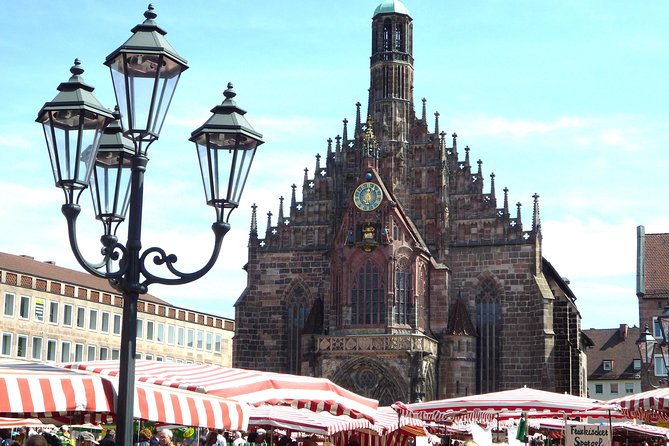
Hauptmarkt has been the city center since the 1300s. It is still one of the most useful places to pause and understand Nuremberg as a living city, not simply an outdoor museum.
The tour includes a short lunch break here, generally around 30 minutes according to the tour information and guide comments. Food and drinks are not included, so use the pause to buy something at the market or nearby. This break is welcome, but do not expect a full restaurant meal unless you arrange it quickly.
The square is also home to the Beautiful Fountain, or Schöner Brunnen. Its golden Gothic tower rises above the market, and the famous wishing ring gives you a small piece of local tradition amid the grand architecture. You get roughly five minutes at the fountain, enough for an explanation and photographs, but not a long stop.
If you visit during the Christmas market season, Hauptmarkt becomes far busier and louder. That can add atmosphere, but it also makes it harder to stay close to the guide and hear every word. Weekday or non-market dates should provide a calmer walk.
Churches, the Old Town Hall, and Albrecht Dürer
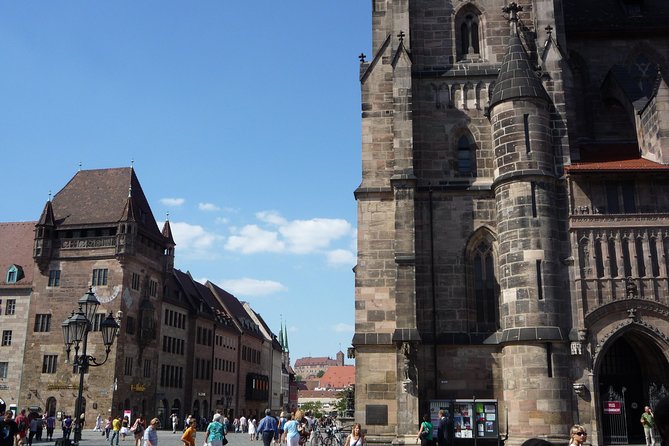
The route continues to St. Sebaldus Church, the oldest church in Nuremberg and the home of the city’s patron saint. The stop is brief, about five minutes, and admission is not included. You should treat this as an exterior orientation unless your guide or schedule allows extra time inside.
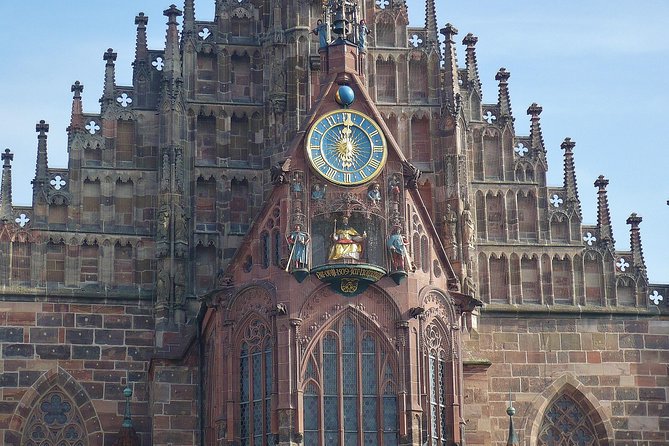
The tour also passes the Gothic St. Lawrence Church, which was rebuilt after World War II. Its reconstruction offers a useful way to discuss wartime damage and the difficult choices involved in restoring a historic city after destruction.
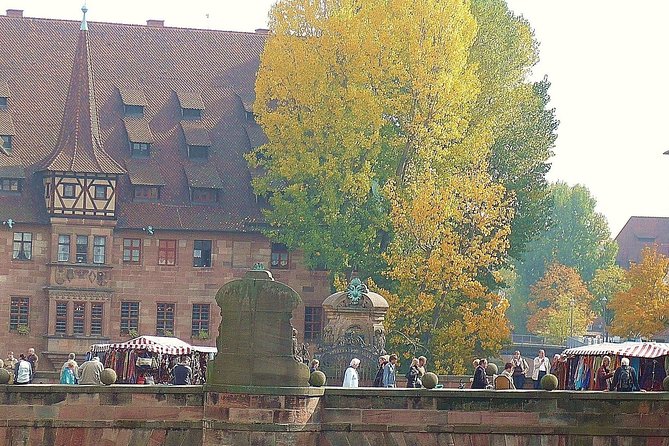
At the Old Town Hall, completed in 1622, the guide helps place Nuremberg’s later civic power in context. The city was not important only because of its Nazi past. It was also a major imperial and commercial center, with a long tradition of craft, trade, religion, and government.
You also see the original house of Albrecht Dürer, the famous German Renaissance artist. The house is now a museum, but admission is not part of this tour. I like this stop because it helps widen the story beyond kings and war. Dürer represents the city’s artistic life and its role in the German Renaissance.
Same city, a completely different kind of day:
- Nuremberg: City Tour with the Bimmelbahn Train
★ 4.4 · 2,475 reviews - Nuremberg: Tunnels and Secret Passages in the City Wall Tour
★ 4.8 · 2,334 reviews - Nuremberg: Medieval Dungeons Guided Tour
★ 4.8 · 1,726 reviews - Nuremberg: Walking Tour of Former Nazi Party Rally Grounds
★ 4.7 · 1,665 reviews
The climb to Kaiserburg Nuremberg
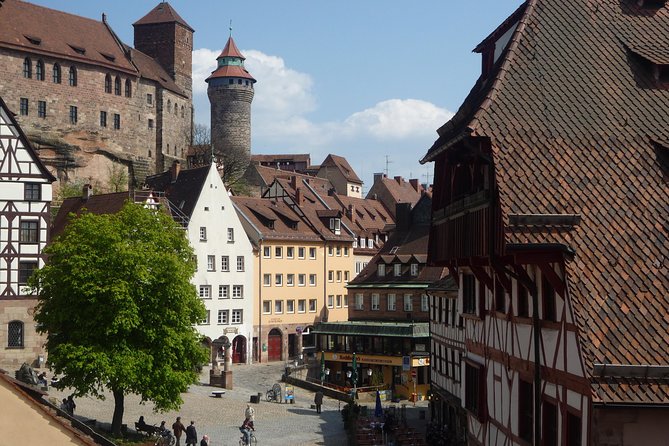
The walk then heads uphill toward Kaiserburg Nuremberg, the Imperial Castle. The castle dates back at least to 1050 and is one of the clearest reminders that Nuremberg once sat close to the center of Holy Roman Empire politics.
You see the castle courtyards and learn where German emperors were crowned. The tour does not include a paid castle admission, so this is primarily an outdoor visit and historical explanation rather than a full museum tour.
The climb is the most demanding part of the Old Town section. Several people have praised the route and the views, but one clear warning is worth taking seriously: you need to be comfortable walking for about four hours, including uphill streets. The tour includes a lunch pause and public transport, so you are not standing or walking every minute, yet the first half can still feel strenuous.
Wear supportive shoes. On rainy days, cobblestones and slopes may slow you down. Guides such as Natasha and Hannes have been praised for keeping the medieval section interesting, even in poor weather, but a good guide cannot remove the physical effort.
From imperial city to the Third Reich
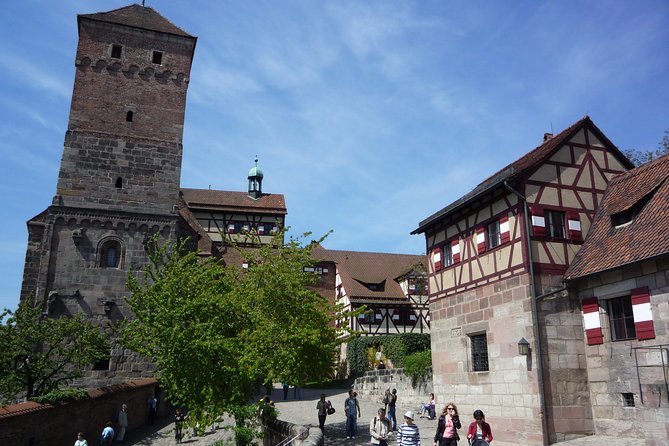
The first half of the tour deals with Nuremberg’s older identity: imperial ceremonies, churches, artists, markets, and defensive walls. The second half turns to the city’s role as a center of Nazi spectacle and propaganda.
That contrast is the tour’s main idea. Nuremberg was used by the Nazis as a symbolic city, sometimes described in connection with the regime’s vision of a Temple City of the Third Reich. The party selected it for mass rallies partly because of its imperial associations and its existing ceremonial spaces.
Rather than treating the Nazi period as an isolated chapter, the guide connects it to the city you have just walked through. You see how historical symbols can be reused for political purposes. This makes the morning Old Town tour more useful than a separate sightseeing stroll, because the older buildings help explain why the Nazis wanted to claim Nuremberg’s image.
Taking public transport to the Rally Grounds
After the Old Town walk, you use a city bus or train to reach the Nazi Party Rally Grounds. Public transport is included in the price, which is a meaningful benefit at $44.74. You do not need to arrange your own route, buy a separate ticket, or guess which stop serves the large site.
The ride also offers a short chance to rest. One guide described the journey as about 20 minutes, though the exact time can vary. Keep your ticket details and meeting instructions handy, since the group needs to move together through the city system.
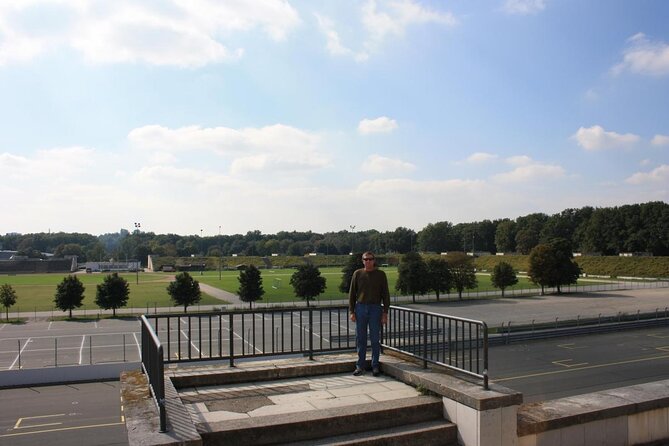
The rally grounds are spread out, so this portion is still partly a walking tour. You should not picture a compact museum complex where every building is next door. The scale is part of the point. The broad spaces were designed to hold enormous crowds and create a feeling of power through size.
Great Street and the unfinished Congress Hall
At Volksfestplatz, you see the fairgrounds used by the Nazis for the Nuremberg Rallies. The guide explains how the area functioned as a stage for mass gatherings and political theater.
The Great Street was planned by architect Albert Speer as the central axis of the rally grounds. Its size makes the regime’s ambitions easier to understand than a textbook description alone. The empty spaces and monumental design were built to impress, organize crowds, and place one political movement at the center of public life.
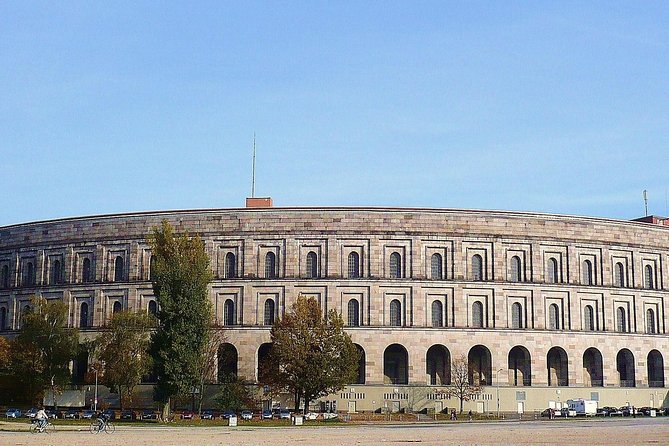
The unfinished Congress Hall is another major stop. Hitler intended the building for Nazi Party meetings, but it was never completed. Its half-finished state is important. You see the physical remains of a plan that aimed to turn architecture into a tool of authority.
The Congress Hall can feel less dramatic than some people expect. It is not a neatly restored symbol with a clear beginning and end. Instead, you see a huge, severe structure and hear how it was planned for party events. If you want polished displays and a longer indoor visit, you should allow extra time for the Documentation Center.
The Documentation Center and Nuremberg Trials
The Documentation Center contains exhibits on important wartime and post-war events, including the Nuremberg Trials. The tour provides an introduction to this material, but you can stay longer if you want a fuller museum visit.
That option matters because four hours cannot cover the rally grounds, the Old Town, the Nazi rise to power, the war, and the trials in equal detail. The walking tour gives you the physical setting and a clear narrative. The museum gives you more documents, images, and explanation.
The Nuremberg Trials add a crucial second chapter to the site. Nuremberg was not only where the Nazi regime held its rallies. It also became the setting for major post-war trials of Nazi leaders. Seeing both sides helps you understand the city’s uncomfortable role in German history.
Some people may find the rally grounds disappointing because the present-day site does not look exactly as they imagined. That reaction is understandable. Much of the power comes from knowing what the buildings were designed to do and seeing their scale in person. The guide’s explanation is especially important here, since the bare structures do not always tell their own story.
How the four hours are divided
The tour generally divides its time between the Old Town and the Third Reich sites. Expect about two hours walking through the medieval center, a lunch pause at the market, public transport to the rally grounds, and roughly another two hours focused on Nazi history.
The advertised duration is approximately four hours, not a hard guarantee. One tour finished about 35 minutes later than planned, so avoid scheduling a tight train connection immediately afterward. The official meeting point is also listed as the end point, though you may choose to remain at the Documentation Center for a longer visit before returning independently.
The pace is usually described as manageable, but the amount of ground covered is real. If you have limited stamina, you may prefer an Old Town only tour, which the provider also offers. This combined version suits you best if you want a broad first look rather than a slow examination of each attraction.
Is $44.74 a fair price?
At $44.74 per person, I consider this a fair price for a four-hour English walking tour that includes a local guide and public transport. You are paying for structure, context, and transport between two areas that are not best covered on foot from the Old Town.
The value is strongest if you are visiting Nuremberg for the first time. A good guide can point out details you might miss, explain the city’s imperial role, show connections to Dürer and the churches, and then make sense of the rally grounds. Guides such as Nick, Hannes, Natasha, Niklas, and Dimitri have been praised for clear English, humor, photographs, and an ability to answer questions.
The value is weaker if you want long indoor visits. Entry to St. Sebaldus Church is not included, and food and drinks are extra. The castle and Dürer’s house are seen as part of the exterior route rather than visited in depth. You are buying a guided overview, not a series of museum admissions.
The tour has a 4.6 rating from 504 reviews, with 91 percent of people recommending it. That is a strong record, but the recurring concerns are useful: some people wanted more time at the rally grounds, and others had trouble hearing in a large group. Your experience will depend partly on group size, weather, market crowds, and the guide assigned that day.
Who should book this Nuremberg tour?
I would choose this tour if you want one organized morning and afternoon covering the city’s major historic themes. It works especially well for history fans, first-time visitors, and anyone who wants the Nazi rally grounds explained rather than simply photographed.
It also suits you if you enjoy stories that connect buildings to people and political events. The strongest guides add humor without turning the difficult subjects into entertainment. Nick has been praised for an engaging delivery, while Hannes has been singled out for local detail and historical storytelling. Niklas has also used photographs to show how past scenes relate to the places you see today.
You should think twice if you dislike long walks, uphill streets, group travel, or serious wartime history. The rally grounds are large and stark. They may feel underwhelming if you expect a dramatic preserved monument. You might prefer a private tour if hearing every word is essential, especially during the Christmas markets.
Book at least several weeks ahead if your dates are fixed. The tour is booked an average of 43 days in advance, which suggests that popular dates can fill early. Free cancellation is available up to 24 hours before the start time. If poor weather causes the operator to cancel, you are offered another date or a full refund.
My advice before you go
Arrive ready to walk. Wear shoes with good grip, bring water, and leave room in your schedule after the four-hour estimate. A small amount of cash or a card for the market lunch is also sensible, since food is not included.
Stay near the guide when the group crosses busy streets or uses public transport. If you cannot hear, speak up at once. This is a simple fix during the tour, but it is much harder to recover missed explanations later.
If you visit during the Christmas market, enjoy the atmosphere but expect crowds and noise. A weekday outside the market season should make the tour easier to follow. If you want more time at the Documentation Center, decide in advance whether to remain there or return to central Nuremberg with the group.
Should you book it?
Book this tour if you want a clear, efficient introduction to both medieval Nuremberg and its Nazi-era sites. The combination is the real strength, and the included public transport makes the price easier to justify.
Choose another format if you want detailed museum visits, a slower pace, or a private guide. For most first visits, though, this four-hour route gives you a useful framework for the city, from imperial castle courtyards and Dürer’s home to the Great Street, Congress Hall, and the Nuremberg Trials.
FAQ
Where does the Nuremberg walking tour begin?
It begins at 10:00 am in front of Nuremberg Central Station, at Bahnhofsplatz, 90443 Nuremberg, Germany.
How long does the tour last?
The tour lasts approximately four hours. It may finish later than the scheduled time, so avoid planning a tight connection immediately afterward.
Is the tour conducted in English?
Yes. The experience is offered in English and includes a local guide.
Does the tour visit the Nazi Party Rally Grounds?
Yes. The second part of the tour uses public transportation to reach the rally grounds, including Volksfestplatz, Great Street, and the unfinished Congress Hall.
Is public transportation included?
Yes. Public transportation by bus or train is included in the tour price.
Is food included?
No. Food and drinks are not included, but the tour includes a short lunch break at the market place.
Does the tour enter the museums and churches?
The tour passes and explains several sites, but admission to St. Sebaldus Church is not included. The Documentation Center is visited as part of the rally grounds section, and you may stay longer there if you wish.
How many people can join the tour?
The activity has a maximum of 25 participants.
Can I cancel for a full refund?
Yes. You can cancel at least 24 hours before the start time for a full refund. Cancellations or changes made less than 24 hours before the start time are not refunded or accepted.
More Walking Tours in Nuremberg
- “Rotes Bier” and “Blaue Zipfel”. A historical-culinary walk
★ 4.4 · 190 reviews - Nuremberg 2-Hour Old Town Highlights Walking Tour in English
★ 4.4 · 107 reviews - Nuremberg: Private Guided Walking Tour
★ 4.5 · 9 reviews - Discover Berlin Half-Day Walking Tour
★ 5.0 · 9,624 reviews
Just added around Nuremberg
- Tour en español al Campo Zeppelin★ 5.0 · 8 reviews
- Stein: Public guided tour of the “Old Mine” museum★ 4.5 · 18 reviews
- “Rotes Bier” and “Blaue Zipfel”. A historical-culinary walk★ 4.4 · 190 reviews
- Nuremberg: Old Town Guided Tour By Bus★ 4.4 · 198 reviews
- Nürnberg kennenlernen: Highlights in der Altstadt★ 4.7 · 189 reviews
- Nuremberg: Bar and Club Tour with Free Shots and Free Entry★ 3.8 · 23 reviews
- Nürnberg Bachelor(ette) Party with Night PubCrawl★ 4.2 · 5 reviews
- Nuremberg: WWII Tour, Courtroom 600 and 3rd Reich Sites★ 4.6 · 94 reviews
Old Town Walking Tours, compared.
Old Town & Viktualienmarkt City Walk in German
Read our review →
The Night Watchman Old Town Walking Tour in German
Read our review →
Browse the lists this tour appears in