
Reviewed · WALKING TOURS
Leipzig: Bus Tour with Walking Tour
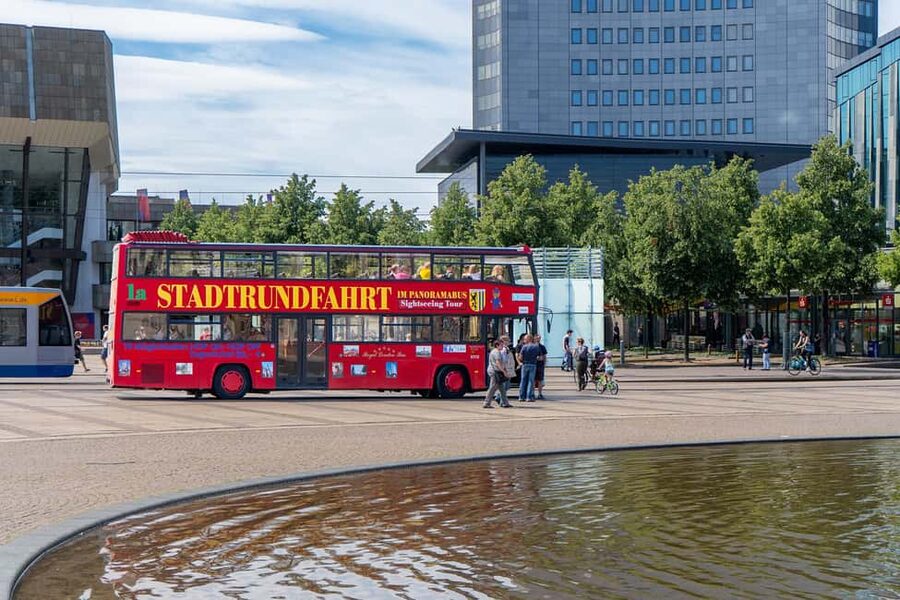
Leipzig’s red double-decker bus gives you a fast, useful introduction to a city that spreads well beyond its compact old center. You pass grand railway buildings, music venues, old neighborhoods, the Panometer, and the Battle of the Nations Monument without spending your first hours guessing where everything is. I especially like the 100-minute route and the free 45-minute walking tour, which together give you both a broad view and a closer look at central Leipzig.
The main weakness is language. Live commentary is in German, and a Saxon accent can make it hard to follow if your German is limited. Written information is available in other languages, but you should book this for the city views and orientation first, not for a full spoken history lesson in English.
- Red double-decker buses cover Leipzig’s major sights in about 100 minutes.
- Richard-Wagner-Straße 2 is the easiest starting point, directly across from the main train station’s East Hall.
- A 20-minute stop at the Battle of the Nations Monument gives the route its one substantial break.
- The 45-minute walking tour is included, but it runs only from March until the start of the Christmas markets.
- Live commentary is in German, with written tour information in other languages.
- Buses run at regular intervals, making the ticket useful for flexible sightseeing during the day.
In This Review
- A smart first look at Leipzig from Richard-Wagner-Straße
- What the 100-minute route actually shows you
- From the Waldstraßen Quarter to the city harbor
- The Panometer and Leipzig’s southern side
- The Battle of the Nations Monument stop
- Bavarian Station, the German National Library, and Augustusplatz
- The included walking tour adds what the bus cannot
- German commentary and what it means for you
- Timing, tickets, and day-of-use tips
- Who gets the best value for $16
- Should you book the Leipzig bus and walking tour?
- FAQ
- Where does the Leipzig bus tour start?
- Where does the tour finish?
- How long is the bus tour?
- Is there a stop at the Battle of the Nations Monument?
- Is the walking tour included?
- When does the walking tour operate?
- Is the commentary available in English?
- Is the activity wheelchair accessible?
A smart first look at Leipzig from Richard-Wagner-Straße
At about $16 per person, this is one of the easier ways to get your bearings in Leipzig without paying for a long private tour. The main stop at Richard-Wagner-Straße 2 sits across from Leipzig Central Station, at the East Hall, so you can begin soon after arriving by train.
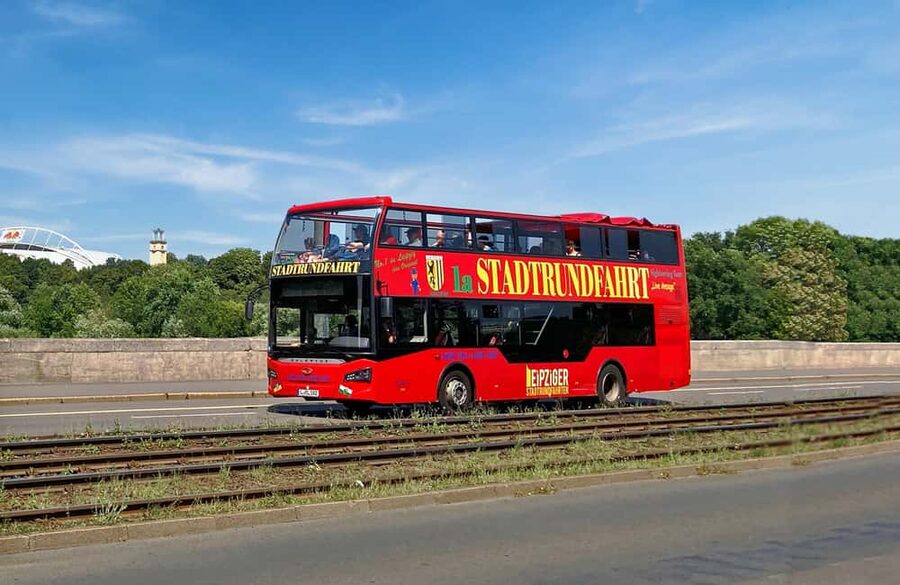
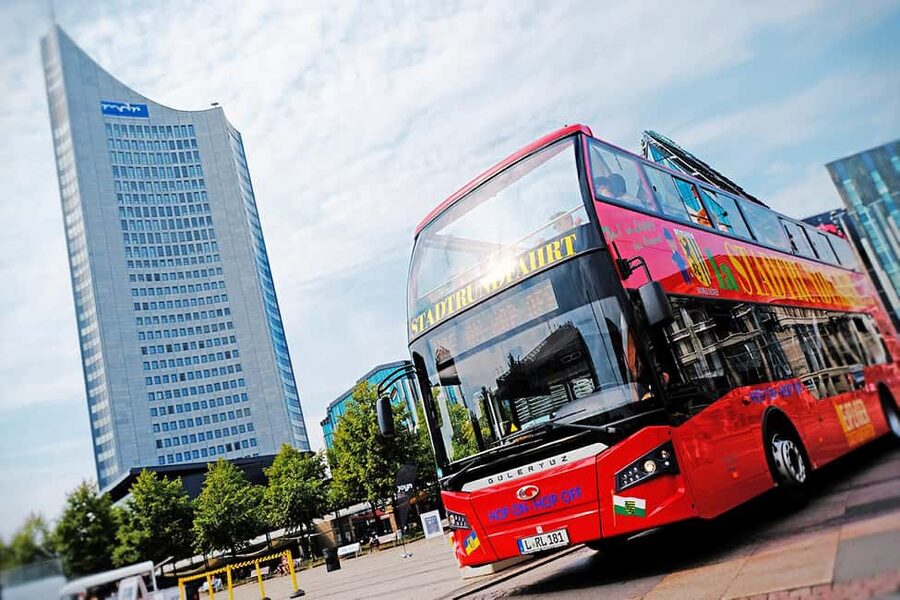
Look for the red double-decker buses marked with Leipzig’s familiar Messemännchen mascot. The buses pass the principal sights rather than stopping for long at each one. The important exception is the 20-minute stop at the Battle of the Nations Monument, where you have time to stretch your legs and take in the huge memorial from outside.
This is not the sort of tour where you spend a full afternoon at every attraction. Think of it as a moving introduction. You see where the zoo, Gohlis, the western neighborhoods, the Panometer, and the southern monuments sit in relation to the old center. Then you can return to the places that interest you most.
The buses run in regular intervals, though exact departure times matter. The last tour begins at 2 p.m., according to the practical information supplied for this experience, so check the current timetable before planning it around a late hotel check-in or an afternoon train.
What the 100-minute route actually shows you
The route starts near Leipzig Central Station, one of Europe’s large historic railway terminals. You pass the station rather than tour its interior, but its scale gives you an immediate sense of Leipzig’s importance as a transport and trading center.
From there, the bus continues toward Leipzig Zoological Garden and Gondwanaland. The zoo is one of the city’s major family attractions, while Gondwanaland is its large tropical hall. You only pass these sights on the bus, so treat this part as a location check. If you want to visit the zoo, plan a separate block of time.
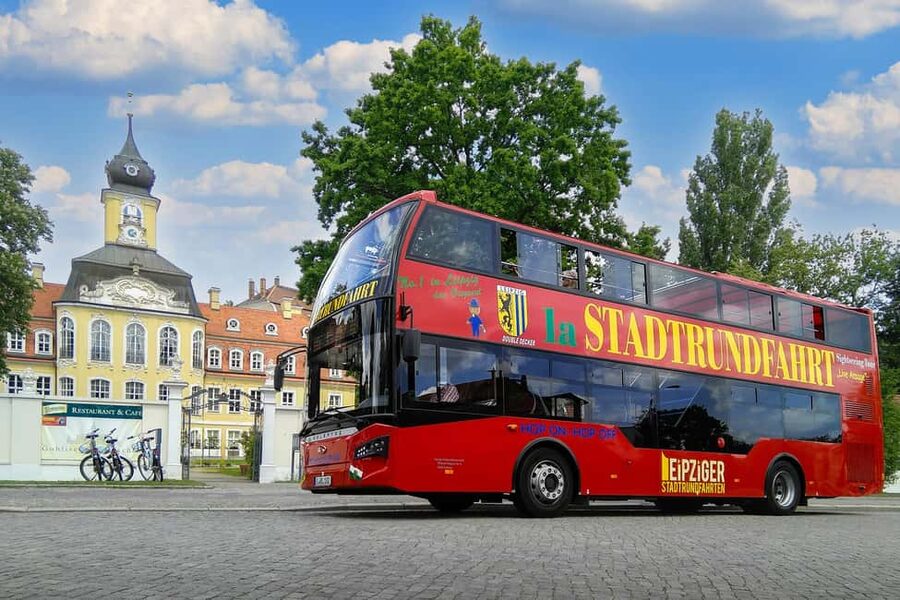
The route then reaches Schiller House Leipzig in Menckestraße. Friedrich Schiller stayed here, and the house connects Leipzig with the city’s literary past. Nearby Gohliser Castle and Gosen Tavern add a different flavor, showing the older northern districts beyond the central pedestrian streets.
You pass Gohliser Castle itself on Poetenweg. The stop is useful because the area contains several sights close together, including the castle, Schiller House, and the old tavern. The bus does not turn this into a castle visit, so you will need to return independently if you want to go inside.
A few more Leipzig trips to weigh up
- Leipzig: 1.5-Hour Historical Walking Tour in German
★ 4.7 · 2,217 reviews - Leipzig: 2-Hour Guided Walking Tour in German
★ 4.8 · 1,612 reviews - 1.5 hour walking tour through beautiful Leipzig
★ 4.6 · 292 reviews
From the Waldstraßen Quarter to the city harbor
Next comes the Waldstraßen Quarter, with the Waldstraßenknolle area near Feuerbachstraße and Max-Planck-Straße. The route also passes Rosental, where a zoo display window lets you glimpse animals without entering the zoo, as well as the Sport Forum.
This section gives you a feel for Leipzig’s greener western side. It is a useful contrast to the station, old center, and large public squares. You are not simply circling the same central streets.
The bus continues to City Harbour Leipzig on Schreberstraße. The harbor is another of those places that can be hard to place on a first visit. Seeing it from the bus helps you understand the city’s water-side recreation areas and the direction of the western districts.
You then pass Capa House, at Jahnallee 61. The building is linked with photojournalist Robert Capa and has an exhibition titled War is over, Robert Capa in Leipzig. The tour only passes the address, but it gives history-minded visitors a useful reason to return on foot.
Nearby sights include the Palm Garden and Rockers Café Tankbar. These are brief visual markers on the route rather than scheduled stops. The value here is range: in a few minutes, you see memorial culture, recreation areas, and local neighborhood life alongside Leipzig’s formal monuments.
The Panometer and Leipzig’s southern side
The route next passes the Federal Administrative Court, a grand civic building with a serious, formal presence. It then continues toward the library known as Albertina, another important city landmark.
At Fichtestraße 66, near Altenburger Straße, the bus passes Eisfichte Coffee and the MDR premises. From here, the route points you toward the Leipzig Panometer, a former gas holder used for very large panoramic art displays.
Again, the bus only passes the attraction. If the current panorama interests you, save it for a separate visit. The bus tour helps you locate it and shows how far it sits from the central station and Augustusplatz.
This part of the ride is especially useful for first-time visitors who want more than the postcard center. You see public institutions, broadcasting facilities, and industrial-era spaces that helped shape modern Leipzig. The commentary may add local anecdotes, but if you do not understand German well, you will get more from the visual route than from the spoken detail.
The Battle of the Nations Monument stop
The most important scheduled break is at the Monument to the Battle of the Nations, beside the Southern Cemetery. The monument commemorates the 1813 battle near Leipzig, one of the largest conflicts in Europe before the First World War.
The bus stops here for about 20 minutes. That is enough time to get off, admire the massive exterior, and take photographs. It is not enough time for a leisurely visit to every part of the monument, so keep your expectations sensible.
This stop improves the tour considerably. A continuous bus loop can leave you feeling as if you have only watched Leipzig through glass. The break gives you a chance to stand beneath one of the city’s most striking landmarks and reset before the final part of the ride.
If you are deciding how to use the day, do not leave this stop to chance. Listen for the guide’s instructions and be ready to reboard on time. The tour information identifies it as the main stop, not an open-ended visit.
Same city, a completely different kind of day:
- Leipzig: City History Canal Sightseeing Tour on a Motorboat
★ 4.7 · 6,232 reviews - Leipzig: 1.5-Hour Public Tour with Night Watchman Bremme
★ 4.6 · 3,116 reviews - Combo Tour in Leipzig: Guided City Tour & City Sightseeing
★ 4.7 · 2,317 reviews - Leipzig: 13-Stop Hop-on/Hop-off Bus Ticket
★ 4.6 · 1,468 reviews
Bavarian Station, the German National Library, and Augustusplatz
After the monument, the bus passes the German National Library, identified in the route information as Deutsche Bücherei. This is another sight best appreciated as part of the city’s wider cultural picture. It is not in the dense old center, and the bus lets you connect it with the other southern districts.
The Bavarian Railway Station follows. This old station now includes a restaurant and is one of Leipzig’s notable railway landmarks. You pass the site rather than receive a meal or an interior visit, so plan a separate stop if you want to explore it properly.
The final major sight is Augustusplatz, Leipzig’s broad central square. Here you see the Concert Hall, Panorama Tower, University Campus, Leipzig Opera, and the entrance to the pedestrian zone. This is the strongest place to continue exploring after the ride because several central sights are close together.
The bus finishes back at the main meeting point, with drop-off at Leipziger Stadtrundfahrten or the company’s nearby stop. You can also use the route as a practical map. If Augustusplatz catches your eye, for example, you now know where to walk after returning to the station.
The included walking tour adds what the bus cannot
The 45-minute walking tour is the best extra in this package. A bus shows you the city’s shape, but a walk gives you a closer look at streets, buildings, and the central story of Leipzig.
You do not need to give advance notice. Simply come to the meeting point on Richard-Wagner-Straße across from the Central Station’s East Hall. Professional guides lead the walk, and the tour operates from March until the beginning of the Christmas markets.
That seasonal limit matters. If you visit during the Christmas market period or in the winter season outside the stated dates, assume that only the bus portion is available unless the operator confirms otherwise.
Because the walk is only 45 minutes, it is best viewed as a compact introduction rather than a full historical tour. Pair it with the bus for the strongest result: use the walk for the central streets and the bus for the wider districts.
German commentary and what it means for you
Live commentary is provided in German on all buses. This gives German-speaking passengers access to local anecdotes and a more personal presentation than a recorded announcement. The accent may be distinctly Saxon, which can make the commentary challenging even for some German learners.
Written tour information is available in other languages. That helps you identify the stops and follow the basic route, but it does not replace live commentary in your preferred language.
If you understand little German, sit where you can enjoy the views and use the written material as a guide. You will still see the main sights, but you may miss jokes, background details, and comments about local places. For an English-language history tour, this is not the right choice based on the information provided.
Timing, tickets, and day-of-use tips
The easiest starting point is Richard-Wagner-Straße 2. It is across from the main railway station, so the location works well if you arrive in Leipzig by train or want to begin near the old center.
Online vouchers may need to be exchanged at the kiosk for a receipt before boarding. Allow a few extra minutes for that step instead of walking straight onto the bus with your phone and assuming the voucher is the final ticket.
The ticket is valid for one tour, while the bus service runs at regular intervals. The practical meaning is that you should confirm the current departure pattern and ask at the kiosk how the day ticket applies to your chosen departure. Do not build your plan around unlimited stop-by-stop hopping unless the operator confirms that arrangement.
Reduced rates are available for pupils, students, people with physical disabilities, and groups of four or more. The tour is wheelchair accessible. You can also reserve now and pay later, and cancellation is free up to 24 hours before the activity for a full refund.
Who gets the best value for $16
I think the price works best for three types of visitors.
First, it suits a first visit to Leipzig, especially if you have only one day. You will see the main center plus far-flung sights such as the Panometer, City Harbour, Gohliser Castle, and the Battle Monument without arranging several separate tram or taxi rides.
Second, it helps families and older visitors who want to reduce walking. You can sit during the long circuit, then choose how much walking to add at the monument and during the included city tour.
Third, it is useful for anyone arriving by train who wants a quick orientation before choosing where to spend the rest of the day. The main stop is convenient, the route is broad, and the cost is modest compared with booking a private guide.
The value is weaker if you want detailed access to attractions. Most stops are pass-by sights, and the walking tour is short. You should not buy this expecting admission to the zoo, Gondwanaland, Gohliser Castle, Panometer, or the monument.
Should you book the Leipzig bus and walking tour?
Book it if you want an inexpensive overview, speak German well enough to follow live commentary, or are happy using written information while watching the city from the bus. The combination of a 100-minute circuit, a 20-minute monument stop, and a seasonal 45-minute walk covers a lot of ground for $16.
Skip it if your main goal is English-language storytelling or long visits inside Leipzig’s attractions. In that case, you may get more from choosing individual sights and exploring them slowly.
For most first-time visitors, I would use this early in the day, while keeping the timetable in mind. Start near the station, take the full circuit, join the walking tour if it is operating, and then return on foot to the central sights that interested you most.
FAQ
Where does the Leipzig bus tour start?
The main meeting point is Richard-Wagner-Straße 2, across from Leipzig Central Station’s East Hall.
Where does the tour finish?
The activity ends back at the meeting point, at the Leipziger Stadtrundfahrten stop or the nearby company stop.
How long is the bus tour?
The bus portion takes about 100 minutes.
Is there a stop at the Battle of the Nations Monument?
Yes. The bus stops at the monument for about 20 minutes. The route also passes the Southern Cemetery.
Is the walking tour included?
Yes. A 45-minute city walking tour is included with the ticket.
When does the walking tour operate?
The walking tour runs from March until the beginning of the Christmas markets.
Is the commentary available in English?
Live commentary is in German. Written tour information is available in other languages.
Is the activity wheelchair accessible?
Yes. The tour is listed as wheelchair accessible.
Just added around Leipzig
- City tour on foot, by S-Bahn and tram★ 4.5 · 12 reviews
- Leipzig City Centre: Scavenger Hunt Self-Guided Tour★ 4.4 · 114 reviews
- Tour on Lake Cospuden★ 4.7 · 58 reviews
- Leipzig: True or false? Walking Tour and Interactive Game★ 4.8 · 28 reviews
- Leipzig Spirits Manufacture: Guided Tour and Tasting★ 4.8 · 79 reviews
- Leipzig: Segway tour to the Battle of the Nations Monument★ 5.0 · 4 reviews
- Leipzig: Segway City Tour – Discover Sights, Parks & History★ 5.0 · 7 reviews
- Leipzig’s Mystery Morning: Breakfast & Escape Game★ 4.2 · 108 reviews
Walking Tours, compared.



Berlin’s Best: 2 Hour Walking Tour Third Reich and the Cold War
Read our review →


Third Reich Berlin: Hitler and WWII Walking Tour
Read our review →Browse the lists this tour appears in