
Reviewed · HISTORICAL TOURS
Karl-Marx-Allee Walking Tour: Berlin’s Socialist History
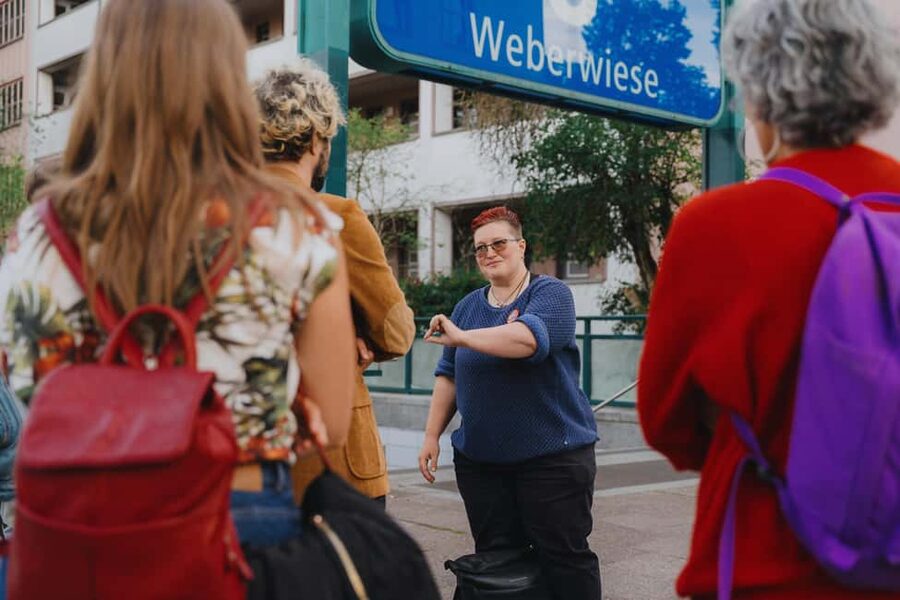
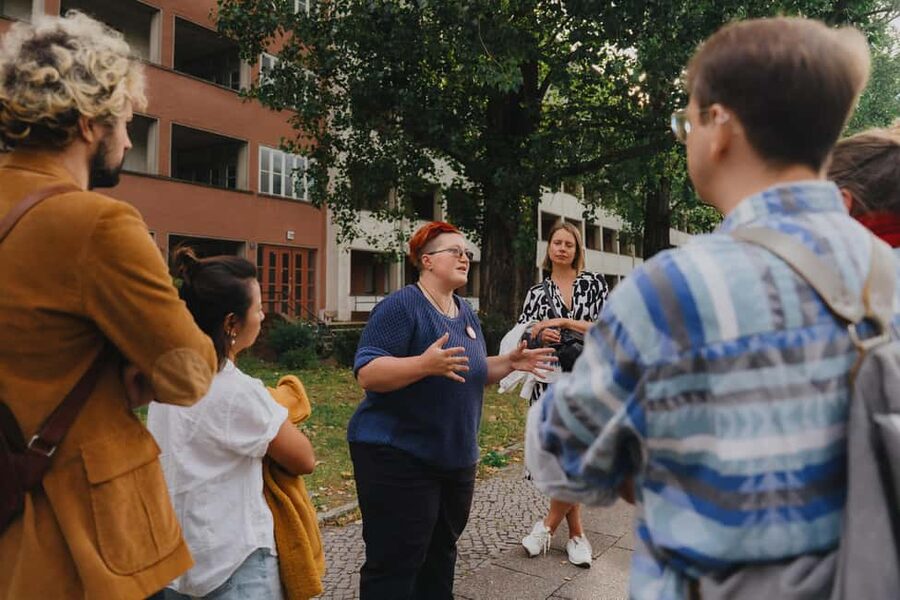
Karl-Marx-Allee is not just a broad Berlin boulevard lined with old apartment blocks. It was East Germany’s grand public statement, built to show what socialism could deliver, and its polished face hid worker anger, state surveillance, and daily compromises. I like that this tour connects architecture with political power, rather than treating the avenue as a collection of oversized buildings.
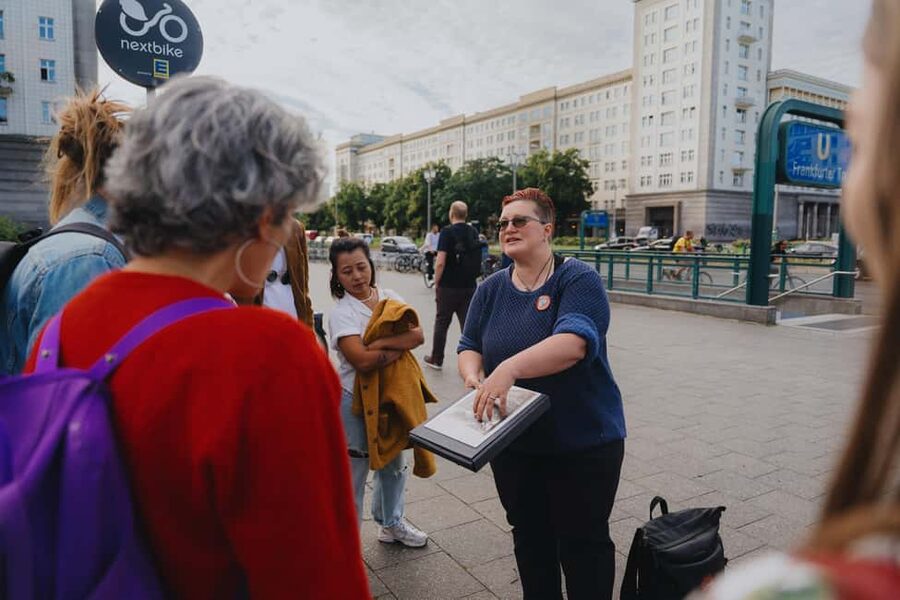
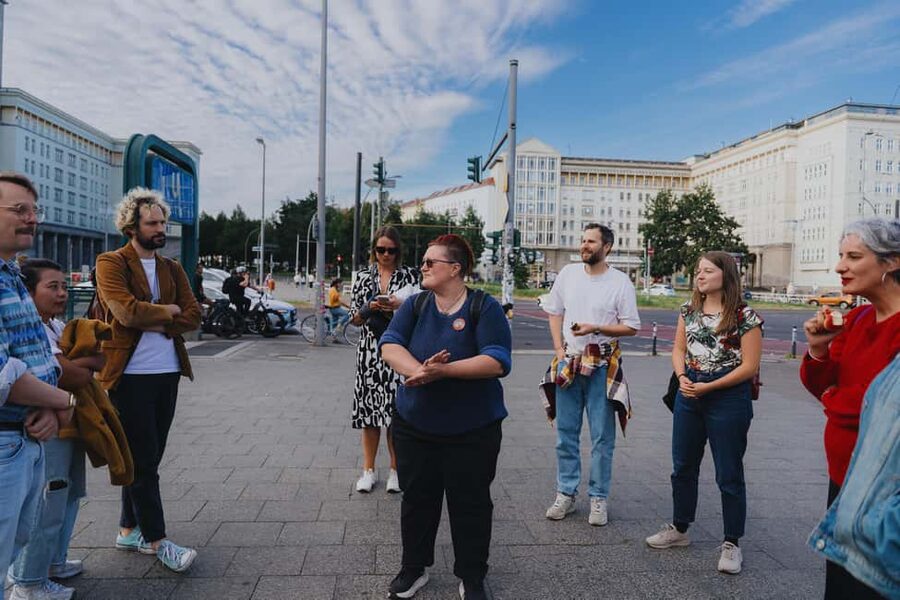
I also like the focus on the 1953 East German uprising and the street’s later life as a center of protest over rising rents. Guide Martina is praised for staying attentive to curious guests instead of rushing through a fixed speech. The main drawback is that this is a serious, mostly outdoor history walk, so you should expect a lot of walking, limited indoor access, and material best suited to children aged 10 and older.
In This Review
- Key points at a glance
- Why Karl-Marx-Allee tells Berlin’s story so well
- Meeting at Frankfurter Tor
- The first buildings and postwar modernism
- The socialist classicism of the 1950s
- The uprising of June 1953
- The perfect public face and the Stasi behind it
- Recognizing Berlin on screen
- Walking from Frankfurter Tor to Strausberger Platz
- From socialist parade route to housing protest site
- Is the $23 price good value?
- Who should book this walk?
- Should you book Karl-Marx-Allee Walking Tour?
- FAQ
- Where does the Karl-Marx-Allee walking tour start?
- Where does the tour finish?
- How long does the tour last?
- Which languages are available?
- Is the tour wheelchair accessible?
- Can children join the tour?
Key points at a glance
- Grand socialist classicism: See the monumental housing blocks built to represent East Germany’s ideal city.
- The 1953 uprising: Learn how construction disputes helped trigger a revolt that threatened the young socialist government.
- Two competing visions of Berlin: Compare postwar modernism with the later, more imposing style chosen by the East German regime.
- The hidden surveillance state: Hear how wiretaps and attic listening stations operated behind the boulevard’s tidy public image.
- Film locations: Recognize places used in The Lives of Others and The Queen’s Gambit.
- A changing avenue: Follow Karl-Marx-Allee from socialist parade route to a site of present-day protests about housing costs.
Why Karl-Marx-Allee tells Berlin’s story so well
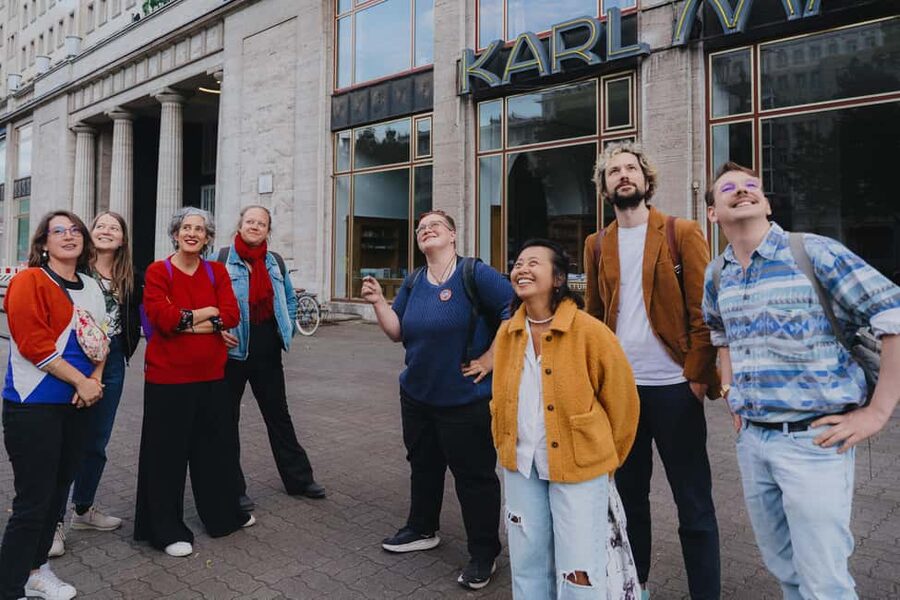
Berlin gives you plenty of places to study the Cold War, but Karl-Marx-Allee lets you read that period in the buildings themselves. The avenue was the largest construction project of former East Berlin’s national rebuilding program after World War II. Its scale was meant to impress.
As you walk between the broad roadway and the tall housing blocks, you can see how architecture became political messaging. The avenue was designed to suggest order, progress, and a new social system rising from the ruins. The buildings were not intended to feel modest or private. They were meant to make the state look capable.
I find this useful because it gives the Cold War a physical shape. Instead of hearing only about borders, speeches, and rival governments, you see the kind of city East Germany wanted to create. The wide avenue, formal buildings, and planned housing all point to the same idea: the government believed it could rebuild society by controlling the space where people lived.
The tour also avoids presenting Karl-Marx-Allee as a simple success story. The street offered some of East Berlin’s best housing, shops, restaurants, and cafes. That promise mattered. Yet the public image of comfort and abundance existed beside strict political control. The contrast is one of the most important things you will take from the walk.
A few more Berlin trips to weigh up
- Berlin: Natural History Museum Entrance Ticket
★ 4.6 · 3,382 reviews - Berlin: World Heritage Cruise to Potsdam
★ 4.5 · 1,435 reviews - Berlin Historical Highlights Walking Tour
★ 4.9 · 657 reviews
Meeting at Frankfurter Tor
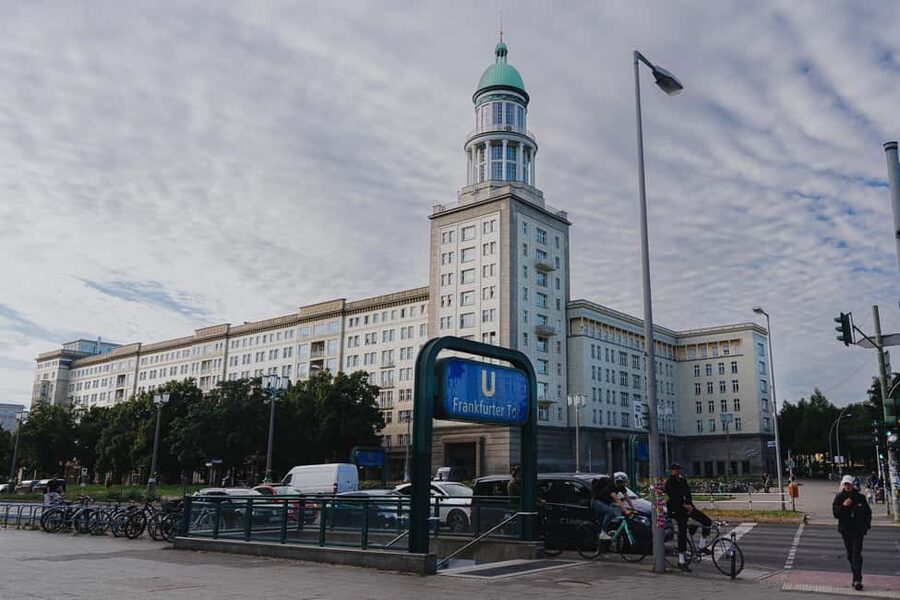
The tour begins outside the Frankfurter Tor U-Bahn station, at the corner of Warschauer Straße and Karl-Marx-Allee. Look for the guide holding an orange umbrella. This is a useful meeting point because Frankfurter Tor gives you an immediate sense of the avenue’s scale before the history begins.
You should arrive ready to walk, with comfortable shoes and weather-appropriate clothing. The experience lasts two hours, with about an hour and a half devoted to the guided walk along Karl-Marx-Allee. The remaining time allows for meeting, movement, and the transition toward the ending point at U Strausberger Platz.
The location is easy to reach by public transport, though the tour information does not provide a private transfer or transport between stops. You are paying for the guide and interpretation, not for a vehicle or entry to a museum. That is worth keeping in mind when comparing this experience with longer sightseeing tours.
The first buildings and postwar modernism
One of the more interesting parts of the walk is that Karl-Marx-Allee’s story starts before the famous 1950s blocks. The immediate postwar years brought modernist ideas about how a damaged city might be rebuilt. Those ideas were more restrained and forward-looking than the grand socialist classicism that came later.
The contrast helps you understand that East Germany’s architectural style was not fixed from the beginning. The young government changed direction. It rejected the earlier modernist approach and adopted a more imposing style that drew on monumental traditions.
Some of the earlier modernist buildings were later screened from view by fast-growing poplar trees. That detail says a lot. The state did not merely change its preferred design. It also tried to control which version of the rebuilt city people would notice.
You may find this section especially rewarding if you like architecture, urban planning, or design. The guide can use the buildings as evidence of changing political ideas, not just as decoration. I would not expect a detailed architectural lecture on every doorway or facade, but you should come away understanding why these different styles appear along the same route.
The socialist classicism of the 1950s
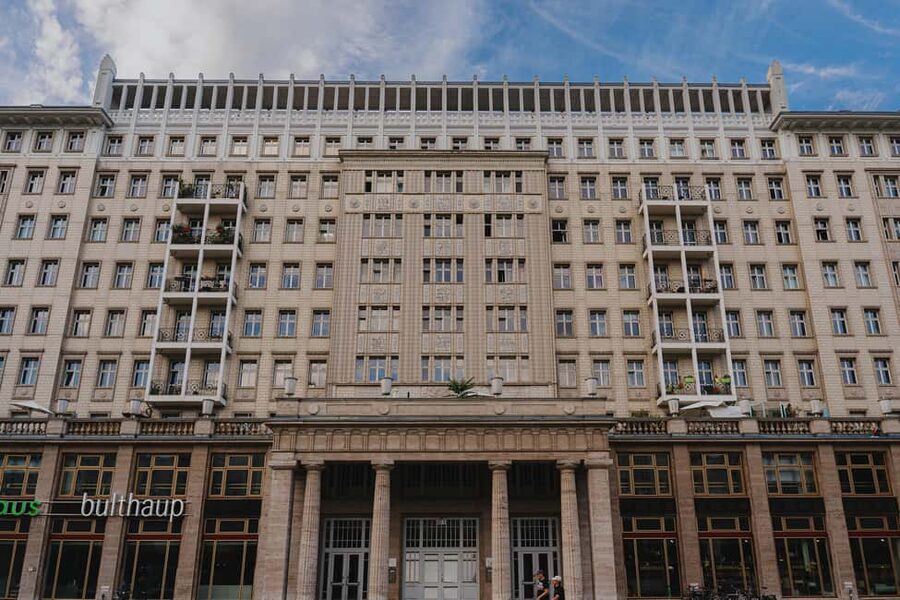
The great housing blocks are the visual center of the tour. Built as part of East Germany’s national reconstruction program, they were intended to show that socialism could provide modern urban life on a grand scale.
The style is often called socialist classicism. It uses monumental proportions and formal decoration to make ordinary apartment housing feel almost ceremonial. You may feel small as you walk past the long rows of buildings. That reaction is part of the point.
The avenue was built with the help of thousands of volunteers working day and night. The story is therefore not only about architects and state planners. It is also about labor, sacrifice, and the pressure placed on workers to rebuild the country quickly.
Look closely at the relationship between the housing and the street. The buildings were not isolated monuments. They formed a planned setting for shops, cafes, restaurants, and public life. The goal was to create a model boulevard where residents could live, shop, eat, and take part in the public culture of the new state.
I like this part because it keeps the buildings connected to ordinary life. You are not only seeing a government project. You are seeing an attempt to define what a good socialist home and neighborhood should be.
Same city, a completely different kind of day:
- Berlin: Reichstag, Dome and Government District Guided Tour
★ 4.7 · 18,288 reviews - Berlin: 1-Hour City Tour by Boat with Guaranteed Seating
★ 4.3 · 16,993 reviews - Berlin: Boat Tour Along the River Spree
★ 4.4 · 11,252 reviews - Discover Berlin Half-Day Walking Tour
★ 5.0 · 9,624 reviews
The uprising of June 1953

The grand rebuilding program nearly caused a crisis that the government could not control. In June 1953, disgruntled workers began a mass uprising. The protest grew from anger connected to work demands and the building of Karl-Marx-Allee, then threatened the existence of the young East German government.
This is the key political turning point of the walk. The avenue was meant to prove that the socialist system served workers. Instead, construction helped expose the gap between official promises and the demands placed on those workers.
You will hear how the uprising moved beyond a narrow dispute. The events became a much wider challenge to state authority. The government survived, but the episode revealed that the polished boulevard did not represent universal consent.
This history also makes the avenue more than an architectural curiosity. Every grand facade carries the memory of a political system trying to present stability while facing anger below the surface. I appreciate that the tour gives this event a central place instead of treating it as a footnote.
The perfect public face and the Stasi behind it
Karl-Marx-Allee was supposed to show the best East Berlin had to offer. Its cafes, restaurants, and well-stocked shops helped create an image of comfort and success. The avenue offered a carefully arranged version of socialist life, one that visitors and residents could see from the street.
Behind that public face was the surveillance state. The East German secret police, known as the Stasi, used wiretaps in apartments and listening stations in attics. These systems were designed to remain unseen, which makes the ordinary-looking residential buildings more unsettling.
The tour’s treatment of surveillance is valuable because it avoids a common mistake: assuming that oppression only happened in obvious government buildings or prisons. In East Berlin, control could reach into the home. A comfortable apartment on an impressive boulevard did not guarantee privacy.
You will not be touring a Stasi museum during this walk, and the experience does not list interior access to apartments or attic stations. Instead, the guide explains how surveillance fitted into the neighborhood’s design and social life. That approach works well for a walking tour because the buildings become clues to what was hidden.
If you have already visited the Stasi Museum or the former headquarters in Berlin, this section can add useful street-level context. If you have not, it offers a clear introduction, though you may want a separate museum visit for documents and preserved rooms.
Recognizing Berlin on screen

Karl-Marx-Allee has the grand, controlled look that filmmakers often seek when they want to show East Berlin or an imagined version of Cold War Europe. The tour points out locations used in The Lives of Others and The Queen’s Gambit.
These film references are a welcome change of pace during a history-heavy walk. They give you a reason to look again at details that might otherwise pass unnoticed. You can connect the real street to the way directors use architecture to create mood and suggest political pressure.
The film stops are not the main reason to book the tour. They work best as an added layer for people who already know one or both productions. If you are a film fan, though, this could make the buildings easier to remember after the tour ends.
Walking from Frankfurter Tor to Strausberger Platz
The route runs from U Frankfurter Tor along Karl-Marx-Allee and finishes at U Strausberger Platz. This makes the tour a useful way to see the avenue as a connected urban project instead of one isolated landmark.
The walk is listed as wheelchair accessible, but you should still consider your own comfort with a two-hour outdoor route. Comfortable shoes are specifically recommended. The information does not give a group size, exact distance, or a detailed surface description, so ask the provider if you need precise mobility planning.
Because the tour takes place outside, weather can affect how much you enjoy it. On a mild day, the open avenue makes the buildings easier to appreciate. In poor weather, the scale and detail may be harder to absorb, especially if you are already tired from a full day of sightseeing.
The end at Strausberger Platz also gives you a natural point to continue exploring Berlin on your own. The tour does not include a meal, transport, or attraction admission, so plan those separately.
From socialist parade route to housing protest site

Karl-Marx-Allee did not freeze in time when the Berlin Wall fell. After reunification, the avenue fell into disrepair and began to look like an awkward leftover from a defeated political system. For a while, it seemed easy to ignore.
Berlin’s housing shortage changed that. As property values and living costs rose, the old boulevard gained new importance. Real estate interest returned, and the street became part of arguments about who can afford to live in central Berlin.
The avenue is now used for local protests about gentrification and rising rents. That change gives the tour a strong present-day ending. Karl-Marx-Allee is no longer mainly a stage for socialist parades, but it remains a place where people argue about housing, power, and the right to shape a city.
I like this final chapter because it stops the tour from becoming a museum piece. The political system is gone, but questions about grand plans, public housing, private property, and daily costs remain. You can see how one generation’s ideal city becomes another generation’s contested neighborhood.
Is the $23 price good value?
At $23 per person, this tour is fairly priced for a two-hour guided history walk. You are paying for a live guide in English or German, a planned route, and interpretation that ties architecture to the 1953 uprising, Stasi surveillance, film history, and current housing disputes.
The value is strongest if you would otherwise walk Karl-Marx-Allee without knowing what you were seeing. The buildings are impressive on their own, but the political context turns a long avenue into a readable story. A guide also helps you notice the tension between public grandeur and private control.
The value is weaker if you want indoor exhibits, preserved Stasi rooms, or a broad survey of all Berlin’s Cold War sites. This tour stays focused on one street. That narrow focus is a strength for architecture and urban history, but it is not a substitute for a full Cold War museum visit.
Free cancellation up to 24 hours before the tour and the option to reserve now and pay later make the booking less risky. Children under 10 are not suited to the activity, and the subject matter is better for older children and adults who can follow political history.
Who should book this walk?
I would choose this tour if you enjoy seeing how history appears in ordinary streets and buildings. It is a good match for architecture fans, Cold War history students, film enthusiasts, and anyone curious about life in East Berlin beyond the usual Wall memorials.
You should also consider it if you want a quieter alternative to Berlin’s busiest sights. Karl-Marx-Allee is a major urban space, but the tour’s subject is more specific and less familiar than Checkpoint Charlie or the Brandenburg Gate.
I would be more cautious if you dislike long outdoor walks, want a highly visual attraction with frequent indoor stops, or are looking for a general introduction to Berlin. The tour asks you to listen, compare styles, and think about how governments use buildings to shape behavior.
The guide matters here. Martina is praised for paying close attention to questions and curious guests rather than simply delivering a rigid speech. That is exactly the quality this subject needs. Karl-Marx-Allee has enough layers that a flexible guide can make the walk feel like an investigation rather than a recited timeline.
Should you book Karl-Marx-Allee Walking Tour?
Book it if you want to understand why this avenue mattered to East Germany and why it still matters to Berlin. The mix of monumental housing, worker revolt, hidden surveillance, film locations, and modern rent protests gives you far more than a photo stop.
Skip it if your priority is indoor museum collections or a short sightseeing ride. For $23, though, it offers a focused way to read one of Berlin’s most politically charged streets. Bring comfortable shoes, arrive at Frankfurter Tor, look for the orange umbrella, and give the buildings time to speak.
FAQ
Where does the Karl-Marx-Allee walking tour start?
Meet outside the Frankfurter Tor U-Bahn station, on the corner of Warschauer Straße and Karl-Marx-Allee. Look for the guide holding an orange umbrella.
Where does the tour finish?
The walking route finishes at U Strausberger Platz.
How long does the tour last?
The activity lasts two hours. The guided walking portion along Karl-Marx-Allee lasts about one and a half hours.
Which languages are available?
The tour is offered with a live guide in English or German.
Is the tour wheelchair accessible?
Yes, the activity is listed as wheelchair accessible.
Can children join the tour?
Children under 10 are not suitable for this activity.
Just added around Berlin
- Love and War in Berlin: Self-Guided Story Puzzle Walk★ 5.0 · 7 reviews
- Rickshaw Tours Berlin – Groups of up to 16 people with several rickshaws★ 4.0 · 97 reviews
- Walking on the Wall: 3-Hour Tour in Berlin★ 4.5 · 34 reviews
- eSIM for Germany and 34 European Countries★ 4.5 · 16 reviews
- Warnemuende Shore Excursion: Berlin Private Sightseeing Tour from Rostock★ 5.0 · 4 reviews
- Your ticket to The Wall Museum Berlin★ 3.0 · 60 reviews
- Warnemuende Shore Excursion: Private Berlin Tour★ 4.5 · 27 reviews
- Karl-Marx-Allee Tour: Life and Architecture in East Berlin★ 5.0 · 19 reviews
Historical Tours, compared.

City History Canal Sightseeing Tour on a Motorboat
Read our review →






Browse the lists this tour appears in