
Reviewed · BERLIN TOURS
Hitler’s Berlin – the rise and fall (Small Group)
Berlin’s Nazi past comes into sharp focus on this compact walk from Brandenburg Gate to the Topography of Terror. You’ll connect political power, wartime destruction, persecution, resistance, and remembrance across a small section of central Berlin. The subject is grim, but the route is handled as serious history, not spectacle.
I like the small maximum group of 15, which gives you a fair chance to ask questions. I also like the guide’s use of Then & Now photos and historic maps, especially at sites where the original buildings are gone or changed. The main drawback is that this is a lot of information on foot, often outdoors, with limited chances to sit.
In This Review
- Key points at a glance
- Brandenburg Gate begins the political story
- Sinti and Roma victims, an essential first stop
- The Reichstag and the mechanics of power
- The Soviet Memorial and the Battle of Berlin
- The Holocaust Memorial requires time to think
- A brief look at persecution of gay men
- The Führerbunker and Hitler’s final days
- Johann Georg Elser and German resistance
- The former Aviation Ministry and Nazi administration
- Topography of Terror closes the walk
- What the guide adds to the experience
- Price, pace, and practical value
- Who should book this Berlin history walk?
- Should you book Hitler’s Berlin?
- FAQ
- Where does the tour start?
- Where does the tour end?
- How long does the tour last?
- How large is the group?
- Is the tour offered in English?
- Are admission tickets included?
- What should I wear?
- Can I cancel for a refund?
Key points at a glance
- Follow the Nazi story in physical order: Begin at Brandenburg Gate and finish near the former Gestapo headquarters at the Topography of Terror.
- See more than Hitler’s headquarters: The route covers Sinti and Roma victims, Jewish victims, homosexual victims, resistance, Nazi administration, and the Battle of Berlin.
- Expect serious historical detail: Guides with academic backgrounds in WWII history explain how the Nazi Party gained power and how dictatorship took hold.
- Use historic images to read modern Berlin: Then-and-now photographs and maps help you understand places where little visible evidence remains.
- Plan for outdoor conditions: The tour runs in all weather and requires comfortable shoes and a moderate level of fitness.
- Allow extra time at the end: The walk is advertised at about two and a half hours, but questions and discussion can make it longer.
Brandenburg Gate begins the political story
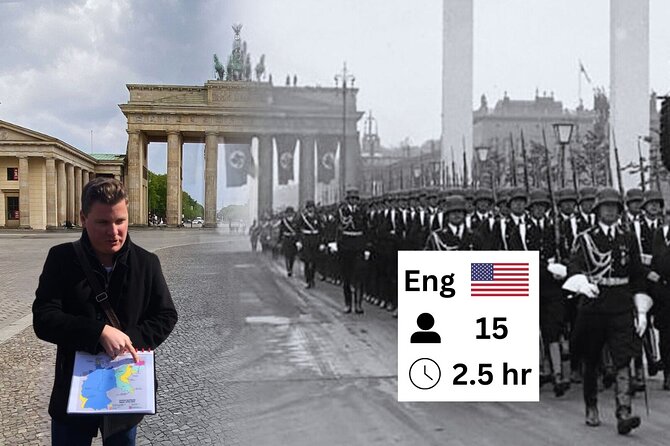
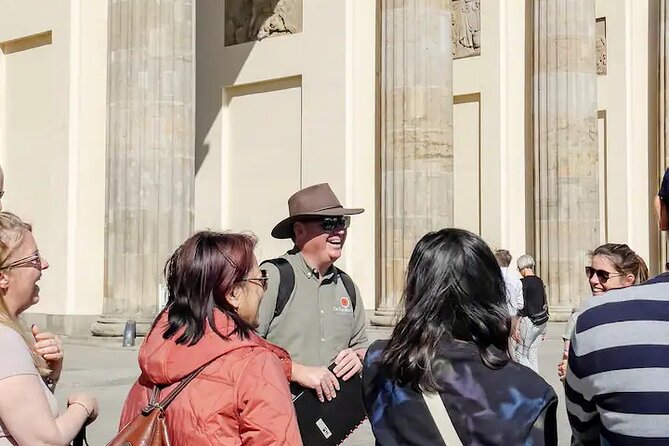
The meeting point is Brandenburg Gate, at Pariser Platz. It is one of Berlin’s most familiar sights, but this tour uses it as a starting point for the political transformation that brought Hitler to power.
You’ll learn how the Nazi Party was elected into government and how Hitler turned that position into the role of Führer. That distinction matters. The tour is not simply a catalogue of wartime events. It explains the steps between electoral success, the weakening of democratic checks, and total control.
This opening gives the rest of the walk a useful frame. You are not asked to treat Nazism as a sudden eruption caused by one man alone. Instead, the guide connects political choices, public support, and the destruction of democratic institutions.
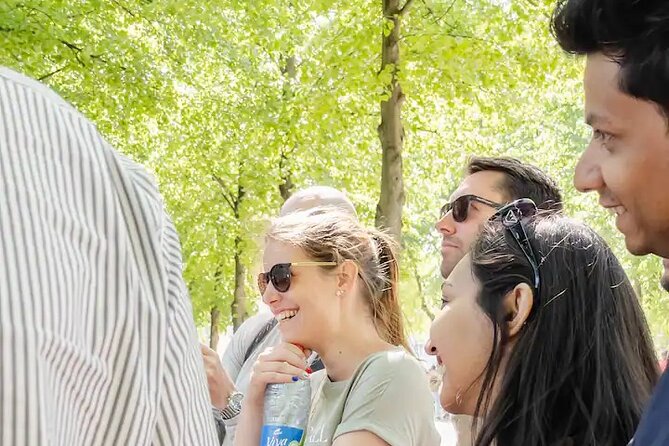
The group can be as large as 15 people, though one reported departure had 11. That is still small enough for a more personal exchange than you would get on a large city walking tour. The guide can adjust explanations to the group, and past departures have included families with teenagers as well as serious WWII enthusiasts.
Other Berlin days worth putting on the list:
- Berlin: Reichstag, Dome and Government District Guided Tour
★ 4.7 · 18,288 reviews - Berlin: 1-Hour City Tour by Boat with Guaranteed Seating
★ 4.3 · 16,993 reviews - Berlin: Boat Tour Along the River Spree
★ 4.4 · 11,252 reviews
Sinti and Roma victims, an essential first stop
The Memorial to the Sinti and Roma Victims of National Socialism is a quiet place to begin the discussion of persecution. You’ll spend about 10 minutes learning how Roma and Sinti people were targeted by Nazi racial theories and state policy.
This stop adds important breadth. A tour focused only on Hitler, military campaigns, and the Holocaust can leave you with an incomplete picture of Nazi persecution. Here, the guide explains the cruel social ideas that classified whole communities as inferior and helped prepare the machinery of mass murder.
The memorial is outside and admission is free. Bring your attention rather than expecting a long museum visit. Ten minutes is enough for an introduction, but you may want to return later if this subject is new to you.
The Reichstag and the mechanics of power
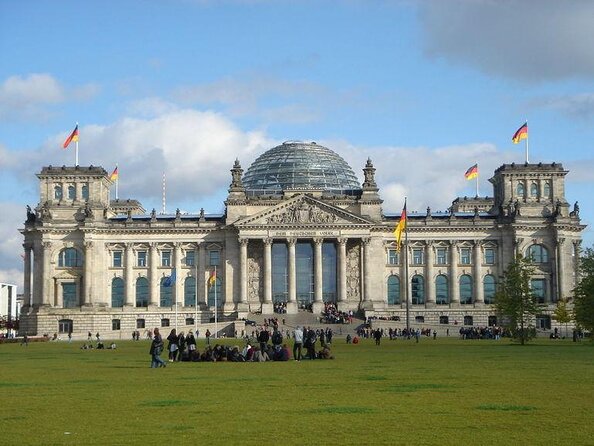
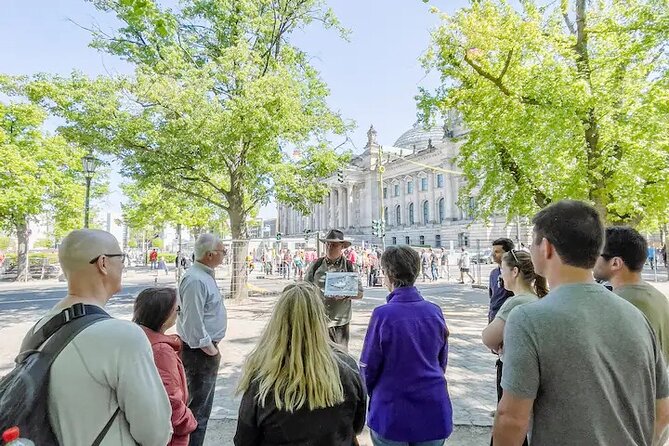
At the Reichstag, Germany’s parliament building, the guide returns to the rise of the Nazi Party. The stop lasts about 15 minutes and focuses on how Hitler was appointed and how he consolidated authority.
You should understand that this is a guided historical stop at the building, not a stated visit inside the parliament. The value comes from linking the place to the political process. The grand building helps make clear that the Nazi takeover involved institutions, laws, and officials, not only rallies and violence.
I find this kind of explanation especially useful in Berlin because the city’s monuments can otherwise become disconnected points on a sightseeing route. Here, the building becomes part of a story about how a democracy can be dismantled from within.
The Soviet Memorial and the Battle of Berlin
The Soviet Memorial in Tiergarten shifts the focus from political ascent to military defeat. You’ll spend around 15 minutes discussing the Battle of Berlin, described during the tour as the third bloodiest operation of WWII, as well as the brutal fighting and the way the conflict was remembered afterward.
This is one of the route’s useful changes of scale. You move from decisions made in government offices to the destruction caused when the war reached Berlin. The memorial also raises questions about postwar memory, since monuments do not simply record events. They reflect who built them, what they wanted remembered, and what they left out.
The stop is outdoors, so the guide’s historic maps and photographs are helpful. They can show you how the city looked during the final battle, when today’s streets and open spaces were scenes of intense combat.
Same city, a completely different kind of day:
- Discover Berlin Half-Day Walking Tour
★ 5.0 · 9,624 reviews - Berlin: Hop-on Hop-off Bus Tour with Live Commentary
★ 4.3 · 8,579 reviews - Berlin: Government District around the Reichstag Guided Tour
★ 4.7 · 8,447 reviews - Berlin: Reichstag, Plenary Chamber, Cupola & Government Tour
★ 4.6 · 8,422 reviews
The Holocaust Memorial requires time to think
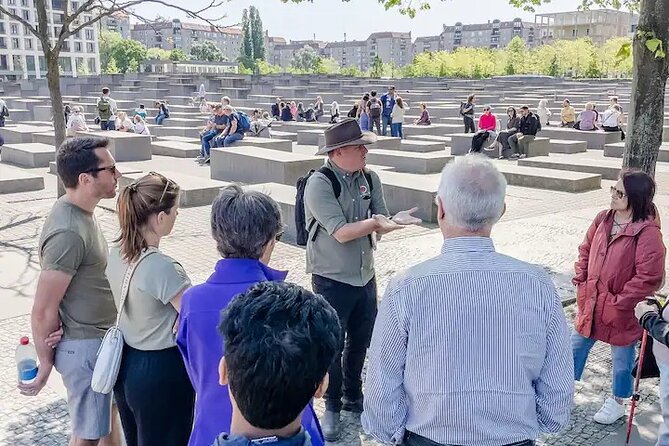
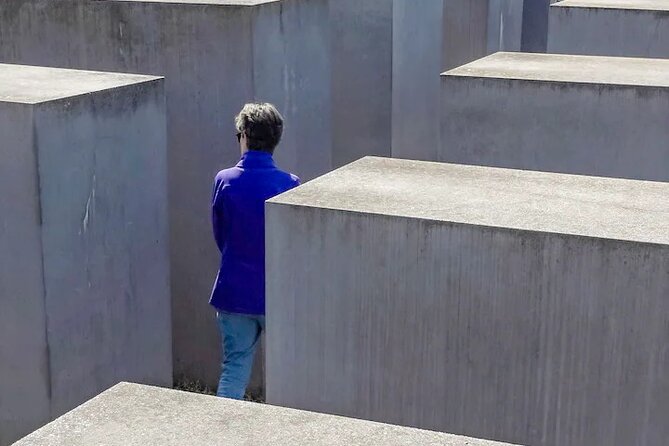
The Memorial to the Murdered Jews of Europe is one of Berlin’s most powerful and debated sites. The tour allows about 15 minutes here, with an explanation of the memorial’s purpose and time to discuss what it means.
The memorial is dedicated to the Jewish victims of the Nazi regime, the largest ethnic group targeted by the Nazis. The guide builds on the earlier discussion of racial ideology and state persecution, helping you see the memorial as part of a broader record of deliberate extermination.
You will not get a full museum visit during this outdoor stop. If you want more detail, the underground information center is a separate experience and is not included in the tour information provided here. Still, a good guide can help you approach the field of concrete blocks with care rather than treating it as a quick photo stop.
This is also a point where the tone matters. Several guides, including Scott, Jochen, and others named in the tour’s feedback, are praised for handling the subject with sensitivity while still inviting questions. That balance is important. The material is emotionally heavy, and a glib presentation would undermine the place.
A brief look at persecution of gay men
The Monument to Homosexuals Persecuted Under National Socialism receives about five minutes. It is a short stop, but it keeps the tour from presenting Nazi persecution as a story with only one victim group.
You’ll learn about the persecution of homosexual people under the Nazi regime. The limited time means this cannot be a full account of the subject, so think of it as an introduction and a prompt for further reading.
I appreciate its inclusion because it shows how different groups were categorized, watched, imprisoned, and abused. It also reminds you that the Nazi state used laws and police power to control private life, not just political opposition.
The Führerbunker and Hitler’s final days
The former Führerbunker is not a preserved underground attraction. The location is marked in the modern city, and the guide explains that Hitler spent his final days there during the last phase of WWII.
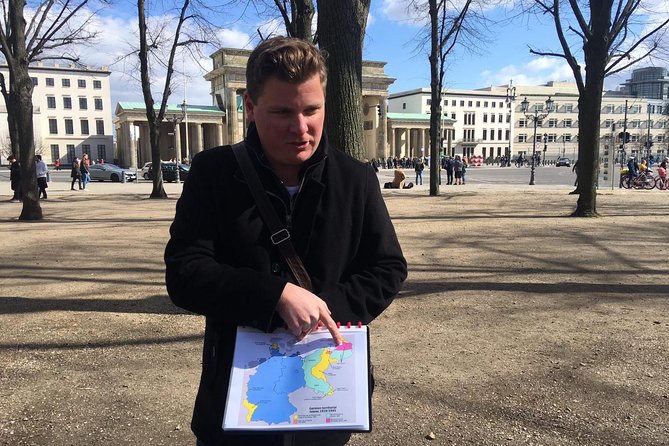
The stop lasts about 15 minutes. Its importance comes partly from the contrast between the historical weight of the place and its low-key appearance today. You are not entering a dramatic ruin or a recreated command center. Instead, the guide uses maps, photographs, and explanation to show what was beneath the ground and how the site fits into the collapse of the Nazi regime.
This is a good place to keep expectations realistic. If you want a theatrical Hitler experience, this tour is not designed for that. It treats the bunker as evidence in a larger story about dictatorship, military failure, and the final destruction of Berlin.
Johann Georg Elser and German resistance
The Johann Georg Elser Memorial introduces one of the most compelling resistance stories on the route. You’ll spend around 15 minutes learning about Elser’s attempt to assassinate Hitler, along with the efforts of other people who opposed the regime.
Elser’s story matters because it challenges the lazy idea that nobody in Germany resisted. Resistance took many forms, and it often carried terrible personal risk. A skilled guide can also explain the limits of resistance, the difficulty of acting under dictatorship, and why some attempts failed.
This stop gives the tour a needed human scale. Much of the route deals with institutions, armies, and mass persecution. Elser’s decision to act brings the discussion back to one individual making a dangerous choice.
The former Aviation Ministry and Nazi administration
The Aviation Ministry of Berlin was built in 1936 to house the German Ministry of Aviation, headed by Hermann Göring. At the time of its construction, it was the largest office building in Europe. The stop is brief, about five minutes, but the building helps explain the administrative side of Nazi power.
You’ll see how the regime’s work was carried out through large ministries and layers of officials. The building is a reminder that dictatorship required paperwork, commands, budgets, and staff, not only speeches and soldiers.
Again, this is primarily an exterior historical stop. The short time makes sense because the building works best as part of the route’s wider argument. It shows the physical scale of the state apparatus before you reach the site connected with its police terror.
Topography of Terror closes the walk
The tour ends at the Topography of Terror, on Niederkirchnerstraße. This was the location of the Gestapo headquarters, and the stop lasts about 20 minutes. You’ll learn about the institutions of Nazi terror and have a chance to take a break for tea or coffee and use the restrooms.
The ending is practical as well as historical. After two and a half hours of walking and concentrated listening, a pause is welcome. The Topography of Terror also gives the route a strong conclusion because the walk has moved from the political rise of the Nazis to the machinery of repression and the regime’s eventual fall.
The tour does not state that admission to an indoor exhibition is included. If you want to continue exploring the site, ask the guide about the best way to do so after the walk.
What the guide adds to the experience
The guide is the main reason to book this walk rather than simply visiting the memorials on your own. The provider describes the guides as local experts with academic backgrounds in WWII history, and several names appear in the feedback: Scott, Jochen, Johan, Matt, and Roshana.
Scott receives especially strong praise for clear explanations, interaction, and tailoring the discussion to the group. Johan is noted for an insightful presentation, Jochen for making the political rise of the Nazi Party interesting, Matt for lively discussion, and Roshana for detailed explanations. You are not guaranteed a particular guide, but these examples give you a sense of the standard to expect.
The best part of the guiding style is the effort to connect places instead of delivering isolated facts. You can ask about the war, the Nazi state, resistance, memorial design, or the meaning of German responsibility after 1945.
There are limits. One poor experience involved awkward, fragmented English from a non-native speaker. Another person found the guide hard to hear over city noise and suggested a microphone. These issues appear to be exceptions within a very high overall rating, but they are worth keeping in mind. Stand near the guide when possible, and speak up if you miss a point.
Price, pace, and practical value
At $54.44 per person, this is not the cheapest way to walk around central Berlin. It can still be good value if you want a connected explanation of the sites rather than a series of brief visits made alone.
You are paying for about two and a half hours of guiding, a small group, historical maps and photographs, and time for questions. Admission is free at the listed stops, so the price rests almost entirely on the guide’s preparation and delivery.
The tour may run longer than the stated time when the group has many questions. That is a plus if you want discussion, but it can affect later plans. I would avoid booking a tight museum reservation immediately afterward.
Wear comfortable shoes. You will walk on different surfaces, and most stops are outside. The tour operates in all weather, so dress for cold, rain, or sun. A warm layer is particularly wise in colder months, since one departure continued despite very low temperatures.
Food and drinks are not included, though the Topography of Terror stop allows time for a tea or coffee break. The route ends there, not back at Brandenburg Gate, so ask the guide for the best connection to your next destination.
Free cancellation is available up to 24 hours before the start time. The activity may be rescheduled or refunded if poor weather affects the departure or if the minimum group size is not met.
Who should book this Berlin history walk?
I would recommend it most strongly to first-time Berlin visitors who want a clear introduction to the Nazi period. It also suits history buffs, families with older children or teenagers, and anyone who prefers discussion to a silent audio guide.
You should be ready to listen closely. The material is dense, and one review specifically points out that careful attention is needed because there is a lot of information. This is not a casual stroll with a few dramatic anecdotes.
The subject is also emotionally demanding. You will discuss genocide, persecution, dictatorship, war, and the destruction of a city. That makes the tour unsuitable if you are looking only for light sightseeing, but it is appropriate if you want to understand why these central Berlin memorials exist and how they relate to one another.
Should you book Hitler’s Berlin?
Book it if you want serious historical context, a short walking route, and a guide who welcomes questions. The combination of the Reichstag, the Holocaust Memorial, the Führerbunker site, the Elser Memorial, and the Topography of Terror gives you a strong introduction to how the Nazi regime rose, ruled, persecuted, fought, and collapsed.
Skip it if you dislike long periods outdoors, dense political explanation, or emotionally difficult subjects. You should also choose another time if your schedule cannot absorb a tour that may run beyond two and a half hours.
For most visitors with a genuine interest in Berlin’s 20th-century history, the price is fair. The sites are free, but the connections between them are not obvious. That is what the guide supplies, and that is where this small-group walk earns its keep.
FAQ
Where does the tour start?
It starts at Brandenburg Gate on Pariser Platz, 10117 Berlin, Germany.
Where does the tour end?
The tour ends at the Topography of Terror, Niederkirchnerstraße 8, 10963 Berlin, Germany.
How long does the tour last?
The advertised duration is approximately two hours and 30 minutes. It may run longer when the group has many questions and discussions.
How large is the group?
The maximum group size is 15 people. A small-group format is intended to allow more personal attention and interaction.
Is the tour offered in English?
Yes. The experience is offered in English and includes a mobile ticket.
Are admission tickets included?
The listed stops have free admission. The tour includes guided visits to key Nazi-era sites and memorials, but an indoor museum admission is not stated as part of the experience.
What should I wear?
Wear comfortable shoes and dress appropriately for the weather. The tour operates in all weather and requires a moderate level of physical fitness.
Can I cancel for a refund?
You can cancel at least 24 hours before the start time for a full refund. Cancellations or changes made less than 24 hours before the start time are not refunded or accepted.
Just added around Berlin
- Love and War in Berlin: Self-Guided Story Puzzle Walk★ 5.0 · 7 reviews
- Rickshaw Tours Berlin – Groups of up to 16 people with several rickshaws★ 4.0 · 97 reviews
- Walking on the Wall: 3-Hour Tour in Berlin★ 4.5 · 34 reviews
- eSIM for Germany and 34 European Countries★ 4.5 · 16 reviews
- Warnemuende Shore Excursion: Berlin Private Sightseeing Tour from Rostock★ 5.0 · 4 reviews
- Your ticket to The Wall Museum Berlin★ 3.0 · 60 reviews
- Warnemuende Shore Excursion: Private Berlin Tour★ 4.5 · 27 reviews
- Berlin’s Gay, Lesbian, and Queer Scene Small-Group Walking Tour★ 4.5 · 66 reviews
Berlin Tours, compared.

Reichstag, Dome and Government District Guided Tour
Read our review →
1-Hour City Tour by Boat with Guaranteed Seating
Read our review →


Reichstag, Plenary Chamber, Cupola & Government Tour
Read our review →

