
Reviewed · HISTORICAL TOURS
Historic center of Berlin – Tour in Italian
Berlin’s most important sights are packed into this 3.5-hour Italian walking tour, but the real subject is not just monuments. It is how one city moved from empire to dictatorship, war, division, and reunification. You walk from Potsdamer Platz to Museum Island, passing the Berlin Wall, Hitler’s bunker site, the Holocaust Memorial, Checkpoint Charlie, and the Brandenburg Gate.
I like the route for two clear reasons. First, it connects places that are often visited separately, so you can see how Berlin’s past fits together. Second, the tour is conducted in Italian, with guides such as Paolo, Giulia, Fabio, Chiara, Elena, and Daniele praised for clear explanations, stories, and personal attention. The main drawback is the amount of ground covered. With up to 28 people and many short stops, this is a brisk orientation walk, not a slow museum visit.
In This Review
- Key points to know before booking
- Potsdamer Platz sets the tone
- Nazi terror at the Topography of Terror
- Checkpoint Charlie and the former Aviation Ministry
- Hitler’s bunker site and the Holocaust Memorial
- Reichstag and the Brandenburg Gate
- Unter den Linden and Bebelplatz
- Neue Wache, Berliner Dom, and Museum Island
- How much history fits into 3.5 hours
- What the $27.91 price really buys
- The guides make the difference
- Practical advice for the morning
- Who should book this Italian Berlin walk?
- Should you book it?
- FAQ
- Where does the tour begin?
- What time does the tour start?
- Where does the tour end?
- How long is the tour?
- Is the tour conducted in Italian?
- What landmarks are included?
- Does the tour enter the Reichstag?
- Is museum admission included?
- How large can the group be?
- What happens if it rains?
- Is cancellation free?
Key points to know before booking
- A serious historical route: The tour covers Nazi persecution, World War II, the Berlin Wall, the Cold War, and reunification.
- Italian-speaking guidance: Expect explanations in Italian, with guides noted for their preparation, courtesy, anecdotes, and ability to answer questions.
- The route crosses central Berlin: You begin at Potsdamer Platz and finish near the Pergamon Museum on Museum Island.
- Mostly exterior sightseeing: The Reichstag, Berliner Dom, museums, and other landmarks are viewed from outside. Museum admission is not included.
- Good value at $27.91: The price includes a local guide and taxes, but not food, drinks, transport, or entry tickets.
- Plan for weather: The tour runs in all conditions, so comfortable shoes and suitable clothing matter.
Potsdamer Platz sets the tone
Meet at 10:00 a.m. at Potsdamer Platz 10, beside the blue bicycle marked for Vive Berlin Tours. The starting point is close to the Potsdamer Platz S-Bahn and U-Bahn station, which makes it simple to reach by public transport. Allow a few extra minutes to find the blue bicycle and tour flag rather than arriving at the last second.
Potsdamer Platz is a smart place to begin because Berlin’s changes are visible here almost at once. Once a major square, it was heavily damaged in World War II and later divided by the Berlin Wall. Today, its modern towers and broad public spaces make it one of the clearest examples of rebuilt Berlin.
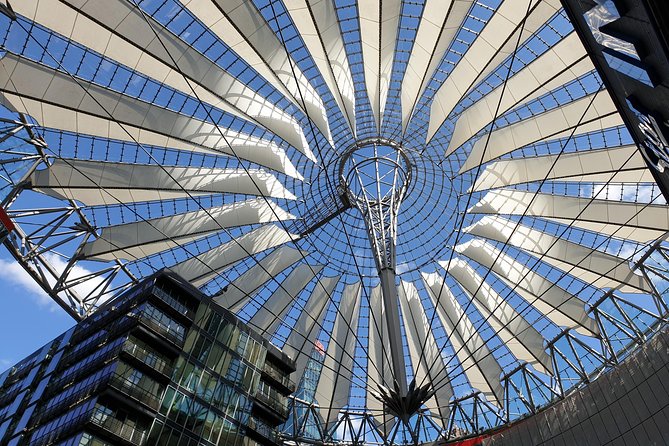
The nearby Sony Center adds another layer. Its contemporary design incorporates remains connected with the old square, giving your guide a useful opening to explain how war damage and modern construction meet in the city center. This stop is brief, about 10 minutes, so think of it as a visual introduction rather than an architectural tour.
A few more Berlin trips to weigh up
- Berlin: Natural History Museum Entrance Ticket
★ 4.6 · 3,382 reviews - Berlin: World Heritage Cruise to Potsdam
★ 4.5 · 1,435 reviews - Berlin Historical Highlights Walking Tour
★ 4.9 · 657 reviews
Nazi terror at the Topography of Terror
The route then turns toward the Topography of Terror, a memorial and documentation site located where the Gestapo and SS headquarters once operated. This is one of the most important stops because it places the machinery of Nazi rule at a real address, rather than treating the period as an abstract chapter in a textbook.
You will also see an original section of the Berlin Wall from this area. The combination is stark: one site recalls the dictatorship that persecuted and murdered millions, while the Wall recalls the later division of Germany. The guide’s role is especially useful here, since the site can feel visually quiet despite its enormous significance.
The stop is scheduled for about 10 minutes. That is enough for an introduction and some context, but not enough for a full visit to the documentation center. If you want to read every panel, plan to return on your own.
Checkpoint Charlie and the former Aviation Ministry
Checkpoint Charlie was once one of the Cold War’s most tense crossing points. Your guide explains the construction of the Berlin Wall and the division between East and West Berlin. The location is now surrounded by the energy of central Berlin, but the tour helps you picture the barriers, controls, and political pressure that once shaped daily life here.
The next stop is the enormous former Aviation Ministry, built under the Nazi dictatorship for Hermann Göring’s ministry. During the Communist period it became the home of government ministries, and it still serves a federal ministry today. That uninterrupted government use makes the building a useful way to understand Berlin’s political changes.
There is an important practical point here: these stops are exterior visits. You are learning through the guide’s explanation and the buildings around you, not entering a museum or government office.
Hitler’s bunker site and the Holocaust Memorial
The former Führerbunker site is deliberately understated. There is no grand ruin to photograph, and the absence of a dramatic monument is part of the point. Your guide explains where the bunker was, how Hitler spent his final days there, and why the place looks as it does today.
This requires a mature approach. The stop is not about glorifying Hitler or turning the site into a spectacle. It is about understanding the end of the Nazi regime and how Berlin handles a location tied to one of the darkest periods in modern European history.
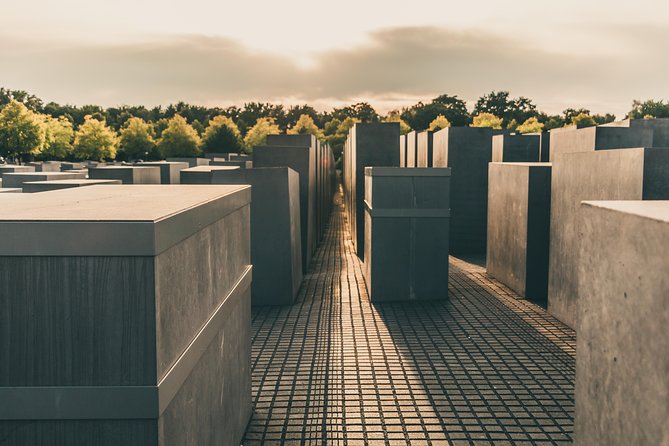
From there, the walk reaches the Memorial to the Murdered Jews of Europe, usually called the Holocaust Memorial. The field of concrete stelae creates a powerful setting for the guide’s explanation of Nazi persecution and the murder of Europe’s Jews. The site is best approached with quiet attention. You will have time to look around, but the scheduled stop is short.
The memorial is one of the places where an Italian-speaking guide adds real value. The physical design is open to personal interpretation, while the historical explanation gives it a firm context. I would not rush away for photographs here.
Same city, a completely different kind of day:
- Berlin: Reichstag, Dome and Government District Guided Tour
★ 4.7 · 18,288 reviews - Berlin: 1-Hour City Tour by Boat with Guaranteed Seating
★ 4.3 · 16,993 reviews - Berlin: Boat Tour Along the River Spree
★ 4.4 · 11,252 reviews - Discover Berlin Half-Day Walking Tour
★ 5.0 · 9,624 reviews
Reichstag and the Brandenburg Gate
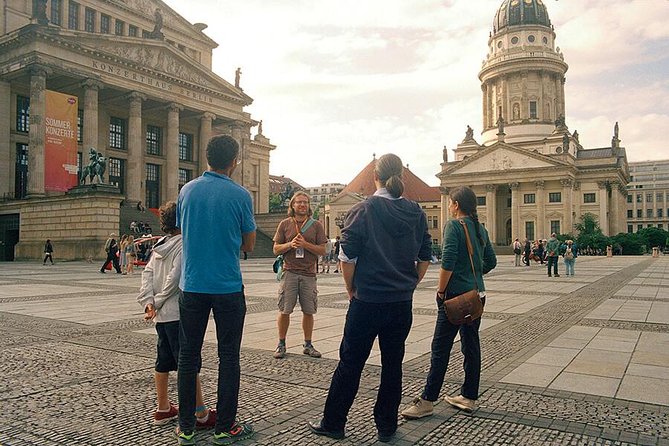
The Reichstag is viewed from outside. Your guide explains its role as the seat of Germany’s Parliament and can tell you how to book a visit to the glass dome. That advice is useful because the dome requires advance planning, and the tour itself does not include entry.
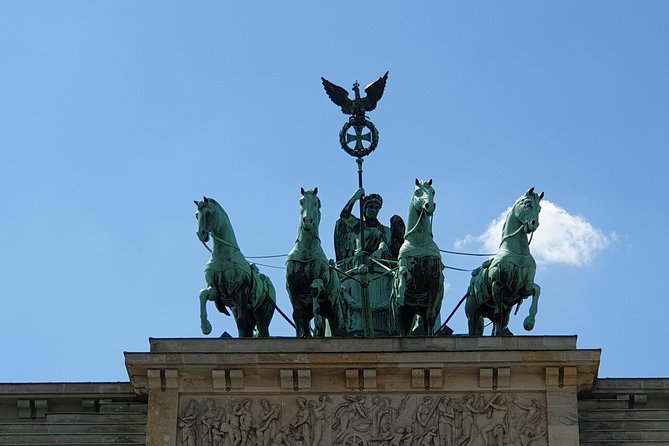
The Brandenburg Gate follows, and it is one of Berlin’s essential sights. The gate began as a symbol of royal power, became linked with the Cold War, and later took on a central role in German reunification. The guide’s explanation gives the monument more weight than a quick photograph can provide.
This is a good place to pause and consider the tour’s central theme. Berlin’s landmarks have often changed meaning without changing location. The same gate can represent monarchy, division, and unity, depending on the period you are studying.
Unter den Linden and Bebelplatz
The route continues along Unter den Linden, Berlin’s grand avenue and a former approach to the imperial palace. You will see how different building periods sit beside one another and how war damage remains part of the city’s appearance.
This is a pleasant change of pace after the heavier memorials. The avenue links major sights while giving you a feel for central Berlin’s scale. The guide points out architectural clues and the marks left by war, so the walk becomes more than a transfer between attractions.
At Bebelplatz, the historical focus turns again. The square is known for the Nazi book burning of 1933, but it also contains Humboldt University and the Catholic Cathedral. That mix of academic, religious, and political landmarks helps explain why the square became such a loaded public space.
The Book Burning Memorial is set into the pavement. Its empty underground library recalls the destruction of books and ideas during the Nazi dictatorship. It is easy to miss if you do not know where to look, which is exactly why the guide’s help matters. The stop lasts about 10 minutes, followed by shorter explanations of Humboldt University and nearby memorials.
Neue Wache, Berliner Dom, and Museum Island
Neue Wache is a memorial to the victims of war and dictatorship. Inside, a mother mourns her dead son, a soldier killed in battle. The image is simple and severe, and the guide explains how the memorial rejects war and its human cost.
The walk then reaches Berliner Dom, the grand Protestant cathedral built under the German emperor. Its scale reflects the ambition to create a church comparable to St. Peter’s for the Lutheran tradition. You see the building from outside, with time for the guide to explain its role and design.
The tour ends on Museum Island, a UNESCO World Heritage Site and one of Berlin’s most important cultural areas. The stated endpoint is the Pergamon Museum at Bodestraße 1-3, near the museum complex. The guide can explain how to visit the museums and which tickets may be most useful, but entry is not part of this experience.
The ending is well chosen. You finish in a place where Berlin’s imperial, archaeological, and artistic past comes together. It also leaves you in a good position to continue sightseeing independently.
How much history fits into 3.5 hours
The route includes around 17 points, with most formal stops lasting between 5 and 15 minutes. That makes the experience efficient, but it also means you should expect movement and short explanations rather than long periods at each site.
I like this format for a first morning in Berlin. You get a clear map of central Mitte, learn which places deserve a second visit, and receive practical advice while the city is still fresh. It is especially helpful if you are seeing Berlin for the first time or prefer to hear history in Italian.
The pace may feel demanding if you want extended time at memorials or if walking for several hours is difficult. The group can include up to 28 people, so the description of a small group should be understood as smaller than a large city tour, not as a private or intimate walk. Most people can participate, and service animals are allowed, but the tour does not promise a private pace.
What the $27.91 price really buys
At $27.91 per person, the main purchase is interpretation and route planning. You are paying for a local guide, taxes, and a carefully arranged path through the city center. No attraction admission is included, but most stops are public outdoor sites anyway.
The value is strongest if you want historical context in Italian. A self-guided walk can take you to the same addresses, but it may not explain why the former Aviation Ministry matters, why the bunker site is marked so plainly, or how the Brandenburg Gate changed meaning over time.
The price does not cover food, drinks, hotel pickup, or transport to and from the attractions. You should also budget separately if you plan to enter the museums or the Reichstag dome. Since the tour ends on Museum Island, you can decide afterward how much more sightseeing you want to add.
The guides make the difference
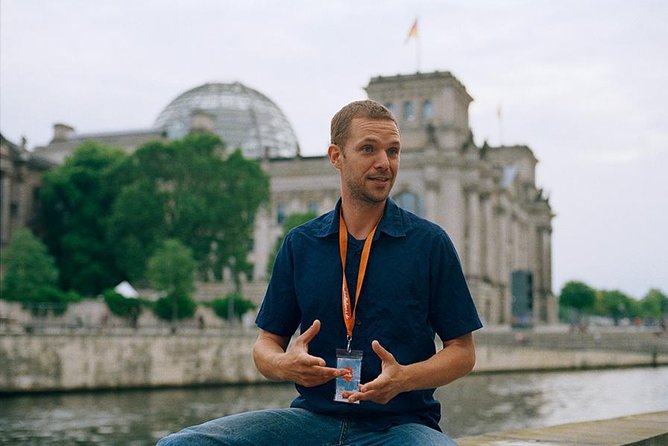
The most praised part of this experience is the guiding. Paolo is described as bringing Berlin to life through history and anecdotes, while Giulia and Fabio are noted for careful, well-prepared explanations. Chiara helped connect Mitte’s main monuments to their past, and Elena was praised for revealing places and details that might otherwise be missed. Daniele is singled out for explaining both the city’s beauty and its small details.
That range of feedback points to what you should hope for from the guide: clear Italian, historical structure, stories that make the sites easier to remember, and attention to the group. The experience is not simply a list of dates and buildings.
Guide assignments can change, so you should not book expecting a particular person. Still, the repeated praise for preparation, courtesy, efficiency, and willingness to help suggests that the quality of the explanation is the tour’s strongest asset.
Practical advice for the morning
Wear shoes suited to 3.5 hours of city walking. The tour operates in all weather, and many of the stops are outdoors, so bring clothing appropriate to the forecast. Berlin’s weather can make a big difference to how enjoyable a long walking route feels.
Use public transport to reach Potsdamer Platz if that is convenient for you. The meeting point is near the S-Bahn and U-Bahn station, and the blue bicycle and company flag are intended to make the guide easier to find.
Keep your schedule open after the tour. You may want to enter a museum on Museum Island, visit the Pergamon Museum when it is available, or arrange a Reichstag dome visit. Since neither museum entry nor dome admission is included, check the current booking requirements separately.
The tour offers free cancellation up to 24 hours before the start time. Cancellations made less than 24 hours in advance are not refunded, and late changes are not accepted. That policy is worth noting if your Berlin plans are still unsettled.
Who should book this Italian Berlin walk?
I would choose this tour if you want a strong first look at Berlin’s central sights without spending a full day inside museums. It suits Italian-speaking visitors who want historical explanation in their own language, particularly those interested in the Nazi era, the Berlin Wall, the Cold War, and reunification.
It is also a good fit if you like seeing many landmarks in one route and then returning later to the places that catch your attention. The guide’s tips about the Reichstag dome and Museum Island can help you plan the rest of your visit.
I would think twice if you dislike brisk walking, large walking groups, or short visits at emotionally serious sites. You should also choose another format if your main goal is detailed museum access, since the tour remains outside the attractions and does not include tickets.
Should you book it?
Book this tour if you want Berlin’s central sights to make historical sense, and if Italian guidance matters to you. At $27.91, it offers good value for a structured route, strong commentary, and useful planning advice.
Skip it if you already know Mitte well or prefer to explore alone at a slower pace. For a first visit, though, the route gives you a solid framework: Potsdamer Platz and its reconstruction, the crimes of Nazism, the Cold War border, the symbols of reunification, and the cultural heart of Museum Island.
FAQ
Where does the tour begin?
The tour begins at Potsdamer Platz 10, 10785 Berlin, Germany. Look for the blue bicycle beside the Vive Berlin Tours flag and logo.
What time does the tour start?
The scheduled start time is 10:00 a.m.
Where does the tour end?
The tour ends at the Pergamon Museum on Museum Island, at Bodestraße 1-3, 10178 Berlin, Germany.
How long is the tour?
The walking tour lasts approximately 3 hours and 30 minutes.
Is the tour conducted in Italian?
Yes. The tour includes an Italian-speaking local guide.
What landmarks are included?
The route includes Potsdamer Platz, Sony Center, the Topography of Terror, Checkpoint Charlie, the former Aviation Ministry, the former Führerbunker site, the Holocaust Memorial, the Reichstag, Brandenburg Gate, Unter den Linden, Bebelplatz, Humboldt University, Neue Wache, Berliner Dom, and Museum Island.
Does the tour enter the Reichstag?
No. The Reichstag is visited from outside. The guide can explain how to book a visit to the dome.
Is museum admission included?
No. Museum entry is not included. The guide can provide information about visiting Museum Island and the Pergamon Museum.
How large can the group be?
The activity can have a maximum of 28 participants.
What happens if it rains?
The tour operates in all weather conditions. Dress appropriately and wear shoes suitable for an outdoor walking tour.
Is cancellation free?
You can cancel up to 24 hours before the start time for a full refund. Cancellations made less than 24 hours before the tour are not refunded.
Just added around Berlin
- Love and War in Berlin: Self-Guided Story Puzzle Walk★ 5.0 · 7 reviews
- Rickshaw Tours Berlin – Groups of up to 16 people with several rickshaws★ 4.0 · 97 reviews
- Walking on the Wall: 3-Hour Tour in Berlin★ 4.5 · 34 reviews
- eSIM for Germany and 34 European Countries★ 4.5 · 16 reviews
- Warnemuende Shore Excursion: Berlin Private Sightseeing Tour from Rostock★ 5.0 · 4 reviews
- Your ticket to The Wall Museum Berlin★ 3.0 · 60 reviews
- Warnemuende Shore Excursion: Private Berlin Tour★ 4.5 · 27 reviews
- Berlin’s Gay, Lesbian, and Queer Scene Small-Group Walking Tour★ 4.5 · 66 reviews
Historical Tours, compared.

City History Canal Sightseeing Tour on a Motorboat
Read our review →






Browse the lists this tour appears in