

Reviewed · HISTORICAL TOURS
Explore Berlin History and Highlights Sightseeing Walking Tour
Berlin’s story is unusually easy to read in its streets. On this 3.5-hour walk, you move from Brandenburg Gate and the Reichstag to Hitler’s bunker site, Checkpoint Charlie, grand Prussian squares, and Museum Island. The city’s past is not tucked away in one museum. It is under your feet, often with a modern building or ordinary car park marking a major event.
I like the small maximum of 15 people, which gives you a fair chance to hear the guide and ask questions. I also like the route’s broad sweep: you get Prussia, the Nazi period, the Second World War, the Cold War, and reunification in one morning.
The trade-off is simple but important: this is a real walking tour, not a sightseeing bus with short stops. You cover a lot of ground, and one disappointed customer found the distance too much. Wear sensible shoes, bring water and a snack, and choose it only if three and a half hours on foot suits you.
In This Review
- Key points to know before booking
- Why this route gives you a useful first look at Berlin
- Brandenburg Gate and the Reichstag: Berlin’s best-known symbols
- The Holocaust Memorial and Führerbunker site
- Luftwaffe headquarters and the Topography of Terror
- Checkpoint Charlie and the Cold War city
- Bebelplatz and Unter den Linden
- Museum Island and the final view toward Alexanderplatz
- Price, pace, and what you get for $32.58
- Who should book this Berlin history walk?
- Should you book it?
- FAQ
- How long does the tour last?
- What time does the tour begin?
- Where does the tour begin?
- Where does the tour end?
- Is this a walking tour?
- How many people can join the tour?
- What language is the tour offered in?
- Are admission tickets included?
- What landmarks are visited?
- Can I cancel for a full refund?
Key points to know before booking
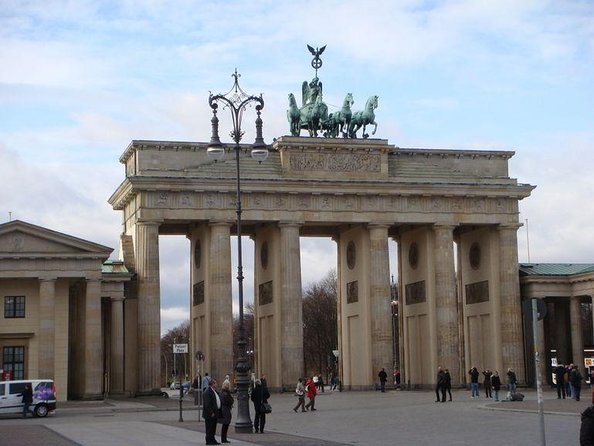
- Eleven major sights in one route: The walk links Brandenburg Gate, the Reichstag, the Holocaust Memorial, Checkpoint Charlie, Gendarmenmarkt, Unter den Linden, and Museum Island.
- A small group capped at 15: The format should feel more personal than a large city walk, with room for questions and discussion.
- History rather than quick photo stops: Guides explain why each site matters, including the Nazi book burning at Bebelplatz and the former SS and Gestapo headquarters.
- Strong guide feedback: Aurel, Cairan, Rhys, Eugen, Steve, Paul, Aaron, Arron, Al, and Kieran are named by past customers as engaging and well-prepared guides.
- No attraction admission is included because none is required: The experience is conducted outdoors, with commentary at each location.
- Free cancellation up to 24 hours ahead: Last-minute cancellations or changes are not accepted for a refund.
Why this route gives you a useful first look at Berlin
This is a timeline walk disguised as a sightseeing tour. You begin with the symbols of modern Germany, move through the crimes of the Nazi state, then trace the division of Berlin and finish in the older heart of the city.
That order works well for a first visit. Berlin can feel scattered at first, with grand monuments beside blank spaces and new buildings beside damaged or rebuilt ones. A guide helps connect those pieces. You are not simply collecting photographs of famous places. You are hearing why the city looks this way.
The route also avoids a common problem with short city tours: spending all morning on one period. Here, the explanations range from the Imperial era and Frederick the Great to the Third Reich, Soviet capture of Berlin, East Germany, and present-day Berlin. Guides have also used photographs on an iPad and personal family images to explain the city’s divided past, which can make distant events easier to grasp.
The experience is offered in English. Past guide names include Aurel, Cairan, Rhys, Eugen, Steve, Paul, Aaron, Arron, Al, Kieran, and Ciaran, with feedback often focusing on clear explanations, humor, patience, and the ability to answer questions. The exact guide is not fixed in the tour details, so you should book for the route and format rather than one particular person.
A few more Berlin trips to weigh up
- Berlin: Natural History Museum Entrance Ticket
★ 4.6 · 3,382 reviews - Berlin: World Heritage Cruise to Potsdam
★ 4.5 · 1,435 reviews - Berlin Historical Highlights Walking Tour
★ 4.9 · 657 reviews
Brandenburg Gate and the Reichstag: Berlin’s best-known symbols
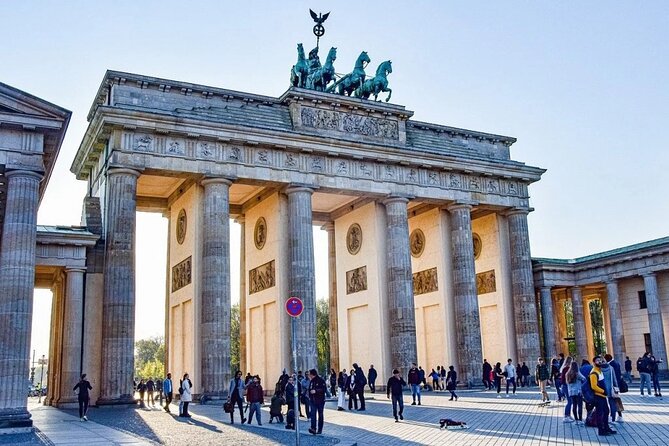
The meeting point is Wurst 🙂 am Brandenburger Tor, at Ebertstraße and Scheidemannstraße. The tour begins at 10:00 a.m., with Brandenburg Gate as the first stop.
You spend about 20 minutes hearing how this gate became tied to major moments in Berlin’s history. It is an ideal opening because the gate works both as an architectural landmark and as a political symbol. Your guide can set the scene before the walk moves into more difficult subjects.
The stop is outdoors and admission is free. For photographs, the area can be busy. Arriving before the start time gives you a better chance to take pictures without rushing, although the tour itself begins at 10:00.
The Reichstag is next, also for about 20 minutes. This is not an interior visit, and there is no parliament tour included. Instead, your guide explains its role during Imperial Germany, the infamous fire soon after Hitler became Chancellor, and the building’s importance to Soviet forces at the end of the Second World War.
That makes this more than a view of a handsome government building. The Reichstag lets you see how architecture can become tied to political power, crisis, war, and the later German state. If you want to go inside the dome, you would need a separate arrangement, since this tour stays outside.
The Holocaust Memorial and Führerbunker site
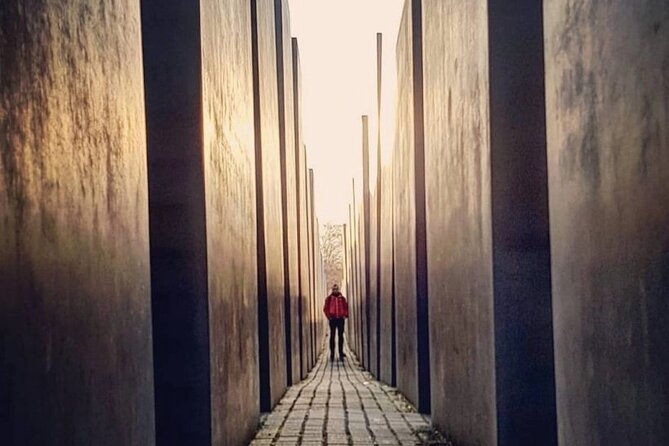
The Memorial to the Murdered Jews of Europe receives about 15 minutes. The field of concrete blocks is powerful, but the guide’s explanation matters. You learn about the crimes behind the memorial and the decisions involved in creating it in central Berlin.
This is a brief stop, so you should not expect a long private visit or an extended museum presentation. Still, a guide gives the place context and helps you approach it with care. The memorial is not treated as just another photo opportunity on a list of sights.
The next stop, also about 15 minutes, is the site of the Führerbunker. Today, the location is associated with an ordinary car park, a jarring detail that makes the history feel especially close to everyday Berlin. This was where Hitler ended his life, beneath what had been the garden of the New Reich Chancellery.
The guide explains the location rather than taking you into a surviving bunker interior. Much of the value comes from understanding what is no longer visible. Berlin’s most notorious wartime site is not presented as a dramatic ruin. Its plain modern setting underlines how the city has dealt with a painful past.
Luftwaffe headquarters and the Topography of Terror
The former Luftwaffe headquarters is now the Federal Ministry of Finance. You spend about 15 minutes here learning about the building’s construction, its use during the Nazi period, and its Cold War importance.
This stop is useful because it shows how a building can pass through several political systems without losing its physical presence. The current ministry occupies a structure linked to the Nazi state, while the wider area also reflects the postwar division of Berlin. Your guide helps separate the building’s architectural identity from the governments that used it.
At the Topography of Terror, the tour pauses for about 20 minutes. This site once housed the headquarters of the SS, Gestapo, and SD. The explanation covers Nazi persecution and the later work of memorialization on the site.
You should think of this as an outdoor historical stop, not a full museum visit. The tour gives you a clear introduction to why the location matters. If the subject interests you, you may want to return later with more time for the indoor exhibits, but that would be separate from this walk.
These two stops are among the most serious portions of the morning. The guides are praised for treating the material with detail and respect, while still keeping the group moving. That balance matters in Berlin, where the worst history is often encountered beside offices, roads, and busy city life.
Same city, a completely different kind of day:
- Berlin: Reichstag, Dome and Government District Guided Tour
★ 4.7 · 18,288 reviews - Berlin: 1-Hour City Tour by Boat with Guaranteed Seating
★ 4.3 · 16,993 reviews - Berlin: Boat Tour Along the River Spree
★ 4.4 · 11,252 reviews - Discover Berlin Half-Day Walking Tour
★ 5.0 · 9,624 reviews
Checkpoint Charlie and the Cold War city
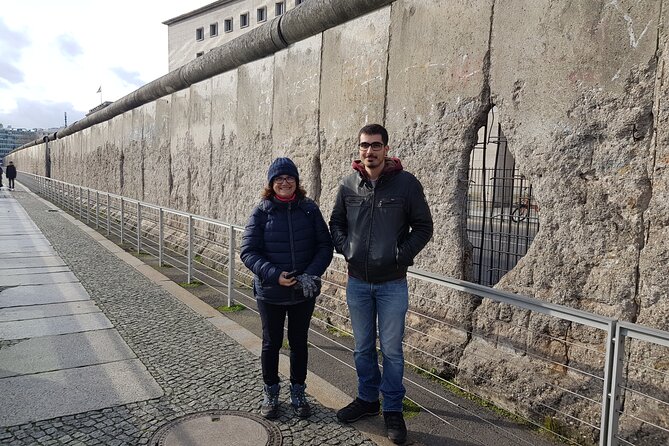
Checkpoint Charlie gets about 20 minutes. The former crossing point is one of the most recognizable Cold War sites in Berlin, and your guide explains its place in the history of divided Berlin.
The checkpoint is also one of the more commercialized sights on the route. The modern setting does not always convey the tension of the original border, so the commentary is especially useful. A good explanation can turn a famous sign and guardhouse into a clearer picture of how East and West Berlin were separated.
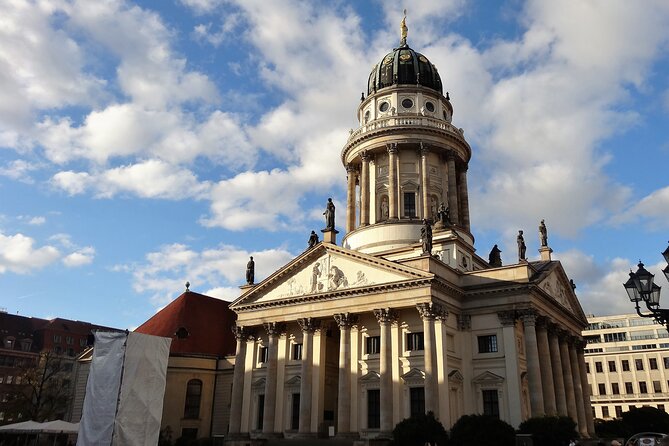
The walk then moves to Gendarmenmarkt for roughly 15 minutes. Here, the mood changes. The square is known for its 18th and 19th-century architecture and its connection to the growth of Berlin under Prussian rule.
This contrast is one of the route’s strengths. In a short distance, you move from Cold War confrontation to the ordered grandeur of the Prussian capital. The guide explains how the square was founded and developed, rather than asking you to admire the buildings without context.
The square is also a good point to pause for photographs. Keep in mind that the visit remains a guided stop, so the time is limited. If you want architectural details or leisurely pictures, you may wish to return after the tour.
Bebelplatz and Unter den Linden
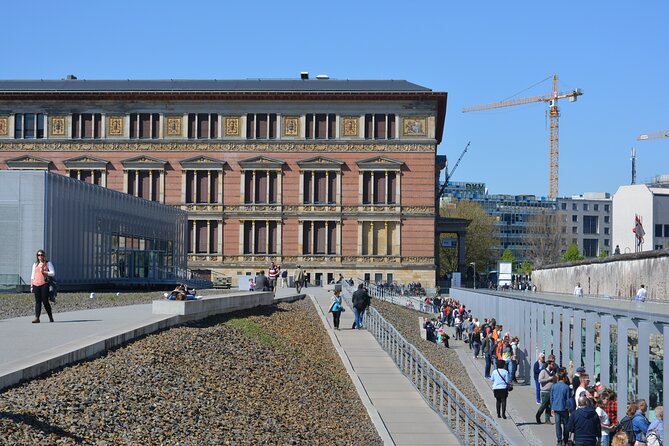
Bebelplatz is a compact but important stop, lasting about 15 minutes. The square is surrounded by the formal buildings of Frederick the Great’s capital, and your guide explains why those buildings were constructed.
The square also carries the memory of the 1933 Nazi book burning. The memorial is easy to miss if you pass through without guidance, which is exactly why this stop earns its place on the route. It connects the polished appearance of Prussian Berlin with the early public actions of the Nazi regime.
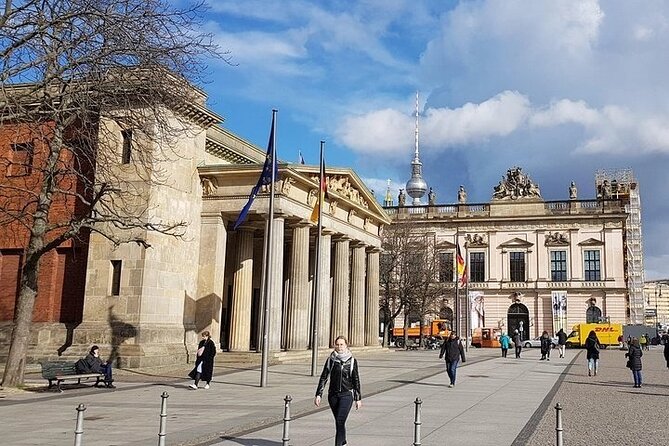
Next comes the eastern section of Unter den Linden, for about 20 minutes. The walk includes Humboldt University, the Memorial to Victims of War and Tyranny, and the German History Museum.
This stretch is less about one single landmark and more about how central Berlin was planned and rebuilt. You see education, public memory, national history, and grand avenues in one sequence. Guides also explain the buildings’ original purposes and what happened to them during war and reconstruction.
The amount covered here is impressive, but it also explains the need for a steady pace. You will hear plenty of names, dates, and political changes. One guide compared the tour to a full meal and advised bringing snacks, which is practical advice for a morning with this much information.
Museum Island and the final view toward Alexanderplatz
The final stop is Museum Island, reached after crossing into what was medieval Berlin. The stop lasts about 20 minutes and includes discussion of the former City Palace, Berlin Cathedral, and the five major museums now gathered on the island.
You do not receive entry to the museums as part of this experience. Instead, the guide gives you an orientation to the island and its place in Berlin’s development. This is useful if you plan to return later, since you finish with a clearer sense of which part of the city you are looking at.
From the eastern side of Museum Island, the guide also discusses Alexanderplatz, the center of postwar East Berlin. That final view extends the story beyond the monuments immediately around you. You finish by looking toward a part of the city shaped by socialist planning and the division of Berlin.
The tour ends at Museum Island, listed as 10 Berlin. From there, you can continue sightseeing on your own, visit one of the museums separately, or use nearby public transport. The activity itself does not include transportation.
Price, pace, and what you get for $32.58
At $32.58 per person, this is a reasonable price for a 3.5-hour guided orientation to central Berlin. You are paying mainly for the guide’s preparation and storytelling, not for admission tickets, since the stops are viewed from public spaces.
I see the value in the number of major sites covered. Visiting even half of these places independently would require planning, map reading, and time spent working out how the sites connect. Here, the route creates a useful framework in one morning.
The price is less attractive if you want long visits inside museums or buildings. There are no attraction admissions, meals, or transport included. You are buying a guided walk, and that is exactly how you should judge it.
The small group limit of 15 improves the deal. Several bookings have had only three, seven, or one group, which can create a more flexible feel. A tiny group may allow more questions and personal explanation, while a full group of 15 will feel less private but should remain manageable.
Because the tour is booked, on average, 59 days ahead, popular dates may fill early. Confirmation arrives when you book, and the experience is offered in English with a mobile ticket. Free cancellation is available until 24 hours before the start time. After that cutoff, the amount paid is not refunded.
Who should book this Berlin history walk?
I would choose this tour for a first visit, especially if you want a clear introduction before exploring Berlin independently. It suits people who care about political and social history, not only famous buildings.
It is also a good fit for families and mixed-age groups, provided everyone can walk for 3.5 hours. One guide was specifically praised for being patient with children, and another made the material accessible to someone with only basic English. Still, the subject matter includes war, dictatorship, persecution, and genocide, so it is not a light sightseeing stroll.
You should also book it if you like asking questions. The strongest guide feedback centers on personal explanations, thoughtful exercises, visual material, humor used carefully, and patient answers. Guides such as Aurel, Cairan, Rhys, Eugen, Steve, Paul, Aaron, and Al are repeatedly described as friendly, engaging, and easy to understand.
I would skip it if you have limited mobility, dislike long walks, or want to spend most of your time indoors. One person misunderstood the walking format and could not take part because of the distance. The tour description does make clear that it is a walking tour, but this point deserves attention before booking.
Should you book it?
Book this tour if you want Berlin’s central sights tied into one understandable story. The route is efficient, the group is small, the price is fair, and the guide can add the meaning that plaques and photographs often miss.
Choose it early in your stay so you can use the final orientation at Museum Island and Alexanderplatz to plan the rest of your visit. Bring comfortable shoes, water, and a snack, and allow extra time later if you want to enter the museums or revisit a favorite square.
Skip it only if a 3.5-hour walk is not realistic for you or if you want interior access rather than outdoor commentary. For an English-speaking introduction to Berlin’s major historical chapters, this is a practical and worthwhile choice.
FAQ
How long does the tour last?
The tour lasts approximately 3 hours and 30 minutes.
What time does the tour begin?
The tour starts at 10:00 a.m.
Where does the tour begin?
It begins at Wurst 🙂 am Brandenburger Tor, at Ebertstraße and Scheidemannstraße, 10117 Berlin, Germany.
Where does the tour end?
The tour ends at Museum Island in Berlin.
Is this a walking tour?
Yes. The experience is a walking tour, and transportation is not included.
How many people can join the tour?
The group has a maximum of 15 participants.
What language is the tour offered in?
The tour is offered in English.
Are admission tickets included?
No attraction admission tickets are needed for the listed outdoor stops, and no separate attraction entry is included.
What landmarks are visited?
The route includes Brandenburg Gate, the Reichstag Building, the Holocaust Memorial, the Führerbunker site, the former Luftwaffe headquarters, the Topography of Terror, Checkpoint Charlie, Gendarmenmarkt, Bebelplatz, Unter den Linden, and Museum Island.
Can I cancel for a full refund?
Yes. You can cancel at least 24 hours before the experience start time for a full refund. Cancellations and changes made less than 24 hours before the start time are not accepted for a refund.
Just added around Berlin
- Love and War in Berlin: Self-Guided Story Puzzle Walk★ 5.0 · 7 reviews
- Rickshaw Tours Berlin – Groups of up to 16 people with several rickshaws★ 4.0 · 97 reviews
- Walking on the Wall: 3-Hour Tour in Berlin★ 4.5 · 34 reviews
- eSIM for Germany and 34 European Countries★ 4.5 · 16 reviews
- Warnemuende Shore Excursion: Berlin Private Sightseeing Tour from Rostock★ 5.0 · 4 reviews
- Your ticket to The Wall Museum Berlin★ 3.0 · 60 reviews
- Warnemuende Shore Excursion: Private Berlin Tour★ 4.5 · 27 reviews
- Berlin’s Gay, Lesbian, and Queer Scene Small-Group Walking Tour★ 4.5 · 66 reviews
Historical Tours, compared.

City History Canal Sightseeing Tour on a Motorboat
Read our review →






Browse the lists this tour appears in