
Reviewed · WALKING TOURS
Erfurt: On the road with the Brückenkrämer. Walking tour with anniversary tasting.
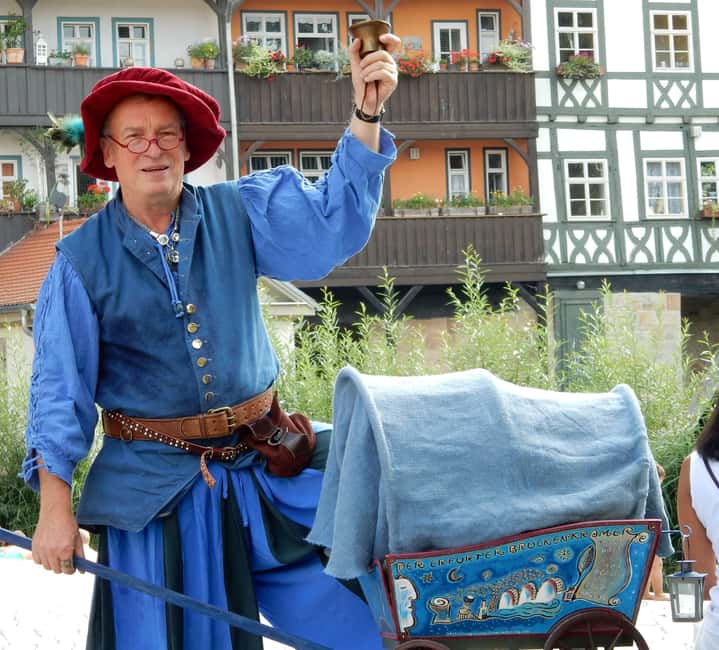
The best part of this Erfurt walk is that it takes you over and under the Krämerbrücke, not just across it with a quick photograph. Reinhard Schwalbe, playing the Brückenkrämer, ties the bridge to merchant life, old city jokes, Martin Luther, Dr. Faust, and the odd habits of Erfurt’s past.
I like the small Brückenkeller visit, limited to groups under 10, and the two local tastings: Goldhelm bridge truffles made with Peru jungle chocolate and a clear 40 percent Erfurt Classic herbal liqueur. The main drawback is that the tour is conducted in German, so you will need enough language skill to follow the humor and stories.
In This Review
- Key points at a glance
- Why the Krämerbrücke deserves more than a photograph
- Meeting the Brückenkrämer at the town hall
- Inside the Brückenkeller under the Kramladen
- Merchant rooms and the Bohlenstube
- Tasting Goldhelm bridge truffles
- Trying Erfurt Classic herbal liqueur
- Fish market, town hall, and patrician Erfurt
- University stories and the Old Synagogue
- Waidspeicher and the route toward cathedral square
- The jokes, characters, and local flavor
- Is $16 a fair price?
- Who should book this walk?
- Final call on the Brückenkrämer experience
- FAQ
- How long does the Brückenkrämer tour last?
- Where does the tour begin and end?
- What language is the tour conducted in?
- What tastings are included?
- Is the Brückenkeller included?
- Can I cancel or pay later?
Key points at a glance
- The Brückenkeller visit: Step below the Kramladen and see a part of the bridge most quick city walks miss.
- Reinhard Schwalbe in costume: The Brückenkrämer presents Erfurt through jokes, tales, and merchant lore.
- Two local tastes: Try Krämerbrücke truffles from Goldhelm and Erfurt Classic herbal liqueur.
- A broad central-Erfurt route: The walk includes the fish market, Krämerbrücke, university quarter, Old Synagogue, Waidspeicher, and cathedral square.
- A glimpse of home life: Learn about the business and private world of a merchant family and see a typical Bohlenstube.
- Good value at $16: Two hours, a live guide, two tastings, and a focused look at Erfurt’s best-known bridge.
Why the Krämerbrücke deserves more than a photograph
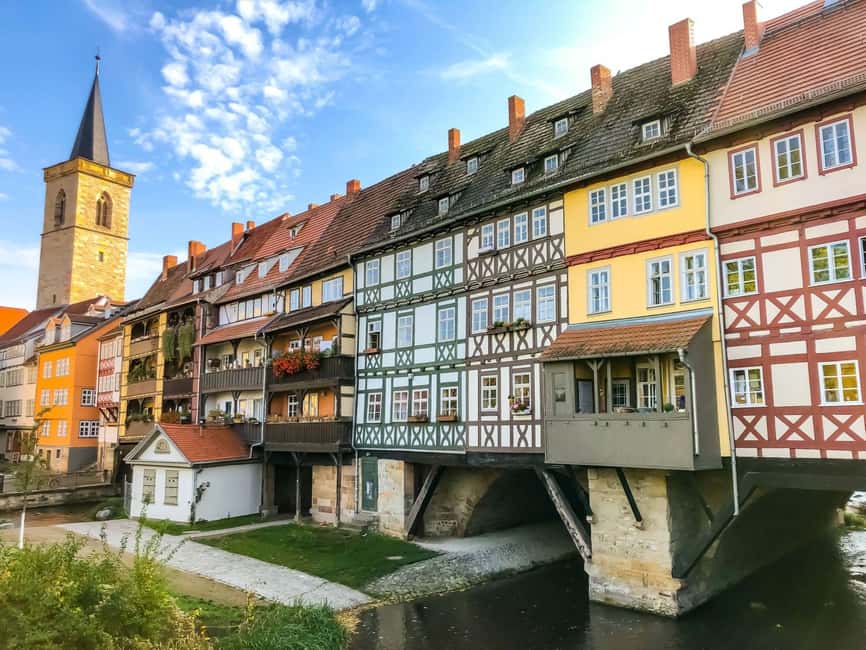
Erfurt’s Krämerbrücke is the natural center of this experience. The bridge is famous for its row of buildings, but the Brückenkrämer approach gives you more than a postcard view. You walk through the medieval lanes around it, hear how trade shaped the area, and look beneath the bridge as well as along its upper passage.
That change in viewpoint matters. A visitor can cross the bridge in a few minutes and leave with a nice picture. This walk asks you to slow down and think about how people worked, lived, sold goods, and moved through the city. The 700th anniversary provides the occasion, but the subject is everyday Erfurt: shops, families, food, drink, rivalries, religion, and local gossip.
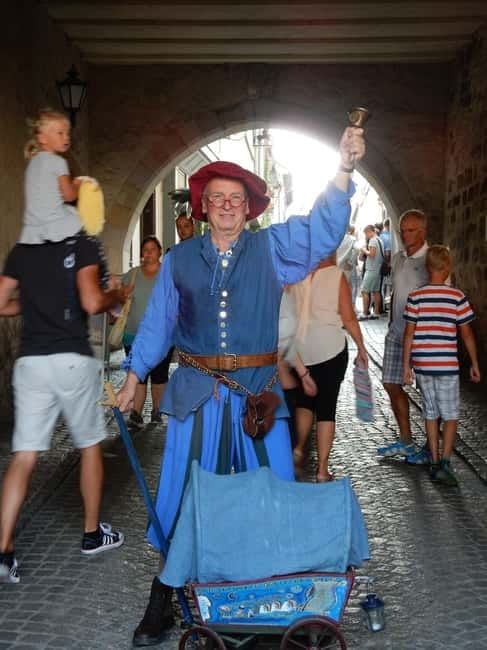
Reinhard Schwalbe leads the walk in the costume of the Brückenkrämer. The character gives the tour a theatrical edge without turning it into a stage show. You are following a merchant figure through the old center, with stories designed to make the buildings and streets easier to remember.
A few more Germany trips to weigh up
- Cologne: Brewery Tour with 3 Kölsch Beer Tastings
★ 4.7 · 3,108 reviews - Hamburg: St. Pauli Highlights Guided Tour with Beer for 18+
★ 4.7 · 2,353 reviews - Hamburg: Elbphilharmonie Plaza and HafenCity Food Tour
★ 4.7 · 1,711 reviews
Meeting the Brückenkrämer at the town hall
The meeting point is the center of the town hall steps. Look for the Brückenkrämer costume, which serves as the identifying sign for the guide. The tour ends back at this same point, a useful arrangement if you want to continue exploring on foot afterward.
The walk lasts two hours. That is enough time for a proper route through the central sights, but not so long that the tour takes over your whole day. I would schedule it early in your Erfurt visit if possible. The route covers several important areas, so you can use the walk to decide which places deserve a later, slower look.
The pace is adapted to the group. This is helpful in a historic center where the best details are often found in narrow lanes and small corners rather than at one grand viewpoint. The experience is also listed as wheelchair accessible, though the visit below the bridge may be worth confirming when you arrange your booking.
The language is German. That is the main practical question to settle before you reserve. Much of the appeal rests on wordplay, old jokes, and colorful tales, so basic conversational German may not be enough for every punchline. If you understand German well, the language is part of the flavor. If you do not, you may still appreciate the route and costume, but you will miss a central part of the experience.
Inside the Brückenkeller under the Kramladen
The Brückenkeller is one of the most useful stops because it takes you below the bridge and into a space connected with the Kramladen. Access is arranged for groups under 10 people, which gives this portion a more personal feel than a large group standing in a public square.
The cellar helps explain the bridge as a working place, not just an architectural curiosity. The tour looks at the trade of a merchant family and also at its private life. That combination is valuable. City history can become a list of dates and rulers, but a shopkeeper’s daily concerns make the past easier to picture.
You can expect the Brückenkrämer to connect the physical setting with stories about work, family, and commerce. The details provided for the walk do not promise a full museum display or a long cellar presentation, so think of this as a focused stop within a larger route. Its strength is the change of setting and the close connection to the bridge itself.
The small-group limit under 10 applies to the cellar visit, not necessarily to every minute of the full tour. If the cellar is the part you most want to experience, ask how your chosen date will be handled.
Merchant rooms and the Bohlenstube
The walk also includes a look at a typical Bohlenstube. The term points to a timber-built interior room, and here it gives the merchant story a domestic setting. You are not only hearing about the public side of trade. You are also getting a glimpse of how a merchant household might have been organized.
This is a strong contrast with the grand civic buildings elsewhere on the route. Patrician houses, town halls, churches, and university buildings tell you about institutions and status. A room such as the Bohlenstube shifts attention toward ordinary interior life, even if the tour can only offer a short view.
I like this balance. The Brückenkrämer is not simply showing you monuments in sequence. He is using the bridge, cellar, shop, and living quarters to explain how the city functioned at street level. You should not expect a detailed architectural lecture on every timber or furnishing, but you will get a more human way to read the old center.
Same city, a completely different kind of day:
- Berlin: Reichstag, Dome and Government District Guided Tour
★ 4.7 · 18,288 reviews - Berlin: 1-Hour City Tour by Boat with Guaranteed Seating
★ 4.3 · 16,993 reviews - Hamburg: Sex and Crime in St. Pauli Tour for Ages 18+
★ 4.7 · 15,447 reviews - Hamburg: 1.5-Hour Harbor and Speicherstadt Day Cruise
★ 4.6 · 14,200 reviews
Tasting Goldhelm bridge truffles
The first tasting is a sweet one: Krämerbrücke truffles from the Goldhelm chocolate manufactory on the bridge, made with Peru jungle chocolate. This is a small portion of the tour, but it makes sense as part of the theme. The bridge has long been linked with shops and trade, and a locally made chocolate connects that tradition with present-day Erfurt.
The tasting is not meant to replace a meal. Think of it as a sample that gives you a flavor associated with the bridge. You may also want to visit the Goldhelm operation separately if chocolate is a major interest, but the tour offers the advantage of pairing the truffle with stories about the place where it is made.
I find food tastings most useful when they are tied to the route rather than added at random. Here, the connection is clear. You are walking through a former trading area, hearing about merchants, and trying a product made on the bridge today.
Trying Erfurt Classic herbal liqueur
The savory or stronger counterpoint is Erfurt Classic, a clear herbal liqueur at 40 percent alcohol, supplied through the Thuringian Specialties Market. This is a proper spirit, not a mild sip, so pace yourself. The tasting is likely to be most enjoyable for adults who already like herbal liqueurs.
The two samples give the tour a pleasing range. The truffle is sweet and chocolate-based, while the liqueur brings a sharper local specialty into the picture. Neither tasting is large enough to change the nature of the walk, but both help break up the storytelling and give you something concrete to associate with Erfurt.
If you do not drink alcohol, the liqueur is the one element to ask about before booking. The supplied details identify it as part of the included tasting, but they do not specify an alternative.
Fish market, town hall, and patrician Erfurt
From the bridge area, the route takes in the fish market, with its patrician houses and town hall. This is one of the city’s key civic spaces, and it gives the Brückenkrämer a natural setting for stories about power, trade, and public life.
The contrast with the merchant cellar is useful. At the cellar, you are looking at business from the shopkeeper’s level. At the fish market, the setting is more official and public. The tour can place those two worlds beside each other without requiring you to study a long historical timeline.
Expect the guide to favor anecdotes over a formal lecture. The supplied themes include tales of an eaten mayor and the strange habits of old Erfurt. These stories may be exaggerated or comic in tone, which is precisely the point: local history often survives through memorable tales as much as through official records.
University stories and the Old Synagogue
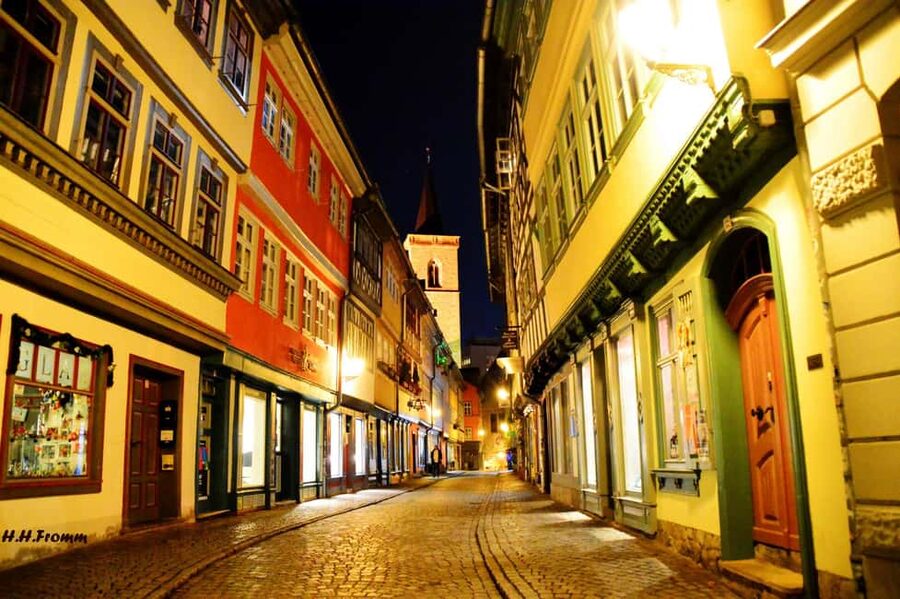
The university quarter adds another side of the city. Here the Brückenkrämer brings in stories about the rebellious student Martin L., who did not miss a trick, along with the learned donkeys of the old university. The humor is a major part of the presentation, so the German-language requirement matters especially in this section.
The Old Synagogue appears on the route as another important stop. The information provided does not promise an interior visit, so you should understand this as a sight encountered during the walking tour rather than a separate museum admission. Still, its inclusion broadens the route beyond the bridge and merchant theme.
I appreciate that the walk includes both comic stories and serious city landmarks. The tone is not a solemn specialist seminar, but it is not limited to jokes either. You get a general sense of how Erfurt’s religious, academic, and commercial quarters fit together.
Waidspeicher and the route toward cathedral square
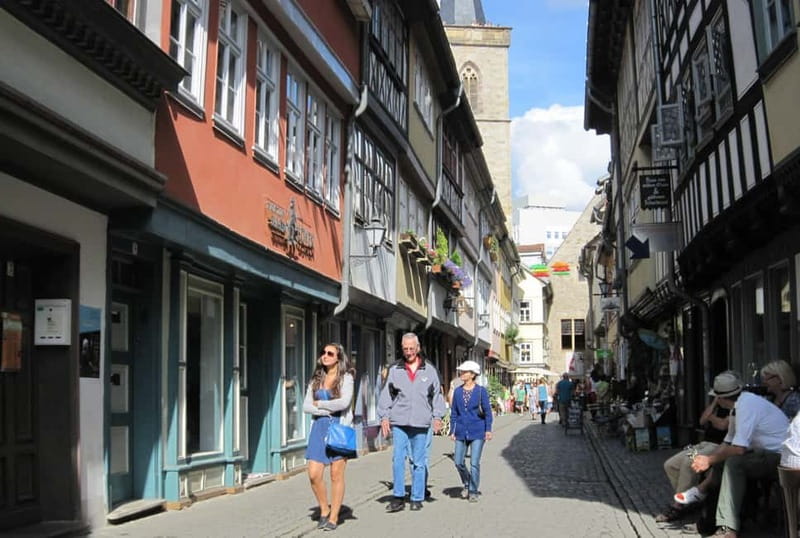
The walk continues to the Waidspeicher at the Arche. The route description does not give a full explanation of the building or promise a formal visit inside, so keep your expectations practical. You will see it as part of a guided circuit through the old center, with the Brückenkrämer supplying context and local tales.
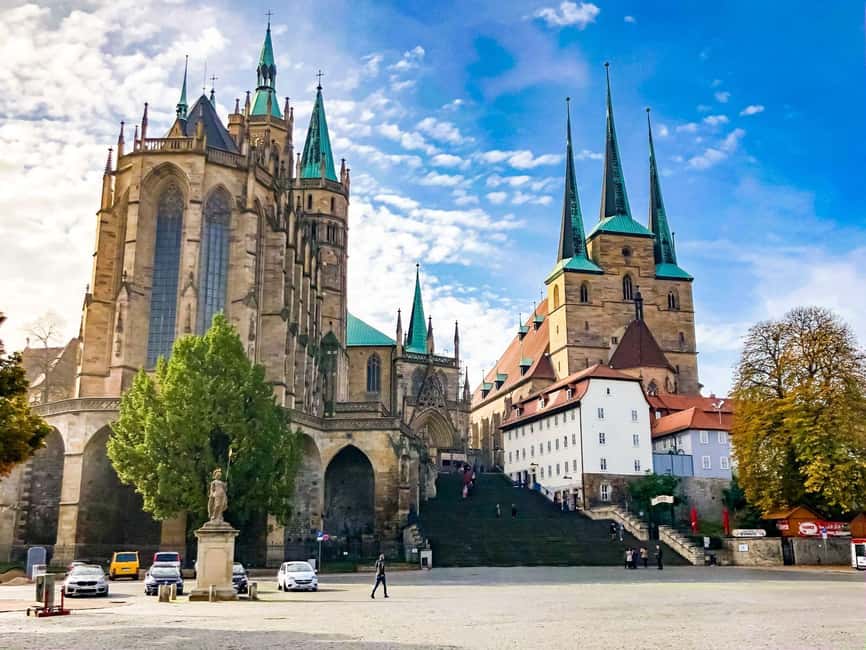
The final major area is cathedral square, where you can view the cathedral, Severi Church, and the citadel. This gives the two-hour walk a strong finish, moving from the compact bridge and lanes to a broad civic and religious setting.
These changing spaces are one reason the tour offers good value. You are not paying for one viewpoint or one tasting alone. In two hours, you move through several distinct parts of central Erfurt, from the bridge’s shopfronts to the cathedral square’s large-scale buildings.
The route includes more sights than can be covered in depth. That is both its strength and its limit. You will gain orientation and a story-led introduction, but you will need a separate visit if you want extended time inside the cathedral, Old Synagogue, or other attractions.
The jokes, characters, and local flavor
The Brückenkrämer’s material includes Martin Luther, the axe-wielding apostle Boniface, Dr. Faust, the indulgence seller Tetzel, and Erfurt’s allegedly eaten mayor. It also touches on puffed beans and beer holes. These are not neutral labels for a standard sightseeing script. They signal a tour that likes odd details, wordplay, and local color.
That style will suit you if you prefer a guide who performs a character and tells stories with a wink. It may be less suitable if you want a quiet architectural survey or a strictly academic account. The tour calls itself humorous, and the humor is not an extra. It shapes how the information is delivered.
The strongest praise attached to this experience centers on its friendly, informative presentation, the entertaining pace, and the chance to try two typical Erfurt specialties. That matches the tour’s design. It aims to make the city easy to enjoy and remember, rather than to overwhelm you with dates.
Is $16 a fair price?
At $16 per person, the tour is priced modestly for a two-hour guided walk that includes two tastings. The value is strongest if you want a live introduction to Erfurt and would otherwise spend time finding the bridge, fish market, university quarter, Old Synagogue, Waidspeicher, and cathedral square on your own.
You are also paying for the themed presentation. A basic self-guided walk can show you the same streets, but it will not provide Reinhard Schwalbe’s Brückenkrämer character, merchant-family stories, cellar access, or the comic connections among local figures.
Optional extras cost more. Musical accompaniment with violin is available for $6 per person. A separate beer tasting with three hand-brewed beers and a snack costs $8 per person. These add-ons may suit a private group looking for a more festive outing, but the core tour already includes the truffle and liqueur tastings.
The tour has a 4.9 rating from 28 ratings, with particular approval for the friendly delivery, useful information, humor, and local samples. Treat that as a sign that the format works well for people seeking an entertaining city introduction, not as a promise that every joke or tasting will suit every visitor.
Who should book this walk?
I would recommend it to first-time visitors who want orientation, local stories, and a taste of Erfurt without giving up half a day. It also fits families with older children who can follow German, couples who enjoy food stops, and small groups that want a guide with a distinctive character.
It is a good match for you if the Krämerbrücke is high on your list and you want to understand more than its exterior. The Brückenkeller and Bohlenstube are the special touches that make this different from a standard central-city walk.
You should think twice if you need an English-language tour, dislike alcohol tastings, or prefer detailed art and architectural analysis. The tour is conducted in German, and its strongest moments come from humor and storytelling. Confirm the cellar arrangements if accessibility there is important to you, even though the activity itself is listed as wheelchair accessible.
Booking remains flexible, with cancellation permitted up to 24 hours before the start for a full refund and a reserve-now, pay-later option. When arranging the tour, provide the day, time, meeting point, group size, and any extras you want. Reinhard Schwalbe lists 01773207885 for questions.
Final call on the Brückenkrämer experience
Book this tour if you want Erfurt presented as a lived-in medieval city, with a merchant’s viewpoint, a cellar stop, local jokes, and two modest tastings. At $16, it offers a lot of useful ground and personality in two hours.
Skip it if you want English commentary or a quiet, highly detailed study of individual monuments. For German-speaking visitors, though, the combination of Reinhard Schwalbe’s costume, the Krämerbrücke setting, and the friendly storytelling makes this a practical and entertaining way to get your bearings fast.
FAQ
How long does the Brückenkrämer tour last?
The walking tour lasts two hours. Check availability for the starting times offered on your chosen date.
Where does the tour begin and end?
It begins at the center of the town hall steps in Erfurt and ends back at the same meeting point. The Brückenkrämer costume identifies the guide.
What language is the tour conducted in?
The live tour is conducted in German. The guide is Reinhard Schwalbe, who presents the walk in the costume of the Brückenkrämer.
What tastings are included?
The tour includes Krämerbrücke truffles made with Peru jungle chocolate from the Goldhelm chocolate manufactory and a tasting of Erfurt Classic, a clear 40 percent herbal liqueur.
Is the Brückenkeller included?
Yes. The experience includes a visit to the Brückenkeller under the Kramladen. This portion is for groups under 10 people.
Can I cancel or pay later?
You can cancel up to 24 hours in advance for a full refund. A reserve-now, pay-later option is also available.
Just added around Germany
- Aachen old town tour – GERMAN (public)★ 5.0 · 24 reviews
- Aachen Private Walking Tour With A Professional Guide★ 5.0 · 11 reviews
- Cologne Highlights: Exclusive Private Tour★ 5.0 · 5 reviews
- Bremen Private Walking Tour With A Professional Guide★ 5.0 · 7 reviews
- Private Walking Tour through the Fascinating Bremen’s City Center★ 5.0 · 5 reviews
- Explore Cologne’s best Street Art Quarter★ 4.5 · 4 reviews
- Bremen Exploration Private Game and City Tour on your Phone★ 4.5 · 7 reviews
- e-Scavenger hunt Bremen: Explore the city at your own pace★ 4.0 · 24 reviews
Walking Tours, compared.





Berlin’s Best: 2 Hour Walking Tour Third Reich and the Cold War
Read our review →


Third Reich Berlin: Hitler and WWII Walking Tour
Read our review →Browse the lists this tour appears in