Reviewed · BERLIN TOURS
Berlin: Sightseeing Tour in Classic Volkswagen T1 Samba Bus
Berlin: Sightseeing Tour in a Classic Volkswagen T1 Samba Bus
Berlin sightseeing rarely gets more distinctive than this. You spend two hours in a beautifully restored 1965 Volkswagen T1 Samba bus, its 21 windows giving you a clear view of the city as you roll from the Cathedral through Mitte, the former West Berlin, Potsdamer Platz, Checkpoint Charlie, and back again.
I especially like two things here: the small group of no more than seven keeps the ride personal, and the driver-guide can take side streets rather than following a fixed tourist-bus route. The photo booklet is another smart touch, showing older views of buildings and interiors while you stand outside them.
The main limitation is simple: this is a moving overview, not a stop-and-visit tour. Nearly every sight is passed from the bus, so you will not enter the museums, climb the Victory Column, or walk through the Holocaust Memorial during the two hours. The vintage vehicle also has limited space, so it is not suitable for non-folding wheelchairs or people over 275 pounds (125 kilograms).
In This Review
- Key points to know before booking
- Why the old Volkswagen changes the tour
- Starting at Berlin Cathedral and Museum Island
- Brandenburg Gate, the Reichstag, and modern government
- West Berlin through the Zoo and Kurfürstendamm
- Potsdamer Platz and the Berlin Wall
- Friedrichstraße, Checkpoint Charlie, and Gendarmenmarkt
- The TV Tower and return to the Cathedral
- What the two-hour format is really worth
- Who will enjoy this Berlin ride most
- Should you book the T1 Samba bus tour?
- FAQ
- Where does the Berlin VW T1 tour start and finish?
- How long does the tour last?
- How much does the tour cost?
- How many people can join the tour?
- What vehicle is used?
- Is there live commentary?
- Which languages are available?
- Does the tour enter the museums and monuments?
- Is the tour wheelchair accessible?
- Can I cancel the booking?
Key points to know before booking
- The 1965 T1 Samba is part of the attraction: The polished split-window bus draws smiles from people on the street and gives the tour a warm, old-Berlin character.
- You cover almost 50 landmarks in two hours: The route connects Museum Island, the government quarter, City West, the Berlin Wall, Checkpoint Charlie, and historic Mitte.
- The guide provides live context: English and German commentary links buildings to Berlin’s imperial, Nazi, divided-city, and reunified eras.
- The photo booklet adds a useful time machine: Old images help you picture lost interiors, wartime damage, and earlier versions of familiar streets.
- The route favors small roads as well as grand avenues: You see more than the standard Brandenburg Gate and Reichstag checklist.
- The value is strongest at the start of your stay: You get a quick mental map of Berlin, then can return to the places that deserve a longer visit.
Why the old Volkswagen changes the tour
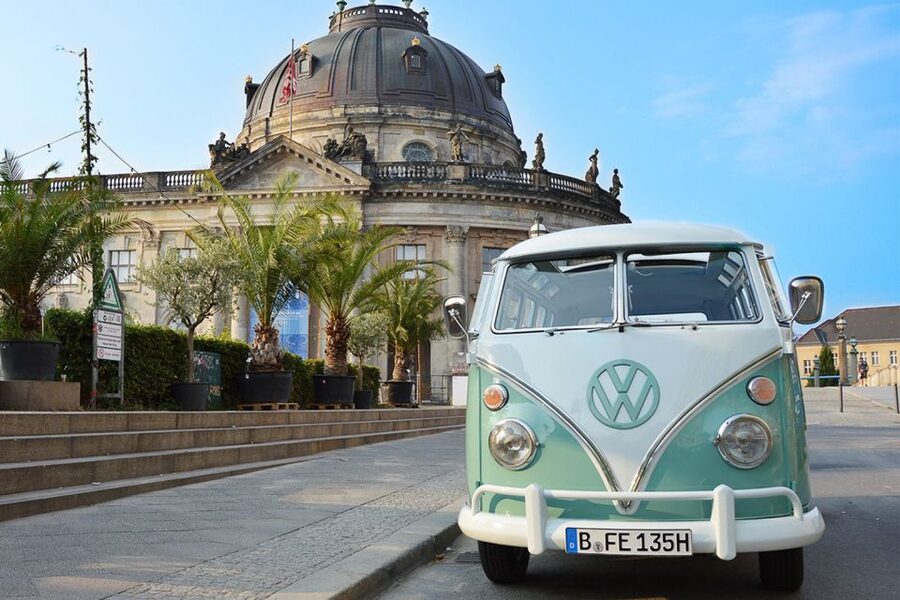
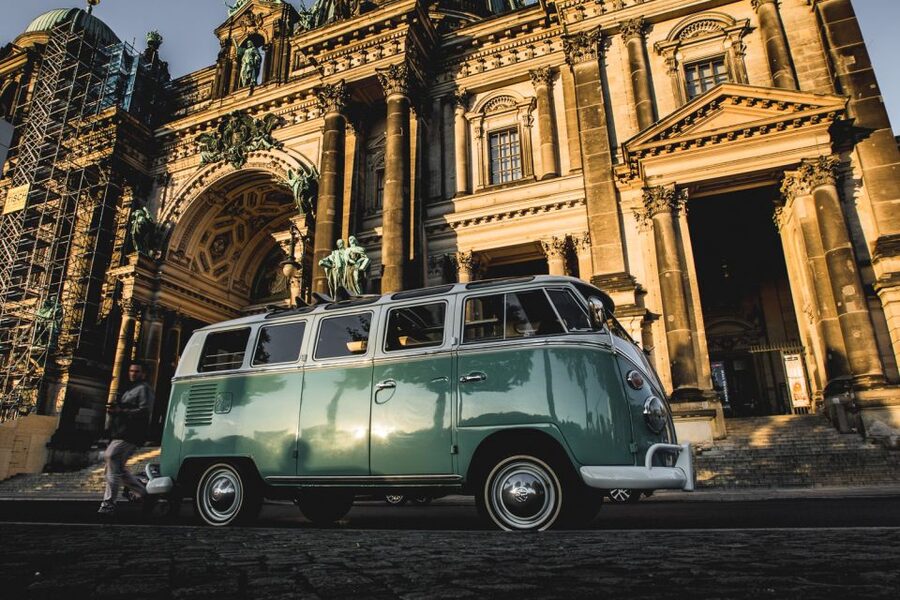
A regular sightseeing bus is built for capacity. This one is built for atmosphere. The rounded body, split windshield, polished details, and rows of windows make the ride feel closer to a private outing than a city transport service.
That matters in Berlin, where the city’s story is spread across broad avenues, open squares, rebuilt blocks, surviving fragments, and ordinary side streets. From the Samba bus, you are not sealed behind a dark window or watching a screen. You see the streets directly, and people often smile or wave as the van passes.
The bus is also more comfortable than its age suggests. It has heating when needed, which is important in Berlin’s cold months. Winter bookings have found the warm interior especially useful on gray or rainy days. In warmer weather, ventilation depends on the windows and the vehicle’s vintage design, so you should not expect the climate control of a modern coach.
With seven people or fewer, you can usually hear the guide clearly and ask questions without shouting across a large cabin. The compact group also makes the route feel more personal. Guides such as Rajko and Michael are praised for explaining Berlin with warmth, humor, and plenty of local detail rather than simply reciting dates.
Other Berlin days worth putting on the list:
- Berlin: Reichstag, Dome and Government District Guided Tour
★ 4.7 · 18,288 reviews - Berlin: 1-Hour City Tour by Boat with Guaranteed Seating
★ 4.3 · 16,993 reviews - Berlin: Boat Tour Along the River Spree
★ 4.4 · 11,252 reviews
Starting at Berlin Cathedral and Museum Island
The tour begins at Berlin Cathedral, an easy landmark on the edge of the Lustgarten. You pass the lawn and the cluster of museums on Museum Island: the Alte Nationalgalerie, Neues Museum, Pergamon Museum, and Bode Museum.
This opening stretch gives you Berlin’s grandest concentration of culture. The architecture is impressive even if you are only looking through the windows, but remember that the museums are viewed from outside. If you want to see their collections, plan separate visits.
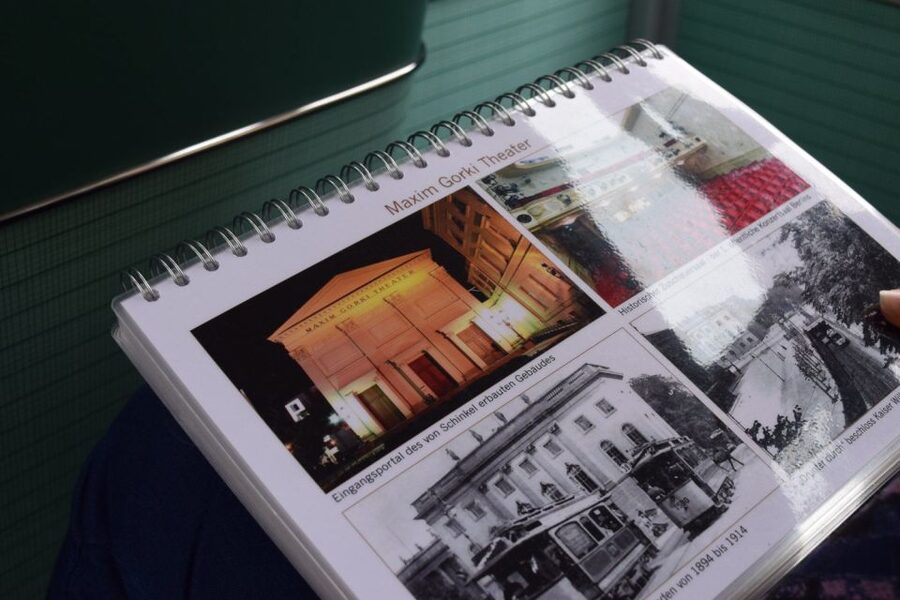
The guide uses the photo booklet to add depth to these passing views. At selected locations, historic photographs help you imagine earlier facades, interiors, and streets. That is particularly useful in Berlin, where war damage, political rebuilding, and modern restoration have changed the appearance of many places.
You then pass the German Historical Museum, Neue Wache, the Crown Prince’s Palace, Humboldt University, the Berlin State Opera, and Bebelplatz. Unter den Linden ties these sights together, and the route gives you a quick sense of how Berlin’s royal, academic, political, and cultural centers sit along the same axis.
Bebelplatz is one of the places where the guide’s explanation matters more than a quick photograph. The square is tied to the Nazi book burning of 1933, and its understated memorial is easy to miss when you are simply walking along Unter den Linden. A live guide can point out details that a passing glance would not reveal.
Brandenburg Gate, the Reichstag, and modern government
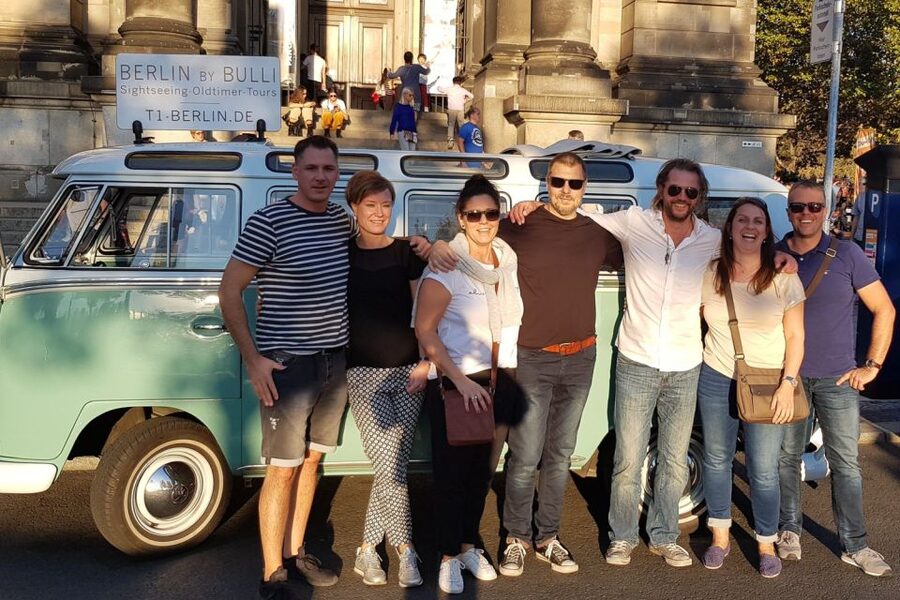
From Unter den Linden, the bus reaches Pariser Platz and Brandenburg Gate. This is Berlin’s most familiar postcard view, but arriving in a small vintage bus gives it a different feel. The gate is not treated as the whole city, just one piece of a much larger story.
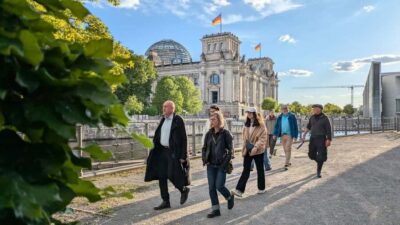
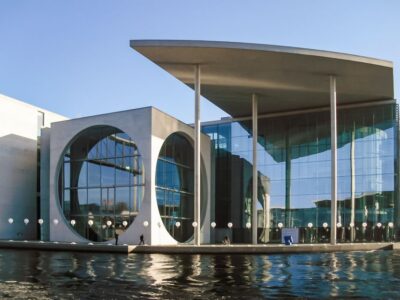
The route continues to the Reichstag, the government district, the Federal Chancellery, and Berlin Hauptbahnhof. Here, the city shifts from royal Berlin to the modern capital of reunified Germany. You see the contrast between historic monuments and bold contemporary buildings in a short stretch.
The Federal Chancellery and Hauptbahnhof are especially useful landmarks for understanding present-day Berlin. The former is a major center of government, while the latter is a large modern rail hub. The tour does not enter either building, but the guide helps place them within the wider city.
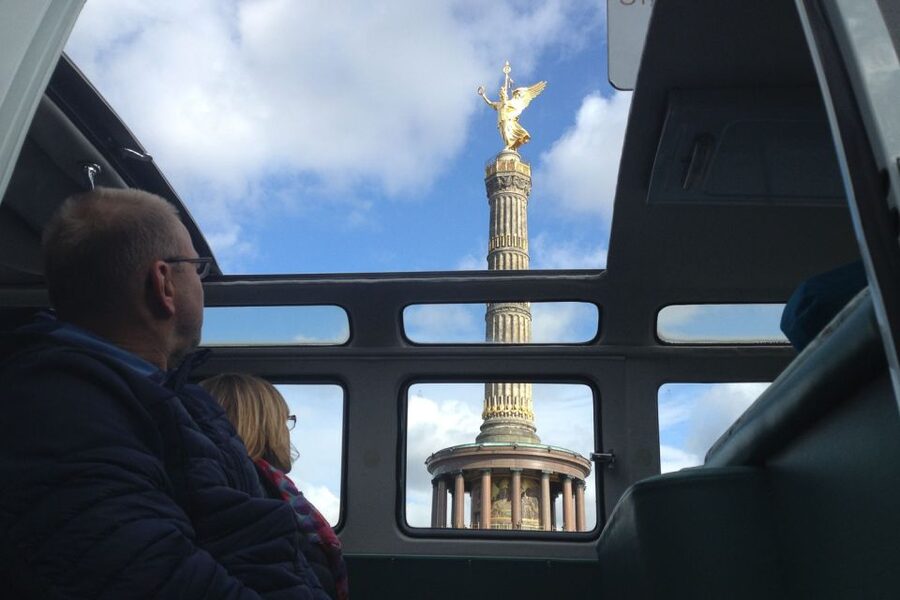
Next come Moltke Bridge, the Kongresshalle, Bellevue Palace, and the Victory Column. Bellevue Palace is the official residence of Germany’s federal president, while the Victory Column rises in the Tiergarten. From the bus, you get the setting and scale, but not the chance to climb the column or explore the park on foot.
This section is a good example of the tour’s strength and weakness. You see a great deal of Berlin’s structure in a short time, but the schedule does not leave room for lingering. If a particular sight catches your eye, write it down for a later visit.
West Berlin through the Zoo and Kurfürstendamm
The route then turns toward City West, passing Berlin Zoo, Theater des Westens, Savignyplatz, Kurfürstendamm, Kaiser Wilhelm Memorial Church, and KaDeWe.
This is a useful counterpoint to the ceremonial center. Kurfürstendamm is associated with West Berlin’s commercial and social life, while Savignyplatz has a more local neighborhood feel. Theater des Westens adds a performing-arts stop, and the Zoo remains one of the area’s best-known institutions.
Kaiser Wilhelm Memorial Church is one of the most meaningful sights on this part of the route. Its damaged tower was left as a reminder of war, beside a newer church structure. You can see the contrast from the street, though a proper visit is needed to appreciate the interior memorial.
KaDeWe, the famous department store on Tauentzienstraße, shows another side of Berlin: shopping, display, and the old West’s polished commercial identity. The bus also passes the Scandinavian embassies, the Embassy District, the Berliner Philharmonie, and Kulturforum.
The Philharmonie and Kulturforum continue the cultural theme introduced on Museum Island, but with a distinctly modern West Berlin setting. You may not get a long look at each building, yet the route makes clear that Berlin’s cultural life is not confined to the historic center.
Same city, a completely different kind of day:
- Discover Berlin Half-Day Walking Tour
★ 5.0 · 9,624 reviews - Berlin: Hop-on Hop-off Bus Tour with Live Commentary
★ 4.3 · 8,579 reviews - Berlin: Government District around the Reichstag Guided Tour
★ 4.7 · 8,447 reviews - Berlin: Reichstag, Plenary Chamber, Cupola & Government Tour
★ 4.6 · 8,422 reviews
Potsdamer Platz and the Berlin Wall
Potsdamer Platz is one of the clearest places to see Berlin’s physical transformation. Once divided and heavily damaged, it became a symbol of redevelopment after reunification. From the bus, you can compare the large modern complex with the older city around it.
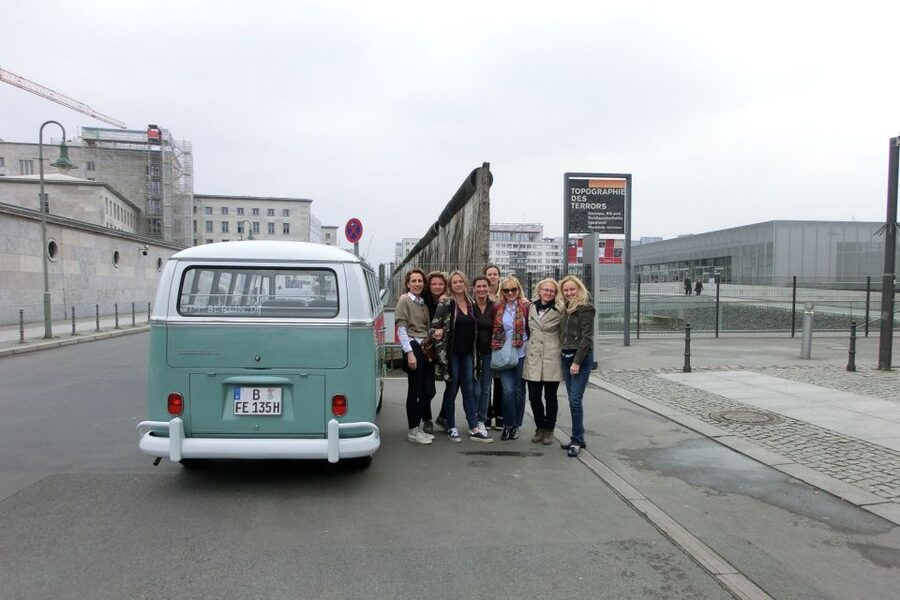
The tour then reaches a remaining section of the Berlin Wall and Niederkirchner Straße. This part of the route gives the history of division a physical presence. The Wall is not just an abstract chapter from the Cold War. It was a barrier that cut through streets, neighborhoods, and daily life.
Nearby Anhalter Bahnhof adds another layer. The former railway station is a striking reminder of Berlin’s wartime destruction and changing transport network. You pass rather than explore it, so treat the stop as an introduction and return later if the site interests you.
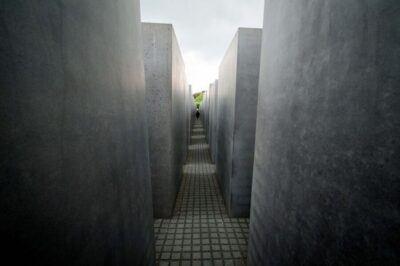
The Holocaust Memorial, the former Führer Bunker area, and the site of the Reich Chancellery follow. This is serious territory, and the guide’s tone matters. You get a compact explanation of the Nazi period and the physical traces that remain, often in places where there is little obvious to see.
The photo booklet is particularly useful here. Historic images can show what once occupied a site that now appears empty or altered. That contrast helps explain why Berlin can feel full of history even when the original building has vanished.
Friedrichstraße, Checkpoint Charlie, and Gendarmenmarkt
The route continues through Friedrichstraße to Checkpoint Charlie. Friedrichstraße has long been one of Berlin’s major north-south streets, while Checkpoint Charlie became the best-known crossing point between East and West Berlin during the Cold War.
Checkpoint Charlie itself can feel busy and commercial, and a short drive-by will not untangle every layer of its history. The value here lies in the guide’s context and in seeing how the checkpoint fits into the surrounding streets. You can later return on foot to visit museums and displays in the area.
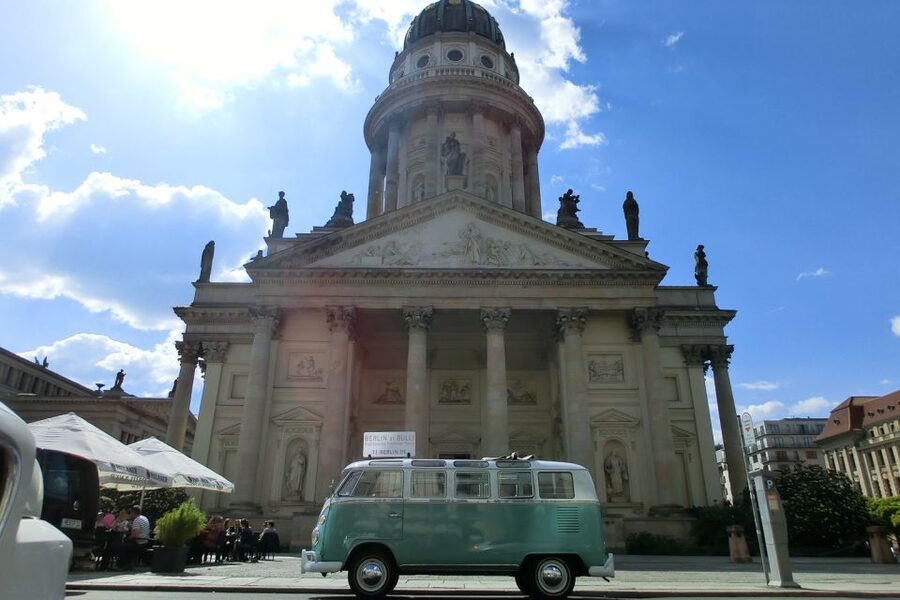
Gendarmenmarkt is another architectural highlight. The square is framed by the French Cathedral, German Cathedral, and Konzerthaus, creating one of the city’s most elegant urban spaces. From the Samba bus, you get a broad view, but the square deserves a walk if you have time.
The route then returns toward Berlin Palace, the Jungfern Bridge, Galgenhaus, and Rotes Rathaus. These sights bring you back to older Berlin, with links to the city’s royal center, bridges, municipal government, and surviving historic structures.
Berlin Palace has a complicated modern identity because the present building incorporates a reconstructed historic exterior with a contemporary interior. A guide can help you make sense of that tension better than a quick photograph can. Rotes Rathaus, the red-brick city hall, provides a clear visual marker as the bus approaches the TV Tower.
The TV Tower and return to the Cathedral
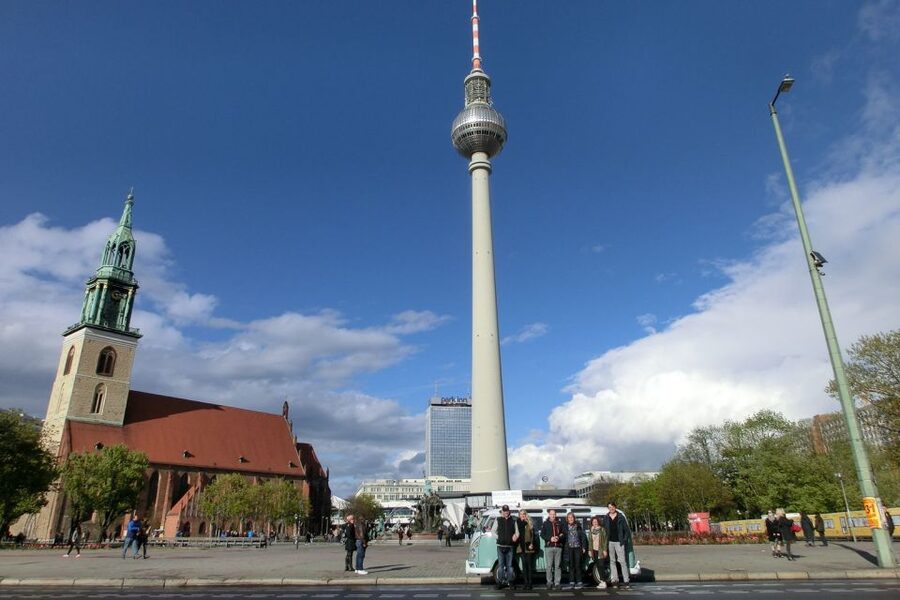
The TV Tower dominates the final part of the route. Built during the era of East Germany, it remains one of Berlin’s most recognizable symbols and a strong reference point for getting your bearings.
You also pass Neptune Fountain and St. Mary’s Church before returning to Berlin Cathedral. This closing section brings together old Berlin and the former East Berlin center. It is a fitting end to a route that moves across nearly eight centuries of city history.
The full list of sights is long, but the experience is not a race in the usual sense. The driver takes a scenic route through main roads and smaller streets, and the commentary connects the stops into a story. Still, you should expect some landmarks to pass quickly. The tour works best as a broad introduction, not as a substitute for museum visits or walking tours.
What the two-hour format is really worth
At $51 per person, this is more expensive than a standard public bus ride and often more than a large hop-on hop-off ticket. You are paying for the restored vehicle, a maximum group size of seven, a live driver-guide, and a route that includes both headline sights and less obvious places.
The value is strongest if you want a personal orientation without spending half a day on foot. In two hours, you reach areas that are far apart: Museum Island, the government quarter, City West, Potsdamer Platz, the Wall, Checkpoint Charlie, and central Mitte.
It is also a strong choice in poor weather. Berlin’s winter cold and rain can make a long walking tour tiring, while the heated bus lets you see the city from shelter. The tradeoff is that you cannot stop whenever you wish, and the windows and compact cabin may feel close if you prefer lots of personal space.
I would book it near the beginning of a Berlin stay. You can mark the places that deserve a second look, then return by train, tram, or on foot. Taking it near the end still works, especially if you want historical context for places you have already seen.
The tour is offered in English or German, and it may include both languages in the same departure. That can slow the commentary a little. If you want every minute in one language, check the departure details before booking.
The activity is wheelchair accessible in general, but non-folding wheelchairs are not allowed. It is also not suitable for people with epilepsy, people with a cold, or anyone above the stated 275-pound limit. Those restrictions are worth checking before you pay.
Who will enjoy this Berlin ride most
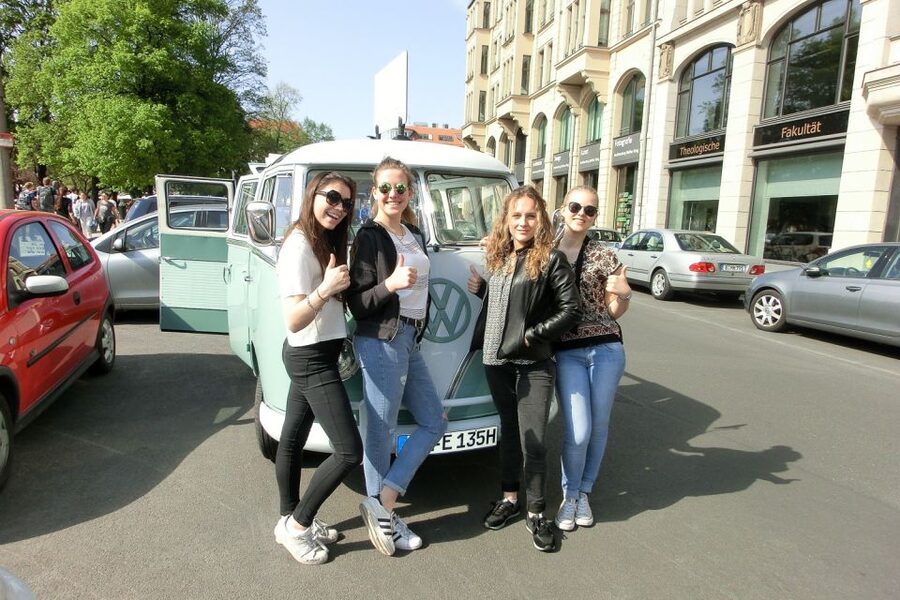
I would recommend it to first-time visitors who want a fast but thoughtful introduction to the city. Families can also benefit, since the unusual vehicle helps hold attention during a history-heavy route, and the cabin is far less anonymous than a large coach.
It suits anyone who likes cars, design, and nostalgic transport, but you do not need to be a Volkswagen fan. The bus adds charm, yet the guide and route are the real reasons to book.
It is also a good fit for repeat visitors. Even if you know the Brandenburg Gate and Museum Island, the side streets, lesser-known buildings, and historical photographs may give familiar places a new meaning.
You should choose another format if your priority is entering museums, spending time at memorials, or taking extensive photographs at each stop. A walking tour or private vehicle with longer stops will serve you better.
Should you book the T1 Samba bus tour?
Book this tour if you want to cover a wide section of Berlin in a small group, enjoy live history, and like the idea of riding in a beautifully maintained 1965 Volkswagen. The route is unusually broad for two hours, and the photo booklet makes Berlin’s changed and vanished places easier to understand.
Skip it if you need step-free access for a non-folding wheelchair, dislike compact vintage vehicles, or want substantial time inside attractions. For most visitors, though, the combination of comfort, character, and city orientation makes $51 a fair price, especially in cold weather or at the start of a first Berlin visit.
FAQ
Where does the Berlin VW T1 tour start and finish?
The tour starts at Berlin Cathedral and returns to Berlin Cathedral after approximately two hours.
How long does the tour last?
The sightseeing tour lasts two hours.
How much does the tour cost?
The listed price is $51 per person.
How many people can join the tour?
The group is limited to seven participants.
What vehicle is used?
You ride in a classic 1965 Volkswagen T1 Samba bus.
Is there live commentary?
Yes. A driver-guide provides live commentary during the tour.
Which languages are available?
The tour is offered in English and German. A departure may include more than one language.
Does the tour enter the museums and monuments?
No. The listed sights are passed from the bus, so you should plan separate visits for interiors and longer explorations.
Is the tour wheelchair accessible?
The activity is described as wheelchair accessible, but non-folding wheelchairs are not allowed.
Can I cancel the booking?
You can cancel up to 24 hours before the activity for a full refund. Reserve-now, pay-later booking is also available.
Just added around Berlin
- Love and War in Berlin: Self-Guided Story Puzzle Walk★ 5.0 · 7 reviews
- Rickshaw Tours Berlin – Groups of up to 16 people with several rickshaws★ 4.0 · 97 reviews
- Walking on the Wall: 3-Hour Tour in Berlin★ 4.5 · 34 reviews
- eSIM for Germany and 34 European Countries★ 4.5 · 16 reviews
- Warnemuende Shore Excursion: Berlin Private Sightseeing Tour from Rostock★ 5.0 · 4 reviews
- Your ticket to The Wall Museum Berlin★ 3.0 · 60 reviews
- Warnemuende Shore Excursion: Private Berlin Tour★ 4.5 · 27 reviews
- Berlin’s Gay, Lesbian, and Queer Scene Small-Group Walking Tour★ 4.5 · 66 reviews
Berlin Tours, compared.
Reichstag, Dome and Government District Guided Tour
Read our review →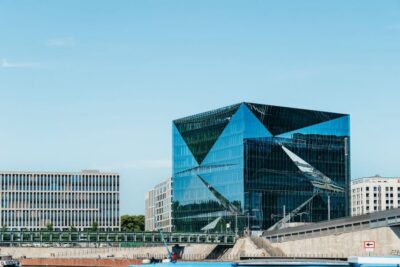
1-Hour City Tour by Boat with Guaranteed Seating
Read our review →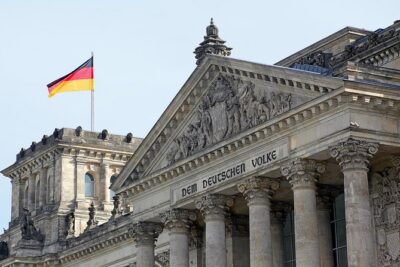
Reichstag, Plenary Chamber, Cupola & Government Tour
Read our review →