
Reviewed · HISTORICAL TOURS
Berlin History Walking Tour with a French-Speaking Guide
Berlin reveals its past in plain sight. On this three-hour walk, you move from Potsdamer Platz and Checkpoint Charlie to the former Führerbunker site, the Holocaust Memorial, Brandenburg Gate, and Museum Island. The route ties Nazi crimes, Cold War division, reunification, and today’s rebuilt capital into one useful morning.
I like the French-speaking guides, who explain rather than simply point. Guides named Anouk, Martin, Paul, Arthur, and Céline have been singled out for clear delivery, humor, patience, and strong answers to questions. I also like the route’s smart ending near Museum Island, where you can have lunch or continue sightseeing.
The main trade-off is that this is a fully walking tour, with no audio receivers. On a busy day, you may need to stay close to the guide to hear everything. A small number of visitors also found that some historical details needed checking, so treat the tour as an excellent introduction, not your only source for Berlin’s past.
In This Review
- Key points to know before you book
- Why this route works for a first morning in Berlin
- Potsdamer Platz shows Berlin’s dramatic reset
- Checkpoint Charlie keeps the Cold War story personal
- The former Führerbunker site requires careful explanation
- The Holocaust Memorial asks you to slow down
- Unter den Linden connects empire, war, and today’s Berlin
- Bebelplatz remembers the Nazi book burning
- Brandenburg Gate changes meaning as Berlin changes
- Museum Island provides a strong finish
- What the French-speaking guiding adds
- Price, pace, and practical value
- Who should book this Berlin history walk?
- Should you book it?
- FAQ
- How long does the Berlin History Walking Tour last?
- What time does the tour start?
- Where does the tour begin?
- Where does the tour end?
- Is the tour conducted in French?
- Is transportation included?
- Are food and drinks included?
- What happens if I need to cancel?
Key points to know before you book
- A serious history route: The tour covers Berlin’s Nazi dictatorship, the Holocaust, Cold War division, reunification, and present-day architecture.
- French from start to finish: The experience operates in French, with guides such as Anouk, Martin, Paul, Arthur, and Céline mentioned by name in the feedback.
- Eight central sights: Potsdamer Platz, Checkpoint Charlie, the former Führerbunker site, the Holocaust Memorial, Unter den Linden, Bebelplatz, Brandenburg Gate, and Museum Island.
- A useful first morning: The 10 a.m. start and roughly three-hour length leave you free for lunch and an afternoon museum visit.
- Walking shoes matter: The route is done entirely on foot and requires a moderate level of fitness.
- Good value at $27.81: For a French-language introduction to central Berlin, the price is modest, though you pay separately for food, drinks, and transport.
Why this route works for a first morning in Berlin
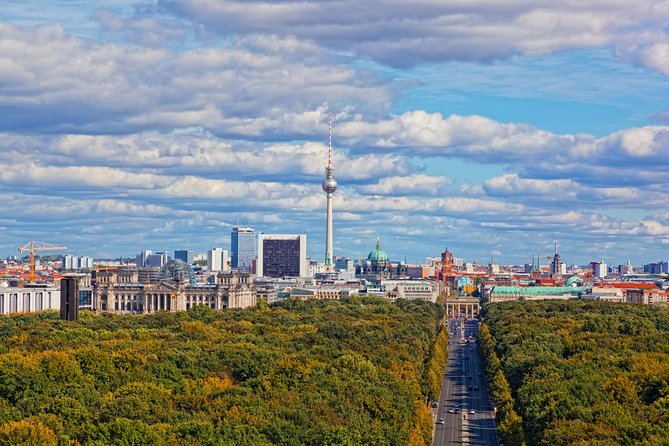
Berlin can feel confusing at first. Its major sights are spread across a wide central area, and the city’s story is not a simple march from medieval beginnings to modern success. Nazi rule, wartime destruction, Soviet occupation, the Berlin Wall, reunification, and rapid rebuilding all overlap.
This walk gives you a framework before you tackle the city on your own. You are not just seeing a gate, a square, or a modern office complex. You are learning how each place changed meaning over time.
The route lasts about three hours, though one reported outing ran closer to three and a half. That is useful to keep in mind if you have a firm lunch booking. The 10 a.m. departure is practical. You get the main orientation early, then still have much of the day for museums, neighborhoods, or a longer meal.
The group can reach up to 25 people. That is small enough to feel manageable, but not the same as a private walk. Since the guide does not use an audio system, position yourself near the front and keep an eye on the group when crossing streets or moving between stops.
A few more Berlin trips to weigh up
- Berlin: Natural History Museum Entrance Ticket
★ 4.6 · 3,382 reviews - Berlin: World Heritage Cruise to Potsdam
★ 4.5 · 1,435 reviews - Berlin Historical Highlights Walking Tour
★ 4.9 · 657 reviews
Potsdamer Platz shows Berlin’s dramatic reset
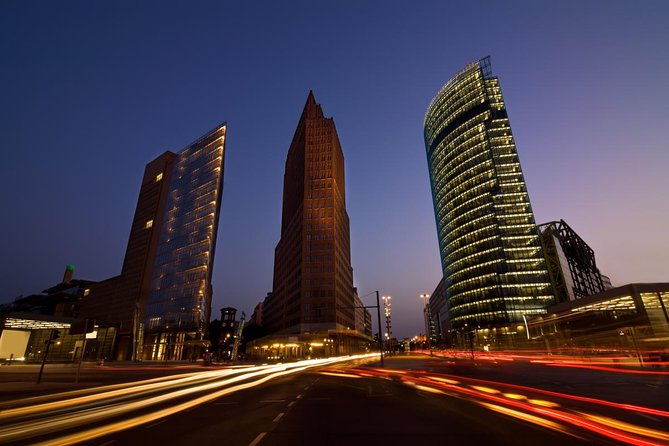
The meeting point is at Potsdamer Platz 10, near the corner of Gabriele-Tergit-Promenade. This is a fitting place to begin because few parts of Berlin better show the city’s modern reinvention.
Potsdamer Platz was once a major center of urban life, then became a devastated zone after the Second World War and a divided area during the Cold War. Today, large contemporary buildings and open public spaces give it a very different look.
The guide uses this contrast to explain how Berlin rebuilt itself. You may also see the Sony Center as part of the modern city’s architectural story. The ten-minute stop is brief, so do not expect a full architectural tour. Its value is the setting and the quick explanation of how a former scar became a symbol of the new Berlin.
Arrive a little early. The supplied meeting information is precise, but central Berlin has several large plazas and busy pedestrian areas. Confirm the exact corner before the 10 a.m. start.
Checkpoint Charlie keeps the Cold War story personal
From Potsdamer Platz, the walk continues to Checkpoint Charlie. The famous crossing point once marked the confrontation between East and West Berlin, and the guide explains its role during the city’s divided decades.
The site is historically important, but the modern surroundings can feel commercial and crowded. That makes the guide especially useful. Without context, Checkpoint Charlie can look like a photo stop surrounded by shops. With context, it becomes a place connected to border controls, military tension, escape attempts, and the daily reality of a divided city.
The stop lasts about ten minutes. That is enough for a clear orientation, though not enough for every detail of the Wall or the border system. If Cold War history is your main interest, plan a separate museum visit later. On this tour, Checkpoint Charlie is one piece of a larger story.
The former Führerbunker site requires careful explanation
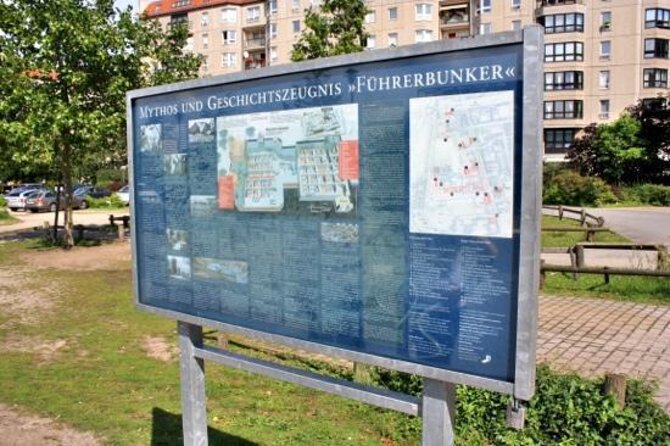
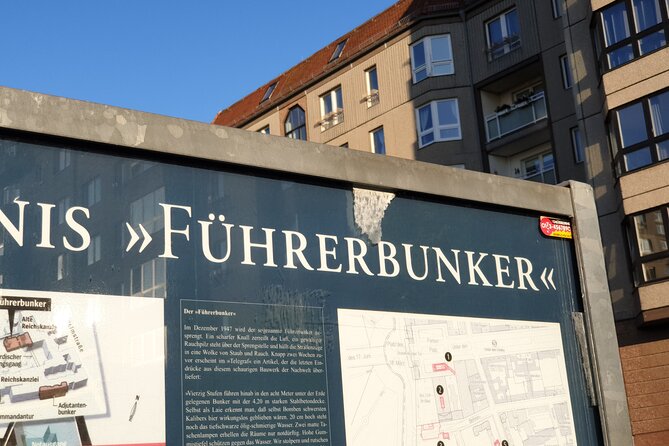
The walk then reaches the place where the Führerbunker once stood. Adolf Hitler spent his final days there in April 1945. The bunker itself is not presented as a preserved attraction. The point is understanding what happened at the site and why there is no dramatic underground monument to visit.
This is one of the most useful stops because the location is deliberately understated. The guide explains the meaning of the site, its connection to the final days of the Nazi regime, and the reasons for its present condition.
The itinerary describes admission as included, but you should understand that this refers to the stop at the site, not entry into an intact bunker interior. The experience is interpretive and historical, not a tour of underground rooms.
The subject is grim, and the guide’s tone matters. The strongest feedback focuses on guides who are precise, articulate, and able to answer questions without turning the material into spectacle. That is the right approach here.
Same city, a completely different kind of day:
- Berlin: Reichstag, Dome and Government District Guided Tour
★ 4.7 · 18,288 reviews - Berlin: 1-Hour City Tour by Boat with Guaranteed Seating
★ 4.3 · 16,993 reviews - Berlin: Boat Tour Along the River Spree
★ 4.4 · 11,252 reviews - Discover Berlin Half-Day Walking Tour
★ 5.0 · 9,624 reviews
The Holocaust Memorial asks you to slow down
The Memorial to the Murdered Jews of Europe is among Berlin’s most affecting public places. Its field of concrete stelae creates a physical experience that changes as you walk through it. The tour allows about 15 minutes here.
Your guide discusses the memorial’s purpose and the crime it commemorates: the systematic murder of Europe’s Jews by Nazi Germany. This is not a stop to rush through with a camera. You will get more from it if you listen, look around, and allow the space to make its impression.
Fifteen minutes is enough for an introduction, but it is not a substitute for a longer visit to the underground Information Centre, if open and available during your stay. The tour’s strength is that it places the memorial within the city’s wider story. You learn why this memorial is here and how Berlin chooses to confront its past.
The stop can be emotionally heavy. That is not a flaw, but it is worth knowing before you book. This is a history walk with serious subjects, not a light sightseeing stroll.
Unter den Linden connects empire, war, and today’s Berlin
Unter den Linden is the broad historic avenue leading toward the center of Berlin. During the walk, the guide points out changes in building styles and the physical marks left by war.
This section helps you read the city. Berlin often looks patched together, with imperial buildings beside postwar structures and new construction. Rather than treating that mix as random, the guide shows you the different periods represented along the avenue.
The stop lasts about 20 minutes, making it one of the longer pauses on the route. You have time to look up at the buildings, ask questions, and connect the avenue to the city’s former royal center.
I particularly like this part for first-time visitors because it moves beyond headline sights. You begin to see Berlin as a city shaped by layers of power, destruction, division, and reconstruction. The walking pace also gives you a chance to absorb the scale of central Berlin instead of viewing it only from a bus window.
Bebelplatz remembers the Nazi book burning
Bebelplatz is both an impressive architectural square and a place tied to Nazi repression. It is remembered for the public burning of books during the dictatorship. The square also includes Humboldt University and the Catholic Cathedral.
The guide explains how these different institutions share one setting. That contrast matters. The square is not only a memorial to censorship and political terror. It is also part of Berlin’s intellectual and religious center.
The ten-minute stop is short but focused. Look down into the memorial marking the book burning, then look around at the surrounding buildings. The guide’s explanation gives the site its proper weight, especially if you have not studied the Nazi period in detail.
This is another place where the tour provides a strong starting point rather than a complete study. If you want to explore Berlin’s Nazi-era institutions in depth, you will need more time elsewhere. Still, Bebelplatz is an efficient and meaningful addition to the route.
Brandenburg Gate changes meaning as Berlin changes
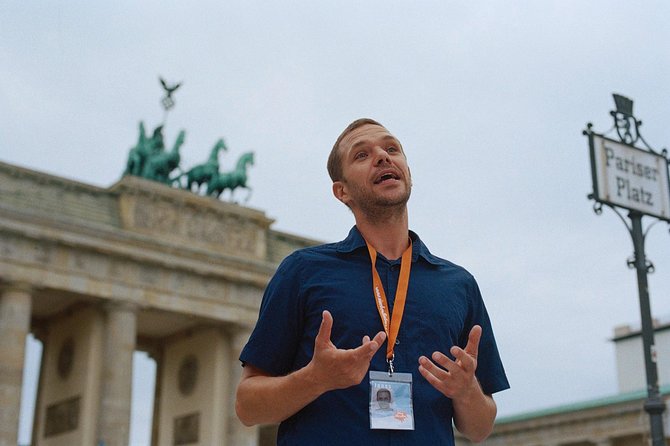
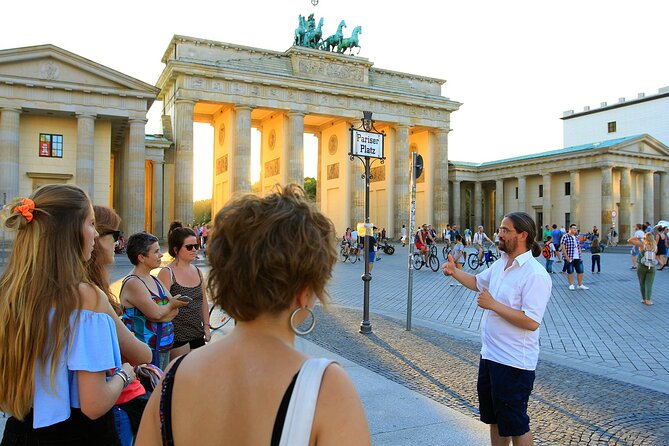
Brandenburg Gate is the best-known landmark on the walk. It began as a royal symbol, later became associated with Cold War division, and now represents German reunification.
The guide traces those changing meanings instead of treating the gate as a single postcard image. That approach makes the stop more interesting. The same structure has been used to express royal power, national division, political theater, and unity.
The visit lasts about ten minutes. You should have time for photographs, but the center of the gate can be crowded. Listen first, then take your pictures. The guide’s explanation is what turns the familiar view into a piece of living political history.
Because Brandenburg Gate is such a central landmark, you may return here later on your own. The tour gives you the background to understand what you are seeing when you come back at a quieter time.
Museum Island provides a strong finish
The tour ends near Museum Island, close to Alexanderplatz, at Museumsinsel 10178 Berlin. The final stop takes in the Berliner Dom and the reconstructed Humboldt Forum.
This is a good place to finish because you are left in one of Berlin’s main cultural districts. The Berliner Dom represents the city’s Protestant architectural heritage, while the Humboldt Forum reflects modern reconstruction and the ongoing debate over how Germany presents its past.
The tour does not include museum admission. That is important when planning your afternoon. You finish near several major cultural sights, but entry tickets, food, and drinks are separate.
You can use the end of the walk as a springboard. Continue with a museum visit, explore the surrounding area, or stop for lunch. The route’s finish is more useful than ending in a residential area or far from public transport.
What the French-speaking guiding adds
The strongest feature here is not a ticket or special access. It is the guide’s ability to make a difficult, layered subject clear in French.
The feedback repeatedly praises guides for warmth, precise explanations, humor, and an easy way with questions. Anouk is described as articulate and attentive to each person. Martin is praised for his passion and ability to make the walk enjoyable. Arthur receives strong marks for his command of Berlin’s past and present, clear speaking, and humor. Paul and Céline are also praised for making the city easier to understand.
Those names may not tell you who will lead your particular departure, but they show the sort of guiding style the company aims to provide. You should expect a live explanation, not a scripted audio recording.
The lack of audio receivers is the chief practical weakness. One person specifically wanted an earpiece system. The group size can reach 25, and city streets are not always quiet. Stay close, ask the guide to repeat anything you miss, and avoid drifting to the back.
A small number of comments also raise concern about imprecise historical details. That does not erase the tour’s value, but it is a fair warning for history specialists. Use the walk to form a clear overview, then check important details through museum material or reputable history sources.
Price, pace, and practical value
At $27.81 per person, this is a reasonably priced introduction to central Berlin. You are paying for a local guide and a French-language explanation across several major sites. You are not paying for transport, meals, or extensive indoor admission.
The value is strongest if you are visiting Berlin for the first time and want the city’s main historical markers explained in one morning. It is also useful if French is your preferred language and you would rather ask questions than read a guidebook.
The walking route requires moderate physical fitness. Dress for the weather because the tour operates in all conditions. Comfortable shoes are essential, and you should plan for several hours outdoors with short pauses rather than long seated breaks.
Service animals are allowed, and the route is near public transportation. The tour uses a mobile ticket, and confirmation arrives at booking. You can cancel without charge up to 24 hours before the start time. After that point, the amount paid is not refunded, and late changes are not accepted.
Who should book this Berlin history walk?
I would choose this tour for a first visit, especially if you have only a few days and want an organized introduction before visiting museums independently. Families with older children, solo visitors, and couples who prefer a social walk should all find the format useful, provided everyone can manage three hours on foot.
It also suits French-speaking visitors who want history explained in natural French rather than through translated signage. The guides’ reported strengths, especially patience and humor, matter when the subject moves from royal Berlin to dictatorship, genocide, division, and reunification.
I would look elsewhere if you want extensive time inside museums, a private guide, a strictly scholarly lecture, or a route focused on only one era. The group may include up to 25 people, the audio setup is simple, and the historical coverage is broad by design.
Should you book it?
Book it if you want a well-priced morning orientation to Berlin’s central sights, with serious history explained in French and a useful finish near Museum Island. The combination of Nazi sites, Cold War landmarks, royal avenues, and modern architecture gives you a strong base for the rest of your stay.
Skip it if you dislike group walking, need frequent indoor breaks, or want every historical detail checked at academic depth. For most first-time French-speaking visitors, though, this is a sensible way to get your bearings, understand the city’s difficult past, and decide what deserves a longer visit.
FAQ
How long does the Berlin History Walking Tour last?
The tour is scheduled for approximately three hours. One reported outing lasted about three and a half hours, so avoid booking a tight appointment immediately afterward.
What time does the tour start?
The tour starts at 10:00 a.m.
Where does the tour begin?
The meeting point is Potsdamer Platz 10, 10785 Berlin, Germany, at the corner of Gabriele-Tergit-Promenade.
Where does the tour end?
The walk ends next to Museum Island, at Museumsinsel, 10178 Berlin, near Alexanderplatz.
Is the tour conducted in French?
Yes. The tour operates in French and includes a professional French-speaking local guide.
Is transportation included?
No. Transportation to and from the attractions is not included. The tour itself is conducted on foot.
Are food and drinks included?
No. Food and drinks are not included in the tour price.
What happens if I need to cancel?
You can receive a full refund if you cancel at least 24 hours before the scheduled start time. Cancellations or changes made less than 24 hours before the start are not accepted for a refund.
Just added around Berlin
- Love and War in Berlin: Self-Guided Story Puzzle Walk★ 5.0 · 7 reviews
- Rickshaw Tours Berlin – Groups of up to 16 people with several rickshaws★ 4.0 · 97 reviews
- Walking on the Wall: 3-Hour Tour in Berlin★ 4.5 · 34 reviews
- eSIM for Germany and 34 European Countries★ 4.5 · 16 reviews
- Warnemuende Shore Excursion: Berlin Private Sightseeing Tour from Rostock★ 5.0 · 4 reviews
- Your ticket to The Wall Museum Berlin★ 3.0 · 60 reviews
- Warnemuende Shore Excursion: Private Berlin Tour★ 4.5 · 27 reviews
- Berlin’s Gay, Lesbian, and Queer Scene Small-Group Walking Tour★ 4.5 · 66 reviews
Historical Tours, compared.

City History Canal Sightseeing Tour on a Motorboat
Read our review →






Browse the lists this tour appears in