
Reviewed · CITY TOURS
Berlin City Walking Tour of Scheunenviertel and Hackesche Höfe in Berlin Mitte
Berlin’s Scheunenviertel is where Berlin’s past feels close enough to touch. On this private walk, you move from former Jewish neighborhoods and wartime stories to courtyards, artists’ spaces, and old dance halls, ending at the New Synagogue on Oranienburger Strasse.
I like the small-group format, which lets guide Swen Goetz adjust the pace and add local stories. I also like the mix of major sights and less obvious stops, especially the former workshop with a hiding place used by a Jewish family. The main drawback is that two hours can feel short for so much material, and some shops in the Hackesche Höfe may be closed on Sundays.
In This Review
- Key points to know before you book
- Why this Berlin Mitte walk feels different
- Scheunenviertel and the Berlin of the 1920s
- Haus Schwarzenberg and the East Berlin view
- Hackesche Höfe and eight connected courtyards
- Clärchens Ballhaus and the atmosphere of old Berlin
- Heckmannhöfe and stories of occupation
- The New Synagogue and the walk’s final chapter
- What the $289.95 group price really means
- Who will get the most from this tour
- Booking, timing, and cancellation details
- Should you book this private Mitte walk?
- FAQ
- How long is the Berlin City Walking Tour?
- What language is the tour offered in?
- Is this a private tour?
- How much does the tour cost?
- Where does the tour start?
- Where does the tour end?
- Who guides the tour?
- Are hotel pickup and drop-off included?
- Must children be accompanied by an adult?
- Can I cancel for a full refund?
Key points to know before you book
- A private walk for up to 15 people: The $289.95 price covers the whole group, making the cost far more reasonable when shared by a family or larger party.
- A serious look at Jewish Berlin: The tour connects the Scheunenviertel, wartime survival stories, and the New Synagogue.
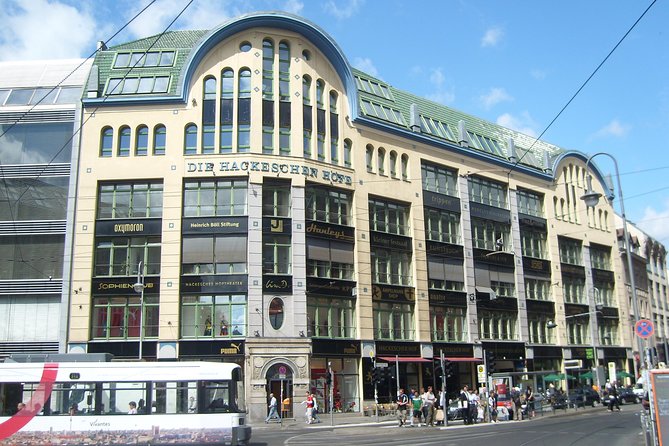
- Eight Art Nouveau courtyards: Hackesche Höfe brings together apartments, shops, bars, cinemas, and colorful restored courtyards.
- Swen Goetz leads the walk: His style includes photographs, anecdotes, and stories about people connected with the neighborhood.
- A lively mix of eras: You move from the 1920s atmosphere of Clärchens Ballhaus to Haus Schwarzenberg’s reminder of East Berlin in the 1980s.
- A flexible private experience: You provide your preferred departure time when booking, and hotel pickup and drop-off are available only if that option is selected.
Why this Berlin Mitte walk feels different
Many central Berlin walks focus on grand monuments and well-known political sites. This one works on a more human scale. You spend time in streets, courtyards, workshops, clubs, and gathering places that reveal how ordinary people lived through the 1920s, the Nazi period, the war, the divided city, and modern reunification.
The tour begins at Rosa-Luxemburg-Straße 41, a convenient central point near public transportation. From there, Swen Goetz takes you through the Scheunenviertel toward Hackescher Markt and then north along Oranienburger Strasse to the New Synagogue.
The supplied duration is approximately two hours, split into three sections of about 45, 30, and 45 minutes. One German-language account describes a walk lasting two and a half hours, so you should allow a little extra time if you want a relaxed pace and room for questions.
I find the private setup especially useful here. The subject matter is detailed, and the value of a local guide lies less in pointing out facades than in explaining who lived, worked, hid, danced, and worshipped in them. A fixed group of up to 15 also means you avoid joining a large public crowd.
A few more Berlin trips to weigh up
- Discover Berlin Half-Day Walking Tour
★ 5.0 · 9,624 reviews - Berlin: Third Reich and Cold War 2 Hour Walking Tour
★ 4.9 · 6,830 reviews - Berlin: Discover Berlin Walking Tour
★ 4.9 · 5,998 reviews
Scheunenviertel and the Berlin of the 1920s
The first 45 minutes focus on Scheunenviertel, once a Jewish suburb just outside the old city center. The name points to an earlier period when barns occupied parts of the area, but the tour uses the neighborhood to explain much more than its name.
You hear about Jewish associations, former prisoners, daily life a century ago, and famous bars. That combination gives the area texture. Instead of treating the quarter as a museum district, the walk connects buildings and streets to the people who used them.
The 1920s are an important thread. Berlin was then known for nightlife, political tension, new art, and rapid social change. The tour’s references to famous bars help you picture the period without reducing it to a film set or a collection of old photographs.
Swen’s approach includes anecdotes and photographs. That matters because many of the stories concern places that have changed, been damaged, or gained new uses. A photograph can show you what a corner looked like before war and redevelopment altered it.
The subject is not light throughout. Jewish life in Berlin was shattered by persecution and the Holocaust, and the tour places the neighborhood within that painful story. The strength of a two-hour walk is its directness: you encounter the human traces without spending the entire day in a museum.
If you are mainly seeking a quick orientation to Berlin’s grand architecture, this may not be your best match. If you want context for the streets around Hackescher Markt and Oranienburger Strasse, the Scheunenviertel section gives you a useful foundation.
Haus Schwarzenberg and the East Berlin view
The second stop centers on Hackescher Markt and takes about 30 minutes. Here you visit Haus Schwarzenberg, a site used to convey the feel of East Berlin in the 1980s.
That is a valuable shift in time. The first part looks toward the Jewish quarter and the 1920s. Haus Schwarzenberg brings you into the more recent past of a divided city, when East Berlin had a very different political and social atmosphere from today’s central Mitte.
The tour also visits a former workshop for blinds. Its most striking detail is a hiding place that was used to protect a Jewish family. This is the kind of stop that gives historical events a physical setting. You are not only hearing that people hid. You are seeing the type of working place where such an act was possible.
The experience does not present the neighborhood as frozen in one era. It moves between Jewish life before the war, survival during persecution, and the look and feel of East Berlin decades later. That layered approach is one of the tour’s strongest features.
Because this is a private walk, you can ask for clarification when the timeline becomes complicated. Berlin’s history has many overlapping periods, and the same street can carry several meanings. I would use this section to ask how the site changed after the war and how it fits into today’s Hackescher Markt district, though the supplied details do not promise a specific length of discussion for those questions.
Hackesche Höfe and eight connected courtyards
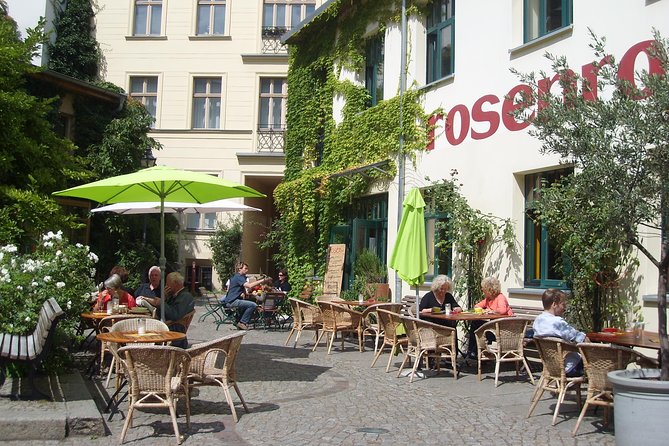
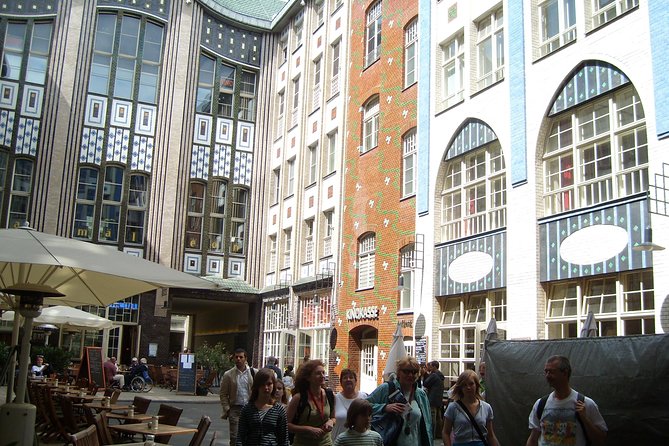
Near Hackescher Markt, you enter Hackesche Höfe, a group of eight courtyards built in the Art Nouveau period. Their design makes the visit more than a photo stop. A series of courtyards links residential buildings with shops, bars, cinemas, and other businesses.
The courtyards are colorful and carefully maintained, with greenery softening the hard urban setting. During the day, there is a steady flow of people through the complex. In the evening, gates close, so the time of your walk affects what you can see and how open the courtyards feel.
Sunday has one clear limitation. Many businesses may be closed, even though the courtyards themselves remain worth seeing. If you want to browse shops or stop for a drink, another day may offer more choice.
For a break, Hackescher Hof at Rosenthaler Strasse 40-41 has a bar and restaurant. A Chardonnay was reported at €5.70, while a small bottle of water cost €3.90, a reminder to check prices before ordering. That detail is practical rather than glamorous, but it can save you an unpleasant surprise during a walking tour.
I like the way Hackesche Höfe works as a bridge between architectural interest and everyday Berlin. You can look at Art Nouveau design, then watch people use the same courtyards for shopping, eating, and meeting friends. The setting is polished, so it does not offer the rougher feel of every historic neighborhood, but it is an important part of Mitte.
Same city, a completely different kind of day:
- Berlin: Reichstag, Dome and Government District Guided Tour
★ 4.7 · 18,288 reviews - Berlin: 1-Hour City Tour by Boat with Guaranteed Seating
★ 4.3 · 16,993 reviews - Berlin: Boat Tour Along the River Spree
★ 4.4 · 11,252 reviews - Berlin: Hop-on Hop-off Bus Tour with Live Commentary
★ 4.3 · 8,579 reviews
Clärchens Ballhaus and the atmosphere of old Berlin
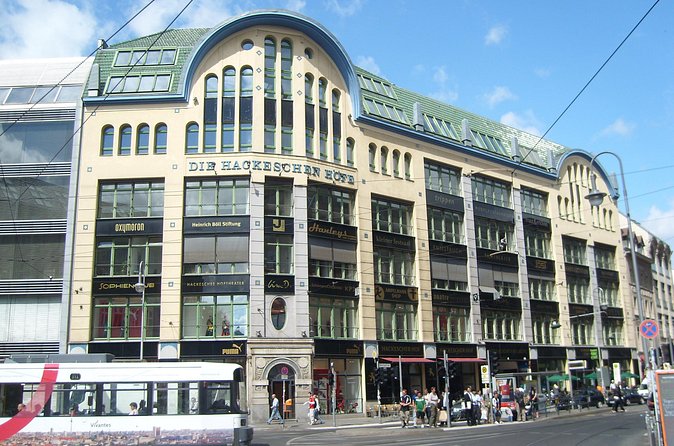
The final section takes about 45 minutes and includes Clärchens Ballhaus. This historic club helps you picture the social world of the 1920s, and the interior has changed very little.
A dance hall can explain a period in a way a formal monument cannot. At Clärchens Ballhaus, the focus turns to music, dancing, fashion, and social life. The place also gives the tour a needed change of mood after the heavier stories connected with persecution and wartime survival.
The stop is particularly useful if you have seen Babylon Berlin or are interested in the city’s film and television image. One account describes the walk as using Babylon Berlin filming locations as a starting point, while the real appeal came from the side streets and the stories attached to them. That is a good way to approach the connection: the screen may draw you in, but the neighborhood context is the main event.
Access details for Clärchens Ballhaus are not specified, so you should not assume that every interior area will be open during every departure. The tour description says you visit the historic club and get a feel for its atmosphere, but exact entry conditions can depend on the day and timing.
Heckmannhöfe and stories of occupation
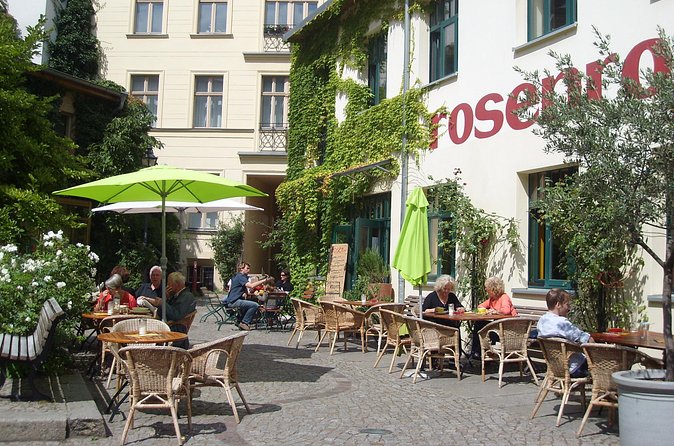
The walk continues to Heckmannhöfe, described as a particularly beautiful courtyard. Here, Swen tells stories about occupiers and the people connected with the buildings.
The word occupiers can refer to a difficult period in Berlin’s past, and the stop adds another layer to the city’s changing social story. Heckmannhöfe also gives you a quieter courtyard setting after the busier streets around Hackescher Markt.
This is a good example of why a guide adds value. A courtyard can look attractive on its own, but the details about who used it and how the buildings changed give the setting purpose. You are encouraged to look beyond decoration and ask what kind of life took place behind the facades.
The New Synagogue and the walk’s final chapter
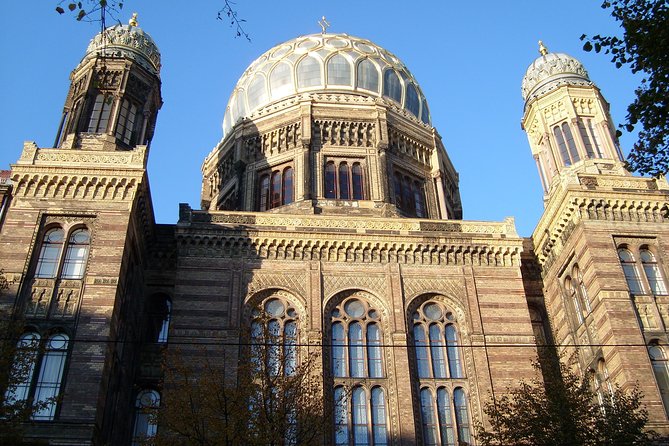
The tour ends at Stiftung Neue Synagoge Berlin, also known as Centrum Judaicum, at Oranienburger Strasse 28-30. The New Synagogue is the final historical focus and brings the Jewish story back to the center of the walk.
Ending here makes sense. The earlier sections introduce the former Jewish suburb, the hiding place, community life, and the effects of war. The New Synagogue provides a final point for thinking about Jewish Berlin, its destruction, and its continuing presence.
The tour description does not include admission to the synagogue or museum, so treat this as an exterior and historical stop unless your guide tells you otherwise. No attraction admission is listed as included, and the included feature is the professional guide.
Oranienburger Strasse is also a practical place to finish. The end point is near public transportation, and you can continue exploring Mitte afterward. Since hotel drop-off is not included unless you select that option, plan your next stop from the New Synagogue rather than expecting to be returned to your hotel.
What the $289.95 group price really means
At $289.95 for up to 15 people, this is not priced like a casual public walking tour. It is a private booking, so the value depends on how many people join.
For a full group of 15, the price works out to about $19.33 per person. For six people, it is about $48.33 each. For two people, it is nearly $145 each, which makes the experience harder to justify unless privacy, custom timing, and a focused subject are priorities.
The price includes a professional guide but not hotel pickup and drop-off unless that option is selected. No entrance fees are listed, and the main benefit is the guided interpretation of places you could otherwise pass without understanding.
I would consider it good value for a family, reunion, school-age group with adult supervision, or several friends who want one shared booking. Solo visitors and couples should compare the cost with a public walk, especially if they are comfortable exploring courtyards independently.
Who will get the most from this tour
I would choose this experience if you want Berlin’s Jewish heritage treated as part of the living city rather than as an isolated museum topic. It also suits anyone curious about the 1920s, Babylon Berlin locations, East Berlin, historic courtyards, and local stories.
The walk is suitable for most participants, and it stays near public transportation. Children must be accompanied by an adult. Since the tour covers several central areas on foot, you should be ready to walk for the full two hours or longer if the pace extends.
The private format helps families and mixed-age groups. You can ask Swen to explain difficult subjects in a way that suits your party, though the supplied details do not promise a customized route or a guaranteed focus on one historical period.
I would be more cautious if your main goal is inside access to museums or a long architectural lecture. The tour is built around streets, courtyards, clubs, stories, and exterior places. It gives you context, not a full museum program.
Booking, timing, and cancellation details
You provide your preferred departure time when booking, and confirmation is received at that point. The starting point is Rosa-Luxemburg-Straße 41, while the walk finishes at the New Synagogue, so the route is point-to-point rather than a return to the start.
The tour is offered in English and uses a mobile ticket. Free cancellation is available if you cancel at least 24 hours before the local start time. Changes or cancellations made less than 24 hours before the start are not accepted for a refund.
Should you book this private Mitte walk?
Book it if you want a guide to connect Berlin’s Jewish quarter, wartime survival, East Berlin, Art Nouveau courtyards, and 1920s social life in one compact route. Swen Goetz’s use of photographs and anecdotes is especially useful for buildings that have changed over time.
Think twice if you are a couple on a tight budget, need guaranteed museum entry, or want a short, purely architectural stroll. For a larger group, the private price becomes much more appealing, and the ability to set a preferred departure time adds real convenience.
My practical choice would be to schedule it on a day when the Hackesche Höfe shops and businesses are open, allow more than the advertised two hours, and continue exploring from the New Synagogue afterward. That gives the walk enough breathing room and lets you see the courtyards as working parts of Berlin, not just pretty backdrops.
FAQ
How long is the Berlin City Walking Tour?
The advertised duration is approximately two hours. The three planned sections take about 45 minutes, 30 minutes, and 45 minutes, though one account describes a walk lasting two and a half hours.
What language is the tour offered in?
The tour is offered in English.
Is this a private tour?
Yes. Only your group participates, with a maximum group size of 15 people.
How much does the tour cost?
The price is $289.95 per group of up to 15 people.
Where does the tour start?
The starting point is Rosa-Luxemburg-Straße 41, 10178 Berlin, Germany.
Where does the tour end?
The tour ends at New Synagogue Berlin, Centrum Judaicum, Oranienburger Strasse 28-30, 10117 Berlin, Germany.
Who guides the tour?
The experience provider is Travelxsite Swen Goetz, and the guide identified in the supplied information is Swen Goetz.
Are hotel pickup and drop-off included?
Hotel pickup and drop-off are not included unless that option is selected.
Must children be accompanied by an adult?
Yes. Children must be accompanied by an adult.
Can I cancel for a full refund?
Yes, if you cancel at least 24 hours before the experience start time. Cancellations or changes made less than 24 hours before the local start time are not accepted for a refund.
Just added around Berlin
- Love and War in Berlin: Self-Guided Story Puzzle Walk★ 5.0 · 7 reviews
- Rickshaw Tours Berlin – Groups of up to 16 people with several rickshaws★ 4.0 · 97 reviews
- Walking on the Wall: 3-Hour Tour in Berlin★ 4.5 · 34 reviews
- eSIM for Germany and 34 European Countries★ 4.5 · 16 reviews
- Warnemuende Shore Excursion: Private Berlin Tour★ 4.5 · 27 reviews
- Warnemuende Shore Excursion: Berlin Private Sightseeing Tour from Rostock★ 5.0 · 4 reviews
- Your ticket to The Wall Museum Berlin★ 3.0 · 60 reviews
- Berlin’s Gay, Lesbian, and Queer Scene Small-Group Walking Tour★ 4.5 · 66 reviews
City Tours, compared.

1-Hour City Tour by Boat with Guaranteed Seating
Read our review →
City History Canal Sightseeing Tour on a Motorboat
Read our review →


Browse the lists this tour appears in